Mogok spinel is one of the classic cabinet-to-gem crossovers: mineral enough for the specimen collector, precious enough for the gem connoisseur. In the hand it is typically an octahedral mineral, often sharp and glassy, with the best crystals carrying a red, hot-pink, pinkish-red, lavender, purple, grey-violet, or orangey-red body color that seems improbable against Mogok’s white marble. The finest red and neon pinkish-red crystals are admired not only for color but for tone: they can be vivid without closing up, fluorescent without looking artificial, and transparent enough that a single small crystal can command the attention usually reserved for ruby.
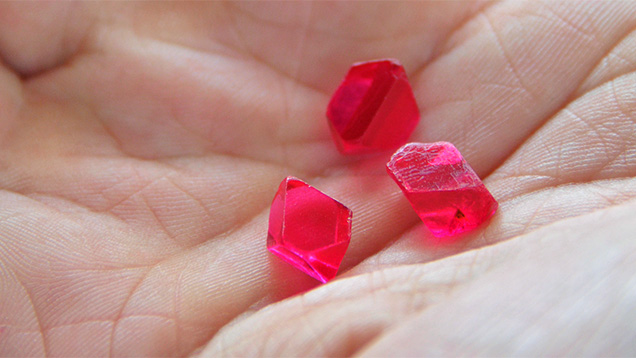
Photo: GIA, “Hunting for ‘Jedi’ Spinels in Mogok”
Geologically, the appeal begins in marble. The Mogok Valley lies within the Mogok Metamorphic Belt, a high-grade terrane of marble, gneiss, calc-silicate rocks, quartzite, peridotite, and intrusive rocks. The spinel is the magnesium-aluminum spinel MgAl2O4, crystallized in carbonate-rich metamorphic environments closely associated with the same marble belts that made Mogok famous for ruby. Inclusions of calcite, dolomite, magnesite, chondrodite, forsterite, phlogopite, graphite, sulfur, apatite, and other minerals are not incidental flaws; in good specimens and gem-study stones they are the mineralogical fingerprints of a high-temperature marble system.
For collectors, Mogok’s distinction is that the locality offers multiple collecting personalities. There are loose transparent octahedra, pink and red crystals in white marble, flattened spinel-law twins, rare “Star of David” macles from the Pein Pyit–Pyant Gyi area, and gem rough from Man Sin whose bright fluorescence helped popularize the trade term “Jedi” spinel. Mogok spinel also has a long cultural afterlife: for centuries spinel was confused with ruby in royal and commercial gem lore, but in Mogok the two minerals are not merely historical rivals. They are real companions in marble and gravel, formed and mined in the same broader stone tract.
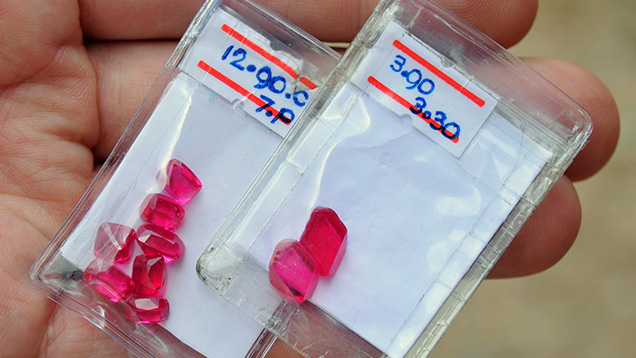
Photo: GIA, “Hunting for ‘Jedi’ Spinels in Mogok”
Search for specimens: View all spinel specimens from Mogok Valley, Myanmar
Mogok Valley is part of the larger Mogok Stone Tract in Mandalay Region, northern Myanmar. The historic mining district includes Mogok, Kyatpyin, Pein Pyit, Man Sin, Dattaw, Bawpadan, Yebu, Onbin, Bawlongyi, Kyauksin, Kyauksaung, Pyaungpyin, Yadanar Kaday Kadar, and many smaller named workings and villages. In mineralogical literature, “Mogok” is often used both narrowly for the valley and broadly for the stone tract; serious labels should preserve the more precise mine or village name whenever it is known.
The deposit type is dominantly marble-hosted metamorphic spinel, with production from both primary and secondary sources. Primary occurrences are in coarse calcite and dolomitic marble, commonly with calc-silicate interlayers and nearby intrusive rocks. Secondary deposits include alluvial and eluvial gravels, karstic cavities, sinkholes, and cavern fills where weathered marble has released resistant gem minerals into gem-bearing gravel locally known as byon. Spinel is therefore recovered both as crystals broken directly from marble and as abraded or loose crystals from gravel.
The geology is not a simple single-event story. The Mogok Metamorphic Belt records high-grade regional metamorphism, intrusive activity, and local metasomatic effects. Studies of the surrounding gneisses and rocks near gem deposits indicate granulite-facies conditions in the Mogok area, and inclusion assemblages in spinel point to formation in high-temperature marble rather than in ordinary low-grade limestone. Some deposits likely owe more to regional metamorphism, while others may reflect local interaction between carbonate rocks and intrusive bodies. That variability helps explain why Mogok spinels can differ from mine to mine in color, inclusion suite, fluorescence, and crystal style.
Mining history is long and layered. Mogok has been a major source of ruby and associated gems since at least the fifteenth century in published gemological accounts, and British, Burmese, and later international writers documented the district’s geology and mining methods from the late nineteenth century onward. Traditional workings include hand-dug pits and shafts in gravel, hillside hydraulic operations, sinkhole and cavern digging, and hard-rock tunneling in marble. Modern field reports describe an unusually dense mining landscape: alluvial workings, open pits, cave and crevice operations, vertical shafts, and hard-rock tunnels occurring within short distances of one another.
Several production periods matter especially to spinel collectors. The early 2000s brought attention to flattened and twinned spinels from the Pein Pyit–Pyant Gyi area, including rare “Star of David” macles. Man Sin became celebrated in the 2000s and early 2010s for exceptionally bright pinkish-red to red spinel, including the low-iron, highly fluorescent material now widely called “Jedi” spinel in the trade. Scientific sampling campaigns in the 2010s documented material from Yadanar Kaday Kadar, Bawlongyi, Kyauksin, Kyauksaung, Pyaungpyin, Man Sin, and local markets, showing that “Mogok spinel” is best understood as a family of related marble-hosted occurrences rather than a single uniform product.
Collecting access must be treated realistically. Mogok has never been an easy casual field-collecting locality, and foreign access historically required special permissions even in calmer periods. Since the 2021 military coup and the subsequent escalation of Myanmar’s civil conflict, the Mogok area has been repeatedly affected by armed control changes, airstrikes, road closures, displacement, and shifting mine administration. As of the mid-2020s, responsible collecting should be understood as specimen acquisition through documented old collections, reputable dealers, and legally and ethically reviewed supply chains—not as a field-trip destination.
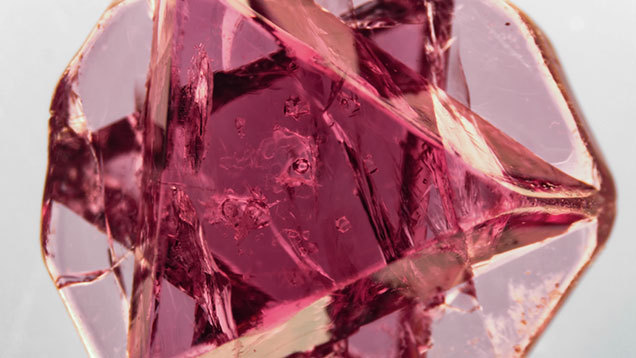
The classic Mogok habit is the octahedron: sharp, lustrous, equant, and often gemmy. Crystals may be loose from gravels or set in white to cream marble, sometimes with calcite and humite-group minerals around them. Flattened octahedral crystals and spinel-law twins are also important. The most famous collector form is the rare “Star of David” macle, a thin twinned crystal in which triangular forms and a central polygon create a star-like outline. These are especially associated with eastern Mogok localities near Pein Pyit and Pyant Gyi and are prized even when small.
Color is the first thing most collectors notice. Mogok produces red, pink, hot pink, pinkish-red, orangey pink, orangey red, lavender, purple, grey, purplish grey, and violet spinel. Red and pink material is mainly colored by chromium and vanadium; orange tones are strongly linked to vanadium; purple material is more iron-influenced. Many red Mogok stones fluoresce strongly under long-wave ultraviolet light, and the finest Man Sin-type stones combine high saturation, low dark tone, and strong fluorescence into the “neon” look that made them famous.
Size ranges vary strongly by style and source. Scientific sample sets from multiple Mogok mines include small rough and cuttable stones from fractions of a carat to several carats, while market stones can be larger. For mineral specimens, the most collectible matrix pieces often feature crystals from a few millimeters to over a centimeter; larger, sharp, undamaged, transparent red or pink crystals in marble are substantially rarer. Loose gem octahedra can be visually spectacular at small sizes because the color and luster are concentrated into a simple cubic-system form.
The most useful associated minerals are not merely display associations but genetic clues. On specimen labels and under magnification, collectors should expect calcite and dolomite marble, chondrodite, norbergite or other humite-group minerals, forsterite, phlogopite, graphite, apatite, and ruby or other corundum in the broader assemblage. Inclusion studies have documented carbonates, chondrodite, clinohumite, forsterite, amphibole, clinopyroxene, apatite, anhydrite, graphite, elemental sulfur, zircon, sulfides, oxides, and hydroxides in Mogok spinel. Carbonate inclusions, chondrodite, and sulfur-bearing multiphase inclusions are especially important in tying the material back to a marble environment.
Quality for a mineral collector is judged differently from quality for a cutter. The cutter wants transparency, clean color, and minimum inclusions. The specimen collector wants crystal integrity, luster, natural faces, sharp octahedral geometry, attractive marble contrast, and locality specificity. A crystal may be too included or too small for fine cutting yet be far more desirable as a mineral specimen if it sits naturally in white marble, shows undamaged edges, or displays a rare twin form. Conversely, many gem parcels of Mogok spinel have been detached from their geological context, leaving only laboratory origin work and dealer history to support the locality.
The best locality-specific indicators are a combination of features, not a single magic test: marble-associated inclusions, elevated zinc and nickel in some Burmese stones, chromium- and vanadium-driven red to pink color, strong fluorescence in select low-iron material, carbonate and sulfur-rich multiphase inclusions, and, for certain specimens, the unmistakable crystal morphology of Mogok twins and octahedra.
Mogok spinel is widely imitated in three ways: by synthetic spinel sold as natural, by non-Mogok spinel sold as Mogok, and by vague “Burmese” attributions used where the actual mine or region is unknown. Synthetic spinel is a long-established material, and flux-grown red spinel has appeared in the gem market. For loose faceted stones, the collector should not rely on color alone; laboratory reports from major gem labs are appropriate for expensive stones, especially when “Mogok,” “Man Sin,” “Jedi,” or “no treatment” materially affects price.
Treatment is less routine in spinel than in ruby or sapphire, but it is not safe to assume every spinel is untreated. Heat-treated spinel has been documented, and laboratory separation depends on microscopic, spectroscopic, and photoluminescence features rather than casual visual inspection. A fine Mogok crystal specimen should also be checked for oil in fractures or surface-reaching cracks. GIA documented oil in fractures of a Mogok “Star of David” spinel and noted that keeping crystals in oil before sale is a common local practice; this is not the same as structural repair, but it affects disclosure and examination.
Condition is critical. Spinel is hard, but Mogok specimens can be delicate because many crystals are thin, fractured, or embedded in softer marble. The flattened “Star of David” twins are especially brittle; one documented GIA reference specimen broke during cleaning. Matrix pieces often have cleaved or etched marble, repaired marble corners, or partly exposed crystals with bruised points. Loose octahedra may show rounded edges from alluvial transport, chips at the octahedral tips, or contact marks that are hard to see under strong color.
Rarity is uneven. Small loose pink to purple Mogok spinels appear regularly, and modest matrix pieces with tiny crystals are available from time to time. Fine red crystals in marble, clean sharp octahedra, undamaged twinned crystals, and credible Man Sin “Jedi” rough are much scarcer. Large gemmy crystals with good faces are rare because Mogok has long been a cutting locality: the best transparent crystals were often faceted rather than preserved as mineral specimens.
Current availability is complicated by conflict, sanctions, and ethics. Older collection pieces, pre-conflict dealer stock, and material already outside Myanmar form an important part of the legitimate collector market. New production may still filter through regional trade, but buyers should request clear provenance, import history where relevant, and assurance that the transaction does not involve sanctioned entities or conflict financing. In the United States, the sanctions environment around Myanmar’s gem sector makes due diligence particularly important for any recent-origin material.
Vincent Pardieu’s “Jedi” story begins not in a mine but in Yangon in the spring of 2001. He was studying gemology while living with the family of U Kyaw Thaung, a Mogok merchant, when Bangkok dealer Hemi Englisher arrived for business. Afterward, Englisher asked him to come see something special. In his hand were small, bright neon pinkish-red spinels—so vivid that Pardieu later wrote they convinced him spinel could equal ruby in beauty. When he asked whether they were from Mogok, the answer was no: they were from Namya, in Kachin State, where a ruby and spinel rush had begun in December 2000. That surprise set the hook for more than a decade of comparison between Namya and Mogok, and for the eventual rediscovery of Mogok material with the same electric look.
The name “Jedi” came to describe stones with no dark side: bright pinkish-red to red spinels with strong fluorescence and low iron. For years, Pardieu found the Namya material unmatched. Then in 2011, Lou-Pierre Bryl brought word of a new Mogok source producing stones as bright as Namya. Mogok was still not open to foreign visitors, so the rumor had to sit unresolved. In June 2013, access reopened, and Bryl went to inquire. By August 2013, after three expeditions, he confirmed a new source at Man Sin, about a kilometer from Pyant Gyi and Pein Pyit.
When Pardieu finally saw the Man Sin stones in Mogok, the locality announced itself in crystal form. Unlike rounded Namya stones from secondary gravels, the Mogok pieces were euhedral crystals with transparent faces. He described holding three stunning crystals with deep, pure, saturated color and no dark tone. They looked so perfect that he compared them, with deliberate irony, to synthetic spinel crystals. Then he reached backward through gem history to Jean-Baptiste Tavernier’s phrase “fine water,” using it for the exceptional transparency and crystallization of the Man Sin spinels.
The Man Sin visit itself produced one of the best collecting lessons in Mogok gemology. At the mine, Pardieu and his team saw miners recover a few bright “Jedi”-type spinels along with small rubies, green tourmaline, and spinels with dark purple cores and shallow blue surfaces. Because not all shareholders were present, the team could not immediately buy the day’s fine production. They were told to visit U Kyaw Thu and his family the next day. They did, drank tea, studied recent stones, and obtained samples for the GIA reference collection. Pardieu also acquired small bright red spinels from a kanase woman working rejects beneath the jig.
The most memorable line came from Dr. Saw Naung Oo, a Burmese miner who helped Pardieu during earlier Mogok visits between 2001 and 2004. He warned him that “the miners keep secrets while the traders tell stories.” It is one of the best sentences ever written about field gemology. In Mogok, where production, rumor, shareholder rights, mine names, market parcels, and old stock overlap, the statement is practical advice: the eyes must do more work than the ears.
The Pein Pyit “Star of David” spinels have their own mythology, but it is a mineralogical one. In December 2015, Pardieu obtained a remarkable crystal in the Mogok gem market, reportedly mined in the early 2000s near Pein Pyit in eastern Mogok. Its outline showed two triangles on opposing sides of a central 12-sided polygon. Hundreds of these twinned crystals were reportedly seen in the Mogok market between 2002 and 2004, but most were tiny or broken. The GIA specimen was added to the reference collection, studied, and then became a cautionary tale: it broke during cleaning. Thin spinel twins can look like invincible little shields of corundum-red light, but structurally they are brittle mineral specimens, not jewelry stones.
There is also a quieter field image from Mogok that belongs in every collector’s mind: kanase women at Baw Lone Gyi working against white marble and blue sky, sometimes with small children nearby, crushing marble and sorting tailings. They offered rubies and spinels, often still in the broken marble, and held up the red crystals against the white host rock to show the color. Field gemologists observed them placing small crystals in their mouths for safekeeping while they continued to work through the marble. That scene captures Mogok more truthfully than a polished auction stone: color, labor, marble, risk, trade, and improvisation all in one gesture.
 Amethyst
 Quartz
 Fluorite
 Tourmaline
 Malachite
 Azurite
 Rhodochrosite