Tsumeb mimetite occupies a special place in the mineral hobby because it combines two qualities that rarely meet in the same species: serious mineralogical complexity and immediate visual seduction. At its best it is not merely yellow lead arsenate; it is glassy, architectural, sharply hexagonal, and unmistakably Tsumeb. The finest crystals from the 1971 Gem Pocket are pale lemon to almost colorless-yellow prisms, highly transparent, with a flat pinacoid termination and a narrow pyramidal bevel—crystals that made Tsumeb the benchmark locality for mimetite in terms of crystal size, perfection, and transparency.
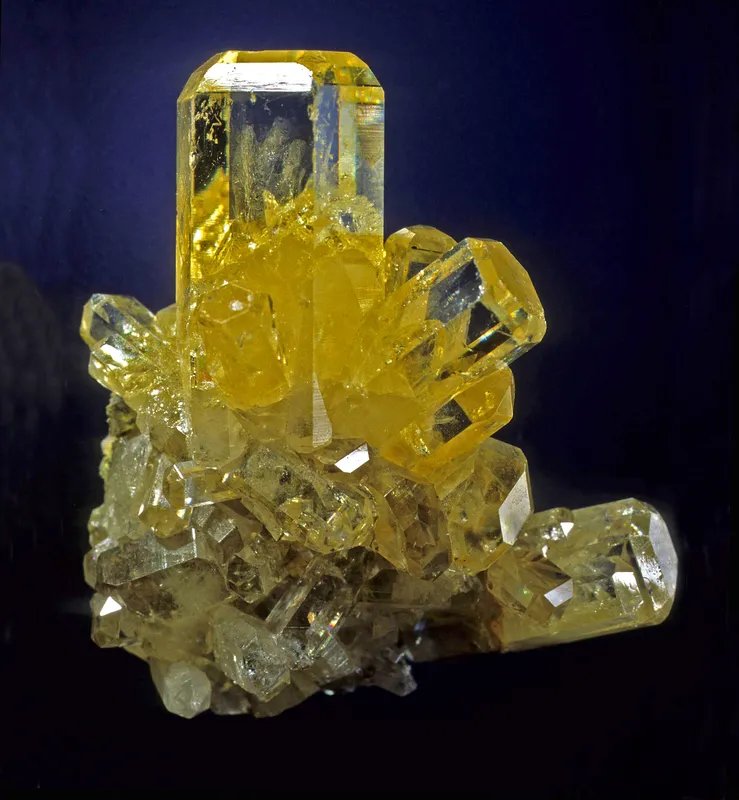
Photo: Tsumeb Mine Notebook
The mine’s mimetite is a product of one of the most chemically fertile oxidation systems ever opened by mining. The Tsumeb orebody was a steep, irregular Cu-Pb-Zn-Ag-Ge-Cd pipe in Otavi Group dolomite, with multiple oxidation zones extending far below the usual shallow weathering environment. That unusual vertical repetition of oxidized conditions allowed mimetite to form in several episodes, in several parts of the mine, and in unusually diverse associations. It appears in all three oxidation zones, sometimes as ordinary crusts or small crystals, sometimes as bright cabinet-quality sprays, and occasionally as specimens that define the upper limit of the species.
Collectors prize Tsumeb mimetite for more than color. Look for crystals that are truly transparent rather than merely translucent; clean, undamaged terminations; isolated or well-spaced crystals on contrasting matrix; and classic associations such as smithsonite, cerussite, wulfenite, duftite, goethite, hematite, malachite, or gartrellite. A Tsumeb mimetite label carries weight only when the specimen itself carries the locality’s visual language: sharp hexagonal prisms, complex supergene associations, and a richness of paragenesis that is difficult to confuse with the more botryoidal Mexican material or the later vivid-orange finds from China and elsewhere.
The locality is also important historically. Tsumeb was already known to local people as a copper source before European commercial mining began, and by the early twentieth century its specimen potential had become obvious. Early mineralogical descriptions confused some mimetite with pyromorphite, which is rare at Tsumeb, but by 1908 mimetite was recognized in the literature. Over the next century, Tsumeb would produce mimetite in forms ranging from early first-oxidation-zone pseudomorph material to the world-famous Gem Pocket and late discoveries of large ivory-white composite prisms.
Search for specimens: View all mimetite specimens from Tsumeb Mine, Namibia
Tsumeb Mine, also known historically as Tsumcorp or Ongopolo Mine, lies at Tsumeb in the Oshikoto Region of northern Namibia. The locality is one of the great polymetallic carbonate-hosted deposits of the world: a Cu-Pb-Zn-Ag-Ge-Cd orebody emplaced in Neoproterozoic Otavi dolomite. The orebody is not a simple vein but an irregular pipe-like structure, broadly elliptical in plan, steeply dipping, and vertically persistent to great depth. In places it was controlled by brecciation, arcuate fractures, bedding-slip shears, dolomite breccia, feldspathic sandstone, sandstone breccia, and massive sulfide replacement along the margins of the pipe.
The pipe transgressed roughly 1700 meters of upper Tsumeb Subgroup dolomites and changed shape dramatically with depth. On some mine levels it narrowed to very small dimensions; on others, particularly around 26 Level, it expanded into a broad ellipse. The ore system was rich but compact, and that compactness matters to collectors: specimens from very different chemical environments may all be correctly labeled “Tsumeb,” yet they may have formed hundreds of meters apart vertically and under very different supergene conditions.
The mine’s primary ore suite included bornite, chalcocite, tennantite, enargite, galena, sphalerite, pyrite, and germanium-bearing minerals such as germanite and renierite. Mimetite formed later in the oxidized zones, when lead, arsenic, chlorine, and other components became mobile in descending and locally perched waters. Tsumeb’s extraordinary secondary mineralogy reflects not just one oxidation cap but three oxidation zones: the first from surface to about 11 Level, the second centered around the 24 to 35 Level interval, and a third in still deeper workings. Mimetite is confirmed from all three.
The earliest mining was at and near the surface. The copper-rich outcrop was exploited before European commercial development, and the “green hill” that marked the deposit entered the formal mining record in the 1890s. Commercial work began in the early twentieth century under the Otavi Minen und Eisenbahn Gesellschaft, initially from open-pit and shallow underground workings. Production expanded after railway access was developed, continued with interruptions through the World Wars and the Depression, and resumed strongly after 1947 under Tsumeb Corporation Limited. The mine finally closed, effectively, in 1996.
From a collector’s standpoint, the most important mimetite production came from both the early upper mine and the second oxidation zone. The upper first oxidation zone yielded pale to grayish, white, yellow, green-coated, and pseudomorphed material, including spectacular replacements in which mimetite crystals were partly or wholly altered to arsentsumebite, bayldonite, duftite, or related lead-copper arsenates. The celebrated 1971 Gem Pocket came from the second oxidation zone, believed to be at West 80 on 28 Level. A separate early-1980 discovery in the North-East Stope on 35 Level yielded large, matrix-free, translucent ivory-white to pale yellow composite prisms.
Tsumeb is not a modern field-collecting locality. The mine is inactive, the workings are not public collecting ground, and the best mimetite now reaches collectors through old collections, museum deaccessions, estate material, long-held dealer stock, and occasional resale of historic pieces. Good provenance—old labels, collection history, or a clear match to a recognized find—is especially valuable because Tsumeb mimetite spans so many visual styles.
Tsumeb mimetite is Pb5(AsO4)3Cl and belongs to the hexagonal apatite group. At this locality it is remarkably variable, but the classic crystal is a hexagonal prism with terminations made up of a pinacoid, pyramid faces, or both. Some crystals are long, pencil-like prisms; others are stout, barrel-like, sheaf-like, divergent, mammillary, cauliflower-like, or crust-forming. Rare tabular crystals have been recorded. Minute acicular crystals occur as coatings or pseudomorph-forming networks, while the great collector specimens show free-standing, lustrous prisms large enough to dominate a thumbnail or miniature.
The color range is broader than many collectors realize. Nearly colorless, white, pale yellow, lemon-yellow, orange, pale brown, red, gray, green, and black mimetite are all documented from Tsumeb. The most famous material is the pale, gemmy yellow Gem Pocket style, but orange mimetite on smithsonite, dark brown to black mimetite with hematite films, and ivory-white composite prisms are all legitimate and collectible Tsumeb expressions. Some greenish “mimetite” associations from the upper workings are actually replacements or coatings by arsentsumebite, bayldonite, duftite, or related copper arsenates rather than simple green mimetite.
Size varies enormously. Early first-oxidation-zone crystals were described up to about 30 mm long and 15 mm thick, with some altered examples reaching 10 cm. Pinch and Wilson reported elongate prisms exceptionally to 120 mm. The 1971 Gem Pocket produced transparent pale-yellow crystals exceptionally to 65 mm, though many surviving specimens are thumbnails and miniatures with crystals in the centimeter range. The 1980 North-East Stope discovery produced matrix-free composite prisms to 75 mm. A later report noted a 12 cm doubly terminated yellow, pencil-like crystal, a striking outlier for the species.
Associations are one of the great strengths of Tsumeb mimetite. It may occur with smithsonite, cerussite, wulfenite, malachite, duftite, arsentsumebite, bayldonite, gartrellite, hematite, goethite, quartz, calcite, dolomite, dioptase, cuprite, anglesite, phosgenite, beudantite, tsumcorite, willemite, and many rarer Tsumeb species. On Gem Pocket pieces, a dusting of powdery yellow gartrellite on the matrix can intensify the visual yellow of the pale mimetite crystals. On first-oxidation-zone specimens, orange mimetite on green smithsonite, or mimetite overgrown by a second generation of smithsonite, creates the kind of multi-stage texture Tsumeb collectors love.
Quality is judged by the same broad criteria as other classic lead arsenates, but Tsumeb has its own hierarchy. The top tier consists of transparent, undamaged, sharply terminated crystals from the Gem Pocket, especially when aesthetic, isolated, and on original matrix. Next are large, sharp, lustrous crystals from other finds—particularly those with unusual color or association. Pseudomorph material can be equally desirable when the form of the original mimetite is crisp and the replacing mineral is correctly identified. Common small crusts, dull coatings, and bruised or contacted sprays are still Tsumeb mimetite, but they do not occupy the same collector category.
The chief authenticity issue with Tsumeb mimetite is usually not artificial treatment but locality, identity, and paragenetic interpretation. Many mimetite specimens from Tsumeb are old, complex, and partially replaced; the green mineral on an old “bayldonite after mimetite” label may be bayldonite, arsentsumebite, duftite, or a mixture. Some early material was even confused with pyromorphite. Because pyromorphite is rare at Tsumeb, a green apatite-group specimen labeled “pyromorphite, Tsumeb” should be treated cautiously unless analytically confirmed.
There are also identity traps in the opposite direction. Bright yellow to orange crystals from Tsumeb are commonly mimetite, but associated smithsonite, calcite, dolomite, cerussite, wulfenite, and arsenate coatings can complicate visual identification. Dark brown to black mimetite may owe much of its color to hematite overgrowth or intergrowth. “Chromian mimetite” labels, when encountered, deserve skepticism and analysis; green coloration alone is not a reliable chromium indicator, and green Tsumeb arsenates are often copper-bearing species or replacements.
No widely documented treatment tradition is associated specifically with Tsumeb mimetite. The more realistic risks are glued repairs, reattached crystals, aggressive cleaning, relabeling from another locality, and old pseudomorph labels that have not kept up with modern analyses. Large Gem Pocket specimens are valuable enough that provenance matters: old collection labels, a reputable dealer chain, or comparison with known 1971 material can make a substantial difference. The best Gem Pocket mimetites should be pale, gemmy, sharply hexagonal, and consistent with the recognized West 80, 28 Level style.
Condition is critical. Mimetite is brittle, relatively soft, and dense, so crystals chip easily and can break under their own leverage on matrix. Termination bruising is common, especially on prisms standing proud of the matrix. Contacted crystals are not unusual in dense sprays, but damage to the main display crystals affects value sharply. Old Tsumeb specimens may also show mine grime, iron oxide films, or natural overgrowths; these should be distinguished from damage or later contamination. Do not assume every coating is a defect—some are part of the specimen’s paragenesis.
Market availability is uneven. Ordinary Tsumeb mimetite appears regularly, especially small cabinet and miniature specimens with modest yellow to orange crystals. Fine Gem Pocket material is scarce, fiercely competed for, and often retained in advanced collections. Aesthetic thumbnails can command serious prices; important miniatures and small cabinets with Gem Pocket provenance can move into five-figure territory. Large, transparent, undamaged crystals from the 1971 find, or major pseudomorphs with correct identification and old labels, should be considered classic-specimen material rather than routine species examples.
The story of Tsumeb mimetite begins with a useful mistake. The earliest published list of Tsumeb minerals, in 1906, did not list mimetite at all but did list pyromorphite. That is telling, because true pyromorphite is very rare at Tsumeb, while mimetite is widespread. The likely culprit was a visual deception: mimetite crystals encrusted or altered by green arsenates such as arsentsumebite, bayldonite, or duftite can look enough like pyromorphite to mislead an early observer. Within two years, Wilhelm Maucher had corrected the record by listing mimetite from Tsumeb. The episode is a reminder that even at the birth of Tsumeb mineralogy, the mine was already playing its favorite trick—making simple labels inadequate.
In 1920, Otto Pufahl gave one of the first vivid descriptions of fresh mimetite from the upper workings. His crystals came from the upper part of the first oxidation zone, between surface and 6 Level. They were prismatic, up to 30 mm long and 15 mm thick, and varied from almost colorless to light gray with a yellowish tinge. Some were translucent; others were completely milky and opaque. He noticed a pale green copper-bearing coating that was only loosely attached. More dramatic were crystals up to 10 cm long that were being transformed into light green and yellowish-green bayldonite—some completely changed, others still preserving a fresh mimetite core. Those specimens, half crystal and half chemical event, are among the classic reasons Tsumeb pseudomorphs remain so difficult and so rewarding.
The defining moment for mimetite collectors came in 1971. In the second oxidation zone, probably at West 80 on 28 Level, miners opened the pocket now simply called the Gem Pocket. Its name is not a dealer’s exaggeration. The crystals were transparent, very pale yellow, and gemmy in a way mimetite almost never is. They formed elongated hexagonal prisms, flat-ended by the pinacoid and finished with a simple pyramidal bevel. The largest reached about 65 mm. The pocket reportedly yielded several hundred specimens, many thumbnails and miniatures, but only perhaps 25 to 30 larger pieces of real significance. That imbalance explains the modern market: many collectors know the look, very few have had the chance to own a major example.
The Gem Pocket had one additional piece of stagecraft. Its matrix was dusted with powdery yellow gartrellite, which subtly strengthened the apparent yellow of the otherwise very pale crystals. A fine Gem Pocket mimetite can look lit from inside, but also gently warmed from below by its matrix. This is why experienced collectors do not judge the find only by color saturation. The great virtue of the 1971 material is transparency, form, and poise—not screaming color.
A stranger episode followed in material described by Keller and Bartelke in 1982: brilliant black mimetite crystals up to 1 cm tall intergrown with reniform hematite. These were not simply black mimetite in the usual sense. A mimetite core had been overgrown by hematite, and the hematite was partly or completely covered by a second generation of mimetite. The result was a mineralogical sandwich that still retained euhedral prism and pyramid forms, with smithsonite and quartz in association. It is a very Tsumeb kind of specimen: the outward form says “mimetite,” the color says something else, and the real answer is a sequence of mineral growth events.
In the first weeks of 1980, John Innes made another notable mimetite find in the North-East Stope on 35 Level. This was not Gem Pocket material. The specimens were matrix-free composite prisms, translucent rather than glass-clear, and ivory-white to pale yellow. Some reached 75 mm. One Harvard specimen from this discovery preserves a pair of conjoined crystals to 52 mm with no associated minerals at all. If the Gem Pocket represents mimetite at its most jewel-like, the 35 Level material represents it as sculptural form—large, pale, self-contained, and almost abstract.
Then, near the end of Tsumeb’s productive life, came another striking report: in 1995, a 12 cm doubly terminated, pencil-like yellow mimetite crystal was found, along with white bipyramidal mimetites resembling witherite and calcium-rich bipyramidal crystals on white calcite. By that time the mine was close to closure, and the great flood of new Tsumeb material was nearly over. The late occurrence feels like a final reminder that even after decades of collecting, mapping, naming, and arguing over Tsumeb minerals, the pipe was still capable of producing forms no collector would have safely predicted.
 Amethyst
 Quartz
 Fluorite
 Tourmaline
 Malachite
 Azurite
 Rhodochrosite