Wieliczka is one of the great names in European mineral collecting because its halite is not merely “rock salt” from an old mine: it is a mineralogical record of a medieval industrial world, a folded Miocene evaporite deposit, and an underground environment where salt continued to crystallize long after miners opened the workings. Fine specimens show transparent to translucent cubic halite, usually colorless, white, greyish, honey-tinted, or lightly iron-stained, with the best examples having sharp cubic geometry, glassy to satiny faces, and a historic old-European label cachet that few evaporite localities can match.
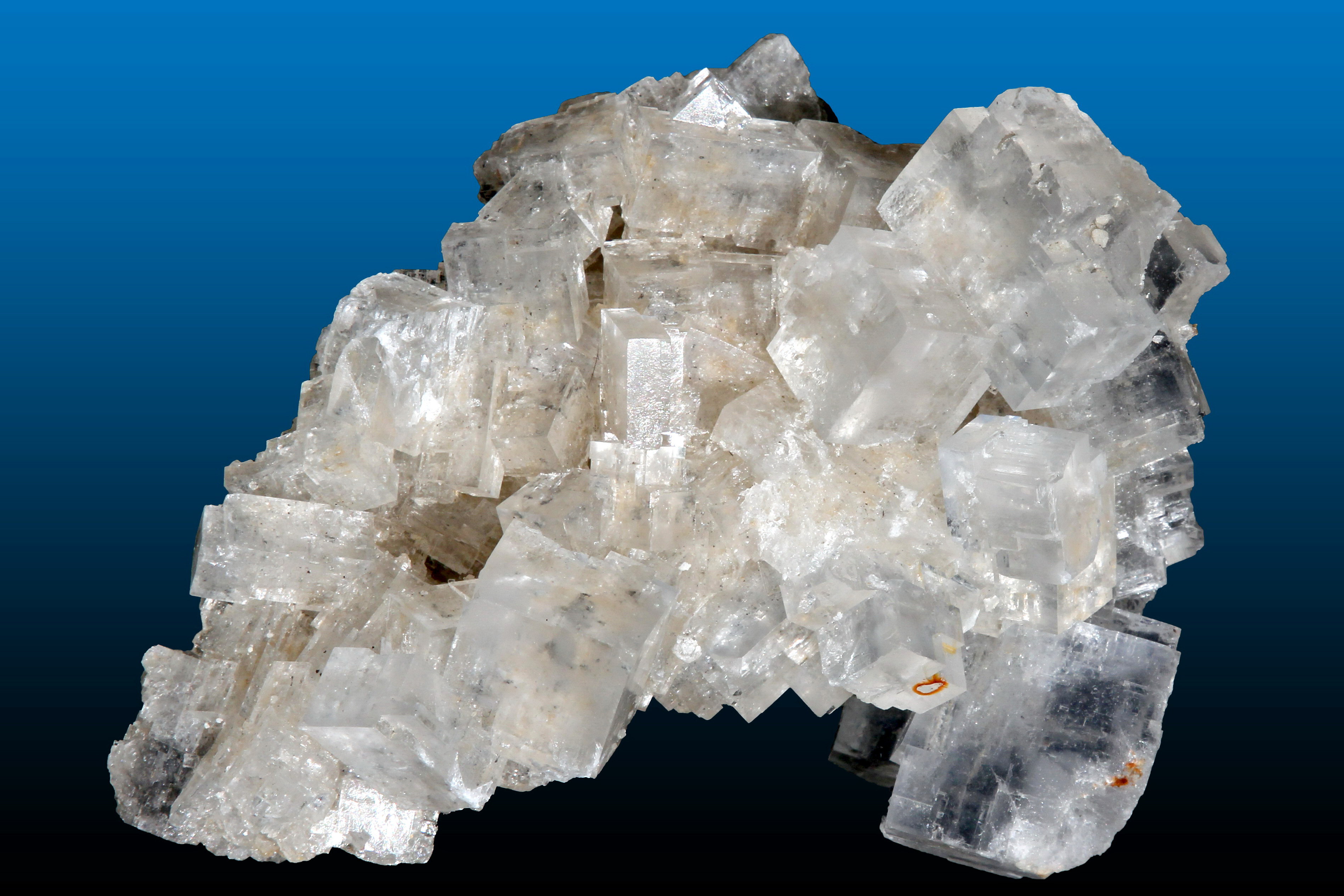
Photo: Wikimedia Commons
The deposit belongs to the Badenian evaporites of the Carpathian Foredeep, formed in the Middle Miocene when seawater in a warm, restricted basin evaporated along the front of the rising Carpathians. Later Carpathian movements disrupted the original salt sequence into an unusually complex body: layered salt below and a shallower breccia-like “boulder salt” member above, with blocks of rock salt enclosed in clay-rich material. For collectors, that geological duality matters because Wieliczka specimens may represent both primary Miocene halite and much younger secondary halite grown from brines inside the mine.
The most storied crystals are the transparent monocrystals and crystal crusts associated with the Crystal Caves, two natural voids discovered in the eastern part of the mine in 1898–1899. Their halite is younger than the Miocene host salt and has been protected because the caves are an underground nature reserve. Such crystals became model examples for crystallography and are represented in museum collections rather than in the casual specimen trade. The market specimens that appear today are generally old collection pieces: clusters of cubic crystals on dark matrix, individual transparent cubes, or masses with frosted, slightly dissolved surfaces from earlier collecting or mining periods.

Photo: Wikimedia Commons
Wieliczka also has a visual language unlike most salt localities. The mine is famous for salt-carved chapels, underground lakes, timbered chambers, and secondary salt growths on old mining objects. Halite cubes may crust wooden tools, metal fittings, pipework, and chamber walls; dripstone forms may hang as stalactites, grow as cauliflower-like crusts, or branch into sparkling “salt spruces.” In collector terms, this gives the locality two personalities: cabinet specimens of classic cubic halite, and in-situ mineral theatre in which the mine itself is the specimen.

Photo: Wikimedia Commons
Search for specimens: View all halite specimens from Wieliczka Mine, Poland
Wieliczka Mine lies at Wieliczka, near Kraków in Lesser Poland, within the historic Kraków Saltworks. The mine exploited a Middle Miocene rock-salt deposit of the Carpathian Foredeep. The salt-bearing succession belongs to the Wieliczka Formation and was formed roughly 13.5–13.8 million years ago in a restricted marine basin at the foot of the Carpathians. Evaporation produced halite-rich sediments, and subsequent Carpathian tectonism folded, sliced, and displaced the deposit northward.
The deposit is especially notable for its twofold structure. A lower stratified member consists of layers of salt with sulphates and siliciclastic interbeds; above it, a boulder-salt member contains large blocks of salt within clay-rich material known to miners as zuber. The mine museum describes the worked deposit as about 5.5 km long east–west and 0.5–1.5 km wide north–south; broader geological descriptions of the Wieliczka Salt Deposit extend the salt body to nearly 10 km along strike. In either view, the deposit is not a simple flat salt bed. It is a deformed evaporite body exposed underground in three dimensions.
Salt production at Wieliczka began before underground mining, with brines exploited since prehistoric times. Rock salt was mined from the 13th century, and the Goryszowski shaft of the 1280s is tied to the beginning of large-scale underground exploitation. Wieliczka received municipal rights in 1290, and by the end of the 13th century the Cracow Saltworks united Wieliczka and Bochnia into a royal salt enterprise that remained economically central for centuries. In the 14th century, salt revenue is described as having supplied roughly one-third of the royal treasury under Casimir the Great.
By the 16th and early 17th centuries, the Saltworks had reached a major flourishing, employing around 2,000 people and producing more than 30,000 tonnes of salt. The mine eventually descended through nine levels to about 327 m below the surface, with dozens of shafts, hundreds of chambers, and more than 240 km of excavations recorded in museum summaries. Rock-salt extraction at Wieliczka ceased in 1964, and exploitation of the deposit ended entirely on June 30, 1996. The mine is now protected as a historic monument, museum, tourist route, and UNESCO World Heritage site.
Collecting access is effectively closed. Visitors move only on authorized routes, in guided groups, and the mine’s rules forbid removing, moving, or destroying objects within the property. The Crystal Caves are protected and not an open collecting source. Modern collector specimens should therefore be treated as old-stock, deaccessioned, historic, or otherwise pre-existing material, not as newly collected field pieces.
Notable mineralogical finds include the Crystal Caves halite, large transparent cubic crystals, and secondary halite speleothems formed after mining opened voids and altered air and brine circulation. The lower Crystal Cave is a natural void of about 706 m3, with halite crystals on the upper walls and roof; the upper cave, about 7 m above it, is about 1,000 m3. Crystal edges in the caves can reach 26–34 cm, although most are smaller, commonly below 20 cm or 10 cm. These crystals are among the classic mineralogical treasures of Wieliczka.
Wieliczka halite is dominated by the cube, as expected for NaCl, but the locality rewards close looking. Good specimens show stacked, intergrown, or isolated cubes on dark grey-brown salty clay or rock-salt matrix. Some crystals are transparent and glassy; others have a satiny, frosted, or slightly “melted” surface from partial dissolution and recrystallization. Sharp, colorless cubes with clean edges and minimal surface dulling are the collector ideal.
The normal color range is colorless, white, smoky-grey, pale honey, tan, and brownish from included clay or surface iron compounds. Secondary halite in the mine can also display yellow, orange, red, and brown hues where brines have interacted with rusting metal. Research on Wieliczka speleothems shows that such colors are typically surface-related iron oxide and hydroxide films or fine mineral aggregates rather than bulk-colored halite. The relevant iron phases include minerals such as goethite, hematite, lepidocrocite, akaganeite, and magnetite. That makes many warm-colored in-situ crusts geologically honest, but it also means the color may sit on or near the crystal surface.
Secondary habits are one of Wieliczka’s great fascinations. The mine contains halite stalactites, stalagmites, columns, cauliflower-like crusts, salt filaments, fibrous salt, and “salt spruce” growths made of networks of small halite cubes. Crystallization on abandoned wooden objects and metalwork is a distinctive part of the mine’s mineralogy, especially where brine seepage and ventilation created microenvironments favorable for repeated dissolution and precipitation.
Typical collector specimens range from thumbnails and miniatures to small cabinet and cabinet pieces. Dealer and auction records document specimens around 6–13 cm across, commonly with individual cubes of about 2–5 cm. Museum material from the Crystal Caves and related holdings can be substantially more important scientifically, with recorded crystal specimens in the 10–35 cm height range. Very large, clean, undamaged cabinet pieces are scarce because halite is soft, soluble, and unforgiving of humidity.
Associated minerals recorded for the Wieliczka Mine include anhydrite, gypsum, calcite, celestine, quartz, mirabilite, thenardite, magnetite, native nickel, and clay-rich “glauconite” material, along with the evaporite rocks and zuber matrix that frame the halite. On specimens, the common visual association is halite with grey-brown salty clay or rock-salt matrix; for in-situ secondary growths, rusting metal, timber, and old mine infrastructure may be the substrate rather than a conventional mineral matrix.
Quality factors are straightforward but strict. The best Wieliczka halite has:
Short-wave ultraviolet fluorescence is mentioned in several market records for Wieliczka specimens, usually as bright orange. It should be treated as a bonus rather than the primary value driver: locality, form, transparency, condition, and provenance carry the specimen.
The main authenticity issue with Wieliczka halite is not a well-documented fake industry, but attribution. Poland has several important salt localities, and generic “Polish halite” should not be upgraded to Wieliczka without a credible label, collection history, or dealer record. Fine Wieliczka material is now largely old-stock; a specimen represented as newly collected from protected underground areas should be questioned.
Souvenir salt from the tourist mine is a different category from mineral specimens. Small salt chunks, carved salt objects, glued decorative pieces, and tourist-shop material may be genuine Wieliczka salt but are not automatically crystallized mineral specimens in the collector sense. A serious specimen should show natural crystal morphology, not simply a broken salt mass attached to a display object.
Condition is critical. Halite is water-soluble, soft, and humidity-sensitive. Old specimens may show rounded cube edges, cloudy surfaces, granular recrystallization, weeping, tackiness, or whitish crusts from cycles of moisture and drying. Some surface dulling is common and may be acceptable on historic pieces, but active dampness is a warning sign. Store specimens in a cool, dry, stable environment, ideally with desiccant and limited air exchange. Avoid bathrooms, kitchens, humid basements, outdoor display, and repeated handling with damp fingers.
Do not clean Wieliczka halite with water. Even a brief rinse can permanently soften edges and destroy luster. Mechanical cleaning is risky because halite is brittle and soft, and loose matrix may crumble. Taste testing, still sometimes mentioned in old mineral-identification habits, is inappropriate for valuable specimens and especially for old mine material that may carry dust, metal residues, or conservation history.
Market availability is intermittent. Auction records from 2010 through 2026 show old Wieliczka specimens still circulating, including small cabinet to cabinet clusters with transparent cubes, old collection labels, and occasional fluorescence. Prices vary widely with size, preservation, provenance, and aesthetics: recorded examples include several-hundred-dollar small cabinet specimens and higher prices for exceptionally transparent, sharp, historic pieces. The best material is not abundant, and specimens with convincing pre-closure provenance are more desirable than anonymous recent offerings.
The story every Wieliczka visitor hears begins with a ring. In the legend of St. Kinga, the Hungarian princess destined to marry Bolesław V the Chaste asked her father, Béla IV, not for gold but for salt, a substance precious in Poland. She is said to have thrown her engagement ring into a salt mine in Máramaros before leaving Hungary. When she arrived in the Kraków region, miners opened a new pit, split a lump of salt, and found the ring inside. The legend made Kinga the patron saint of salt miners, and in Wieliczka that story is not a footnote: it is carved into the identity of the mine.
The Crystal Caves give the mineral collector a more tangible miracle. In 1898–1899, miners reached two natural voids in the eastern part of the mine, about 80 m below the surface. The lower cave, an upward-elongated void of about 706 m3, had its upper walls and roof coated with halite crystals. Seven metres above it lay the upper cave, about 1,000 m3, later partly disfigured by old workings but still preserving fragments of crystalline lining. The largest crystal edges reached 26–34 cm. These were not ordinary mine crusts but transparent halite crystals so fine that specimens from the caves entered museum collections as exemplary crystallographic material.
There is a quieter story in the secondary salt growths. Once the mine opened voids in the deposit, it changed air circulation, humidity, brine migration, and the surfaces on which salt could grow. Old timber, a jug, a broom, metal arches, pipes, and forgotten working surfaces became substrates for crystallization. Brine creeping over rusting iron could deposit halite tinted yellow, orange, red, or brown; brine on wood could leave glittering cubic crusts. In this sense, Wieliczka is not only a fossil Miocene evaporite. It is a living salt laboratory in which human mining created new mineral habitats.
The scale of the mine makes those small crystals feel more consequential. Over seven centuries, miners drove shafts, chambers, and drifts through the deposit until the mine reached nine levels and 327 m depth. Some chambers from the late Middle Ages and early modern period survived because salt workings can be more durable than comparable ore-mine voids. The result is a rare collecting paradox: the mineral itself is common table salt, but the locality context is so historically and geologically specific that a good labeled Wieliczka halite carries the atmosphere of an underground city.
 Amethyst
 Quartz
 Fluorite
 Tourmaline
 Malachite
 Azurite
 Rhodochrosite
_-_Kopalnia_soli_Wieliczka,_Polska.jpg)

.JPG)