Staßfurt halite is classic European salt-mining material with a pedigree that reaches far beyond attractive cubes. This is the locality that made the word “Staßfurt” a fixture in evaporite geology: the rock salt and potash salts belong to the great Upper Permian Zechstein evaporite succession of northern Germany, where repeated restriction and evaporation of seawater laid down carbonates, anhydrite, halite, and then potassium-magnesium salts. For collectors, Staßfurt is not simply another source of NaCl; it is the old German potash field whose mineral suite gave the world textbook evaporite associations and several historically important potassium-magnesium minerals.
The most admired Staßfurt halites are transparent to translucent crystals with water-clear body color interrupted by electric blue, violet-blue, or azure internal zoning. In good examples the blue is not a surface stain but a phantom-like banding or cloud suspended inside the crystal. Clear, colorless Staßfurt halite also occurs as sharp cubes, stacked echelon growths, and tabular or floater crystals, but the locality’s reputation among specimen collectors rests largely on the combination of sharp cubic form, glassy transparency, and saturated internal blue.

Photo: Wikimedia Commons
The blue color made Staßfurt halite a scientific problem as well as a collecting prize. Early twentieth-century workers debated whether the color came from colloidal sodium, iron and manganese inclusions, sulfur, organic matter, or other causes. Later optical studies on Staßfurt blue rock salt showed distinct absorption behavior, and modern explanations focus on lattice defects and metallic sodium nanoparticles produced in the halite structure rather than ordinary pigment-like inclusions. For a collector, that matters because the best Staßfurt pieces show color inside the crystal architecture: phantoms, bands, and zones that reveal growth history.
The historical setting is equally important. Staßfurt became the cradle of industrial potash mining: shafts begun in 1851–1852 for rock salt encountered potassium salts that were first treated as troublesome overburden, then recognized as an agricultural and chemical resource. By 1861, Staßfurt had the world’s first potash factory, and the town’s salts helped launch a major German industry. The collector holding a Staßfurt halite is holding a specimen from the same district that transformed potash from plant ash chemistry into a modern mined commodity.
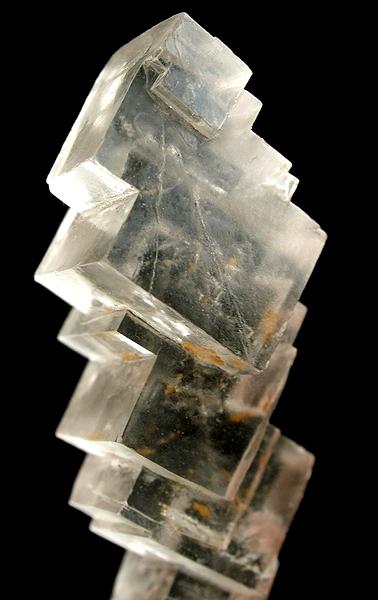
Photo: Wikimedia Commons
Search for specimens: View all halite specimens from Staßfurt, Saxony-Anhalt, Germany
Staßfurt lies in the Salzlandkreis of Saxony-Anhalt, on the Bode River south of Magdeburg. Mineralogically, collector labels may read simply “Staßfurt,” “Stassfurt,” “Staßfurt Potash deposit,” or may specify one of the old mines such as Leopoldshall or Friedrichshall. The broader mining field is tied to the Staßfurt-Egeln salt structure, an anticline/salt-saddle setting in which Zechstein rock salt and potash seams were brought within reach of nineteenth-century mining.
The deposit is a marine evaporite system of Zechstein age. In the German Zechstein succession, the Staßfurt Formation corresponds to the Z2 evaporite cycle. The typical evaporite order is carbonate and anhydrite followed by thick rock salt and then potash salts; in the Staßfurt series, the rock-salt unit known as Staßfurt-Steinsalz is associated with the potash seam Kaliflöz Staßfurt. In the mining literature and modern rock-salt studies, this interval includes light, grey, reddish, and anhydritic rock salts, plus carnallitite and sylvinite. The red colors in the salt rocks are tied to fine hematite, while the potash-rich units include carnallite, sylvite, kieserite, anhydrite, and halite.
Mining history begins with brine and salt long before the collector specimens. Documentary traditions around Staßfurt’s salt economy reach back to medieval salt works, but underground mining changed everything. The von der Heydt and Manteuffel shafts were sunk in 1851–1852 for rock salt. Potash salts encountered during that work were soon recognized as valuable, and in 1861 Staßfurt became the starting point for industrial potash production. The discovery moved potash away from its older dependence on plant ash and made mined potassium salts a large-scale fertilizer and chemical resource.
The major old workings are not casual collecting localities. Leopoldshall is recorded as an abandoned potash mine; Friedrichshall and other Staßfurt-area workings are historic mines rather than public collecting sites. Collectors should treat Staßfurt halite as old-mine material, estate material, or dealer-provenanced specimen material unless a specimen has a modern, documented institutional source. The accessible public face of the locality today is historical: the Stadt- und Bergbaumuseum Staßfurt, the urban mining-history landscape, and the open spaces created in response to mining subsidence.
The locality’s mineralogical importance extends beyond halite. Staßfurt is a type-locality or type-locality region for several evaporite species, including classic potash and magnesium salt minerals. Mindat records 22 valid minerals for the Staßfurt area and lists six valid type-locality minerals. The old potash mines Leopoldshall and Friedrichshall are especially important on labels, with halite accompanied in the district by anhydrite, bischofite, boracite, carnallite, epsomite, gypsum, kainite, kaliborite, kieserite, leonite, picromerite, pinnoite, polyhalite, sylvite, and related salts.
Staßfurt halite is overwhelmingly a cubic mineral in collector presentation, but the best specimens are not monotonous cubes. Documented examples include sharp single cubes, stacked echelon arrangements of offset cubes, transparent tabular crystals, and floaters with clean faces on all sides. Some pieces show faden-like internal or central line features running along the length of the crystal group, a particularly desirable habit when the crystal is water-clear.
The color range runs from colorless and white through greyish, violet-blue, and saturated azure-blue. The blue is the signature collector color. In fine specimens it appears as internal zoning: bands, phantoms, or broad clouds that seem to hover inside otherwise clear halite. Some crystals are nearly colorless except for one deep blue corner or internal sheet; others show layered blue striping across a transparent body. Violet-blue Staßfurt crystals can be especially attractive because the color grades from smoky blue into purple at the thickest portions of the cube.
Documented collector pieces cluster strongly in the miniature to small-cabinet range. Published and illustrated specimens include examples around 2.2 cm, 3.7 x 3.2 x 2.0 cm, 6.0 x 2.7 x 1.5 cm, 6.0 x 4.0 x 3.5 cm, 6.7 x 1.9 x 1.7 cm, 7.0 x 5.8 x 3.8 cm, 7 x 5 x 4.5 cm, and 8.3 x 6.3 x 2.5 cm. Larger massive pieces exist, but the most refined collector value is usually in sharp crystals with glassy transparency rather than bulk size.
Associated minerals on specimen labels and in the deposit include sylvite, carnallite, kainite, kieserite, anhydrite, gypsum, polyhalite, boracite, bischofite, epsomite, leonite, picromerite, pinnoite, and kaliborite. Not all of these appear visually on halite specimens, and many Staßfurt halites are essentially single-mineral pieces. Still, the district’s potash-salt suite is part of what makes a Staßfurt label meaningful: halite here belongs to one of the world’s historic potash evaporite assemblages, not to a simple modern brine-pan occurrence.
Quality is judged by three main factors. First is transparency: the best pieces are water-clear enough that internal color zones, phantoms, cleavage, or growth lines can be read through the crystal. Second is color placement: blue concentrated as natural-looking internal bands or phantoms is far more desirable than dull, muddy, or merely surface-colored material. Third is integrity of form: sharp cubes, stacked cube chains, complete floaters, and undamaged edges carry the locality best. A colorless but exceptionally sharp stacked Staßfurt crystal can be as collectible as a blue one, especially if it retains an old label.
Halite is soft, soluble, and perfectly cleavable; Staßfurt material should be treated as a vulnerable historical specimen, not a durable display mineral. Avoid humidity, water, wet cleaning, breath condensation, and prolonged handling. Store specimens in a dry cabinet, preferably in a sealed box with stable desiccant if the climate is humid. Never rinse a Staßfurt halite, even briefly. Dust should be removed only with very gentle dry air or a soft brush used cautiously around edges.
Condition issues are common and should be expected. Minute edge bruises, cleavage nicks, dissolved-looking corners, and dull patches can occur even on good old pieces. Scratches are easy to produce because halite has low hardness, and cleavage can create deceptively flat “damage faces” that look natural at first glance. When evaluating a specimen, inspect edges under strong side lighting; minor cleavages often flash differently from natural growth faces.
Authentication is usually more about provenance than species identification. Halite itself is easy to recognize by cubic cleavage, softness, and solubility, but serious collectors should not use taste tests on specimens. For Staßfurt, the question is whether a specimen truly comes from the old German locality and whether the blue color is natural to the specimen. Natural Staßfurt blue halite is well documented in the mineralogical literature, but blue coloration in halite can also be produced or modified by irradiation and structural defects in NaCl. A high-value blue Staßfurt piece should have a credible chain of custody: old labels, museum or collection history, dealer documentation, or consistency with known Staßfurt habits.
The best Staßfurt halites are not abundant on the market. Old-time blue crystals, sharp transparent floaters, and unusual faden or stacked echelon pieces appear sporadically through specialist dealers, auctions, estate collections, and museum deaccession-like collection dispersals rather than as steady mine-production material. Small colorless or pale crystals are more affordable, but saturated blue specimens with strong form and clean condition are genuinely scarce. A modest, honest crystal with an old Staßfurt label may be preferable to a brighter but poorly documented “blue halite” offered without locality history.
In the nineteenth century, Staßfurt’s potash beds were a discovery that almost looked like a nuisance. The shafts were sunk for rock salt, and the potassium-magnesium salts above the rock salt were at first the odd overburden—the “abraumsalze”—standing between miners and the material they expected to work. Then chemists and agricultural reformers realized that these bitter, complicated salts were a new source of potash. A Scientific American article from 1869 captured the economic surprise in plain language: potash had long come chiefly from the ashes of plants, but at Stassfurt it had been found “in vast amounts” at the salt mines. The article named the cast of minerals that still makes the locality feel alive to collectors: polyhalite, sylvite, carnallite, kainite, rock salt, anhydrite, kieserite, tachyhydrite, and boracite. In one district, the old chemistry of wood ash began giving way to the mineralogy of an evaporated Permian sea.
The blue halite itself became a scientific riddle. By 1940, Nature could say that blue halite from Stassfurt had received “much attention,” and the debate already had a history: colloidal sodium, inclusions, iron and manganese, sulfur, and organic substances all had advocates or skeptics. Nine years later, another Nature note described optical measurements of blue rock salt from Stassfurt and followed what happened as the color responded to heating. A collector sees beauty in the blue phantoms; physicists saw absorption maxima, decoloration, shifting peaks, and a chance to watch defects inside a simple NaCl lattice.
Staßfurt also paid a physical price for salt. Mining and water inflow changed the city above the workings. The old center subsided into a broad depression: seven meters deep over an area of about 200 hectares. Roughly 800 historic buildings were demolished as the town hall, church, residential blocks, and the old civic fabric were lost. In 2005, citizens, planners, and officials met in a multi-day public workshop in an open shopfront to decide what could be done with a center that people understandably wanted back but that remained at risk. The answer was not a reconstruction over unstable ground. The subsidence zone was flooded and remade as an urban lake and landscape space—an unusually visible memorial to the same salt geology that produced the specimens.
 Amethyst
 Quartz
 Fluorite
 Tourmaline
 Malachite
 Azurite
 Rhodochrosite

