Eosphorite from the Ilha Claim is one of the classic visual signatures of the Jequitinhonha Valley pegmatites: warm golden-brown to orange-brown blades and sprays scattered over crystallized rose quartz. The appeal is not only the eosphorite itself, but the way it sits in color contrast—amber phosphate against soft pink quartz, sometimes with tiny olive-green zanazziite spheres, white albite, muscovite, wardite, or other phosphate companions. Fine examples have the unmistakable look of old Brazilian pegmatite material: delicate, lustrous, and unusually architectural for a secondary phosphate.
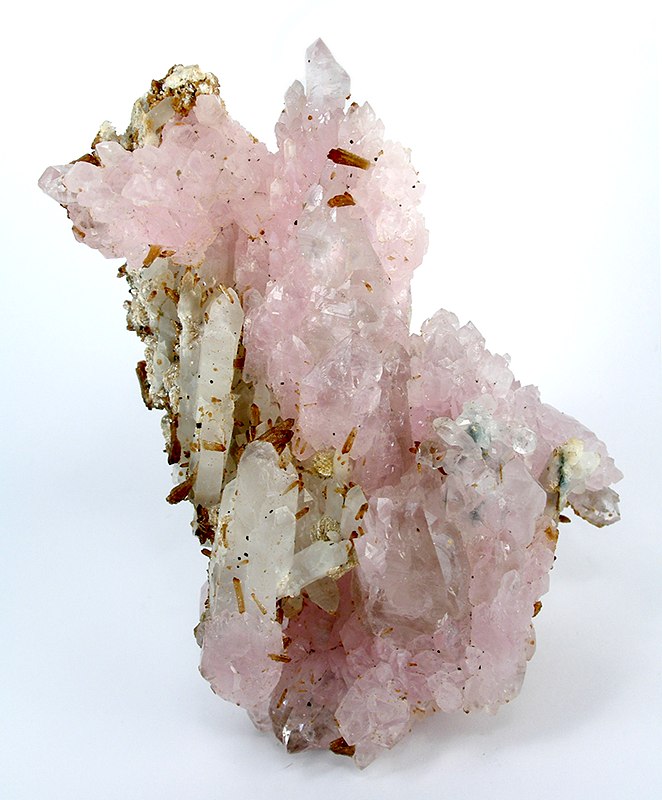
Photo: Wikimedia Commons
The locality, also known as Lavra da Ilha, is a zoned granite pegmatite on a small island in the Jequitinhonha River, near Taquaral in the municipality of Itinga, Minas Gerais. It is not the type locality for eosphorite, but it is a type locality for several important rare phosphates, including zanazziite, whiteite-(CaFeMg), and whiteite-(MnFeMg). That scientific significance is part of why Ilha specimens are still taken seriously by phosphate collectors: the same pocket environment that produced beautiful rose quartz also recorded a complex late-stage phosphate paragenesis.

Photo: Wikimedia Commons
Collectors usually look for three things in Ilha eosphorite: sharp, undamaged brown blades; a strong rose-quartz matrix with real crystallization rather than massive quartz; and a convincing old provenance. The most desirable pieces are complete miniatures and small cabinets where the eosphorite is not merely an accessory but a visible, aesthetic spray or field of crystals. Zanazziite association adds mineralogical importance, while wardite, whiteite, and other phosphates add depth for systematic collectors.
Search for specimens: View all eosphorite specimens from Ilha Claim, Brazil
Ilha Claim, Lavra da Ilha, lies about 3 km north of Taquaral on an island in the Jequitinhonha River. Mindat records the coordinates as 16° 38' 42'' South, 41° 51' 49'' West, and lists the locality as an inactive claim. The setting is a zoned granite pegmatite, partly covered by alluvium, trending roughly N 40° E, subvertical, and reportedly about 300 meters long where exposed or inferred from outcrops. The pegmatite is enclosed in quartzose mica schists.
The deposit was discovered in 1969. Published locality notes describe the island as about 500 meters long, with the pegmatite worked by an excavation roughly 70 × 10 meters and more than 15 meters deep. The mine was repeatedly affected by the annual rise of the Jequitinhonha River, which filled the workings with sand; small production continued for a time during low-water periods after the sand was cleared. This hydrologic setting is not a footnote—it is central to why the locality has an almost legendary character among collectors. It was a pegmatite pit on an island, in a river, fighting the river every season.
The pegmatite is described as having a quartz core surrounded by feldspathic zones with albitic replacement bodies and geode-rich areas. The rose quartz belongs to a late stage of pegmatite development, and the phosphate suite is tied to the alteration and weathering of primary phosphate minerals such as triphylite. The resulting assemblage is unusually rich: eosphorite, zanazziite, wardite, whiteite, rockbridgeite, montgomeryite, apatite, vivianite, collinsite, montebrasite or amblygonite-series material, and other species occur with quartz, rose quartz, albite, muscovite, microcline, pyrite, sphalerite, cassiterite, niobium-tantalum oxides, and beryl.
Production appears to have been most important in the 1970s, with classic rose-quartz and phosphate specimens entering collections through Brazilian channels and through early U.S. dealers. Richard “Rich” Kosnar is repeatedly associated with early American importation of Ilha material; several documented specimens in the market were acquired by him in Brazil in 1973 or 1974 and remained in his personal collection for decades. By the 2000s and 2020s, most quality Ilha eosphorite specimens appearing for sale were old-collection pieces rather than products of regular active mining.
Collecting access should be treated as closed or highly restricted. The claim is inactive, historically water-affected, and located in a river setting where seasonal flooding and sediment fill are part of the mine’s history. Any modern field collecting would require local permission, safe seasonal conditions, and careful confirmation of current land and mining status.
Notable finds include the crystallized rose quartz clusters that made the locality famous, particularly crusts, crowns, and doubly terminated rose quartz individuals around earlier quartz. Eosphorite is so persistent in these specimens that its presence, especially with zanazziite or wardite, is often one of the visual clues pointing to Ilha origin. The locality is also mineralogically notable as the type locality for zanazziite and the whiteite species whiteite-(CaFeMg) and whiteite-(MnFeMg).
Ilha eosphorite is best known as lustrous, translucent, golden-brown to orange-brown crystals perched on pink crystallized quartz. The crystals are commonly elongated, bladed, prismatic, or “sword”-shaped, sometimes forming sprays, radial groups, sheaves, or scattered individual blades across quartz surfaces. Fine examples can show sharp terminations and enough translucency to glow amber under strong light.
The usual collector-scale crystals are small: many are only a few millimeters, while better specimens show crystals approaching 1 cm. Dealer and museum-photo records show eosphorite as both isolated blades and clustered sprays on rose quartz, quartz, albite, and muscovite. Larger aggregate groups and sheaf-like masses have been described from Minas Gerais material, but the classic Ilha aesthetic remains the small, sharp brown phosphate accenting pink quartz.
The formula of eosphorite is Mn2+Al(PO4)(OH)2·H2O. At Ilha it belongs to a phosphate-rich pegmatite environment where late fluids and the alteration of earlier phosphate minerals generated a complex secondary assemblage. Childrenite has been reported only as a microscopic zone within an eosphorite crystal cluster, which is important: visually similar brown phosphate crystals may require analysis if a precise species label matters.
The most characteristic association is rose quartz. Ilha rose quartz can range from nearly purple-pink to pale pink-white and may be transparent, translucent, or opaque. Individual rose-quartz crystals are described from a few millimeters up to about 2 cm, with one or two terminations; clusters may occur as irregular crusts on quartz, striped or parallel aggregates, or crowns of doubly terminated crystals around larger quartz. This rose quartz is the stage on which the eosphorite performs.
Zanazziite is the other great companion. It appears as small green spheroids or crystals on rose quartz and quartz, commonly with brown eosphorite. Wardite, whiteite-(CaFeMg), whiteite-(MnFeMg), apatite, montebrasite or amblygonite-series material, rockbridgeite, montgomeryite, vivianite, collinsite, albite, muscovite, pyrite, and quartz are part of the broader locality suite. For collectors, a specimen with eosphorite plus rose quartz plus zanazziite carries both aesthetic and locality-specific mineralogical strength.
Quality is judged by contrast, placement, and survival. The best pieces have bright pink rose quartz, lustrous and undamaged eosphorite, and crystals that stand free rather than lying as broken brown debris. Open sprays on the display face are especially desirable. A small but sharp eosphorite spray on vivid rose quartz can be more important than a larger, dull, edge-worn phosphate crust. Provenance matters strongly: old labels from Rich Kosnar, Kay Robertson, Paul Muse, Martin Zinn, Alvaro Lucio, or other recognized collections add confidence and historical value.
Ilha eosphorite is not commonly faked as a mineral species, and no well-documented treatment specific to eosphorite from this locality has become part of the standard collector literature. The bigger authenticity issue is locality and association. Many brown eosphorites from Brazilian pegmatites can look broadly similar, so an Ilha attribution is strongest when supported by the classic rose quartz association, zanazziite or wardite, old labels, or a documented chain of custody.
A special caution concerns “roscherite” labels. Roscherite-style green minerals on Ilha specimens have long caused confusion. Zanazziite was originally connected with material that had been referred to as roscherite, and later work established zanazziite as a distinct species from Lavra da Ilha. Some dealer labels still use or repeat roscherite for green material on Ilha rose quartz, but that identification should not be accepted without analysis. In many classic Ilha pieces, the green spheres are better regarded as zanazziite unless proven otherwise.
Condition problems are common. Eosphorite crystals are small, elevated, and brittle-looking; tips chip easily, sprays flatten, and exposed blades break along pocket edges. Rose quartz matrices can show contacted backs, broken peripheries, iron or manganese oxide dusting, pyrite specks, or thin coatings of hyalite opal or quartz. Some old specimens were trimmed aggressively to emphasize the rose quartz, and there are documented comments that miners sometimes removed eosphorite from rose quartz because they thought the brown phosphate detracted from the specimen. For today’s collector, intact eosphorite on rose quartz is part of the point, not a flaw.
Rarity is relative. Small Ilha eosphorite specimens exist in many collections, and the locality is well represented in photos. But fine, undamaged, aesthetic examples with strong rose quartz, sharp eosphorite, and zanazziite are not abundant on the current market. Most good pieces seen today are recycled old collection specimens from 1960s–1970s production or later dispersals. Recent market appearances range from modest thumbnails and small phosphate combinations to four-figure rose-quartz display pieces where eosphorite is a desirable accessory.
When buying, favor specimens with precise locality wording: Ilha claim, Lavra da Ilha, Taquaral, Itinga, Jequitinhonha Valley, Minas Gerais, Brazil. Be cautious with vague labels reading only “Minas Gerais” or “Taquaral,” since the region hosts multiple pegmatites with phosphate minerals and rose quartz. If a specimen is sold as eosphorite with zanazziite, whiteite, wardite, or roscherite-group minerals, analysis or credible old provenance becomes more important.
The Ilha Claim was not an ordinary pegmatite hole on a hillside. It was a working pit on an island in the Jequitinhonha River, so low and exposed to the river that seasonal water was part of the mining cycle. Locality descriptions record an island about 500 meters long and an excavation about 70 meters long, 10 meters wide, and more than 15 meters deep. Each annual rise of the river filled the pit with sand. Work resumed only after low water allowed the sand to be cleared again.
One field account captures the strangeness of the place better than any summary: the pit was dug perhaps five meters below river level, and from the bottom one could throw a stone into the river on either side of the island. Pumps had to run continuously. When the water was held back enough to expose the working floor, little jets of water shot up from cracks in the rock, some as high as a foot. That image—brown phosphate and pink quartz coming from a pit that seemed to be leaking the river from below—is the essential Lavra da Ilha story.
The locality’s collector fame began with beauty before it became taxonomy. The rose quartz drew attention first: pink crystals in real clusters, crowns, crusts, and little doubly terminated groups, rather than massive rose quartz. Then the “little green things” on some specimens became interesting. Those green spheroids and crystals, associated with eosphorite on rose quartz, helped lead to the description of zanazziite. A small river-island pegmatite became a type locality because collectors and mineralogists looked closely at what had been clinging to the showier quartz all along.
Rich Kosnar’s name runs through the old Ilha material in the American market. Specimens documented from his collection were acquired in Brazil in 1973 and 1974, during the period when Ilha’s classic production was still fresh. Later auction descriptions describe him as the first U.S. dealer to import minerals from the locality and note that some pieces stayed in his personal collection until his death. For collectors today, an old Kosnar Ilha label does more than add romance; it places a specimen near the beginning of the locality’s international collecting history.
 Amethyst
 Quartz
 Fluorite
 Tourmaline
 Malachite
 Azurite
 Rhodochrosite
