






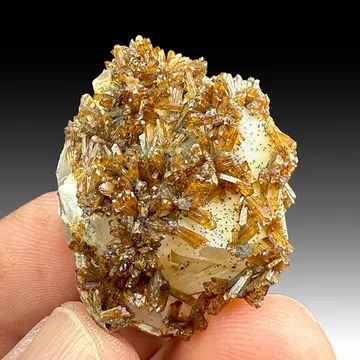
Eosphorite - manganese aluminum phosphate forming honey-brown crystals and radiating sprays; prized for contrast with albite/quartz and NH/SD localities.
Key facts
Eosphorite is a manganese aluminum phosphate and the Mn-dominant member of the childrenite–eosphorite series. Beloved by pegmatite aficionados, it most often forms as honey-brown to golden-orange prismatic crystals, fans, and radiating sprays on bright white albite or quartz—compositions that can be strikingly aesthetic. Individual crystals are commonly millimeter to centimeter scale with vitreous luster and fine striations; larger, well-isolated prisms occur but are rarer. Color ranges from tan to amber and caramel-brown, sometimes with delicate pinkish or orange tones in more Mn-rich zones. Because eosphorite readily intergrows with its Fe-rich partner, childrenite, zoning or core–rim variations are common and add scientific interest.
Collectors prize eosphorite for:
Among phosphate collectors, eosphorite is a classic. It lacks the neon colors of showy silicates, yet great pieces have undeniable presence—especially Brazilian fans perched on white feldspar or quartz. Historic U.S. occurrences (New Hampshire and South Dakota) supply “textbook” systematic examples with excellent provenance, while Brazil produces modern cabinet-grade matrix pieces with outstanding aesthetics. Availability is moderate: small singles and sprays are accessible, but robust, undamaged matrix clusters with top color and balance are selective and command strong prices. Because many sprays are delicate, pristine condition significantly impacts value. As with many pegmatite phosphates, choice pieces are absorbed into collections and do not re-enter the market often, keeping pressure on fine examples.
Below are reliable, well-documented sources that produce (or produced) distinctive and collectible eosphorite. Each locality link includes a quick map and a gallery filtered to eosphorite specimens from that source.
Another Linópolis classic, the Ilha Claim has yielded sharp, glassy eosphorite fans with excellent brightness and composition. Collectors value the contrast of warm eosphorite with clean albite blades and clear quartz, and the frequent phosphate paragenesis that creates “teaching” specimens for pegmatite mineralogy. Matrix integrity and minimal repairs lift top examples into the upper tier.
Color and Transparency:
Crystal Form and Habit:
Luster and Surface Quality:
Matrix and Associations:
Size and Aesthetics:
Condition:
Repairs:
Treatments:
Eosphorite is moderately hard (about 5 on Mohs) but brittle with perfect cleavage—treat it gently.
Handling:
Environment and Light:
Cleaning:
Storage:
By prioritizing sharp form, vibrant warm color, bright luster, clean contrasty matrix, and excellent condition—with minimal or well-disclosed repairs—you can assemble an eosphorite suite that’s both aesthetically compelling and scientifically instructive.