Panjshir emerald is one of the few modern emerald sources whose best crystals can legitimately be discussed in the same breath as fine Colombian material. Its appeal is immediate: lively, saturated green to slightly bluish green crystals, often in slender hexagonal prisms, sometimes with a glassy “pencil” habit that gives cutters useful retention and specimen collectors attractive individual crystals. The finest rough can be startlingly bright for schist- and vein-hosted emerald, while lower-grade material commonly shows the pale cores, darker green skins, fractures, and etched surfaces that make Panjshir instantly recognizable to anyone who has handled parcels from the valley.
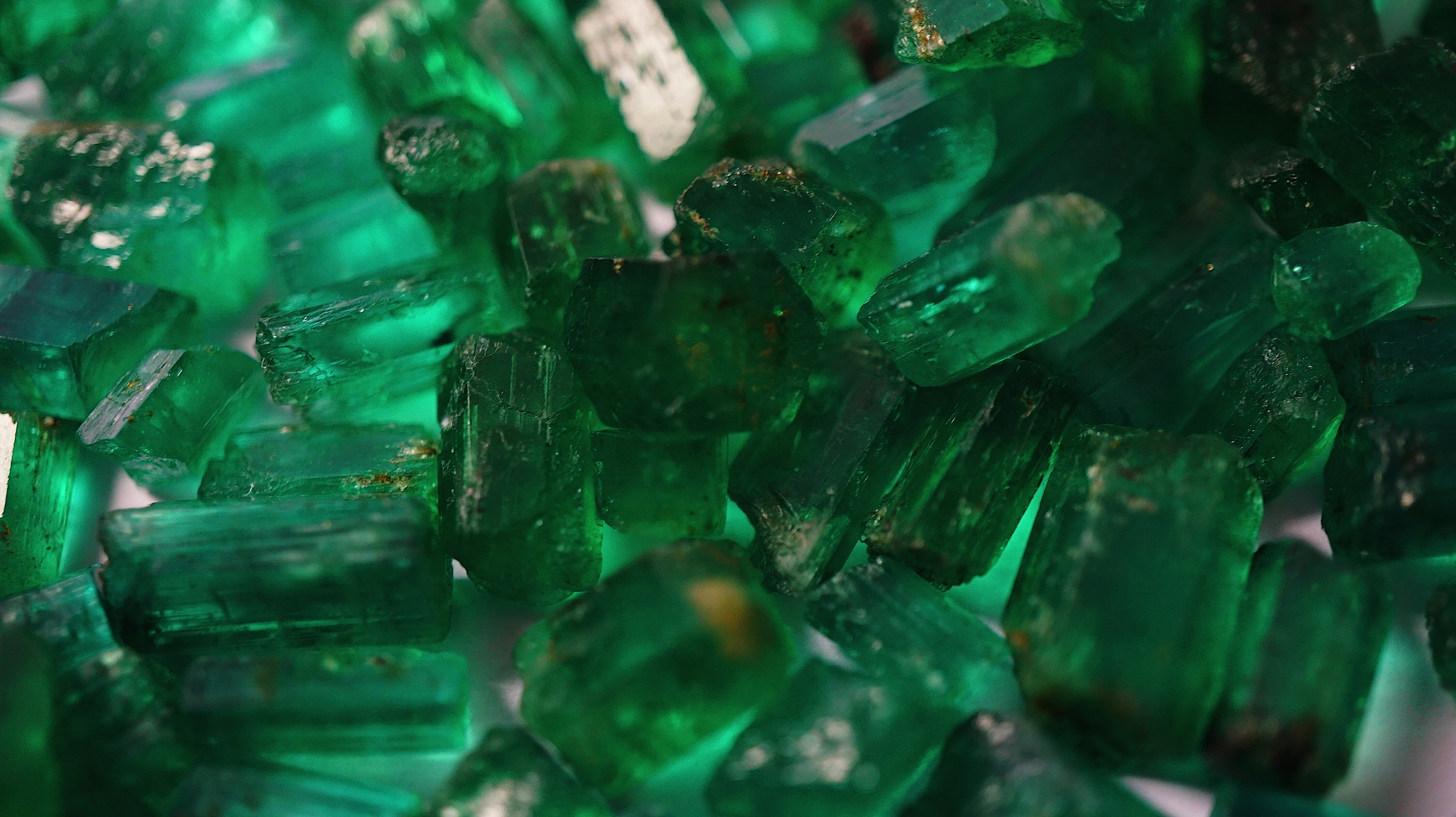
Photo: Paweł Maliszczak / Wikimedia Commons
Geologically, Panjshir is not a pegmatite emerald locality. The emeralds occur in hydrothermal veins and altered shear zones within the rugged Hindu Kush, on the eastern side of the Panjshir River, in a structural corridor related to the great suture systems of northeastern Afghanistan. Quartz, albite, ankerite, carbonate, pyrite, phlogopite, tourmaline, and mica-rich alteration are the relevant companions; the emerald is the product of beryllium-bearing fluids meeting chromium- and vanadium-bearing rocks under tectonically active, hydrothermal-metamorphic conditions.
Historically, Panjshir occupies an unusually romantic place in emerald lore. Ancient references to “smaragdus” from Bactria cannot be assigned confidently to Panjshir emerald in the modern sense, but they show that green stones from the Afghanistan region were known very early. Modern commercial production began to matter in the 1970s and 1980s, then became internationally visible after the Soviet withdrawal, when Gary Bowersox and colleagues published the classic 1991 Gems & Gemology study. Since then, Panjshir has moved from a war-zone curiosity into a serious origin for both gem rough and mineral specimens.
Collectors look for sharply terminated hexagonal prisms, saturated green color, visible transparency, undamaged terminations, and matrix associations with white quartz, carbonate, pale albite, mica, or pyrite. A clean single crystal of a few carats can be desirable; a matrix piece with multiple lustrous emerald crystals is much scarcer; and large, transparent, undamaged crystals over 50 carats are exceptional. The locality also rewards close study under the microscope: multiphase fluid inclusions, color zoning, etched surfaces, and unusual internal “nodules” are all part of Panjshir’s personality.
Search for specimens: View all emerald specimens from Panjshir, Afghanistan
The Panjshir emerald district lies in northeastern Afghanistan, roughly north to northeast of Kabul, in steep Hindu Kush terrain along and east of the Panjshir River. Older gem literature often gives the principal mining belt as extending from the Khenj area toward Dest-e-Rewat, with named zones and mines including Khenj, Mikeni, Darkhenj, Buzmal, Yaknow/Butak, Rivat/Rewat, Darun, Aryu, and other local workings. Administrative names and spellings vary widely in the literature and in trade labels: Panjsher, Panjsheer, Panjshir, Mikeni, Milzeni, Khenj, Khanj, Buzmal, Dahane Revat, Rewat, and Darun may all appear on older labels.
The deposit type is best treated as tectonic-metamorphic, hydrothermal emerald mineralization. Emerald-bearing veins and altered zones cut carbonate and clastic metamorphic rocks near major structural contacts. The host assemblage includes metamorphosed limestones or marbles, calcareous slates, phyllites, schists, and related altered rocks, with quartz-ankerite and quartz-albite veins carrying emerald in places. Later work has emphasized the role of hydrothermal alteration, intense fracturing, and proximity to the regional suture system. The simplest collector’s rule is important: Panjshir emerald specimens are not from the famous Nuristan-Laghman pegmatite fields, even though Afghanistan is rightly famous for pegmatite minerals.
Mining has long been small-scale, local, and episodic. In the early modern period, emerald was reported from Buzmal in the 1970s and was then studied by Soviet and Afghan geologists. During the 1980s and early 1990s, villagers and mujahideen-linked networks worked hundreds of shafts and tunnels, typically with hand tools, drills, and explosives. Production was irregular but significant enough that Bowersox and colleagues estimated roughly 10 to 12 million U.S. dollars in 1990 production, after an estimated 2 million U.S. dollars in 1989. Later surveys and satellite studies show a district that continued to change: from scattered artisanal adits and tunnels toward more concentrated workings, trenching, and in some areas mechanized surface excavation.
Access has always been one of the defining facts of Panjshir emerald. The mines sit high above villages, commonly in steep, cold, and unstable terrain. Older field accounts describe miners living near the workings during the week, descending to villages for supplies, and working in poorly ventilated tunnels lit by lanterns or oil-burning cans. Winter snow restricts higher-elevation work, and political conditions have repeatedly shaped who can enter, mine, buy, sell, and export. For collectors, practical access is not a casual field-collecting matter; most specimens enter the market through Afghan and regional dealers, with historical routes through Kabul and Pakistan and more recent movement through international gem-trade channels.
Notable finds include crystals well over 100 carats, with a 190-carat crystal reported in earlier GIA literature, a 132-carat crystal illustrated in the 1991 study, and later accounts of very large fine-quality crystals and faceted stones. A particularly famous market moment was the sale of a 10-carat Afghan emerald at Christie’s Hong Kong in December 2015 for 2.275 million U.S. dollars, a result that helped draw renewed gem-laboratory attention to high-end Panjshir material and the problem of separating Colombian-looking Afghan emeralds from true Colombian stones.
Panjshir emerald most often forms euhedral prismatic crystals of beryl, Be3Al2(Si6O18), with a hexagonal cross-section, basal pinacoid terminations, and first-order prism faces. Second-order prism faces are reported but less common, and dipyramidal forms are not a defining habit in the classic material examined by GIA. Collectors will see short stout crystals, elongated “pencils,” broken crystal sections, etched crystals, and occasional matrix groups.
Color ranges from light green through medium green to deep, saturated bluish green. The best stones have a vivid color that can be Colombian in appearance, but Panjshir parcels also include many lighter, more included, or unevenly colored crystals. Color zoning is common. A classic feature is a paler interior with a darker green exterior or “skin,” which matters greatly to cutters because the most attractive color may lie near the surface rather than throughout the body of the crystal.
Typical crystals in older production were often in the 4- to 5-carat range. Crystals over 50 carats have been found repeatedly but are not ordinary; crystals over 100 carats are rare and command special attention when color, transparency, and termination quality survive mining damage. Gem-quality faceted stones are most commonly under 5 carats, but much larger fine stones and crystals have been documented by gem laboratories and trade reports.
The most important associated minerals for collectors are quartz, ankerite, albite, carbonate minerals, pyrite, phlogopite, tourmaline, muscovite or fuchsite-bearing mica, calcite, dolomite, and iron oxides. Pyrite is especially attractive when present as bright metallic accents near emerald crystals, but many Panjshir specimens are simple emeralds in white to buff carbonate-quartz-albite matrix. Brown or black alteration products and iron staining are common on rough surfaces and in fractures.
Under magnification, Panjshir emerald is famous for multiphase fluid inclusions. Classic material may contain elongated needle-like, tubular, tabular, jagged, or irregular inclusions with liquid, vapor, and multiple daughter crystals. Halite-like cubic crystals, probable sylvite, carbonates, and other daughter minerals have been reported. These inclusions can resemble the three-phase inclusions long associated with Colombian emerald, but Panjshir stones often show more complex internal populations, sometimes with numerous daughter crystals rather than a simple Colombian-style inclusion scene.
A second distinctive feature is the occurrence of etched surfaces and internal “nodules.” The nodules described in the classic GIA study are rounded, marble-like bodies within larger crystals, and some nodular material is cleaner than the surrounding emerald. For a mineral collector, this is not a defect in the same way a late break is a defect; it is part of the growth and dissolution history of the crystal. For a cutter, however, nodules, skins, etching, and zoning make orientation and yield highly dependent on the individual piece of rough.
Quality in Panjshir material is judged by a tight combination of saturation, transparency, crystal integrity, and locality character. A fine specimen should show real emerald color without requiring strong backlighting, crisp crystal form, minimal blast damage, and a believable Afghan matrix. For loose crystals, a complete termination and natural prism faces matter greatly. For gem rough, the highest-value pieces combine a rich green exterior with enough internal transparency to cut a lively stone without losing all the color-bearing skin.
The first authenticity issue is origin. Panjshir emerald can resemble Colombian emerald visually and microscopically, especially the high-quality material that entered the trade around 2017 and was later described by SSEF as a distinct “type II” Panjshir material. Some Afghan stones have reportedly entered the market as Colombian. Serious gem buyers should not rely on color or three-phase inclusions alone; origin determination may require a laboratory report using microscopy, UV-Vis-NIR, FTIR or Raman data, and trace-element chemistry.
The second issue is treatment. Like emerald from nearly every major source, Panjshir material may be oiled or otherwise fracture-filled to reduce the visibility of fractures. Older GIA reporting noted oiling in Pakistan-market material and documented a dyed Panjshir crystal in a parcel bought in Pakistan. Synthetic emeralds have also been detected mixed into sale lots of cut stones. For faceted stones, disclosure and a respected laboratory report are essential. For mineral specimens, look for unnatural green concentrations in fractures, suspiciously glossy fracture networks, resin-like residues, or color that pools in cracks rather than following the crystal.
Condition is a major collecting filter. Much Panjshir emerald has been extracted by drilling and blasting, and beryl’s poor-to-indistinct basal cleavage plus natural fractures make emerald vulnerable to shattered terminations, internal stress cracks, and bruised prism edges. Attractive color can be present in pieces that are too fractured for cutting, and sharp specimens may still show tiny edge nicks or natural etching. A specimen with undamaged terminations, bright luster, good color, and matrix is much scarcer than loose broken crystal sections from gem parcels.
Rarity is tiered. Small loose crystals and included rough are available with some regularity. Clean, saturated, thumbnail-sized crystals are much less common. Matrix specimens with multiple emeralds are genuinely desirable, especially when the crystals are well exposed rather than buried in carbonate or quartz. Large, transparent, undamaged crystals with strong color are rare enough to compete with gem rough in pricing.
Market availability remains active but uneven. Panjshir emerald appears regularly in the international gem trade, in Afghan dealer inventories, on specimen marketplaces, and in occasional high-end jewelry auctions. At the same time, legal control, export routes, local licensing, and political authority in Afghanistan have shifted repeatedly. That uncertainty makes provenance documentation, old labels, credible dealer history, and laboratory origin reports more important than usual. For a serious collector, “Panjshir” should not be accepted as a decorative label alone; the best purchases combine locality plausibility, mineralogical consistency, condition, and documentation.
Gary Bowersox’s 1990 trip remains the classic field account of Panjshir emerald mining. He entered a valley still marked by war and found that the same men who had fought Soviet troops were now turning their energy toward the mountains. The image is hard to improve: more than 5,000 villagers mining emeralds under the authority of Commander Ahmad Shah Massoud, the “Lion of Panjshir,” in a landscape where the Hindu Kush itself was described as the more formidable adversary.
The journey into Panjshir was not a simple road trip. In 1990, foreign access through surrounding countries was restricted, and the practical route described by Bowersox was through northern Pakistan. From near Chitral, the party crossed into Afghanistan and then traveled roughly 150 miles by foot, mule, and horse through rugged terrain, land-mine fields, and high passes, some approaching 14,900 feet. It took six days to reach Panjshir. That detail matters because it explains why early Western knowledge of the mines was so fragmentary: the emeralds were not merely remote; they were behind mountains, borders, tribal rivalries, and war debris.
The villages below the mines had the feel of frontier boom towns. Khenj and Mikeni had shops selling mining tools, wood for construction, food supplies, and familiar soft drinks such as Sprite and Pepsi, but no electricity. Candles and oil lamps supplied the light. The only communication with the outside world was by military radio controlled by the local commander and reserved for emergency and military use. Miners lived at high-elevation workings from Saturday afternoon until Thursday afternoon, then descended to their families and supplies. The weekly diet Bowersox recorded was plain: rice, nan, beans, and tea.
At Buzmal, the oldest and most dangerous of the mines described in the 1991 report, the “mine” was not a single organized underground operation but dozens of pits and tunnels scattered over a mountain about 10,000 feet high. Teams chose a place and began “gophering,” tunneling irregularly into hard limestone. A tunnel might run 30 to 50 yards before suddenly changing direction toward another group’s emerald find. Explosives were used without careful measurement or timing. Bowersox wrote of six dynamite blasts from a shaft above shaking the tunnel he was traveling through in a matter of minutes. It is easy to understand how many crystals were damaged before ever reaching daylight.
The working conditions were as stark as the terrain. Tunnels were often about four feet wide and four to five feet high, oval, unsupported, smoky, and poorly lit. Except at Khenj, there were no generators or compressors for lighting or ventilation in the hundreds of tunnels described. Miners worked without hard hats. Gas- and diesel-powered hand drills were used well inside the workings, filling passages with smoke and carbon monoxide. Bowersox recorded that many miners became ill and that a few had died from the fumes. The miners themselves understood the danger and left the shafts frequently simply to breathe.
Once rock was blasted loose, it was carried out by wheelbarrow or container and examined quickly in daylight. If no “green” appeared, the rock was tipped down the mountainside as waste. If emerald was visible, the pieces were kept at camp until the team returned to the village. In winter, snow pushed work to lower elevations, where the emeralds were generally poorer, or forced miners to rework waste piles from the higher mines. That image—miners searching old dumps because snow had closed the better ground—belongs to Panjshir as much as the bright green crystals do.
The market rhythm in 1990 was equally specific. Emeralds had to be brought to one of the nearest villages, such as Khenj, Mikeni, or Dest-e-Rewat. On Mondays and Thursdays, miners and businessmen gathered for a scheduled meeting chaired by the local commander. Production was evaluated, and a 15 percent tax was collected for the Jamiat-e-Islami party, described then as funding reconstruction of the war-devastated area. After that, stones could be retained by miners or sold by auction in the village, then usually moved toward Pakistan for cutting, trading, and distribution.
A later field account by GIA’s Andy Lucas gives the valley a different but equally vivid tone. Lucas traveled with Arthur Groom of Eternity Emerald after meeting Abdullah Abdullah before the trip. The route still demanded horses and steep climbs, and the destination was still a place few dealers visited casually. Lucas’s strongest memory was not only danger or difficulty but hospitality. He summed up the valley with the line: “Come as a foe and leave defeated. Come as a friend, and you will find some of the most hospitable and friendly people on the planet.” For a locality so often discussed through war, smuggling, and political instability, that human note is worth keeping.
By 2009, Bowersox returned in a different mode: not simply as a gem explorer but as part of a USAID-sponsored survey team with Derrold W. Holcomb and Dr. Lawrence W. Snee. The team recorded GPS readings at mine sites for potential licensing and mapping. They interviewed approximately 1,400 miners working at 172 emerald mines. The survey confirmed that the actual emerald-bearing area extended beyond the known workings by an additional area equal to about 30 percent of the previously known area. Yet even this technical survey ran into the realities of Panjshir: some miners did not understand, or did not want to accept, the purpose of GPS mapping, licensing, or formalization, preferring to continue mining land they regarded as customary, tribal, or family property.
That survey also caught the valley in transition. Older tunnels and shafts were still present, but trenching, open pits, better water control, reduced blasting in some places, and even mine-site bathrooms were reported. Heavy equipment appeared at some operations. The difference is not cosmetic. Every collector who has seen a shattered emerald crystal from a blasted pocket understands the stakes: less uncontrolled blasting can mean better preserved crystals, better cutting rough, and less waste of a finite resource.
 Amethyst
 Quartz
 Fluorite
 Tourmaline
 Malachite
 Azurite
 Rhodochrosite