Kagem is the modern standard by which many serious collectors now judge Zambian emerald specimens: long hexagonal crystals of saturated green to bluish green beryl, often standing out dramatically from white quartz, pale feldspar, dark mica-schist, or black tourmaline-rich material. The finest pieces have a combination that is unusual in emerald specimens from large-scale production mines: recognizable crystal form, rich color, enough translucency to glow at the edges, and believable mine provenance from a heavily documented operation.

Photo: Wikimedia Commons
The geological appeal is equally strong. Kagem lies in Zambia’s Kafubu emerald district, within the Ndola Rural Emerald Restricted Area of the Copperbelt Province. The emeralds are not the carbonate-hosted style made famous by Colombia; they are schist-hosted emeralds formed where beryllium-bearing pegmatites interacted with chromium- and vanadium-bearing mafic-ultramafic rocks. In practical specimen terms, that means the crystals are products of a contact or reaction zone: pegmatitic fluids supplied beryllium, while altered talc-magnetite and mica-rich schists supplied the color-making chromophores.
This contrast in parent rocks is the key to Kagem’s personality. The mine geologists follow the meeting places: quartz-tourmaline and quartz-feldspar pegmatites cutting or approaching talc-magnetite schist, especially where structures such as shear zones and vein intersections concentrate the chemistry. Collectors see the result as emerald crystals in or on white quartz, in mica-rich schist, or associated with dark tourmaline, magnetite, and other minerals that give many Kagem pieces a rugged, high-contrast African character.
Kagem’s historical importance is not merely that it produces emeralds, but that it brought industrial-scale planning, security, sorting, grading, and international auction marketing to a gemstone sector that had often been opaque. Since Gemfields took operational control in partnership with the Zambian government, Kagem has become a central source of Zambian emerald rough for the global trade, while also yielding some of the largest named emerald crystals and clusters of the modern era: Insofu, Inkalamu, Chipembele, Imboo, and the Kafubu Cluster.
For specimen collectors, Kagem is especially interesting because attractive display pieces were not always the priority. For decades, the economic logic of emerald mining favored cutting rough, cabochon material, beads, and commercial parcels. Specimen-quality crystals enclosed in quartz or schist required careful preparation and a market that valued mineral display aesthetics as much as gem yield. The prepared Kagem specimens that began appearing around 2009 changed that perception. They proved that the mine could produce not only gem rough but legitimate cabinet and small-cabinet specimens with sculptural mineralogical presence.
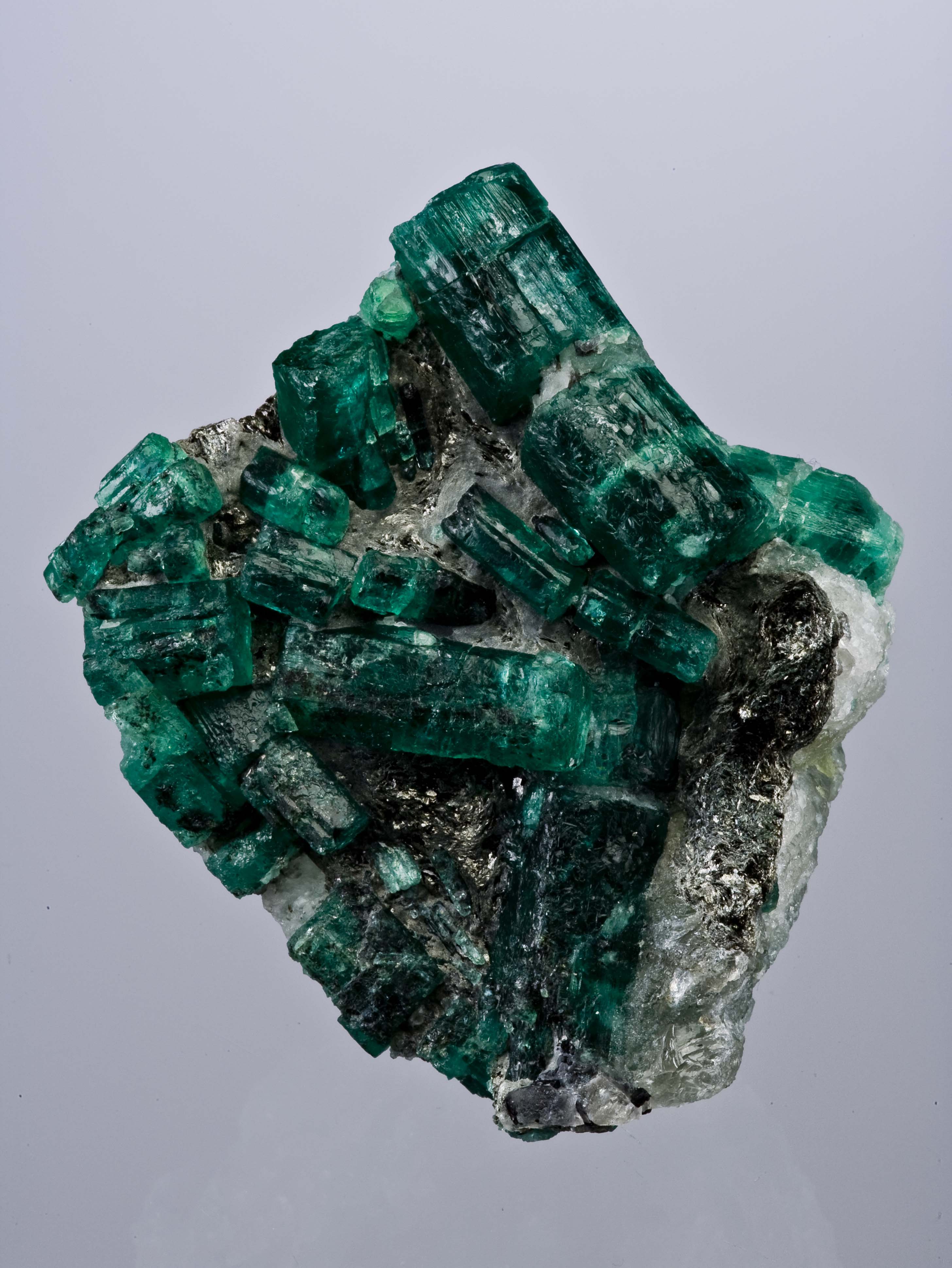
Photo: Wikimedia Commons
The look serious collectors prize is specific: a freestanding or well-exposed hexagonal prism; strong green or bluish-green saturation; visible termination; minimal edge bruising; natural association with quartz or schist rather than a stripped loose crystal; and enough translucency that the crystal is not merely black-green in hand. The finest specimens are not necessarily the cleanest gem rough. A display emerald must balance crystallography, color, matrix, condition, and provenance. Kagem can provide that balance, but the supply of true specimen-grade pieces remains far smaller than the mine’s enormous gem-production footprint suggests.
Search for specimens: View all emerald specimens from Kagem Emerald Mine, Zambia
Kagem Emerald Mine is in the Kafubu emerald mining district of Lufwanyama District, Copperbelt Province, Zambia, south of Kitwe and west of Ndola. The mine sits within the Ndola Rural Emerald Restricted Area, a long-established emerald-producing zone centered on the Kafubu River area. Mindat records the locality at approximately 13° 5' 21'' South, 28° 8' 19'' East.
The deposit belongs to the schist-hosted, mafic-ultramafic-associated class of emerald deposits. The country rock sequence in the Kagem area includes talc-magnetite schist, amphibolite, and quartz-mica schist, with Pan-African pegmatites cutting through the metamorphic package. The emerald-bearing zones occur where beryllium-bearing pegmatites interact with chromium- and vanadium-bearing altered metabasites. In the mine, those productive reaction zones may be narrow, ranging from only centimeters to a few meters, so the operation’s geology is intensely hands-on: the valuable rock is not simply a bulk orebody but a series of contacts, intersections, shears, folds, and local enrichments.
The Chama pit has long been the principal open-pit operation. GIA’s field report described Kagem’s scale as exceptional among colored-stone mines, with the pit more than a kilometer long and developed in benches to manage highwall stability. The mine also includes or has evaluated other pits and bulk-sampling areas such as Fibolele and Libwente; a 2023 mineralogical study described Chama, Libwente, and Fibolele as operating pits at Kagem.
Zambian beryl in the Kafubu area was first reported in 1928 by geologists Dick and Baker of the Rhodesian Congo Border Concession Company, but the early assessment did not lead to immediate emerald development. Exploration continued intermittently through the mid-20th century, and government-related work in the 1970s helped define the district. Kagem Mining Ltd. was authorized in 1980 to explore and mine in the Kafubu area, at that time with majority Zambian government ownership. Gemfields entered the story in the 2000s and, in June 2008, established the now-familiar 75/25 partnership structure with the Zambian government through the Industrial Development Corporation.
Mining at Kagem is primarily open pit. The operating method is a strip-and-fill approach: waste rock is removed to expose the contact zones, exhausted areas of the pit are backfilled where appropriate, and emerald-bearing reaction zones are recovered with special care. The mine blasts the talc-magnetite schist and pegmatite separately but avoids blasting the emerald-bearing contact zone itself. Once the contact is exposed, experienced chiselmen recover crystals by hand under supervision from geology and security teams. This matters to collectors because hand recovery is one of the reasons complete crystals and matrix pieces can survive at all.
The mine also has a history of underground exploration. GIA documented a pilot underground project developed to study the deeper continuation of the deposit, including decline ramps, narrow tunnels, roof-bolted workings, and crosscuts that intersected quartz-tourmaline and quartz-feldspar pegmatites in talc-magnetite schist. The pilot scale was small compared with open-pit production, but it demonstrated that the mineralized system extends below the open-pit exposures.
Access for private collecting should be considered closed. Kagem is an active commercial mine with strict security, controlled recovery, formal sorting, and auction-based sales of rough. Visitors, staff, and vehicles are searched, and recovered emeralds move through lock boxes, sorting houses, and weight-controlled procedures. Collector specimens reach the market through commercial channels, prepared material, and downstream dealers, not through casual field collecting.
Notable finds have given Kagem an outsized place in modern emerald lore. Insofu, the “elephant” emerald, weighed 6,225 carats and was recovered in February 2010. Inkalamu, the “lion” emerald, weighed 5,655 carats and was discovered on October 2, 2018. Chipembele, the “rhino” emerald, weighed 7,525 carats, or 1.505 kg, and was discovered in July 2021. Imboo, the “buffalo” emerald, weighed 11,685 carats and was introduced by Gemfields at its August–September 2025 high-quality emerald auction. The Kafubu Cluster, a 37,555-gram emerald cluster discovered at Kagem in March 2020, represents the mine’s ability to produce mineralogical objects on a scale far beyond normal faceting rough.
Kagem emerald is beryl, Be3Al2(Si6O18), colored principally by chromium and vanadium, with iron contributing to the cooler bluish cast typical of much Zambian material. In hand, the best crystals show a saturated green to bluish green body color. Fine stones and specimen crystals can be intensely green at the edges or when backlit, while thicker crystals may look darker face-up because of tone, inclusions, and iron content.
The standard habit is hexagonal prismatic. Good specimens may show straight, well-defined prisms with flat basal terminations, longitudinal striations, stepped growth, slightly etched or pitted surfaces, and internal growth features. Compared with the glassy perfection imagined by jewelers, many Kagem specimen crystals have a textured surface: this is part of their natural hard-rock origin and is not, by itself, a defect. Collectors should distinguish between natural surface pitting and post-mining abrasion or bruising.
Specimen sizes range widely. Thumbnail and miniature crystals are common in the trade relative to large display pieces, while small-cabinet and cabinet matrix specimens are much scarcer. Documented prepared specimens include crystals several centimeters long on quartz; Wikimedia-hosted specimen descriptions record examples such as a 4.6 x 1.3 x 1.1 cm emerald crystal on a 4.6 x 3.0 x 3.0 cm specimen, and a richer 7.9 x 7.0 x 4.5 cm plate carrying multiple emeralds. Large named crystals such as Insofu, Inkalamu, Chipembele, and Imboo are exceptional gem rough rather than normal mineral-specimen inventory.
The most important associated minerals at Kagem include quartz, feldspar, phlogopite, muscovite, talc, magnetite, actinolite, tremolite, graphite, dolomite, schorl or dark tourmaline, and locally spessartine. For display pieces, quartz is the classic contrast matrix. White quartz makes green crystals visually legible, while mica-schist and black tourmaline or magnetite add geological context and color contrast. A clean loose emerald crystal may be gemologically desirable, but a well-composed crystal on quartz or in natural schist can be more desirable to a mineral collector.
Gemological studies of Kagem emeralds report colors from light to medium bluish green through saturated green of medium tone. A 2023 study of faceted Kagem samples reported refractive indices of no = 1.589–1.597 and ne = 1.578–1.591, birefringence of 0.004–0.008, and specific gravity of 2.67–2.86. The same study reported medium to strong dichroism, with yellowish green in the ordinary ray and bluish green in the extraordinary ray, and typical inertness to long-wave and short-wave UV.
Inclusions are not incidental at Kagem; they are part of the locality fingerprint. Common internal features include two-phase inclusions with gas bubbles, occurring as elongated, rectangular, hexagonal, oval, irregular, or negative-crystal forms. Raman work has identified fluid components including H2O, CO2, N2, and CH4 in various combinations. Mineral inclusions identified in Kagem emeralds include actinolite, graphite, magnetite, and dolomite, with black graphite enclosed in actinolite reported as a notable feature. Under magnification, clusters of black magnetite may appear as hexagonal or rectangular particles; partially healed fissures can show iridescent colors.
Trace chemistry is one of the reasons Kagem material can often be separated from emeralds of other major origins in laboratory origin work. Published LA-ICP-MS data on Kagem samples show high sodium, significant magnesium and iron, moderate-to-high cesium, low-to-moderate potassium and rubidium, and comparatively low zinc against some other African deposits. For collectors, this does not replace provenance documentation, but it explains why reputable laboratories can often support a Zambian or Kagem-type origin assignment when the specimen or cut stone is important enough to test.
The quality factors for Kagem specimens differ from quality factors for cut gems. For a mineral specimen, the most desirable pieces have a visible complete prism, strong color, natural matrix, good exposure, credible preparation, and minimal repair. Transparency is a bonus, especially where backlighting produces a glow, but an emerald specimen can be valuable even when included if the crystal is large, sharp, richly colored, and aesthetically placed. Loose crystals are judged more harshly for termination, luster, symmetry, bruising, and whether the base is natural or broken.
Kagem is active, famous, and commercially important, so provenance matters. “Zambian emerald” is common in the gem trade; “Kagem emerald” is a more specific claim. For high-value specimens, ask for a documented chain of custody, old labels where available, dealer invoices, laboratory reports for cut stones, or credible mine-to-market documentation. A specimen described only as “Kagem type” should not be priced as a documented Kagem specimen unless the seller can support the claim.
There are two different authenticity questions. The first is whether the material is natural emerald rather than synthetic emerald, glass, dyed quartz, assembled stone, or another green mineral. The second is whether a natural emerald is actually from Kagem. A simple visual inspection may identify obvious imitations, but it cannot reliably prove Kagem origin. Advanced origin work may require microscopy, spectroscopy, and trace-element chemistry.
For loose gems, treatment disclosure is essential. Emerald is commonly clarity enhanced with oils or resins introduced into surface-reaching fractures. This is not specific to Kagem, and it does not automatically make a stone undesirable, but the type and degree of filling strongly affect value. Minor traditional oiling is widely accepted in the emerald trade; heavy filling, colored fillers, or polymer resins should be disclosed and priced accordingly. “No oil” Kagem emeralds with fine color and clarity command a premium and deserve laboratory confirmation.
For mineral specimens, treatment concerns are slightly different. Watch for oiling or wetting used to deepen color temporarily, repaired crystals reattached to matrix, composite specimens, glued emerald crystals placed on quartz, and overzealous trimming that creates a misleading “matrix” presentation. Because Kagem crystals commonly occur in quartz and schist, a matrix association is plausible—but plausibility is not proof. Examine contact points under magnification. Natural contacts should show coherent growth, pressure shadows, or matrix continuity; suspicious pieces may show glue menisci, mismatched dirt, unnatural gaps, or crystals perched where no growth relationship makes geological sense.
Condition issues are common. Emerald has a hardness of 7.5–8, but it is often brittle because of inclusions and fractures. Kagem crystals may have edge wear on terminations, bruised prism corners, internal fractures, surface pits, and cleavage-like breaks at the base. This is especially important in freestanding crystals: a sharp termination and undamaged prism edges matter. Matrix pieces should be checked for repaired quartz, stabilized schist, and losses around exposed emeralds.
Rarity depends on category. Facetable Kagem rough and cut Zambian emeralds are commercially available because the mine is a major producer. Ordinary small loose crystals and included green fragments are not especially rare. Fine, undamaged, well-exposed matrix specimens are much rarer. Large cabinet specimens with multiple emeralds, strong contrast, and legitimate preparation are genuinely scarce, especially compared with the volume of gem rough the mine produces. Named giant crystals and clusters are effectively institutional or trophy objects rather than normal collector-market material.
Current market availability is strongest through dealers handling Zambian emerald rough, cut stones, and older prepared specimen material. Kagem’s rough production is normally sold through controlled auctions rather than casual mine sales, so collector specimens often appear indirectly: older iRocks/Collector’s Edge-type prepared pieces, redistributed private-collection specimens, dealer inventories, and occasional new pieces that were preserved rather than cobbed for gem yield. The best buys are specimens where the aesthetics stand on their own and the provenance is specific enough to survive future resale scrutiny.
The modern Kagem story begins with a kind of geological rescue. When Gemfields arrived, the Chama pit had already been worked under earlier management for nearly two decades, but the working face was not the clean, bench-controlled open pit later shown in field reports. GIA described a 60-meter highwall covered with waste soil, with older work focused mainly on outcropping contact zones. Miners had even been lowered into contact zones in excavator buckets. Gemfields spent roughly a year cleaning the pit, removing pegmatite and talc-magnetite schist to expose the emerald-bearing contacts properly. The result was a deeper, more orderly pit with 10-meter benches and a mine plan built around the reaction zones rather than around the luck of surface exposure.
One of the most vivid geological ideas at Kagem is the “tri-junction.” In the Chama pit, talc-magnetite bodies trend broadly east-west, while pegmatites trend roughly north-south, modified by later deformation. Where quartz-tourmaline and quartz-feldspar veins intersect within talc-magnetite schist, the mine’s geologists recognize a particularly favorable site for emerald formation. It is the kind of structural-geochemical meeting place that collectors can picture: one rock carrying beryllium, another carrying chromium and vanadium, fractures and folds making pathways, and the emerald appearing where the chemistry and pressure-temperature conditions align.
The GIA field team’s account of collecting reference samples reads like a mineral collector’s dream, but with the discipline of a laboratory expedition. On the first day at Kagem, the team was taken down to the bottom of the large open pit while miners used an excavator to remove ore from a local shear zone. They were allowed to pick emerald samples from the freshly removed material. Vincent Pardieu collected several matrix specimens with outstanding color and transparency; Tao Hsu found a large emerald crystal with good color and form. Later, Pardieu and Hsu followed that stone to the sorting house and watched it being cleaned with high-pressure air. The point was not commercial romance but scientific provenance: samples recovered directly from the pit, under documented circumstances, become the most valuable reference material for origin research.
The underground pilot project adds another layer to Kagem’s story. Historically, Zambian emerald mining had been open-pit work, partly because water makes underground mining difficult in the area. GIA’s team descended stairs to a decline ramp, entered talc-magnetite schist within only a few meters, and moved through narrow tunnels and crosscuts to see pegmatite contacts underground. The project had developed about 950 meters of workings over five and a half years. Nineteen miners worked the pilot, drilling, removing, loading, and hauling material by a rope-and-pulley system in bags. The underground operation could remove about 20 tons of contact-zone material per day; GIA noted that a single truck in the open pit could remove that much material five times every hour. The contrast is striking: hand-scale underground learning beside industrial-scale open-pit throughput.
Security at Kagem is not background detail; it shapes the whole life of a crystal after recovery. The field report described 150 security guards and 50 security dogs working around the concession at the time of the visit. Chiselmen worked under supervision, emeralds went into lock boxes, and everyone leaving the pit—visitors, staff, and management alike—was searched. At the sorting facility, safe boxes could have four locks, with weights checked and waste retained so the mass balance stayed accountable. For collectors, this helps explain why well-documented Kagem pieces carry an unusually modern paper trail compared with many colored-stone localities.
Outside the formal operation, the same report recorded a more complicated scene: people described by mine staff as illegal miners trying to recover emerald-bearing material from license areas and dumps. The GIA visitors later met some of these individuals in the Kafubu area, either returning from night prospecting in the morning or setting out in the evening. They were said to sell mainly to local or foreign merchants waiting in nearby villages or in Kitwe. Mobile phones, useful for coordinating illicit buying and selling, were banned inside the Kagem operation.
The great named emeralds have made Kagem famous beyond mineral collecting. In February 2010, the mine recovered Insofu, a 6,225-carat rough emerald whose name means “elephant” in Bemba. In October 2018 came Inkalamu, the “lion” emerald, a 5,655-carat crystal discovered in the eastern part of Kagem’s largest open pit at 10:15 a.m. by geologist Debapriya Rakshit and veteran miner Richard Kapeta. Gemfields described it as having remarkable clarity and a balanced golden-green hue, and connected its name to conservation partnerships with the Zambian Carnivore Programme and Niassa Carnivore Project.
Chipembele followed in 2021. Weighing 7,525 carats, or 1.505 kg, the “rhino” emerald was discovered on July 13, 2021, by geologist Manas Banerjee and Richard Kapeta’s team. Gemfields’ account says the discovery “left everyone speechless.” It later received Guinness World Records recognition as the largest uncut emerald. The animal-name sequence—elephant, lion, rhino—gave Kagem’s exceptional stones a mythology rooted in African megafauna, but the names also functioned as public markers of individual mineral events in an industry where most rough disappears into parcels, cutting rooms, and anonymity.
In 2025, Gemfields introduced Imboo, the “buffalo” emerald, at its high-quality emerald auction running from August 25 to September 11. At 11,685 carats, it became the largest exceptional gemstone yet announced from Kagem. Adrian Banks of Gemfields described it under strong light as an intense verdant green with golden warmth and captivating clarity. By then, traceability itself had become part of the story: buyers of such stones could be offered Provenance Proof nanoparticle tagging so cut descendants of the original crystal could still carry a link back to Kagem.
The Kafubu Cluster tells a different kind of mineral story. Rather than a single named crystal destined to be studied for gem yield, it was a 37,555-gram mass of emeralds from Kagem, discovered in March 2020 and later offered at auction. Trade reporting described it as likely to become the most expensive single emerald item Gemfields had sold. For a mineral collector, the cluster is important because it belongs more to the world of specimens than to calibrated gemstones: a mass of emerald-bearing geological architecture big enough to be weighed in kilograms, yet tied to the same narrow reaction zones that can produce a thumbnail crystal on quartz.
 Amethyst
 Quartz
 Fluorite
 Tourmaline
 Malachite
 Azurite
 Rhodochrosite
