Coscuez is one of the great names of Colombian emerald, not merely a satellite of Muzo but a classic mine in its own right. Its finest crystals have the unmistakable Colombian combination collectors prize: glassy hexagonal beryl with rich green saturation, lively transparency where the crystal is clean, and a dramatic host-rock setting of white calcite, gray to black shale, and occasional pyrite. In hand specimen, the best Coscuez pieces have a particularly sculptural quality—emeralds rising from calcite veins like small green towers, sometimes as clusters of individually terminated prisms rather than a single simple crystal.
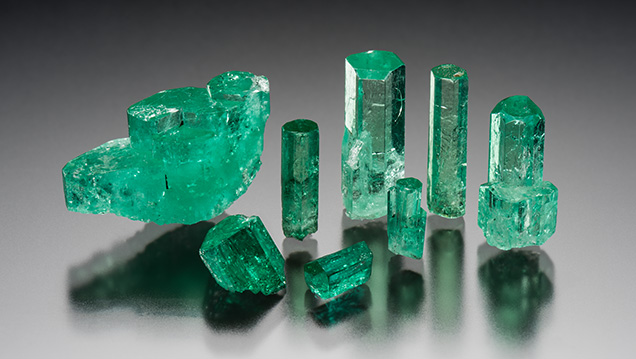
Photo: GIA
The mine lies in Colombia’s western emerald belt in Boyacá, within the Muzo district, close enough to Muzo that older trade language sometimes blurred the two. That habit is understandable geographically but misleading mineralogically. Coscuez has its own crystal character, its own mining history, and a color range broad enough that Bogotá dealers have long summarized it with the saying: “From Coscuez comes a little of every Colombian mine.” Some stones lean toward lively bluish green; others are darker, more saturated, and slightly bluish green with a medium-dark to very dark tone; still others can be almost indistinguishable from fine Muzo material.

Photo: Wikimedia Commons
The deposit is part of Colombia’s unusual sedimentary-hosted emerald province. Instead of the pegmatite-related setting familiar from many emerald localities elsewhere, Coscuez emeralds formed in fractured Lower Cretaceous black shales and carbonate rocks, where saline hydrothermal brines moved through faults, breccias, and calcite-rich veins. The mineralizing system brought together beryllium with chromium and vanadium in a carbonaceous sedimentary environment, producing beryl colored deeply enough to be emerald: Be3Al2(Si6O18).
For collectors, Coscuez is attractive because it straddles gem and specimen worlds. A loose transparent Coscuez crystal can be a cutting stone; a matrix specimen can be a cabinet centerpiece; a small thumbnail with emerald on calcite can show the entire geological story in a few centimeters. The most desirable specimens combine saturated color, high luster, intact terminations, minimal bruising, and convincing locality provenance. Matrix pieces are especially treasured because Colombian emerald mining has historically favored gem recovery over specimen preservation.
Search for specimens: View all emerald specimens from Coscuez Mine, Colombia
The Coscuez Mine is in the municipality of San Pablo de Borbur, Western Boyacá Province, Boyacá Department, Colombia. Mindat places it at about 5° 37' 56" N, 74° 9' 23" W, within the western emerald-bearing region of the Eastern Cordillera. The mine is commonly grouped with the Muzo district, and the two mines lie only about 10 km apart, though older field reports emphasized that the terrain and roads made travel between them anything but simple.
Geologically, Coscuez belongs to the western Colombian emerald belt, where emeralds occur in Lower Cretaceous carbonaceous shales, limestones, dolomitic rocks, and hydrothermal breccias. Earlier literature often used the broad term Villeta Formation for the emerald-bearing strata; more recent stratigraphic treatments distinguish the Muzo Formation and related Lower Cretaceous units. The essential setting remains clear: intensely folded and faulted black shales cut by calcite veins, with emerald crystals concentrated in veins, pockets, and fractured zones.
At the mine scale, the emerald-bearing veins are typically calcite-rich and can vary from narrow seams to veins many centimeters thick. Ringsrud’s 1986 GIA field report described calcite veins at Coscuez up to 35 cm thick and several meters long, cutting across the original bedding of the shales. In places those veins intersect, and where open cavities remained, free-standing emerald crystals could grow with sharp faces and terminations. The associated minerals reported from Coscuez include calcite, pyrite, quartz, dolomite, parisite, fluorite, apatite, albite, and baryte.
Historically, Coscuez was known before the Spanish conquest and was worked by Indigenous miners for centuries. Spanish records treated it for a long time as part of the Muzo emerald region, but by the mid-1600s it appeared in records as a distinct mine. A 1646 royal grant to Captain Francisco de Ovalle is one of the early documents separating the Coscuez heights from the broader Muzo concession.
Mining methods shifted with time. Colonial miners followed productive veins underground by hand. In the twentieth century, tunneling remained important because Coscuez’s topography is steep, the host rock is comparatively hard, and abundant water was not available for the sort of hydraulic tailings work seen at some other Colombian emerald sites. By the 1980s, bulldozers and limited blasting were being used to expose white calcite veins in black shale, after which miners checked the veins by hand for emerald. Later, corporate redevelopment under Fura Gems aimed to move the mine from traditional small-scale underground work toward a more mechanized operation, including surveying historical tunnels, bulk sampling, wash-plant development, optical sorting, larger declines, and systematic exploration.
Production has fluctuated sharply. Coscuez was an important producer by the 1960s and 1970s and, according to GIA’s later summary of Fura operations, accounted for a very large share of world emerald production during the 1970s. Civil conflict and the wider violence of Colombia’s emerald wars disrupted mining in the 1980s. Artisanal work revived in the 1990s, with many small licenses and tunnels, before later consolidation and corporate redevelopment.
Recent access and collecting conditions must be understood as industrial and security matters, not casual field-collecting opportunities. Coscuez is an active historic mining district with legal concessions, local community claims, security concerns, and a long history of tension between formal operators and independent guaqueros. As of February 2026, Colombian reporting stated that shareholders of Coscuez S.A., a Fura Gems affiliate, had decided to begin voluntary liquidation, citing financial unsustainability, security risks, prolonged operational interruptions, and vandalism at the La Paz mine. For collectors, this makes newly mined, documented Coscuez material especially dependent on established dealers, old collections, legally exported rough, and specimens already in circulation.
Notable finds from Coscuez include the Guinness Emerald Crystal, widely reported as a 1,759 ct gem-quality emerald crystal, and modern Fura auction material that included large rough emeralds exceeding 80 ct. Older literature also records an 18-ounce, approximately 550 ct crystal reportedly recovered during colonial tunneling and sent to a museum in Madrid, though its present whereabouts are not established in the sources consulted.
Coscuez emeralds most often occur as hexagonal prismatic crystals, either singly or in groups, in calcite veins within carbonaceous shale. The classic specimen format is green emerald on white to gray calcite, sometimes with dark shale still attached and pyrite providing brassy accent. Calcite is by far the most common matrix mineral in documented specimen photographs; pyrite is also frequent, with quartz and parisite appearing much less often.
A distinctive Coscuez habit is the aggregate crystal: three, four, five, six, or more emerald prisms growing together, each with its own termination. These multi-terminated clusters are one reason Coscuez specimens can look more architecturally complex than many Muzo pieces. Fine faces may be bright and little etched, giving the crystals a glassy, sharply defined appearance. Double terminations are known and are particularly desirable when undamaged and set naturally in calcite or shale.
Color is not a single fixed “Coscuez green.” The locality’s output spans a broad Colombian range. Stones may be lively and lightly saturated, bluish like Chivor material, warm and Muzo-like, or darker and strongly saturated. A commonly recognized Coscuez type is strongly saturated, slightly bluish green, medium-dark to very dark in tone. Such stones can be powerful in color but may sacrifice transparency and liveliness if the tone becomes too deep. In rough, Coscuez material has been described as generally more uniform in color throughout the crystal than some Muzo rough, which may show a paler core and darker outer rind.
Typical specimen crystals are millimeters to a few centimeters. Thumbnail and miniature pieces with 5 mm to 2 cm emeralds on calcite are realistic collector targets; fine 2–3 cm crystals on matrix are substantially scarcer and command strong premiums. GIA illustrated modern Coscuez rough from 0.445 to 6.397 ct in a 2019 report, while Mindat and dealer archive examples show matrix specimens ranging from small thumbnails to cabinet pieces. Historical and exceptional crystals are far larger, but these are not the norm available to collectors.
Internal features are part of the character of Coscuez emerald. Two-phase and three-phase inclusions occur, along with carbonaceous “coaly” inclusions, calcite, albite, pyrite, quartz, and rare barite, fluorite, and apatite inclusions. Much of the familiar Colombian emerald jardin in Coscuez stones consists of partially healed fractures and voids. Compared with Muzo, GIA’s 1986 observations suggested Coscuez stones may show slightly more unidirectional partially healed fractures, while Muzo stones more often display obvious three-phase inclusions at low magnification.
Trapiche emeralds are known from the western Colombian emerald belt, including Coscuez, but they are not the common face of the locality. In older field comparisons, trapiche emeralds were reported as more common at Muzo than at Coscuez. A true Coscuez trapiche with strong pattern, natural surfaces, and credible provenance is therefore a specialist specimen rather than a routine purchase.
The quality factors that matter most are color saturation, transparency, luster, crystal form, termination integrity, matrix contrast, and provenance. A small but vivid, glassy, undamaged emerald on natural calcite can be more collectible than a larger, duller, battered crystal. For cut stones, fine color and low treatment dominate value; for mineral specimens, natural placement and crystal perfection matter just as much as gem transparency.
Coscuez is a prestige Colombian locality, but it is also a locality where labeling discipline matters. Because Coscuez lies in the Muzo district and because older trade practice often used “Muzo” broadly, Coscuez specimens and stones have sometimes been absorbed into the more famous Muzo name. Conversely, material sold as Coscuez should not be accepted on name alone. Serious collectors should prefer specimens with old labels, mine-run documentation, reputable dealer history, laboratory origin opinions for significant cut stones, or clear chain of custody.
For gem emeralds, clarity treatment is the central authenticity and value issue. Colombian emeralds commonly contain surface-reaching fractures, and oil or other fillers may be used to improve apparent clarity. That does not make a stone fake, but it must be disclosed. Untreated or only lightly treated fine Colombian emeralds are significantly rarer and more valuable than heavily filled stones. Resin or polymer filling, dyed fillers, and unstable fillers should be treated cautiously, especially in stones represented as high-end Coscuez material.
For specimens, the principal concerns are repair, fracture filling, reattachment to matrix, and locality confusion. Emerald crystals can break easily at the base or along fractures, and some repaired specimens look convincing until inspected under magnification. Watch for unnatural glue lines where a crystal meets calcite, suspiciously perfect positioning, mismatched contact surfaces, glossy residues in cracks, or matrix that does not fit the crystal’s base. On matrix specimens, calcite may be naturally etched or cleaved, but fresh damage around an emerald can indicate trimming, extraction bruising, or repair.
Condition is often imperfect, even on expensive pieces. Colombian emeralds are commonly fractured, and mining practices historically prioritized gem recovery over specimen preservation. Minor contacting, rehealed cracks, and internal jardin are normal; broken terminations, large chips, glued bases, and unstable matrix should affect price. Calcite matrix is softer and more chemically sensitive than emerald, so avoid acids, ultrasonic cleaners, steam cleaning, and aggressive soaking. Treated emerald gems should also be protected from heat, solvents, detergents, and sudden temperature changes that can affect fillers.
Availability is mixed. Small loose crystals, faceted stones, and modest matrix specimens from old production appear regularly in the trade. Fine matrix pieces with sharp, lustrous, saturated crystals remain much scarcer. Large, clean, undamaged crystals with reliable Coscuez provenance are rare, and cabinet-quality specimens from older collections can bring strong competition because the mine’s recent operating situation has become uncertain. The 2026 move toward voluntary liquidation by Coscuez S.A. may further emphasize older documented material and legally exported stock already outside the mine.
The older stories of Coscuez are inseparable from the violent first contact between Spanish soldiers and the Muzo people. In 1538, Captain Luis Lanchero entered Muzo territory and failed. Spanish accounts described the Muzo as formidable fighters, protected by poison arrows, camouflaged pits, jungle traps, and fortifications. The emerald lure was already clear: during that first campaign, Lanchero’s soldiers reportedly found small emerald crystals in the craws of wild turkeys they had butchered for food. That image—a hungry army cutting open birds and discovering green crystals inside—was enough to keep colonial attention fixed on the mountains.
The conquest did not come quickly. Campaigns in 1545, 1550, and 1551 also failed. In 1558 Lanchero returned with Spanish soldiers and allied Indigenous fighters, and the decisive turn came not from swords or firearms but from European hunting dogs released into battle. The dogs caused panic and confusion; after two costly battles, Spanish forces brought the region under colonial control. The victory gave Spain access to the emerald country, but Lanchero did not enjoy his conquest for long. A chest wound from his first fighting in the region never healed, turned gangrenous in 1562, and killed him.
Coscuez itself emerges distinctly in the Spanish record in 1646, when Captain Francisco de Ovalle arrived in Muzo with a royal seal granting him authority over mines in the Coscuez heights “as long as the rocks there show the green of the emerald.” The claim caused confusion because the mine was already known and being worked. A new governor accepted the claim in 1647, and from that point Coscuez stands more clearly as its own place in the paperwork rather than simply a name folded into Muzo.
The colonial mine could be deadly. In the mid-1600s, a large cave-in at Coscuez reportedly buried almost 300 Spaniards and Indigenous workers. Work in the area was abandoned soon afterward. The same period also produced the story of a magnificent 18-ounce, roughly 550 ct emerald crystal extracted by miners following veins underground; it was reportedly sent to a museum in Madrid. The contrast is stark: one vein producing a royal-scale crystal, another swallowing hundreds of lives.
Modern Coscuez retained its own rough theatre. In the 1980s, Ron Ringsrud described the mountain face as steep, difficult, and scarred by workings. One tunnel, La Tabla, penetrated 600 m into the mountain as miners followed emerald-bearing calcite veins. Plastic tubes carried air into the tunnel. Outside, bulldozers stripped black shale until white calcite appeared; then men with picks moved in, searching the vein by hand for green.
Below the workings, mine waste entered a winding stream called La Culebrera—the Serpent Pit. The name referred either to the stream’s twisting path or to the reputation of the independent diggers working there. Compared with the famous Itoco River below Muzo, where thousands of guaqueros might gather, La Culebrera was smaller and more confined. Ringsrud saw only about 50 people working there during one visit, although local miners said it could support far more. Because the stream could not absorb the same pressure as Muzo’s river, guaqueros more often entered the mine property at night and dug unauthorized tunnels into the hillside.
The stories did not end with mechanization. In March 2024, Associated Press reporting from Coscuez described women entering the small mines in rubber boots and helmets, carrying drills like the men. They walked in single file, then branched into separate tunnels, each worker taking a designated place to drill. Broken rock was hauled out in carts, washed, and sifted. Yaneth Forero kept small opaque emeralds at home from months of work and spoke of the dream of a house with tiled floors. Carmen Alicia Ávila, then 57, said she had been in the industry for almost four decades; when she started at 19, she was not allowed into the shafts and instead sifted rock selected by men. Older villagers recalled the old belief that if women approached the mines, the emeralds would hide. Ávila dismissed it plainly: “That was pure machismo.”
The same reporting put numbers to the present-day struggle. Around Coscuez, a local association counted about 200 women working in mines; five small mines were owned by women and allowed only female miners. Some of the tunnels were so tight that miners had to take turns inside. The dream remained the same one that has pulled people into these mountains for centuries: one stone large enough to change a life. Rumor in town said one miner had recently found an emerald that sold for $177,000 and left forever. For most, the reality was hunger, cold, heat, sleeplessness, and long odds underground.
 Amethyst
 Quartz
 Fluorite
 Tourmaline
 Malachite
 Azurite
 Rhodochrosite