Eugui dolomite belongs on the short list of world-class dolomite occurrences: a locality where dolomite is not merely a matrix mineral or a minor accessory, but the main event. The best pieces show pale gray, bluish gray, white, or nearly colorless rhombohedra with a glassy to pearly luster, crisp twinning, and a striking degree of translucency that can make good crystals look almost like calcite “Iceland spar” at first glance. The classic collector image is a sculptural cluster of interpenetrant rhombs perched on carbonate matrix, the faces clean enough to transmit light yet enlivened by subtle zoning, fine striations, tiny dark inclusions, or occasional films of manganese oxides.
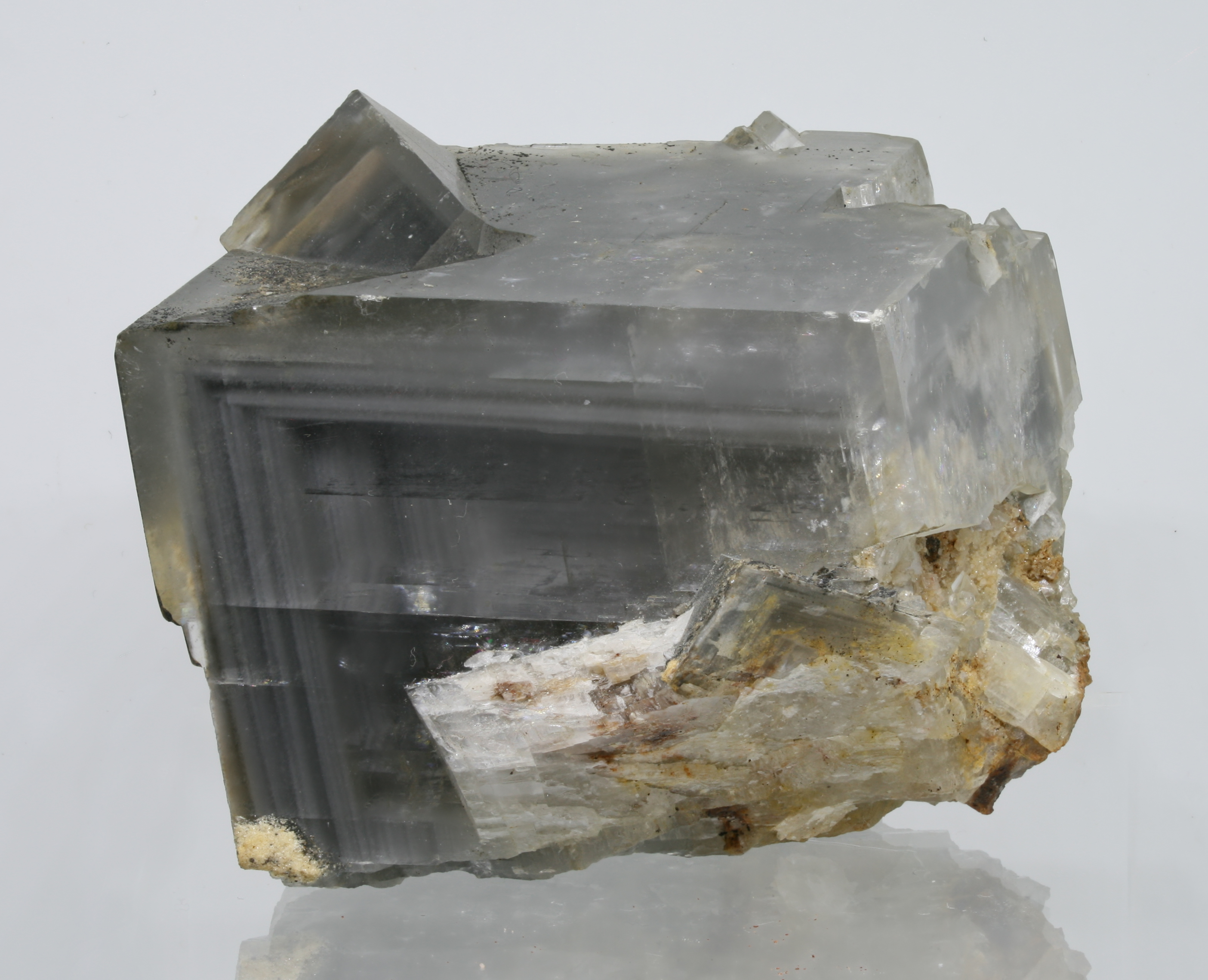
Photo: Miguel Calvo, Wikimedia Commons
The locality is the Eugui magnesite district near the village of Eugui, in Esteríbar, Navarre, in the western Pyrenees close to the Spanish-French border. Mineral specimens come principally from the Azcárate and older Asturreta magnesite quarries, where Carboniferous carbonate rocks were altered through a complex sequence of carbonate replacement. In broad terms, the deposit records the transformation of carbonate host rocks through calcite, dolomite, and magnesite in a stratabound magnesite body, with zebra-textured magnesite and dolostone forming the geological backdrop for the specimen pockets.
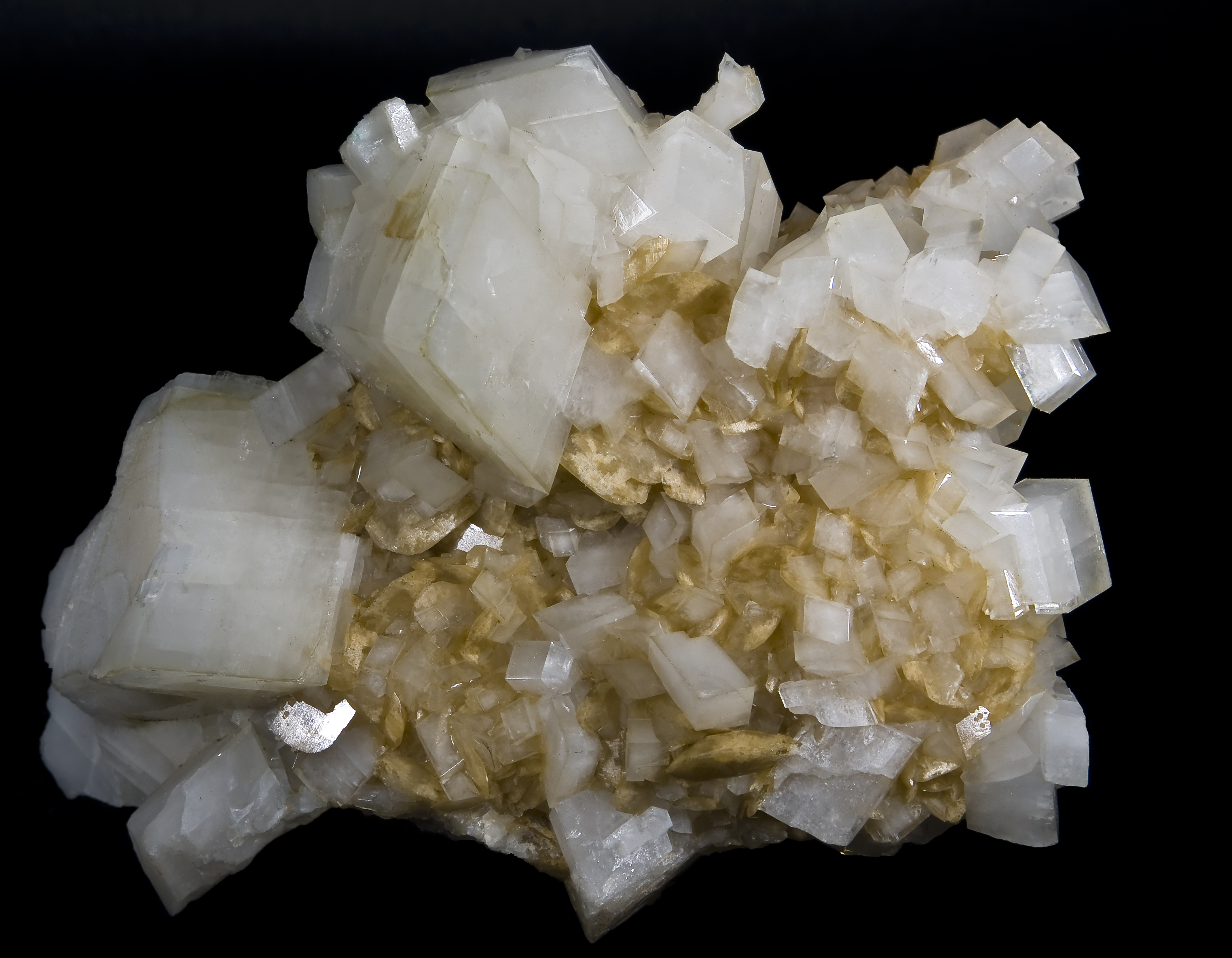
Photo: Didier Descouens, Wikimedia Commons
Historically, Eugui is one of the great Spanish mineral localities. The magnesite deposit was discovered in the 1930s and industrial exploitation began in 1945 with Magnesitas Navarras S.A. Collector-quality dolomite emerged from mining rather than from a purpose-worked specimen mine, which explains both the quality and the irregularity of supply: pockets appeared when quarrying intersected suitable cavities or seams, and the best material was saved only when miners or collectors recognized it in time.
For collectors, the locality’s highest appeal lies in the combination of size, transparency, twinning, and sculptural form. Fine Eugui dolomite is expected to be rhombohedral, preferably sharp and bright, with an aerial group or a dominant crystal that has not been dulled by bruising. Large clean crystals are especially desirable because dolomite so rarely forms transparent, display-quality crystals of this scale. The most celebrated specimens have crystal edges measured in centimeters, and exceptional material from the classic productive period reached far beyond the ordinary cabinet range.
Search for specimens: View all dolomite specimens from Eugui, Spain
Eugui lies in the Esteríbar municipality of Navarre, north of Pamplona, in the western Pyrenees. The important specimen-producing workings are the Eugui magnesite quarries, especially Azcárate and Asturreta, with Asturreta also known as the Militares quarry. Azcárate is the active open-pit magnesite quarry most often named on later specimen labels, while Asturreta is the older working and is credited for many older fine dolomites.
Geologically, the deposit sits in a Carboniferous carbonate sequence of Namurian age in the Asturreta anticline. The Spanish geological-site inventory describes the magnesite deposit as the only magnesite deposit in Navarre, hosted in dolomitic rocks and associated with dolomite, calcite, and other minerals. The setting is not a simple open-space vein environment; it is a carbonate-replacement system in which limestone and dolostone were transformed metasomatically, producing magnesite and later carbonate textures. Published work on the deposit emphasizes a discoidal magnesite body within folded Namurian carbonates, zebra banding, stylolite-controlled replacement, and later dolomite after magnesite in parts of the system.
The wider Eugui magnesite deposit is large by European standards. The village of Eugi describes the deposit as extending in bodies between roughly 50 and 150 m wide over a total length of about 19 km, and as having formed more than 300 million years ago during the Carboniferous. Industrially, the deposit is mined for magnesite rather than for mineral specimens. Magnesitas Navarras began exploitation in 1945, built processing capacity at nearby Zubiri, and developed the operation into a major producer of magnesium-based materials for refractories, agriculture, animal feed, and environmental uses.
For specimen collectors, the most important production period was the classic era of the 1960s and nearby years. Mindat’s dolomite occurrence notes for Azcárate state that the best crystals were produced in the late 1960s, and the local Eugi account records a spectacular mid-1960s geode, 50 m long and 20 m deep, containing dolomite of previously unknown quality with crystals reaching 20 cm on edge. That discovery is central to the locality’s reputation: it established Eugui not just as a good Spanish locality, but as a world reference for transparent, large, rhombohedral dolomite.
Collecting access should be treated as closed unless formal permission is obtained. The Spanish geological-site inventory explicitly states that access is not authorized because the locality is an active mining operation. Mineral collecting is listed as admissible only for research purposes. Modern pieces entering the market therefore come from old collections, from material saved during earlier quarry work, or from occasional permitted recovery connected to mining rather than from casual field collecting.
The associated mineral suite reflects the carbonate-hosted magnesite system and the black shale components of the quarry. Along with dolomite and magnesite, documented minerals include calcite, aragonite, quartz, pyrite, chalcopyrite, chalcocite, malachite, goethite, graphite, manganese oxides grouped historically as “wad,” and a series of uncommon phosphate minerals in the black shales at Azcárate. Collector specimens are most often dolomite alone or dolomite with magnesite, calcite, aragonite, quartz, chalcopyrite, malachite after chalcopyrite, or minor dark manganese-oxide speckling.
The defining habit is the rhombohedron. Eugui crystals are typically sharp rhombs, commonly twinned or interpenetrant, and many of the best groups have a stacked, sculptural quality rather than the drusy, carpet-like habit familiar from many ore deposits. Single crystals may be isolated floaters, perched individuals on matrix, or dominant rhombs embedded in smaller dolomite crystals. Fine specimens often show a combination of broad lustrous faces and subordinate growth features, including fine striations, stepped edges, and subtle zoning.
Color is part of the locality’s charm. The standard hue is pale gray to bluish gray, but the range includes colorless, white, smoky gray, and zoned gray-white crystals. Some specimens show internal bands or darker gray zones, especially in larger transparent rhombs. Small dark inclusions are common enough to be considered characteristic rather than automatically detrimental, provided they do not muddy the entire crystal. Manganese oxides can occur as tiny black specks or films on the faces, and these may add contrast when they are delicate and preferentially distributed rather than smeared.
Transparency varies widely. The most coveted pieces are transparent to translucent, with glassy internal windows and a bright pearly sheen on the faces. Less desirable examples are opaque, heavily included, heavily etched, or chalky. A particularly fine Eugui specimen should show crisp edges, clean rhombohedral geometry, and enough internal clarity to distinguish it from ordinary white dolomite matrix material.
Typical collector pieces range from miniatures to small cabinets, with crystals from a centimeter or two up to several centimeters. Dealer and museum examples commonly fall in the 5–10 cm specimen range, often with main crystals around 1.5–4 cm. The locality is famous, however, because exceptional crystals reached much larger sizes: the published occurrence data note rhombohedra to 20 cm, and the Eugi village account describes crystals with edges up to 20 cm from the major mid-1960s geode. Such large, sharp, transparent crystals are exceptional and belong to the upper tier of the locality.
Matrix matters. The best cabinet specimens are three-dimensional and stand naturally, with the dolomite raised above pale carbonate or magnesite matrix. Dolomite on magnesite is especially evocative of the deposit, particularly when creamy to golden magnesite contrasts with white or gray dolomite. Associations with aragonite, calcite, quartz, chalcopyrite, and malachite are also known, but the most valuable dolomite specimens usually succeed because of the dolomite itself: crystal size, transparency, twinning, and undamaged presentation.
Quality is judged ruthlessly because the locality’s ceiling is so high. Collectors look for sharp, lustrous, translucent to transparent rhombs; clean twinning; pleasing architecture; minimal bruising on exposed edges; and undisturbed matrix contact. A single bruised corner can be acceptable on a large classic crystal, but widespread edge damage, cleaved backs presented as crystal faces, dull surfaces, or repaired contact points reduce desirability sharply. Fine Eugui dolomite should look alive in hand, catching light across broad rhombohedral faces and showing the crisp geometry that made the locality famous.
Eugui dolomite is a classic rather than an abundant modern commodity. Small to mid-grade examples appear regularly from collections and dealers, but top-quality old pieces with large, transparent, undamaged rhombs are scarce. The active mine continues to exist, yet access is restricted and specimen production is not the mine’s purpose. As a result, the market is dominated by historic material, occasional released specimens, and older dealer stock.
No well-established Eugui-specific fake or standard treatment is part of the published locality record. The main authenticity concern is not synthetic dolomite but attribution and assembly: ordinary colorless dolomite from another locality, a damaged crystal glued to unrelated matrix, or a specimen broadly labeled “Spain” or “Eugui” without enough locality confidence. Good Eugui labels usually reference Eugui, Esteríbar, Navarre, and may specify Azcárate, Azkarate, Asturreta, or Militares. Older labels may use Spanish or Basque spellings such as Eugi, Eugui, Navarra, Cantera Azcárate, Cantera Azkarate, or Cantera de los Militares.
Condition is the collector’s constant challenge. Dolomite has perfect rhombohedral cleavage, and Eugui crystals are often transparent enough that internal cleaves, bruised edges, and repaired corners are easy to see under strong light. Examine broad faces for hairline cracks, check high points for frosted impact marks, and inspect the base of any freestanding crystal for glue or suspicious fill. Because fine Eugui crystals can be very glassy, oiling or wetting would be easy to notice as an unnatural film in recesses, though such treatment is not a known locality hallmark.
Be careful with the word “gemmy.” In Eugui material, it should mean real translucency or transparency, not just a shiny white rhomb. A fair specimen may be opaque but sharp and attractive; a premium specimen should transmit light, show clean internal zones or windows, and retain crisp geometry. Manganese-oxide speckling should be evaluated aesthetically: fine dark peppering can be a plus, but heavy black coatings can mask luster and damage.
Market availability spans a wide price range. Modest miniatures and small-cabinet specimens with ordinary luster or minor damage can still be accessible, while aesthetic clusters with transparent rhombs climb quickly. Recent dealer listings and auctions show small to small-cabinet examples still circulating, but the finest material is increasingly provenance-driven: ex-collection labels, old Spanish or European dealers, and pieces tied to the classic productive period carry extra weight. For serious collectors, a top Eugui dolomite is best bought on overall quality rather than on size alone; a smaller, brilliant, undamaged twinned rhomb can be far more satisfying than a larger bruised or cloudy plate.
The defining Eugui story is the mid-1960s geode. In the language of the local village account, the find was not just a pocket but a “gran geoda”: 50 m long and 20 m deep. Inside were dolomite specimens of a quality previously unknown at the deposit, with crystals reaching 20 cm on edge. It is difficult to overstate what that meant for collectors. Dolomite is common as a rock-forming carbonate and as a minor accessory in ore deposits, but transparent rhombohedra of that size are another matter entirely. The mid-1960s pocket turned Eugui into a locality that could stand beside the great names of specimen mineralogy, not because of color flamboyance, but because of scale, clarity, and form.
The industrial setting adds another layer to the story. Eugui was not a romantic hand-dug crystal mine; it was a working magnesite operation that had changed the economic life and landscape of a mountain village long tied to livestock, agriculture, and wood. The deposit had drawn attention in the 1930s because magnesite was scarce, and by 1945 Magnesitas Navarras had been created to exploit it. A processing furnace was built at Zubiri, and early quarry work was carried out with primitive methods before modern mining transformed the company. The great dolomite specimens were incidental treasures within that industrial history: pockets of collector beauty intersected while pursuing refractory raw material.
Asturreta carries the aura of the older workings. It was the first quarry worked at Eugui, later restored and revegetated, and many of the older fine dolomites trace back there rather than to the more familiar Azcárate name. Azcárate, by contrast, is the active name most modern collectors recognize. The distinction matters. A label reading “Eugui” may be perfectly valid, but the best provenance tells a more precise story: Asturreta for older classics, Azcárate for many later specimens, and occasionally “Militares” for the old Asturreta quarry.
Miguel Calvo and Emilia Sevillano, “Famous Mineral Localities: The Eugui Quarries, Navarra, Spain,” The Mineralogical Record, 22(2), 137–142, 1991 — The key collector-oriented locality article for Eugui, repeatedly cited in locality databases and specimen references.
Miguel Calvo and J. Viñals, “Los minerales de las explotaciones de magnesita de Eugui (Navarra),” Revista de Minerales, 2(4), 6–21, 2003 — Spanish-language treatment of the minerals from the Eugui magnesite workings, including the wider species suite beyond dolomite.
F. Velasco, A. Pesquera, R. Arce, and F. Olmedo, “A contribution to the ore genesis of the magnesite deposit of Eugui, Navarra (Spain),” Mineralium Deposita, 22(1), 33–41, 1987 — A foundational ore-genesis paper describing metamorphic grade, fluid inclusions, and a genetic model for the magnesite deposit.
Stefano Lugli, José Torres-Ruiz, Giorgio Garuti, and Fernando Olmedo, “Petrography and Geochemistry of the Eugui Magnesite Deposit (Western Pyrenees, Spain): Evidence for the Development of a Peculiar Zebra Banding by Dolomite Replacement,” Economic Geology, 95(8), 1775–1791, 2000 — Detailed petrographic and geochemical study of the zebra-banded magnesite and dolomite-replacement textures.
J. M. González and F. Arrese, “Mineralogía y mineralogénesis del yacimiento de magnesita de Asturreta (Navarra),” Estudios Geológicos, 33, 35–44, 1977 — Earlier Spanish work on the mineralogy and genesis of the Asturreta magnesite deposit.
E. Salla and A. Canals, “Las magnesitas de Eugui (Pirineos occidentales): Datos texturales y microtermométricos,” Macla, 17, 105–106, 2013 — Short paper adding textural and microthermometric data for the Eugui magnesites.
Spanish Geological Survey / IGME, “PS008: Magnesitas de Eugui,” Inventario Español de Lugares de Interés Geológico — Official geological-site inventory entry summarizing the deposit’s stratigraphy, replacement origin, access restrictions, scientific value, and mineralogical interest.
IGME Museo Geominero, “Collection of Minerals from the Autonomous Regions: Information Sheet 7,” Case 114, Navarre — Museum educational sheet identifying Eugui as a legendary Spanish mineral locality and noting a 15 x 8 cm dolomite specimen on matrix in the autonomous-region display.
HyperPhysics / Georgia State University, Dolomite page — Includes an Eugui, Navarra dolomite specimen about 15 cm high displayed in the Smithsonian Museum of Natural History.
“Dolomite from Asturreta Quarry, Eugui, Spain” — Fabre Minerals, Vimeo — Short specimen video of a bluish-gray, lustrous, twinned rhombohedral dolomite group from Asturreta, dated to 1958 and formerly in the Andrés Jiménez Shelly collection.
“Malachite after Chalcopyrite with Dolomite from Azcárate Quarry, Eugui, Spain” — Fabre Minerals, Vimeo — Video of a classic Eugui association: malachite after chalcopyrite on better-than-usual crystallized dolomite matrix.
“Dolomite from Eugi” — MineralTown — MineralTown media page with video material and locality context for Eugi/Azkarate dolomite, including associated quartz, aragonite, chalcopyrite, and malachite.
“Chalcopyrite pseudomorphosed into malachite, Eugui, Spain” — Les Minéraux / Minerals and Crystals — Direct MP4 specimen video showing malachite after chalcopyrite on rhombohedral dolomite from Azkarate.
Mindat: Azcárate Quarry, Eugui, Esteríbar, Navarre, Spain — Primary online locality page for the active quarry, with coordinates, mineral list, occurrence notes, references, and a large photo archive.
Mindat: Dolomite from Azcárate Quarry — Species-specific occurrence entry noting world-class quality, late-1960s best production, pale gray color, rhombohedra to 20 cm, rarity at the site, and associated minerals.
Mindat: Asturreta Quarry / Militares Quarry — Locality page for the older quarry, important for many classic and older Eugui dolomites.
IGME: PS008 Magnesitas de Eugui — Official Spanish geological-interest listing with access restrictions, deposit geology, stratigraphy, mineralogy, and conservation valuation.
Concejo de Eugi: Magnesitas — Local village account of the magnesite deposit, mining history, famous dolomite crystals, and the mid-1960s giant geode.
Magnesitas Navarras — Official company background for the mining and industrial operation that exploits the Eugui magnesite deposit.
ANFRE profile: Magnesitas Navarras — Industry profile with details on open-pit extraction at Azkárate, blasting, processing at Zubiri, and product markets.
Wikimedia Commons: Dolomita Eugui (Navarra) — High-resolution photograph by Miguel Calvo of a zoned 5.5 cm-edge Eugui rhombohedral dolomite crystal.
Wikimedia Commons: Dolomite-Magnésite, Navarre — Featured photograph by Didier Descouens showing dolomite with magnesite from Azcárate Quarry.
Wikimedia Commons: Dolomite-Navarre — Large 31 x 17 cm dolomite specimen from Azcárate Quarry photographed by Didier Descouens.
Minerals.net: Dolomite — General dolomite reference that singles out Eugui for water-clear, transparent crystals in unusually large sizes.
 Amethyst
 Quartz
 Fluorite
 Tourmaline
 Malachite
 Azurite
 Rhodochrosite

