Panasqueira is one of the great European names in hydrothermal mineral specimens: a long-lived W-Sn-Cu mine where cassiterite, SnO2, is not merely an ore by-product but one of the locality’s classic collector minerals. The best cassiterites have the unmistakable Panasqueira look—jet-black to deep root-beer-brown crystals with adamantine to submetallic luster, perched on pale muscovite, milky quartz, siderite, arsenopyrite, fluorapatite, or ferberite. They are not usually the giant, freestanding cassiterite crystals of Bolivia or China; their appeal is more architectural and association-driven: black, sharp, twinned crystals set into the layered mineral drama of the Panasqueira vein system.

Photo: Didier Descouens, Wikimedia Commons
Geologically, Panasqueira is a vein-type tungsten-tin-copper deposit in Portugal’s Central Iberian Zone, hosted in metasedimentary Beira schists above a concealed granite-greisen cupola. The ore occurs in stacked, subhorizontal quartz veins, typically thin but persistent, and the classic paragenesis places cassiterite in the early oxide-silicate stage together with quartz, wolframite or ferberite, topaz, muscovite, tourmaline, and arsenopyrite. That early timing matters to collectors: cassiterite is part of the fundamental Panasqueira mineralizing event, not a late accidental coating.
The mine is historically important for more than specimens. Industrial exploitation dates to the late nineteenth century, and the district became strategically famous for tungsten during both world wars. Tin was repeatedly important when tungsten prices fell, and Panasqueira has produced cassiterite concentrate alongside its more famous wolframite concentrate. For collectors, the same mine that produced thousands of tonnes of strategic metal also produced cabinets full of fluorapatite, ferberite, arsenopyrite, quartz, muscovite, siderite, and cassiterite—often from open pockets in the veins.
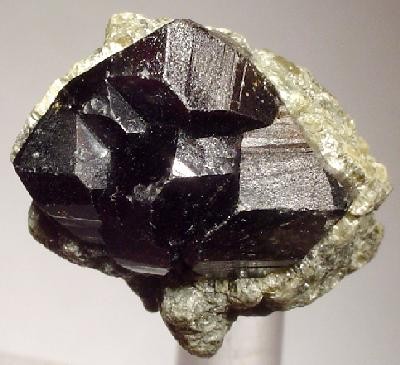
Photo: Rob Lavinsky, iRocks.com, Wikimedia Commons
A fine Panasqueira cassiterite is judged less by mass than by sharpness, luster, natural placement, and association. The premium specimens show isolated or clustered crystals with crisp cyclic twinning, reflective black faces, and some translucency or reddish-brown internal color under strong light. Matrix is not an afterthought: quartz, muscovite, siderite, arsenopyrite, fluorapatite, and ferberite are part of the locality signature, and a specimen that shows that signature clearly is often more desirable than a larger but visually anonymous mass of cassiterite.
Search for specimens: View all cassiterite specimens from Panasqueira Mines, Portugal
The Panasqueira Mines lie in central Portugal, in the Covilhã area of Castelo Branco District, on the southern edge of the Serra da Estrela. The mining center is associated especially with Barroca Grande, Aldeia de São Francisco de Assis, the old Rio or Cabeço do Pião plant area, and the broader Couto Mineiro da Panasqueira. Modern descriptions place the mine roughly 300 km northeast of Lisbon and about 200 km southeast of Porto, in rugged pine- and eucalyptus-covered country.
The deposit is a stacked system of subhorizontal hydrothermal quartz veins developed in metasedimentary rocks around a concealed granite-greisen cupola. The veins carry wolframite or ferberite, cassiterite, chalcopyrite, arsenopyrite, pyrite, quartz, muscovite, topaz, tourmaline, siderite, carbonates, fluorapatite, and many rarer species. In mining terms, Panasqueira is a tungsten mine with tin and copper by-products; in specimen terms, it is a pocketed hydrothermal vein locality whose cavities can produce exceptionally well-crystallized minerals.
The classic mineralization sequence begins with the oxide-silicate stage: quartz, wolframite or ferberite, cassiterite, topaz, muscovite, tourmaline, and arsenopyrite. A main sulfide stage follows, with arsenopyrite, pyrite, pyrrhotite, chalcopyrite, sphalerite, and related sulfides. Later alteration and carbonate stages add siderite, calcite, dolomite, and late sulfides. Cassiterite therefore belongs to the early, high-temperature architecture of the deposit, commonly linked with quartz-muscovite-topaz-tourmaline assemblages and with the same ore-forming system that made Panasqueira a world-class tungsten locality.
The industrial history is unusually long. A mining company was founded in 1896 to work tungsten at Panasqueira, and underground production has continued more or less continuously since then, with interruptions after World War II and in the mid-1990s. The first areas worked included Cabeço do Pião, Vale das Freiras, Vale da Ermida, Panasqueira, and Barroca Grande. In 1904, a mechanized treatment plant was built near Cabeço do Pião on the Zêzere River. In 1911, Wolfram Mining and Smelting Company acquired the concessions and invested in treatment plant upgrades and a 5,100 m aerial ropeway carrying ore from the mine areas to the Rio plant.
Tin has a real production history here, not just a specimen history. During the unstable tungsten market of the 1920s, tin recovery was intensified, and in 1927 Panasqueira produced about 110 tonnes of cassiterite concentrate together with about 190 tonnes of wolframite concentrate. Later plant practice separated dense minerals by gravity and magnetic methods: wolframite and siderite are magnetic relative to cassiterite, allowing a non-magnetic cassiterite concentrate to feed the tin circuit. Recent technical reporting describes cassiterite concentrate production at roughly 70 tonnes per year at about 74% Sn, though the mine’s commercial identity remains dominated by tungsten.
The mine’s wartime history is dramatic. During World War I, the workforce rose sharply and the company also allowed individual miners to recover ore from small surface veins in the concession. During World War II, tungsten demand made Panasqueira one of Portugal’s strategic mining centers. Company and technical histories record thousands of workers in the early 1940s, plus thousands of independent miners working small veins in the hills. Those old pits and shafts still mark the landscape around the modern operation.
Collecting access is not the casual dump-digging scenario imagined by many rockhounds. Panasqueira is an active industrial mine with controlled underground workings. Specimens historically reached collectors through miners, the mine’s own crystal shop, local networks, and dealers. The mine has operated a crystal shop at the main office installations, supervised by geological staff, with underground workers responsible for bringing collectible crystals to the shop when possible. That arrangement is one reason genuine Panasqueira specimens often have a distinctly mine-sourced character and why well-documented old labels are valuable.
Notable cassiterite finds include sharp, lustrous black cyclic twins on muscovite or quartz, cassiterite associated with fluorapatite and arsenopyrite, and display specimens preserved in institutional collections. A cassiterite group on muscovite over quartz from Panasqueira is recorded in the collection of the National Museum of Natural History and Science in Lisbon. The Smithsonian’s public educational mineral displays have also shown a Panasqueira cassiterite with quartz and muscovite of about 12 cm width, illustrating that the locality’s cassiterite has long been considered museum-worthy even when Panasqueira is better known to the general public for wolframite and apatite.
Panasasqueira cassiterite is typically black, brownish black, deep reddish brown, or “coffee” colored, with a hard, bright luster that can approach metallic on the darker faces. Strong light may reveal warm brown to reddish internal flashes, especially on thinner edges or smaller crystals. The most desirable crystals are sharp, lustrous, and visibly twinned, often forming cyclic twins, clustered twins, or compact groups rather than large isolated single crystals.
Crystal sizes on collector specimens are commonly in the millimeter range. Attractive small cabinet pieces may show equant crystals of about 5–8 mm densely covering a muscovite-rich matrix. Sold examples and photographed specimens commonly show crystals around 4–11 mm, while crystals approaching 1.5–2 cm are already notable for the locality. Literature and dealer descriptions occasionally cite larger crystals, but the collectible Panasqueira cassiterite market is dominated by thumbnails, miniatures, and small cabinet pieces where crystal quality and setting matter more than sheer size.
The best matrix combinations are instantly recognizable. Muscovite is especially important: pale silvery to olive-green mica can form a sparkling bed under the black cassiterite, giving contrast and a classic Panasqueira texture. Quartz is another standard matrix, sometimes massive and milky, sometimes crystallized. Siderite adds tan to brown rhombs or coatings; arsenopyrite contributes bright metallic blades or blocky crystals; pyrite may appear as sparkling microcrystals; fluorapatite, when present, gives a high-value association in greenish, bluish, or purple tones; ferberite or wolframite can connect the piece directly to the mine’s main ore identity.
Habit is one of the locality’s key diagnostic features. Panasqueira cassiterite often appears as sharp equant to short-prismatic crystals, twinned crystals, cyclic twins, and compact clusters. Faces may be highly lustrous and striated, and well-preserved examples show crisp terminations with little rounding. Compared with some cassiterite localities that produce bulky brown prisms, gemmy honey crystals, or botryoidal “wood tin,” Panasqueira’s finest material is darker, brighter, and more mineralogically integrated into complex W-Sn-Cu vein assemblages.
Quality factors are straightforward but demanding. Look first for undamaged terminations and complete crystal groups; broken black cassiterite can still sparkle but loses much of its sculptural force. Next, evaluate luster: the most attractive Panasqueira cassiterites have mirrorlike black faces, not dull granular surfaces. Third, judge contrast and association. A small sharp black cluster on pale muscovite or quartz may be far better than a larger, visually muddy piece. Finally, look for a coherent locality signature: cassiterite with muscovite, quartz, siderite, arsenopyrite, fluorapatite, ferberite, pyrite, chalcopyrite, sphalerite, topaz, tourmaline, or dolomite is very much in keeping with Panasqueira’s documented assemblages.
Panasqueira cassiterite sits in an interesting middle ground: cassiterite is very common at the deposit as an ore mineral, but fine crystallized collector specimens are not abundant in proportion to the mine’s scale. Ordinary cassiterite-bearing material and concentrate are one thing; sharp, lustrous, undamaged, aesthetic matrix specimens are another. The best pieces tend to be fought over by collectors who specialize in Panasqueira suites, European classics, tin minerals, or hydrothermal vein assemblages.
There is no well-established, locality-specific epidemic of fake Panasqueira cassiterite comparable to the famous fakery problems in some other mineral species and localities. The more realistic concerns are misattribution, trimming, repair, and composite enhancement. Because Panasqueira is a famous name, a generic black cassiterite on pale matrix may be offered with a loose or optimistic locality. Conversely, real Panasqueira specimens can be under-described if they came out through older mine or dealer channels with sparse labels. Provenance matters: old dealer labels, mine labels, MinID records, or a credible chain of ownership are meaningful.
Cassiterite itself is hard and dense, but the specimen as a whole may be more fragile than the cassiterite suggests. Muscovite matrix can cleave and shed flakes; quartz points can chip; siderite and carbonate coatings may bruise; arsenopyrite and pyrite associations can have contact damage. Many Panasqueira pieces were recovered from active mining rather than collector-only pocket extraction, so contacts, bruised edges, and missing peripheral crystals are common. The best examples are those where the cassiterite crystals themselves remain sharp and the matrix has not been heavily sawn into an unnatural-looking display block.
Treatments are not usually expected for cassiterite from this locality. Cassiterite does not benefit from the common color-enhancement treatments used on some gem minerals, and its natural black-brown luster is already the attraction. Still, collectors should inspect for glued repairs at crystal bases, suspiciously isolated crystals attached to unrelated matrix, resin or adhesive fluorescence under UV light, and mismatched surface patina. Panasqueira associations are varied, but they are not random: the mineral relationships should look grown together, not assembled.
Market availability is steady but selective. Small thumbnails and miniatures appear periodically, especially older dealer stock and specimens from contemporary Portuguese or European channels. Fine examples with bright twinned crystals on attractive muscovite or quartz remain much less common, and cassiterite with strong fluorapatite, ferberite, or arsenopyrite association commands additional interest. Large cabinet specimens with abundant sharp cassiterite are scarce; when they appear with strong provenance and clean condition, they should be treated as significant Panasqueira suite pieces rather than as ordinary cassiterite specimens.
The Panasqueira story begins in scrubby mountain country, before the great galleries, ropeways, and flotation circuits. At the end of the nineteenth century, the hills were covered in heather, broom, arbutus, and pine—plants cut and burned by charcoal makers who sold charcoal in Fundão and Covilhã. One of those men, remembered by the nickname “O Pescão de Casegas,” found a shiny black stone. He took it to Manuel dos Santos at Barroca do Zêzere, and that black stone led from charcoal country into one of Europe’s great tungsten-tin mines.
Dos Santos did what a practical man would do: he went to look at the place himself, then took the matter to Lisbon, asking the mineralogy professor and engineer Silva Pinto to examine the ground where the sample had been found. When Silva Pinto reached the locality and saw the abundance of wolframite, he bought the ore already collected and the land from dos Santos. The first mining registration under Firma Almeida Silva Pinto e Comandita was published on 25 November 1898. The beginning was not grand—outcropping veins, rudimentary washing, hand work—but within a few years the locality had moved from a charcoal burner’s curiosity to an organized mining property.
The first decades read like a machine being assembled piece by piece in the mountains. By 1904 a mechanized treatment plant had been built near Cabeço do Pião, using the Zêzere River for water. The first underground drifts opened at Rio, though richer veins soon drew attention toward Panasqueira. In 1911, Wolfram Mining and Smelting Company acquired the rights, buildings, equipment, and 125 hectares of rural land. In 1912 the company installed an aerial ropeway 5,100 meters long, carrying ore from the mining sites to the Rio treatment plant. That same year, production was recorded at 267 tonnes of wolframite concentrate grading 65% WO3, mined by 244 workers from 10,791 tonnes of vein material and 86,063 tonnes of host rock.
War repeatedly changed the scale of life at Panasqueira. In 1914, World War I brought accelerated expansion: the plant was enlarged, a furnace was installed, production increased, and the workforce rose to about 800. Around another thousand people were allowed to work small surface vein exposures in the concession, recovering small quantities of ore and selling it back to the company. Those independent workings left a scatter of old pits and shafts around the modern mine—small scars from a time when strategic metal prices turned farmers, shepherds, and villagers into part-time miners.
Tin had its own hour. After World War I, tungsten prices became unstable, and the search for cassiterite intensified. In 1927, the mine produced about 110 tonnes of cassiterite concentrate alongside about 190 tonnes of wolframite concentrate. The following year, the Wolfram Mining and Smelting company was reorganized as Beralt Tin & Wolfram, a name drawn from Beira Alta. When tungsten prices fell sharply in 1931, tin was no longer just an accessory; it helped keep the operation alive.
The World War II years were the giant chapter. Panasqueira’s manpower rose from 750 workers in 1933 to 3,300 in 1940 and nearly 5,800 in 1943, with about 4,800 additional individual miners working small veins in the surrounding hills. Portugal’s neutrality gave the mine an extraordinary wartime position: tungsten from Panasqueira was sold into a world where both sides wanted it. For collectors, that history explains why old Panasqueira labels and pre- or post-war provenance carry a particular atmosphere. These are not just pretty minerals from an obscure pocket; they are specimens from a mine woven into European industrial and wartime history.
The collector-mineral side of Panasqueira has its own underground vocabulary. Pockets in the veins—cavities where crystals could grow freely—are known in mining slang as “rotos.” These openings may be only centimeters across or large enough to produce dramatic mineral groups. The finest cassiterite specimens owe their existence to such spaces: slow-moving hydrothermal fluids, open cavities, and a paragenesis rich enough to place cassiterite beside muscovite, quartz, arsenopyrite, siderite, fluorapatite, ferberite, and topaz.
A modern detail is especially appealing to collectors: the mine’s specimen recovery was not purely accidental waste picking. The operation has maintained a crystal shop at the main office installations, supervised by a geologist, with underground staff responsible for bringing crystals in when they are encountered. Proceeds have been shared in a way intended to support local miners’ families. That arrangement gives Panasqueira specimens a human trail from stope to shop to collection, and it explains why serious collectors prize labels and context so highly.
 Amethyst
 Quartz
 Fluorite
 Tourmaline
 Malachite
 Azurite
 Rhodochrosite
