Aurichalcite from Tsumeb is not the showiest of the mine’s famous blue-green minerals, and that is exactly why good examples matter. In a locality dominated in collectors’ imagination by azurite, dioptase, cerussite, smithsonite, mimetite, and malachite, aurichalcite occupies a narrower, more intimate niche: pale greenish-blue to turquoise-blue sprays, crusts, velvety tufts, and delicate acicular crystals, usually tucked into vugs or spread thinly over zinc-rich secondary assemblages. A fine Tsumeb aurichalcite is a connoisseur’s specimen rather than a trophy by size; its appeal lies in the softness of color, the textural contrast against white hydrozincite or glassy hemimorphite, and the unmistakable sense that it belongs to the mine’s early oxidized, zinc-copper chemistry.
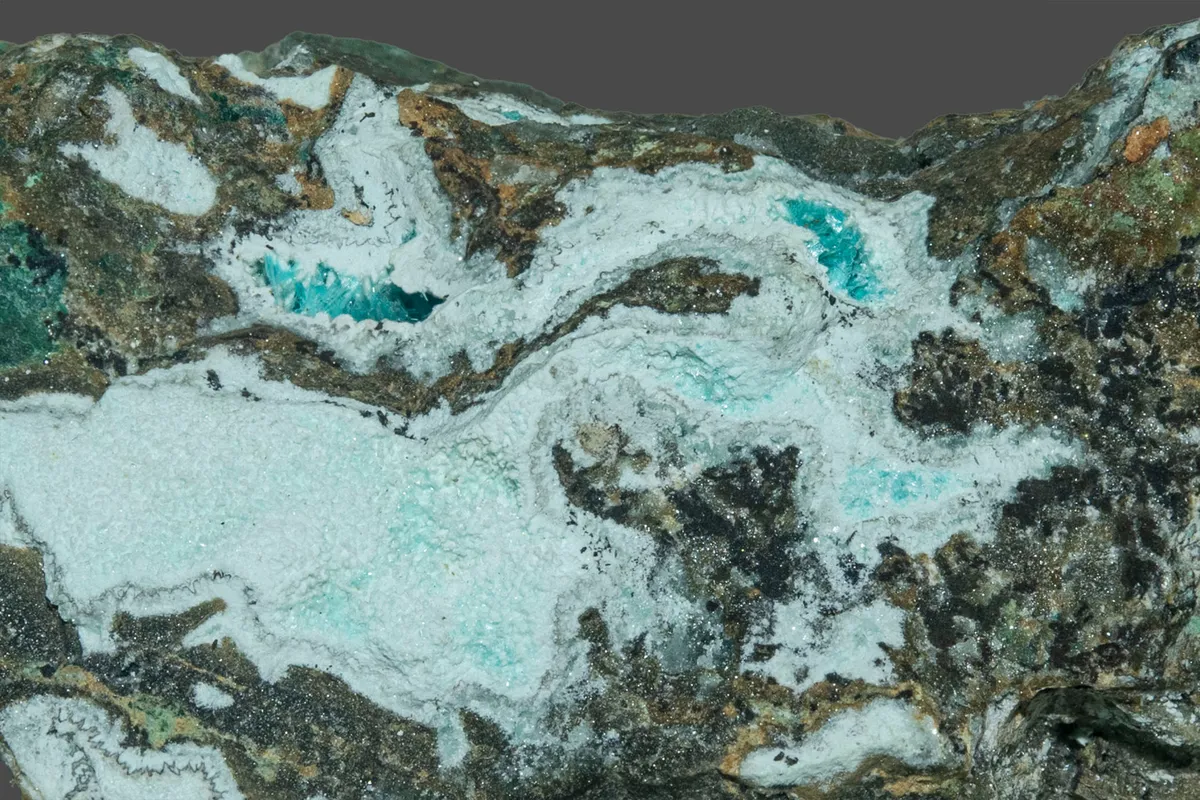
Photo: Tsumeb Mine Notebook
The setting is one of the great mineralogical engines in the history of collecting: a copper-lead-zinc-silver-germanium-polymetallic orebody developed in a steep, pipe-like, carbonate-hosted breccia system in the Otavi Mountainland. Tsumeb’s fame rests on two interacting facts. First, the primary ore was chemically extravagant, with copper, lead, zinc, arsenic, cadmium, gallium, germanium, silver, and other minor constituents available to later fluids. Second, oxidizing groundwater repeatedly entered the pipe, producing not one simple weathered cap but multiple oxidation zones down the deposit. Aurichalcite formed in this supergene environment where copper and zinc were both mobile, and at Tsumeb it is tied especially to the upper part of the first oxidation zone, including early open-pit and shallow underground material.
For collectors, the best Tsumeb aurichalcite is judged less by size than by freshness. The finest pieces show clean, pale blue-green acicular crystals, feathery aggregates, or velvety radial balls, preferably in open cavities rather than merely as indistinct staining. White hydrozincite, colorless hemimorphite blades, smithsonite, quartz, or gossanous matrix can make the aurichalcite easier to read visually. Because aurichalcite is very soft and almost impossible to clean once dusty or rubbed, preservation is a major part of quality. A small specimen with crisp, unworn needles and old Tsumeb provenance can be more desirable than a larger but flattened or dirty example.
Search for specimens: View all aurichalcite specimens from Tsumeb, Namibia
The Tsumeb Mine, also known in later years as the Ongopolo Mine, is in the town of Tsumeb in the Oshikoto Region of northern Namibia. It exploited a rich, steeply plunging, carbonate-hosted polymetallic breccia-pipe deposit within the Otavi Group carbonate sequence. The orebody transgressed dolomitized limestones and dolomites, with feldspathic sandstone, sandstone breccia, dolomite breccia, calcite, quartz, and sulphide-rich zones arranged in a complex pipe structure rather than a simple vein.
The mine’s supergene mineralogy is divided into three important oxidation zones. The first oxidation zone extended from the surface to about the 11 Level and included the old open pit and shallow mine workings. The second oxidation zone lay much deeper, roughly from the 24 to 35 Levels, centered around the North Break Zone, a fracture and palaeo-aquifer system that allowed oxidizing fluids into the pipe. The third oxidation zone was discovered still deeper, from around the 42 Level downward. Aurichalcite belongs mainly to the first oxidation zone story. It was relatively common in the upper portion of that zone and especially in open-pit material, but it is rare at depth, and reports from deeper oxidation zones have been treated cautiously.
Tsumeb was known as the “Green Hill” before industrial mining. Copper-bearing outcrops were worked and traded locally before European mining interests arrived. Mathew Rogers, sent by the South West Africa Company, reached Tsumeb in January 1893 and was astonished by the exposed ore. The German company Otavi Minen und Eisenbahn Gesellschaft began development with trial shafts in 1900; full-scale production followed in 1906 after railway construction made commercial shipment possible. Mining began in the open pit and then moved underground as surface ore was exhausted. For most of the 20th century Tsumeb was a major producer of copper, lead, zinc, silver, germanium, cadmium, and related metals, while also becoming one of the most productive specimen mines in the world.
Commercial underground mining effectively ceased in the mid-1990s, and the mine is not a casual collecting locality. Specimens now reaching collectors come from old collections, dealer inventories, museum deaccessions, and pieces preserved from mining days rather than from routine modern field collecting. For material leaving Namibia, mineral export rules matter: private collectors and researchers need Ministry of Mines and Energy permission for collected or purchased mineral material, and commercial export has additional permitting requirements. Serious collectors should value old labels, documented provenance, and a clear chain of ownership, especially for Tsumeb species whose modern supply is finite.
Aurichalcite is a basic copper-zinc carbonate hydroxide with formula (Zn,Cu)5(CO3)2(OH)6. At Tsumeb it occurs as a supergene mineral, most characteristically in pale green, sky-blue, greenish-blue, and turquoise-blue acicular crystals and crusts. The color is usually softer and less saturated than dioptase, less intense than azurite, and more delicate than most malachite. The best pieces have a silky or velvety surface made of innumerable fine needles rather than a massive blue-green coating.
The classic Tsumeb habit is acicular to feathery. Crystals may form tiny sprays in cavities, velvety radial balls, thin crusts, or pale blue-green crystalline linings on gossanous or zinc-rich matrix. Individual crystals are generally very small. Documented Tsumeb specimens include acicular crystals to about 1.5 mm in a 67 mm cabinet specimen with hemimorphite and hydrozincite, and another old specimen with pale-blue aurichalcite crystals to about 5 mm in vugs with hemimorphite blades and hydrozincite. That 5 mm figure is meaningful for Tsumeb aurichalcite: this is a mineral where millimeters matter.
The most diagnostic association from Tsumeb is aurichalcite with hemimorphite and hydrozincite, a paragenesis characteristic of the upper levels of the first oxidation zone. In such pieces, chalky white hydrozincite may cement brecciated altered dolostone, while colorless glassy hemimorphite blades and pale-blue aurichalcite share open spaces. Less commonly, aurichalcite is associated with smithsonite; quartz and azurite are also recorded associations. Rare pseudomorphs of aurichalcite after azurite have been reported, but they should not be assumed without strong evidence, because azurite at Tsumeb was more commonly altered to malachite and a wide array of other secondary species can mimic fibrous or crusty replacement textures.
Quality factors for Tsumeb aurichalcite are straightforward but unforgiving. Look for undamaged acicular growth, open vugs, clean contrast, and a stable old matrix. Avoid specimens where the aurichalcite reads only as ambiguous greenish stain unless the label or analysis is compelling. A Tsumeb aurichalcite with hemimorphite and hydrozincite is especially satisfying when all three minerals are visually separable: white hydrozincite, glassy hemimorphite, and blue-green aurichalcite. Pieces with smithsonite add interest, particularly when the aurichalcite is visibly scattered on or among the smithsonite rather than merely described on a label.
There is no well-documented modern trade in deliberately fabricated “fake Tsumeb aurichalcite” comparable to the notorious fakes of some more expensive display minerals, but there are several real authenticity issues. The first is misidentification. Aurichalcite, rosasite, hydrozincite, hemimorphite, pale malachite, chrysocolla, and other blue-green secondary copper-zinc minerals can be confused, especially when present as microcrystalline crusts or fibrous aggregates. Rosasite in particular is a common visual trap: it can be blue-green and botryoidal, while aurichalcite is more typically feathery, acicular, or velvety. For high-value or unusual Tsumeb material, analysis by Raman, XRD, SEM-EDS, or another appropriate method is a sensible expectation, not an insult.
The second issue is locality inflation. Tsumeb is a premium locality, and old-looking labels are sometimes treated as value multipliers. A specimen should make paragenetic sense. Pale blue-green aurichalcite in vugs with hemimorphite and hydrozincite fits Tsumeb’s upper first oxidation zone very well; a large, bright, plush aurichalcite specimen resembling classic Ojuela, Kelly, 79 Mine, or other well-known aurichalcite localities should be questioned if the only evidence for Tsumeb is a recent handwritten label. Provenance from older collections, especially with German, British, South African, or established dealer labels, adds confidence.
Condition is central. Aurichalcite has a hardness of only about 1 to 2, and its best Tsumeb forms are fine acicular growths. Needles are easily bruised, flattened, rubbed, or loaded with dust. Cleaning is difficult to impossible without damaging the specimen; compressed air can break fragile growth, water can mobilize dirt into the mat, and brushing is usually disastrous. Store good pieces in a lidded box or protected display case, away from dust, vibration, and direct handling. The surface should be examined under magnification before purchase, because damage that looks like harmless dullness to the naked eye may reveal broken, matted needles.
Rarity is contextual. Aurichalcite was not one of Tsumeb’s great trophy species, and it was relatively common in the upper first oxidation zone, but high-quality, well-preserved, unquestionably Tsumeb aurichalcite is not abundant on the modern market. Old Tsumeb aurichalcite specimens with hemimorphite have been described by dealers as uncommon, and recent auction records show that attractive association pieces still draw competition, especially when tied to significant collections. A completionist Tsumeb collection should include aurichalcite, but the right example is usually a patient purchase: a small, honest, fresh specimen with clear association is preferable to an over-described piece where the aurichalcite is barely visible.
Before Tsumeb was a mine, it was a color on the horizon. The copper-stained outcrop was remembered as the “Green Hill,” and the name Tsumeb is commonly traced to Otjisume, “the place of the frog,” a reference to the appearance of the mineralized hill. European travelers in the 1880s encountered Africans transporting copper ore and crudely smelted metal, then traced that trade back to the outcrop. By the time Mathew Rogers arrived in January 1893, the surface expression of the deposit was already legendary. Rogers wrote back to his employers that he had “never seen such a sight” as the one before him at “Soomep,” and doubted he would ever see another like it. For a collector, that remark is more than frontier drama: it describes the same near-surface oxidized world that later yielded aurichalcite with hydrozincite, hemimorphite, smithsonite, azurite, malachite, and other brightly colored species.
The first specimens were rescued almost by accident from ore. In 1900, a large sample was shipped to Germany for metallurgical testing, and Wilhelm Maucher, then connected with the Bergakademie in Freiberg, recognized that the shipment contained more than smelter feed. He preserved well-crystallized secondary minerals and went on to publish early descriptions of the Tsumeb ore in 1908. That detail matters for aurichalcite collectors because the aurichalcite-hydrozincite-hemimorphite paragenesis of the upper first oxidation zone was already part of the early mineralogical record. Some Tsumeb aurichalcites are therefore not merely “old”; they belong to the first era in which the mine’s specimen significance was understood.
One surviving object gives that early period a tangible date. A cabinet-size aurichalcite specimen in the Natural History Museum, London, catalogued as BM.1909,104, was purchased from Dr. F. Krantz of Bonn in 1909. The specimen is 85 mm across and consists of brecciated altered dolostone cemented by chalky hydrozincite, with vugs hosting feathery pale-blue aurichalcite crystals to about 5 mm and stacked colorless hemimorphite blades. Because it was acquired in 1909, it must have come from the upper first oxidation zone above the 6 Level. That is a rare thing in Tsumeb collecting: not just an old specimen, but an old specimen whose acquisition date anchors it to a shallow mining horizon.
Another preserved cabinet specimen, now in the MGMH collection, carries a later collecting chain but the same paragenetic signature. It passed from Bergakademie Freiberg provenance through Georg Gebhard and Mark Feinglos, who purchased it in 1993. Its gossanous cavities are largely filled with intergrowths of hemimorphite, hydrozincite, and aurichalcite; the aurichalcite supplies the weak blue-green color, and small remaining voids are lined with free-standing acicular crystals to about 1.5 mm. It is a quiet specimen, but it records the exact kind of upper-zone chemistry that makes Tsumeb aurichalcite recognizable.
The mine itself kept opening new mineral worlds as it deepened. Early production began in the open pit, then followed the ore underground through a steep, irregular pipe. Geologists later recognized three oxidation zones rather than a single weathered cap. The first was the shallow zone of the open pit and upper levels; the second was associated with the North Break Zone around the 29 Level; the third was found still deeper, below about the 42 Level. Aurichalcite is principally a mineral of the first of these worlds. That is why a Tsumeb aurichalcite label with “open pit,” “upper levels,” “first oxidation zone,” hemimorphite, hydrozincite, or early German provenance carries real mineralogical weight.
The modern market tells a quieter but revealing story. In 2019, an aurichalcite with hemimorphite from the Kay Robertson Collection appeared at auction as a 5.7 x 2.3 x 1.7 cm small cabinet specimen. The description emphasized velvety radial balls of aurichalcite only to about 1 mm, an old handwritten Kurt Weichel label from Osnabrück, and the fact that old Tsumeb aurichalcites do not commonly appear for sale. In 2023, a different Tsumeb association specimen, smithsonite stalactites with scattered blue aurichalcite from the Dr. Erika Pohl-Ströher Collection, sold for $785. The best-defined smithsonite stalactite was 4 cm tall, and the aurichalcite was valued not as the main mass of the piece but as the blue mineralogical accent that made the association more interesting. That is often how aurichalcite works at Tsumeb: not as the loudest voice in the cabinet, but as the species that makes a zinc-copper story complete.
 Amethyst
 Quartz
 Fluorite
 Tourmaline
 Malachite
 Azurite
 Rhodochrosite