Trepča Stari Trg—also written Stan Terg or Stari Trg in older literature—is one of the classic European sulfide localities, and its arsenopyrite is part of the mine’s unmistakable visual language: hard, bright, tin-white to grey metallic crystals set among quartz needles, black iron-rich sphalerite, galena, pyrrhotite, pyrite, calcite, dolomite, and pale carbonate druses. The best pieces are not merely “arsenopyrite from Kosovo”; they are Trepča assemblage specimens, where sharp metallic arsenopyrite brings a steel flash against the mine’s characteristic white quartz and calcite or the dark velvet of sphalerite.
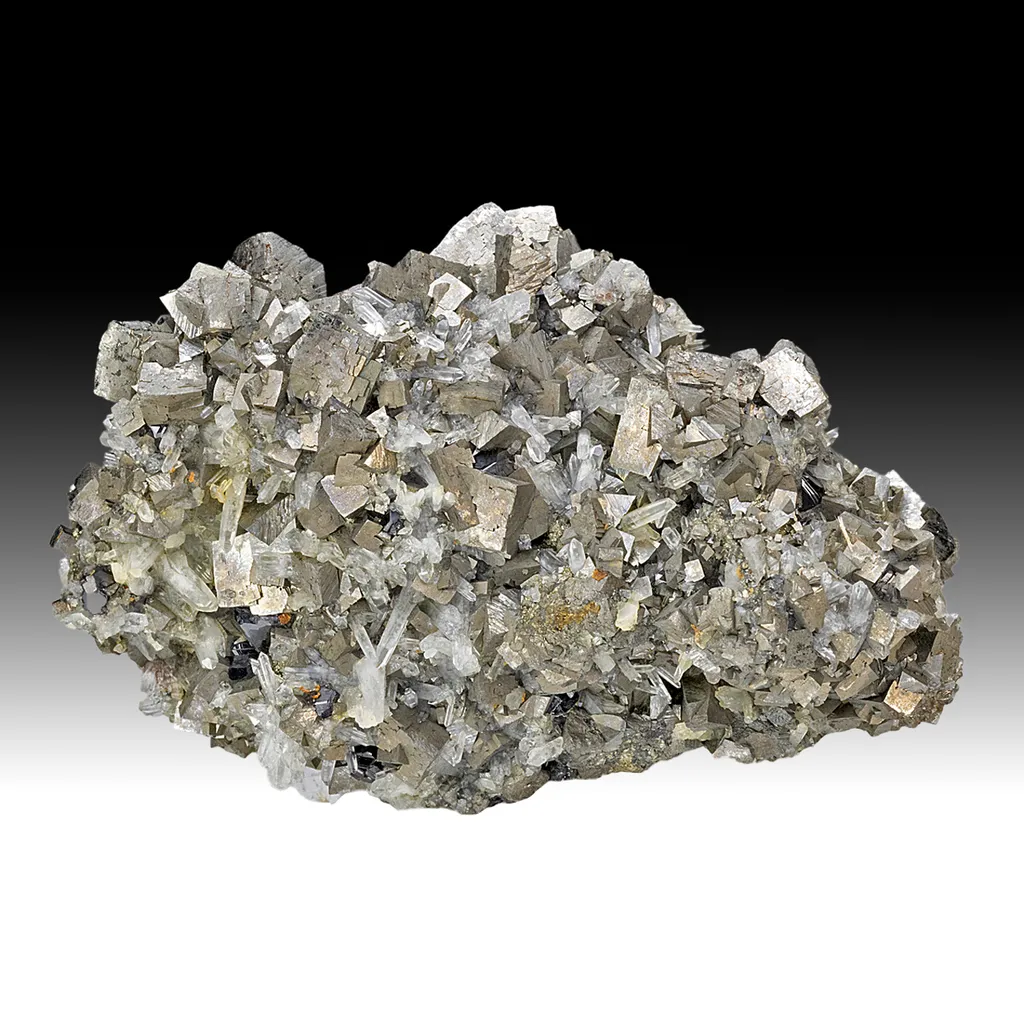
Photo: EarthWonders
What makes the locality special is the combination of abundance, complexity, and display quality. Trepča was not a single-species showpiece locality; it was a deep, long-lived hydrothermal system that repeatedly opened space, dissolved carbonate host rocks, brecciated them, and refilled the voids with sulfides, sulfosalts, quartz, and carbonates. Arsenopyrite formed in that crowded, high-temperature sulfide environment and commonly appears as short, blocky to prismatic crystals, lozenge-faced mosaics, parallel crests, and crystals implanted on earlier sulfides.
The geological setting is equally important to the collector. The Stan Terg deposit belongs to the Trepça Mineral Belt of the Vardar Zone and is generally described as a Pb-Zn-Ag skarn and carbonate-replacement system related to Oligocene–Miocene magmatism. Ore bodies are largely hosted by Triassic carbonates in an anticline, with mineralization guided by faults, fissures, palaeo-karst cavities, and a central volcanic breccia-pipe. That setting explains why Trepča specimens so often look like frozen episodes of chemical overgrowth: arsenopyrite on pyrrhotite, calcite on arsenopyrite, quartz threading through galena, and later pyrite or marcasite replacing earlier pyrrhotite.
Historically, Trepča is one of the great mining names of the Balkans. Definite mining at Trepča is documented from the early 14th century, and the modern underground mine opened in 1930 on the site of medieval workings. Between 1931 and 1998 the deposit produced tens of millions of tonnes of ore and major tonnages of lead, zinc, silver, and bismuth, while also supplying generations of collectors with specimens. The mine’s own crystal and mineral museum at Stantërg became an essential part of the locality’s identity, preserving the best of what the underground workings revealed.
For arsenopyrite specialists, Trepča pieces are judged by sharpness, brightness, crystal separation, and association. A fine example should show recognizable arsenopyrite forms rather than merely a grey metallic crust. The most desirable specimens carry sharp, silvery crystals on contrasting quartz, calcite, dolomite, sphalerite, or galena, ideally with good three-dimensional relief and minimal sulfide bruising. Large single crystals are prized, but Trepča’s most characteristic arsenopyrite may be the aggregate: tight, repeating, lozenge-faced crystals that read as a metallic mosaic across the matrix.
Search for specimens: View all arsenopyrite specimens from Trepča Stari Trg Mine, Kosovo
The Trepča Stari Trg Mine lies near Stari Trg/Stantërg in the Trepča Valley, about 8–9 km northeast of Mitrovica in northern Kosovo. The locality is also encountered under several historical and administrative spellings: Trepca, Trepča, Stari Trg, Stan Trg, and Stan Terg. Older mineralogical labels from Yugoslav-era collections commonly use “Trepca, Stari Trg, Yugoslavia,” while modern labels may use “Stan Terg” or “Trepça Stari Trg Mine, Mitrovica District, Kosovo.”
Geologically, the mine is the central and best-known deposit of the Trepça Mineral Belt. The ore system is hosted mainly in Upper Triassic limestones and marbles, with schists forming an impermeable structural cover and Tertiary volcanic rocks—especially andesite, trachyte, latite, pyroclastics, and a volcanic breccia-pipe—playing a major role in the localization of mineralization. The principal economic minerals are galena and sphalerite, accompanied by pyrite, pyrrhotite, arsenopyrite, boulangerite, chalcopyrite, and a large suite of sulfosalts and rare Bi-, Sb-, Ag-, and Sn-bearing phases.
The deposit is not a simple vein system. Its ore bodies are elongated and columnar to manto-like, developed along carbonate contacts, structural traps, faults, fissures, and hydrothermal karst cavities. Hot, metal-bearing fluids dissolved carbonate rocks beneath schist caps and around the volcanic conduit, producing cavities and breccias that later became lined and filled with sulfides, quartz, and carbonates. Near the volcanic pipe, skarn assemblages include garnet, hedenbergite, ilvaite, actinolite, and magnetite; farther out, carbonate-replacement and karst-fill ore bodies dominate.
Mining history at Trepča is unusually long. A definite phase of medieval mining began in 1303, focused on silver, lead, and iron. In the 15th century, Dubrovnik merchants and Saxon miners were involved in the district, and the ruins of the 14th-century St. Peter’s Saxon basilica remain near the Stari Trg miners’ village and open pit. Very old workings, stopes, and narrow mine entrances were still visible in the area described by later visitors.
Modern industrial mining began after British Selection Trust exploration in the 1920s. Trepca Mines Limited was capitalized in London in 1927, the concession was granted in 1928, and the Stan Trg mine opened in 1930. The mine quickly became one of the major Pb-Zn producers of interwar Europe, with a flotation plant, later smelting capacity, and very large annual ore output before World War II. After the war, the Yugoslav government nationalized the mine and associated smelting operations.
The working mine developed downward from the medieval open pit, with upper adits at several elevations and later shafts reaching deep levels. Published accounts describe mining down to the 11th level, approximately 15 m above sea level, with a total vertical extent around 800 m and ore extending still farther downdip. The deposit’s strike length and vertical continuity explain why it yielded specimens over such a long collecting history: new levels and new stopes repeatedly intersected pockets, breccias, and sulfide-lined cavities.
The Kosovo war and the environmental problems around the metallurgical complex brought a severe interruption at the end of the 1990s. The mine was flooded or inactive for a period, and smelter operations were stopped in 2000. Ore production resumed in 2005 at a reduced scale, and later technical literature describes underground extraction of lead-zinc ore by the Trepça Mining Company. For collectors, the practical point is simple: Trepča is an industrial underground mine, not a public collecting site. Specimens enter collections through mine-approved channels, older collections, museum exchanges, miners’ finds, and established dealers; casual underground collecting is not an option.
Notable finds from Trepča are not limited to arsenopyrite. The mine is famous for pyrrhotite crystals and pyrite pseudomorphs after pyrrhotite, black iron-rich sphalerite, galena in varied habits, vivianite, ludlamite, childrenite, boulangerite “plumosite,” calcite, dolomite, rhodochrosite, and complex Bi-Sb-Ag sulfosalts. Arsenopyrite occupies a strong middle ground in this suite: common enough to be a recognizable locality species, but capable of forming excellent display specimens when the crystals are sharp, bright, and well placed.
Trepča arsenopyrite is typically greyish tin-white to silvery, with a bright metallic luster on fresh faces. The most characteristic crystals are short prisms and blocky forms with flat, diamond-shaped faces. Many crystals are only a few millimeters long, but published descriptions record crystals reaching several centimeters, and the best cabinet specimens show arsenopyrite as prominent, freestanding metallic crystals rather than a subordinate sprinkling.
The classic habit is blocky to prismatic. Fine examples may show a crisp, lozenge-faced geometry that distinguishes arsenopyrite from the more cubic language of pyrite and galena. On some specimens, arsenopyrite forms mosaic-like sheets of repeated diamond faces, producing a tiled metallic surface. Rarer habits include long-prismatic to acicular crystals, dendritic aggregates, and “crests” of parallel crystals.
Associations are central to the locality’s appeal. Arsenopyrite occurs with quartz, calcite, dolomite, sphalerite, galena, pyrite, pyrrhotite, marcasite, chalcopyrite, and sulfosalts such as boulangerite and jamesonite. Quartz provides some of the best contrast, especially as white to colorless prismatic crystals cutting through or rising between arsenopyrite clusters. Calcite may sit on arsenopyrite as white to translucent rhombs or scalenohedral groups. Black sphalerite gives a strong color contrast, while galena adds heavier, lead-grey cube and cubo-octahedral forms.
Epitactic relationships are a locality hallmark. Literature records arsenopyrite growing epitactically on galena and marcasite, and collectors also encounter arsenopyrite associated with pyrrhotite and pyrite-after-pyrrhotite assemblages. This is why careful identification matters: a Trepča sulfide specimen may contain several grey-to-silver metallic minerals that look superficially similar but reflect different generations of mineralization.
Typical collector-size specimens range from thumbnails and miniatures with millimetric arsenopyrite crystals to small-cabinet and cabinet pieces carrying crystals around 5–10 mm. Dealer records show modern examples with arsenopyrite crystals around 6–10 mm, and older or exceptional specimens may carry larger individuals. The best pieces balance crystal size with sharpness and contrast; a 6 mm brilliant, undamaged crystal group on quartz may be more desirable than a larger but bruised or visually crowded sulfide mass.
Quality factors are straightforward but unforgiving. Look for bright, untarnished faces; visible crystal terminations; minimal edge bruising; and a matrix that clarifies rather than hides the arsenopyrite. Strong Trepča pieces often have a pleasing “mineral architecture”: arsenopyrite as the metallic framework, quartz or calcite as the bright accent, and sphalerite or galena as a darker base. Flat, massive, or heavily coated arsenopyrite is less desirable unless the specimen preserves an unusual paragenesis.
The most distinctively Trepča arsenopyrite specimens do not look like generic arsenopyrite from a tungsten vein or gold deposit. They look like part of a dense Balkan Pb-Zn-Ag system: metallic, polymetallic, often crowded, and richly associated. This locality identity is a major reason collectors prize them.
No well-documented, locality-specific fake arsenopyrite problem is known for Trepča Stari Trg. The usual risks are misidentification, overbroad locality labels, composite repairs, and confusing associated sulfides. Because Trepča produced abundant galena, pyrite, marcasite, pyrrhotite, sphalerite, and sulfosalts, a label that simply says “silver metallic crystals” should not be accepted as arsenopyrite without visual confirmation. Arsenopyrite should show its silvery to tin-white color, metallic luster, hard crisp faces, and characteristic blocky or prismatic habit; galena will tend toward cubic cleavage and lead-grey softness, pyrite toward brass-yellow cubic or pyritohedral habits, and marcasite toward paler brassy to greyish spear or cockscomb forms.
Condition is the main collecting issue. Arsenopyrite itself is fairly robust for a sulfide, but many Trepča matrices include pyrrhotite and marcasite, which may oxidize or destabilize in poor storage. Published locality descriptions note that unstable pyrrhotite specimens from Trepča can alter after years of exposure to humidity, producing sulfate powder, and that pseudomorphic replacement of pyrrhotite can create cracks in associated sulfides. If arsenopyrite sits on or near pyrrhotite, marcasite, or pyrite-after-pyrrhotite, inspect for powdering, rusty stains, open cracks, and dull friable areas.
Store Trepča arsenopyrite dry and stable. Avoid damp cabinets, basements, and large temperature swings. Do not wash sulfide-rich specimens unless you are certain the matrix is stable and can dry thoroughly. A soft brush and air drying are safer than soaking. Keep arsenopyrite out of children’s hands and avoid grinding, heating, or cutting it; FeAsS is an arsenic-bearing sulfide, and the hazard is chiefly from dust, ingestion, or heating rather than from normal display handling.
Market availability is better than many classic European sulfide localities because Trepča produced many specimens and has continued to send material into the trade through modern and old-collection channels. Still, truly fine arsenopyrite pieces are selective rather than common. Small examples with quartz or calcite appear regularly, but large, bright, undamaged crystals on attractive matrix are scarcer. Specimens with older labels, Ferat Voca provenance, museum or notable collection histories, or unusually strong multi-mineral associations command a premium.
For authenticity, the strongest labels give the specific locality as Trepča Stari Trg Mine, Stan Terg/Stan Trg Mine, or Stari Trg Mine, rather than merely “Kosovo” or “Trepča.” Older labels may say Yugoslavia or Serbia; those are historically normal for specimens collected before Kosovo’s modern political status. A good Trepča arsenopyrite should also “fit” the locality mineralogically: quartz, calcite, dolomite, black sphalerite, galena, pyrrhotite, pyrite, marcasite, chalcopyrite, boulangerite, or jamesonite associations are all plausible, while an isolated arsenopyrite crystal glued to an unrelated matrix would be suspicious.
The first Trepča story a collector should know begins not with crystals but with a word. One tradition explains “Trepča” as a memory of ancient furnaces; another gives it a more lyrical origin, tied to a wedding legend in which a girl was adorned from head to foot with gold and silver. In that telling, Trepča became a word for beauty—an oddly fitting prelude to a mine that later filled cabinets with metallic sulfides and pale carbonates.
The documented mining story begins in 1303, when extraction of silver, lead, and iron became intense enough to enter history. Trepča silver helped finance fortifications along the Ibar Valley against Ottoman pressure. By the 15th century, merchants from Dubrovnik were involved in managing and trading the ores, and Saxon miners—experienced specialists of medieval European mining—were brought into the district. Their presence survives in stone: the tall ruins of St. Peter’s Saxon basilica, dating from the 14th century, stand between the Stari Trg miners’ village and the open pit. Its walls once carried frescoes, some traces of which were still visible when later authors described the site.
The ground around the basilica still held the physical clues of old work. Between the church and the open pit, at the base of rocky gossan outcrops, collapsed entrances of very narrow ancient workings lay under vegetation. Above the open pit, another old stope and shaft remained open among bushes on the slope. These are the kinds of details that make Trepča more than a label: the modern arsenopyrite specimen in a collector’s drawer comes from the same mineralized hill where medieval miners followed oxidized outcrops by hand.
In 1936, old underground workings produced remnants of tools thought to date from the 14th or 15th century. Harold Abbott Titcomb, a mining engineer and amateur archaeologist, examined the finds. One reported artifact was an axe found at 200 m depth, described as “made of nickel and steel,” with the provocative suggestion that it may have been hammered from nickel-iron meteorite material. The mine museum later displayed old mining tools, including a small wooden shovel with a 15 cm handle and a 30 cm bucket, and a wooden spoon-like scraper measuring about 15 by 40 cm.
The modern industrial chapter began in the 1920s, when the British Selection Trust entered Yugoslavia in search of mineral opportunities. Alfred Chester Beatty’s company sent geologists into the old workings, and in 1926 signed a contract that launched systematic mapping, sampling, and drilling. On December 9, 1927, Trepca Mines Limited was capitalized in London for £1,789,028, and on March 1, 1928 a mining concession was granted. The mine opened in 1930 on the medieval open-pit site. The name “Stan Trg,” now familiar on labels, was a distortion of “Stari Trg,” meaning “old place” or “old market.”
The early production figures were staggering. In the 1930s the mine reached 600,000 to 700,000 tons of ore per year, with annual metal output of 50,000 to 60,000 tons. From 1930 to 1940 it yielded 5.7 million tons of ore. Its flotation plant produced 625,000 tons of lead concentrates, 685,000 tons of zinc concentrates, and 444,000 tons of mixed lead-copper-pyrite concentrate. These numbers matter to collectors because they explain the depth of the Trepča specimen tradition: the finest arsenopyrite, pyrrhotite, galena, sphalerite, vivianite, and carbonate specimens came out of a mine that was continuously cutting new ground at industrial scale.
World War II brought a darker chapter. After German seizure of the mine in 1941, Hermann Göring’s Reichswerke Company managed the facilities. Published accounts describe the wartime operation as functioning largely as a slave-labor camp and producing batteries for German U-boats. Many Trepča miners were also involved in the Yugoslav resistance. In 1946, Tito’s government nationalized the mine and smelter.
One of Trepča’s most collector-specific mysteries concerns its “cave” specimens. The deposit’s mineralization filled hydrothermal karst cavities, and Trepča specimens commonly show stalactitic carbonate forms overgrown by sulfides. Yet authors noted an intriguing absence: they had not seen the expected axial canals in carbonate stalactites that would prove dripping from cave ceilings. The implication was striking—the cavities may have been fully flooded, and their walls overgrown below the water table, not decorated in air-filled caverns. A specimen that seems at first like a cave decoration may actually record a submerged hydrothermal chamber.
The museum story nearly became a tragedy of rumor. In the confusion after the Kosovo war, a 1999 report claimed that the mineralogical museum had been plundered. Later authors were able to state that the report was false and that the collections had been preserved. For collectors who know how easily mine museums vanish, this was not a minor correction. Trepča’s museum was a repository for the locality’s memory: the best crystals, old tools, labels, and records that connect specimens to the mine’s human history.
After the war, the mine was flooded or inactive, and the industrial complex was on standby. An environmental appraisal found heavy pollution around the smelters, and in August 2000 operations were ordered stopped. Then came the slow revival. By August 2005, through the work of mine management and miners, ore production resumed and the zinc concentrator restarted. The reopening mattered not only economically but mineralogically: new ore development again raised the possibility of new pockets, new sulfide assemblages, and fresh material for study and collecting.
 Amethyst
 Quartz
 Fluorite
 Tourmaline
 Malachite
 Azurite
 Rhodochrosite