Anglesite from Tsumeb is one of the quiet classics of the mine: not as instantly recognizable as its azurite, dioptase, or cerussite, but deeply prized by collectors who understand what Tsumeb did better than almost any locality on Earth—make lead minerals in sharply crystallized, highly individualized forms. The best specimens show dense, glassy PbSO4 crystals with the unmistakable heft of lead sulfate: colorless, white, gray, yellow, pale green, and rarely pale blue. They can be blocky and adamantine, thinly tabular, diamond-shaped, bipyramidal, or developed into odd spear-like forms that look more sculpted than grown.
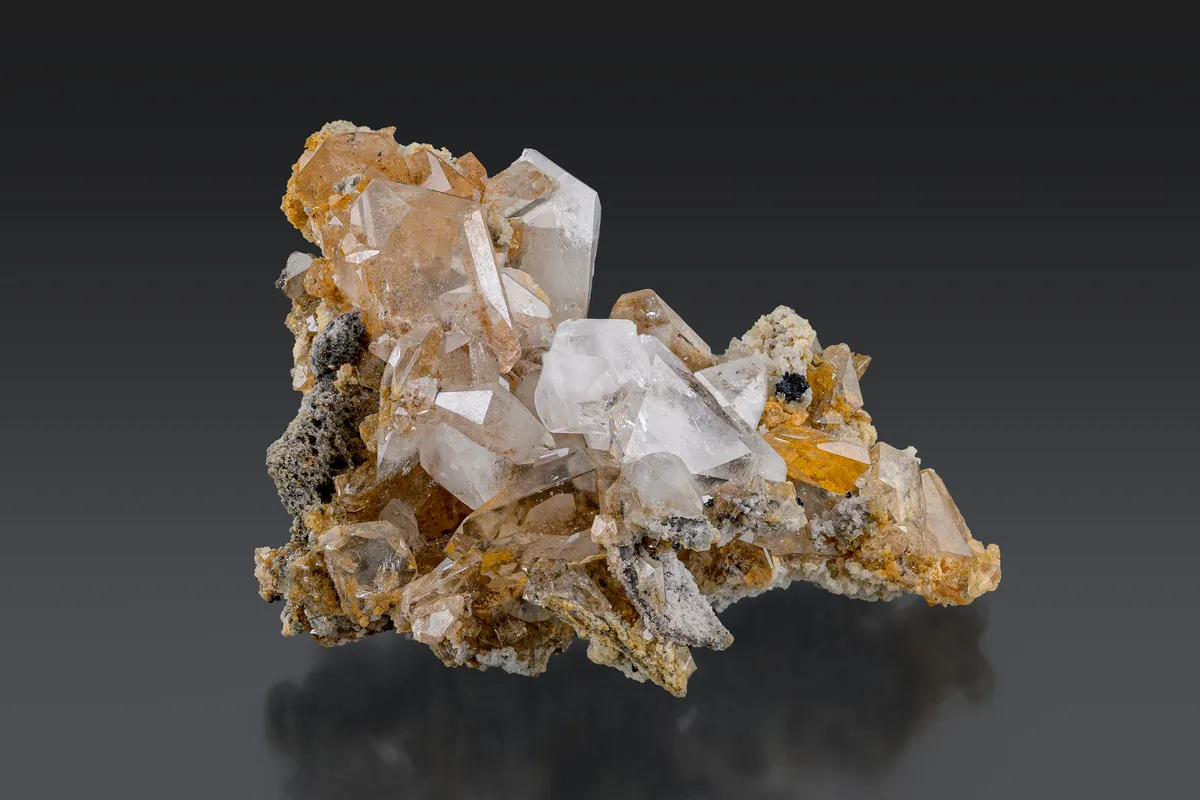
Photo: Tsumeb Mine Notebook
The reason Tsumeb anglesite matters is inseparable from the mine itself. Tsumeb was a copper-lead-zinc-silver deposit in a steep, pipe-like orebody hosted by dolomitized carbonate rocks of the Otavi Mountainland. Its primary ores carried an unusually rich chemical inventory—lead, copper, zinc, arsenic, cadmium, germanium, gallium, molybdenum, silver, and more—and oxidizing groundwater was able to penetrate the pipe to remarkable depths. That combination produced three separate oxidation zones and one of the most diverse secondary-mineral assemblages ever recorded from a single mine.
Anglesite formed there as a supergene lead sulfate, intimately tied to galena-rich sulfide ore and to lower-pH portions of the oxidation sequence. It is recorded from all three oxidation zones, though historically it was notably more common in the first oxidation zone. At Tsumeb, that means anglesite can be an early upper-level classic, a companion to galena and cerussite, a component of richly colored arsenate associations, or a strange one-off form from an old pocket whose exact level may be lost.
Collectors look for Tsumeb anglesite specimens that prove their locality at first glance: sharp orthorhombic geometry, strong adamantine luster, high translucency, and matrix or association that places the specimen firmly in Tsumeb’s lead-copper environment. A clean miniature with transparent diamond-shaped crystals may be more desirable than a larger but bruised mass; a yellow, green, or blue piece with convincing provenance may be pursued aggressively; and old labels from OMEG, Tsumeb Corporation, the Kegel, Klein, Pinch, or other historic collections add real mineralogical value.
Search for specimens: View all anglesite specimens from Tsumeb, Namibia
The locality is the Tsumeb Mine, also known as the Ongopolo Mine or Tsumcorp Mine, at Tsumeb in the Oshikoto Region of northern Namibia. It sits within the Otavi Mountainland, a carbonate terrain whose dolomites and limestones provided both the host rocks and the hydrologic architecture that made Tsumeb’s secondary mineralogy extraordinary.
Geologically, the deposit was an irregular, subvertical, pipe-like polymetallic orebody cutting through Neoproterozoic carbonate rocks. The pipe was not a simple vein. It included dolomite breccias, feldspathic sandstone and sandstone breccias, massive sulfide bodies, open-space fillings, replacement zones, and structurally controlled ore along what mine geologists described as North and South Veins. In places the pipe was attenuated by bedding-slip shears; in other places it broadened into an elliptical body. On 12 Level, the orebody was only about 25 by 6 meters in plan, while deeper in the mine it reached far larger dimensions.
The oxidation history is the key to anglesite. Tsumeb developed three major oxidation zones: the first from surface to about 11 Level, with reduced oxide mineralization continuing locally below; the second from about 24 to 35 Level, centered near the North Break Horizon around 29 Level; and a third from roughly 42 Level downward. Anglesite is recorded from all three, but it was most abundant in the first oxidation zone, where galena-rich massive sulfide ores and cavities provided lead and sulfate in the right chemical setting.
The mine’s history began long before modern specimen collecting. The copper-stained outcrop known as the “Green Hill” was worked by local African miners before European commercial mining. Mathew Rogers investigated the occurrence for the South West Africa Company in January 1893. The German Otavi Minen und Eisenbahn Gesellschaft developed trial shafts in 1900, and full-scale commercial production began in 1906 after a railway connection to the coast was completed. Mining first exploited surface ore and shallow workings, then moved underground as the open-pit ore was exhausted.
For most of the twentieth century Tsumeb was both an ore mine and an accidental museum of crystallized chemistry. Early ore sent to Freiberg for metallurgical testing in 1900 already contained preserved secondary minerals in well-crystallized form, and Wilhelm Maucher’s 1908 descriptions include anglesite among the species known from the early years of mining. By the inter-war period, mine managers and collectors such as F. W. Kegel, Wilhelm Klein, W. Thometzek, and Keller had assembled collections that later became essential records of the mine’s upper levels.
Commercial mining continued, with interruptions from world wars and economic downturns, until the mid-1990s. By closure, the workings reached about 1700 meters below surface, down to 48 Level. In mid-1996, labor conflict and pumping problems led to rapid flooding of the mine. Small-scale upper-level work continued for a short time, and there was a later specimen-mining effort from 1998 to 2002, but the great era of regular Tsumeb specimen production was over.
Collecting access today should be understood in that context. Tsumeb is an inactive, flooded, historically important mine site, not an open collecting ground. Serious anglesite specimens now reach the market from old collections, historic dealer stocks, museum deaccessions where applicable, and the continuing redistribution of material saved during active mining.
Notable anglesite finds span the mine’s life. Klein recorded anglesite from surface down to 12 Level, with large crystals associated with native copper between 7 and 9 Levels. Very large crystals have been reported, including crystals to 500 mm on a face, though the exact mine position of those giant pieces is not known. Opaque white, transparent-cored crystals to 200 mm resembling spear points were also recorded, as were much smaller groups of flawless transparent yellow crystals. In 1986, a pocket produced masses of sea-green anglesite crystals in unusual platy aggregates, some weighing several kilograms. Pale blue Tsumeb anglesite is rarer still and appears in the collector literature as a small but memorable discovery, partly lost to blasting.
Tsumeb anglesite is orthorhombic PbSO4, but its appeal lies in how many ways that simple formula expressed itself in the mine. The most typical collector form is the sharp, angular, diamond-shaped crystal: flattened, lustrous, and geometric, often colorless to white or gray. Thick tabular and blocky crystals are also classic, as are thinner tabular plates and bipyramidal forms. Rosický’s 1926 work on Tsumeb anglesite treated three variations of bipyramidal crystals, evidence that the species was already being studied crystallographically while the mine was still in its early decades.
Color is one of the locality’s great attractions. Most Tsumeb anglesite is colorless, white, gray, or translucent milky white. Yellow crystals are particularly desirable, especially when bright and transparent. The yellow color has been attributed in collector literature to inclusions, possibly cadmium-bearing material such as greenockite. Green and pale green crystals are much less common, and pale blue anglesite is among the most coveted color variants. Color should always be judged with habit, luster, and provenance; a richly colored but battered piece may be less important than a water-clear, sharply formed miniature with an old level label.
Typical specimen sizes range from thumbnails and miniatures with crystals of a few millimeters to a few centimeters, up to cabinet specimens with crystals several centimeters across. Documented examples include tabular crystals to 18 mm on a 65 mm gossanous specimen, a 37 mm partly gemmy crystal from 7 Level in the first oxidation zone, and collector specimens with crystals in the 4 to 7 cm range. Larger crystals above 20 cm are recorded, and the largest reported Tsumeb anglesites are in a different category altogether: massive individual crystals said to reach roughly half a meter on a face. Such giants are not the normal market material and are best treated as historic reference points rather than realistic collecting expectations.
The most faithful matrix for anglesite at Tsumeb is sulfide ore, especially galena-rich massive sulfide. This is one of the useful locality cues: anglesite at Tsumeb is strongly tied to galena, and some specimens show anglesite alone on or in cavities in massive sulfides. Cerussite is a common later lead carbonate in the same environment and can form pseudomorphs after anglesite. Associations also include malachite, azurite, arsentsumebite, beudantite, carminite, scorodite, brochantite, wulfenite, mimetite, duftite, calcite, smithsonite, and many other Tsumeb species, but the most mineralogically convincing associations are those that make sense for a lead-rich, lower-pH supergene paragenesis.
Quality factors are specific and unforgiving. The best Tsumeb anglesites have adamantine luster, sharp edges, transparent to translucent interiors, intact terminations, and an aesthetic relationship to matrix. Damage matters because anglesite is soft, brittle, and heavy; crystal corners and beveled terminations chip easily, and large crystals can be bruised during mining or later handling. For Tsumeb in particular, a specimen with an old label naming a level or a historic collection may outrank a prettier but undocumented piece, because level data are rare and mineralogically meaningful.
Tsumeb anglesite occupies an interesting place in the market: the species is not rare at the locality in a strict occurrence sense, but fine display-quality specimens are not casually replaceable. Anglesite was widespread enough to be called common in Tsumeb’s mineral record, yet the best examples—large, sharp, lustrous, unusually colored, undamaged, and on convincing matrix—are much scarcer than that word implies.
Authenticity concerns are mostly about attribution, condition, and interpretation rather than a famous Tsumeb-specific treatment problem. Colorless, white, gray, and yellow anglesite can be confused with cerussite by eye, especially when the form is tabular or when both species occur on the same lead-rich matrix. Twinning is a useful clue: Tsumeb anglesite is not generally reported as twinned, whereas cerussite commonly is. Weight, luster, crystal habit, and association help, but important specimens—especially unlabeled old pieces—deserve analytical confirmation if the identification affects value.
Pseudomorphs require special caution. Cerussite after anglesite is reported as common at Tsumeb, while arsentsumebite after anglesite is rare. A specimen sold simply as “anglesite” may actually be a replacement, a partial replacement, or an anglesite-cerussite association. That distinction is not merely academic; it changes both the mineralogical story and the market category.
Color claims should be handled conservatively. Yellow, green, and pale blue Tsumeb anglesites are real and documented, but rare colors invite overstatement. A pale blue specimen offered in early 2026 was described as unusually colored and desirable despite damage, while a larger bladed anglesite with posnjakite was priced in the thousands. Those public offerings illustrate the modern market spread: modest damaged pieces can still be accessible, but large, sharp, colorful, or richly associated Tsumeb anglesites move quickly into premium territory.
Condition is the everyday issue. Anglesite has low hardness and substantial density, so even a small crystal carries enough mass to damage itself if handled casually. Avoid storing specimens loose in drawers, and never allow crystals to knock against harder minerals. Old Tsumeb anglesites may show edge wear from mine recovery, trimming, shipping, or decades of collection storage. Under magnification, check crystal corners, terminations, and contact points carefully; “cleaved matrix” or a broken neighboring crystal is often less important than an undamaged main display crystal.
Provenance adds real value. Labels from OMEG, Tsumeb Corporation, historic European collections, the Kegel or Klein spheres of collecting, Bill Pinch-related material, long-established dealers, or specimens with mine level data should be preserved with the specimen. At Tsumeb, a level number is not decoration—it places the piece within the mine’s oxidation architecture.
Tsumeb’s anglesite story begins in the shadow of the Green Hill. Long before collectors argued over blue, yellow, or diamond-shaped crystals, local African miners were winning copper from the stained outcrop that marked the future mine. European explorers in the 1880s encountered copper ore and smelted metal moving through local trade, and the trail led back to Otjisume, “the place of the frog,” a name attached to the appearance of the copper-colored hill. When Mathew Rogers reached the outcrop in January 1893, he wrote back that he had never seen such a sight at “Soomep” and doubted he would ever see its equal.
The early scientific life of Tsumeb anglesite began almost accidentally. In 1900, a large ore sample was sent to Germany for metallurgical testing. Wilhelm Maucher, handling the material at the Bergakademie in Freiberg, recognized that the ore was not merely smelter feed. It held well-crystallized secondary minerals worth preserving and describing. Within a few years, anglesite was part of the early Tsumeb mineral record, not as a late collector’s footnote but as one of the species noticed from the beginning of modern mining.
One of the most evocative surviving anglesites is a 42 mm miniature now recorded in the Tsumeb Mine Notebook. Its main crystal is 37 mm across, colorless to white, equant, partly gemmy, and complex, with smaller crystals clustered around the base. Inside it are minute inclusions of an undetermined mineral, perhaps relict sulfide, arranged in a way that appears crystallographically controlled. The label history is as interesting as the crystal: it belonged to F. W. Kegel, general manager of OMEG from 1922 to 1932, and the Kegel Collection was purchased from his widow for the Smithsonian in 1950 using Roebling endowment funds. Its Smithsonian label records the source as 7 Level in the first oxidation zone, exactly the kind of mine-position data collectors wish every Tsumeb specimen had retained.
The old managers did more than run the mine; they created the record by saving specimens. Kegel, Wilhelm Klein, Thometzek, and the shift-boss Keller assembled mineral collections during the inter-war years that later moved into major museums. Klein’s material is especially valuable because he recorded the mine level for his specimens. For anglesite, that matters: Klein documented the species from surface to 12 Level and noted large crystals with native copper between 7 and 9 Levels. Those few numbers are a map of a vanished collecting world.
The most tantalizing anglesite anecdotes are the ones where the pocket was partly lost. Don and Gloria Olson returned from a Namibia buying trip with unusual pale blue anglesite crystals in milky plates 6 or 7 cm across. Miners told them that many more pieces had already been bought by Namibian collectors, and that much larger crystals had been present in the pocket before a blast too close to the vug shattered them. For collectors, it is a painful image: pale blue Tsumeb anglesite, already rare, fragmented at the moment of discovery.
Another account places the most impressive anglesite a seasoned observer had seen in the home of Clive Queit, who was living in Tsumeb in the 1980s and dealing specimens. That period also produced the famous 1986 sea-green anglesite pocket, where crystals of unusual habit formed intergrown platy aggregates weighing up to several kilograms. Tsumeb often did this: it made a species that elsewhere might be predictable, then changed the color, habit, association, and scale until the specimen no longer looked quite like any other locality’s version.
The mine’s final decades sharpen the poignancy of these stories. By the 1980s, Tsumeb was deep underground, famous among collectors, and still capable of surprises in both the second and third oxidation zones. Yet the upper levels could also produce wonders late in the game, as shown by the 1994 Easter Pocket of azurite on 8 Level. Commercial mining ended in the mid-1990s, and the mine flooded rapidly after the pumps were shut down in 1996. The great anglesites of Tsumeb are therefore not part of an ongoing supply. They are survivors: from blasts, sorting tables, mine offices, dealer flats, museum drawers, and old collections whose labels may carry the only remaining trace of the level where they grew.
 Amethyst
 Quartz
 Fluorite
 Tourmaline
 Malachite
 Azurite
 Rhodochrosite