Broken Hill anglesite belongs to one of the great oxidized-zone suites in mineral collecting: a lead-silver-zinc deposit so large, long-mined, and mineralogically varied that its secondary lead minerals have been collected, traded, studied, and preserved for well over a century. The appeal of its anglesite is not just the species itself—PbSO4, a heavy, highly lustrous lead sulfate—but the unmistakable Broken Hill context: blocky white to ivory crystals in old gossan cavities, small bright coatings on reticulated cerussite, and rarer gemmy amber to greenish-amber crystals that carry the color and weight of the old Australian oxidized lode.

Photo: Wikimedia Commons / Rob Lavinsky, iRocks.com
The finest Broken Hill anglesites are collectible because they are immediately recognizable rather than merely large. Many classic pieces show stout, blocky, lustrous crystals—often white, cream, greyish, or faintly smoky—set into oxidized lead ore. Others are more sculptural: anglesite crusts and partial replacements following the delicate boxwork of reticulated cerussite. That style, with lead sulfate preserving or coating an airy lead-carbonate lattice, is one of the locality’s signature looks.
Broken Hill is not a simple “lead mine” in the ordinary collecting sense. The orebody is the archetypal Broken Hill-type Pb-Zn-Ag system: a huge, deformed, metamorphosed, stratiform sulphide body hosted in the Willyama Supergroup and later exposed, oxidized, collapsed, veined, and chemically reworked near surface. The weathered lode produced a spectacular secondary mineral suite, including cerussite, anglesite, smithsonite, coronadite, goethite, linarite, chlorargyrite, pyromorphite, native silver, raspite, stolzite, and many rarities. In that suite, anglesite is one of the principal lead-sulphate products of galena oxidation, but at Broken Hill it also enters a complicated sequence with cerussite, coronadite-rich gossan, silver halides, secondary sulphides, and late cavity minerals.
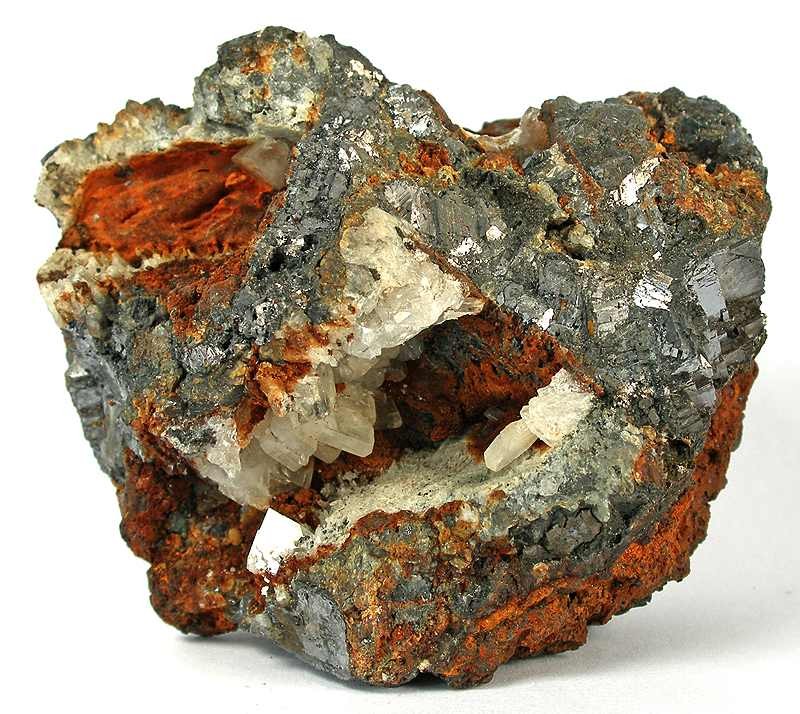
Photo: Wikimedia Commons / Rob Lavinsky, iRocks.com
Historically, Broken Hill specimens matter because the mines helped build both Australian mining and Australian mineral collecting. Old Broken Hill anglesites turn up with pedigrees to early Australian collections, hotel-traded miner specimens, institutional acquisitions, and famous private cabinets. The Australian Museum’s George Smith material, the Powerhouse Museum’s Aldridge Collection specimens, and numerous old European and American labels all reflect the same reality: the best oxidized-zone pieces were already prized when the lode was still being opened and the city was growing around it.
Collectors look for sharpness, undamaged terminations, luster, color, and old provenance. A simple Broken Hill anglesite can be an attractive lead-sulfate specimen; a great one has either fine crystal definition, a strong association with cerussite or galena, a rare amber color, or a believable old label tying it to the great period of oxidized-zone production.
Search for specimens: View all anglesite specimens from Broken Hill, New South Wales, Australia
Broken Hill lies in far western New South Wales, close to the South Australian border, and is built directly around the famous Line of Lode. The original ore seam was a boomerang- or coat-hanger-shaped Pb-Zn-Ag body several kilometres long, hundreds of metres wide in places, and plunging deeply at its ends. The orebody crops out near its central part, which is why the lode was visible to early pastoralists and prospectors as the “broken hill” on the plain.
Geologically, the deposit is a high-grade metamorphosed Broken Hill-type lead-zinc-silver system hosted by the Willyama Supergroup. The original sulphide accumulation formed in a Proterozoic marine and volcanic-sedimentary environment and was later folded, sheared, metamorphosed, fractured, and partly remobilized. This long history is essential to the collector minerals. The primary ore contained abundant galena and sphalerite with a famous gangue and metamorphic mineral association; later weathering of the exposed lode created the oxidized assemblages that yielded anglesite, cerussite, coronadite, smithsonite, silver halides, and related secondary species.
The old gossan of the main lode was extraordinary. Much of it was a dense black rock rich in plumbic coronadite with quartz, goethite, altered rock fragments, botryoidal oxide textures, cracks, vughs, and deeper zones containing cerussite, pyromorphite, silver halides, secondary sulphides, and relics of the primary ore. Published work describes the pre-mining gossanous outcrop as about 2.5 km long, with oxidation commonly reaching around 120 m and locally far deeper. That oxidized profile, repeatedly rejuvenated and structurally disrupted, is the environment from which the classic Broken Hill anglesite and anglesite-on-cerussite specimens came.
Mining began after Charles Rasp, a boundary rider on Mount Gipps Station, investigated the dark outcrop in 1883. He initially suspected a tin-bearing gossan, but the lode proved to be enormously rich in silver, lead, and zinc. The Broken Hill Proprietary Company—BHP—was registered in 1885, and the deposit became one of the foundations of Australian industrial mining. Early high-grade oxidized and secondary ores were particularly important because they could be mined and treated before deeper, more complex sulphide and zinc ores required new metallurgical methods.
The collecting history is inseparable from mining. Many good mineral specimens were recovered by miners before being sold, traded, given to local collectors, or carried away through dealers and institutions. The upper oxidized zone produced the greatest range of cabinet-quality secondary minerals, including the reticulated cerussite and anglesite combinations most prized today. The best older specimens are commonly attributed to the Central Mine, Broken Hill Proprietary Mine, Block 14, South Mine, Kintore open cut, Zinc Corporation Mine, North Mine, and other workings along the Line of Lode, though many old labels simply read “Broken Hill.”
Modern collecting access is not comparable to the early mining years. Broken Hill remains an active and historically significant mining district, with old workings, private land, heritage areas, waste dumps, and industrial hazards. Serious collectors should treat field access as permission-only and should not assume that an old mine name on a label implies current legal access. In practice, most collectible Broken Hill anglesite now enters the market from old collections, estate material, dealer stock, and occasional dispersals rather than from casual field collecting.
Notable finds include blocky white anglesite crystals reportedly reaching around 3 cm, small lustrous crystals scattered over reticulated cerussite, and rare amber to greenish amber gem-like crystals that have passed through important Australian collections. A classic museum example is the Australian Museum’s 10 x 8 x 5 cm anglesite-on-cerussite from the Central Mine, registered in 1927 as part of the George Smith Collection. Another institutional record is the Powerhouse Collection’s group of three anglesite specimens from the Aldridge Collection of Broken Hill minerals.
Broken Hill anglesite most often presents as blocky, tabular, stout prismatic, or wedge-like orthorhombic crystals. The crystal groups are typically compact rather than delicate: individual crystals may look squared-off, heavy, and glassy to adamantine, with a density of form appropriate to a lead mineral. Many specimens are white, ivory, cream, greyish, or colorless to faintly smoky; better old pieces can show translucent areas and sharp reflective faces. Rarer examples display honey, amber, or greenish amber tones, and those are especially sought after when the color is natural, internal-looking, and accompanied by credible Broken Hill provenance.
The common size range for individual display crystals is small to moderate. Broken Hill is not known for the giant, dramatic single anglesites of some other world localities; instead, its strength lies in attractive matrix specimens and old oxidized-zone associations. Published collector commentary and specimen records describe good blocky crystals commonly around 1 cm, with some Broken Hill pieces reaching roughly 3 cm for individual crystals. A documented Wikimedia Commons example measures 4.2 x 2.9 x 2.4 cm overall and carries sharp ivory-colored anglesite crystals to 1.6 cm. Another measures 8.3 x 8.2 x 5.1 cm and shows anglesite crystals to 1 cm in a galena-rich vug.

The most distinctive association is with cerussite. Broken Hill is one of the classic localities for reticulated cerussite—open, lattice-like groups of lead carbonate—and some of these are coated, encrusted, partially replaced, or pseudomorphed by anglesite. The result can be a pale, sugary, pearly, or sparkling surface over the cerussite framework. On some pieces, tan or colorless cerussite remains visible, while anglesite forms a lead-sulfate skin or replacement over part of the structure. These specimens are immediately recognizable and are often more desirable than isolated anglesite crystals of comparable size.
Other associated minerals include galena, smithsonite, coronadite, goethite, linarite, chalcocite, chlorargyrite, pyromorphite, kaolinite, spessartine, chalcopyrite, native sulphur, native copper, aurichalcite, brochantite, marshite, and rosasite. Not every association is common on hand specimens, but they reflect the complexity of the oxidized and transitional zones. Galena-rich matrix pieces can be especially appealing when sharp anglesite crystals are tucked into vughs with metallic lead sulphide still visible. Linarite-associated micro material, especially from the Kintore open cut and other oxidized zones, adds a brilliant blue contrast on small specimens.
Quality factors are specific. The best Broken Hill anglesites have bright luster, undamaged corners, crisp blocky form, attractive contrast with matrix, and a locality style that makes sense. For anglesite-on-cerussite pieces, the value is not simply the amount of anglesite but the preservation of the reticulated architecture: intact lattice, minimal crushing, open negative space, and a pleasing distribution of anglesite over cerussite. For amber-colored anglesite, collectors should look for natural-looking color zoning, uncolored broken surfaces where appropriate, and old provenance, because artificial color enhancement is known in anglesite from other sources.
Broken Hill anglesite is a classic old-locality mineral, but it is not uniformly rare. Small white anglesite crystals, coatings on cerussite, and mixed oxidized-zone pieces appear periodically on the market. Fine examples—sharp cabinet specimens, old labels, gemmy amber crystals, or intact anglesite-coated reticulated cerussite—are much less common and increasingly collection-driven.
The chief authenticity concern is locality and style rather than a well-documented Broken Hill-specific fake industry. Anglesite and cerussite occur at many lead deposits, and old labels can be vague. Broken Hill material should make visual and paragenetic sense: blocky white to ivory anglesite in oxidized lead ore, anglesite with reticulated cerussite, anglesite with galena or coronadite-rich gossan, or older Australian collection history. Be cautious with specimens sold as “Broken Hill” that lack either style, provenance, or credible dealer history.
Color deserves particular attention. A known anglesite treatment involves household bleach producing amber to reddish surface coloration on otherwise pale material from Morocco. That episode is not a Broken Hill find story, but it matters to Broken Hill collectors because natural amber and greenish amber Broken Hill anglesites are desirable. On any unusually warm-colored anglesite, examine broken edges, damaged corners, and contact points under magnification. Artificial surface coloration tends to look too even, may coat broken surfaces, and may not match the crystal’s internal optical character. Strong old provenance is a major advantage for amber Broken Hill pieces.
Condition is a serious issue. Anglesite is soft and dense, and Broken Hill pieces commonly combine it with fragile cerussite. Reticulated cerussite frameworks are easily crushed, and sugar-like anglesite coatings can be abraded by careless cleaning. Avoid ultrasonic cleaning, acids, or aggressive mechanical work. Dusting should be gentle; storage should prevent specimens from rattling against harder minerals. Because anglesite, cerussite, galena, and pyromorphite are lead minerals, handling should be followed by hand washing, and specimens should not be used in settings where powder, chips, or dust can be ingested.
Market availability remains best through established dealers and collection dispersals. Small combination specimens can still be obtainable, while old-time pieces with labels to the Aldridge, George Smith, Chapman-era Australian collections, or other recognized cabinets command a premium. The strongest Broken Hill anglesite specimens are those that tell the locality’s full story at a glance: oxidized lead ore, bright heavy crystals, cerussite architecture, and a label history as solid as the mineral itself.
Charles Rasp’s discovery story begins not with a polished mineral cabinet but with a dark hill on Mount Gipps Station. In 1883, Rasp was working as a boundary rider when the black outcrop caught his attention. He had purchased a prospector’s guide while in Adelaide and thought the dark surface might be tin oxide. With James Poole and David James, he went out to examine the hill and pegged the blackest section. That claim became the first mining lease on Broken Hill.
The scale of what followed is almost comic in hindsight. George McCulloch, owner of Mount Gipps Station, reportedly warned that Rasp and his companions did not have the money to develop the place if it proved worthwhile. His answer was not to discourage them, but to enlarge the venture: “What did you say you'd pegged out? Forty acres. Man, we'll all of us go into it and peg out the whole hill.” Out of that practical station-country calculation grew the Syndicate of Seven and, in 1885, the Broken Hill Proprietary Company.
The ore soon answered every doubt. Thomas Nutt found rich silver ore in April 1885, and Knox’s shaft was sunk on the spot Nutt identified. Assays of 2,000 to 3,000 ounces of silver per tonne were later reported there, transforming the black hill into the engine of a mining city. Before rail and processing systems were fully developed, ore moved toward South Australia by camel trains, wagons, and pack mules—a mineral economy in motion across the outback.
For collectors, one of the best stories is Edward W. Aldridge and the Duke of Cornwall Hotel. Aldridge was a Broken Hill publican in the late nineteenth century, and local legend says he accumulated nearly 5,000 mineral specimens by trading minerals for beer with miners who came into his pub. That is exactly the kind of origin collectors love because it explains why so many early Broken Hill pieces were saved at all: miners recognized beauty and rarity in the oxidized lode, and Aldridge had both the eye and the counter space to turn those finds into a collection.
The Aldridge Collection became famous enough that part of it nearly left Australia for an American buyer. Sir Edgeworth David wanted to keep it in the country, and Hugh Dixson purchased a large portion on his behalf. In 1912, Dixson presented 92 Aldridge minerals to the Powerhouse Museum through the University of Sydney. Among the Powerhouse records today is a group of three anglesite specimens from Broken Hill, part of that broader Aldridge legacy.
The Australian Museum preserves another thread of the story in the George Smith Collection. A Central Mine specimen registered in 1927 shows reticulated cerussite with a sugar-like coating of anglesite, measuring 10 x 8 x 5 cm. It was part of a 1927 acquisition of 1,700 Australian and overseas minerals, described by the museum as the last collection of the renowned George Smith. That single specimen connects several worlds at once: a working Broken Hill mine, a fragile secondary lead-mineral texture, a major Australian collector, and the institutional effort to keep the country’s mineral history visible.
 Amethyst
 Quartz
 Fluorite
 Tourmaline
 Malachite
 Azurite
 Rhodochrosite

