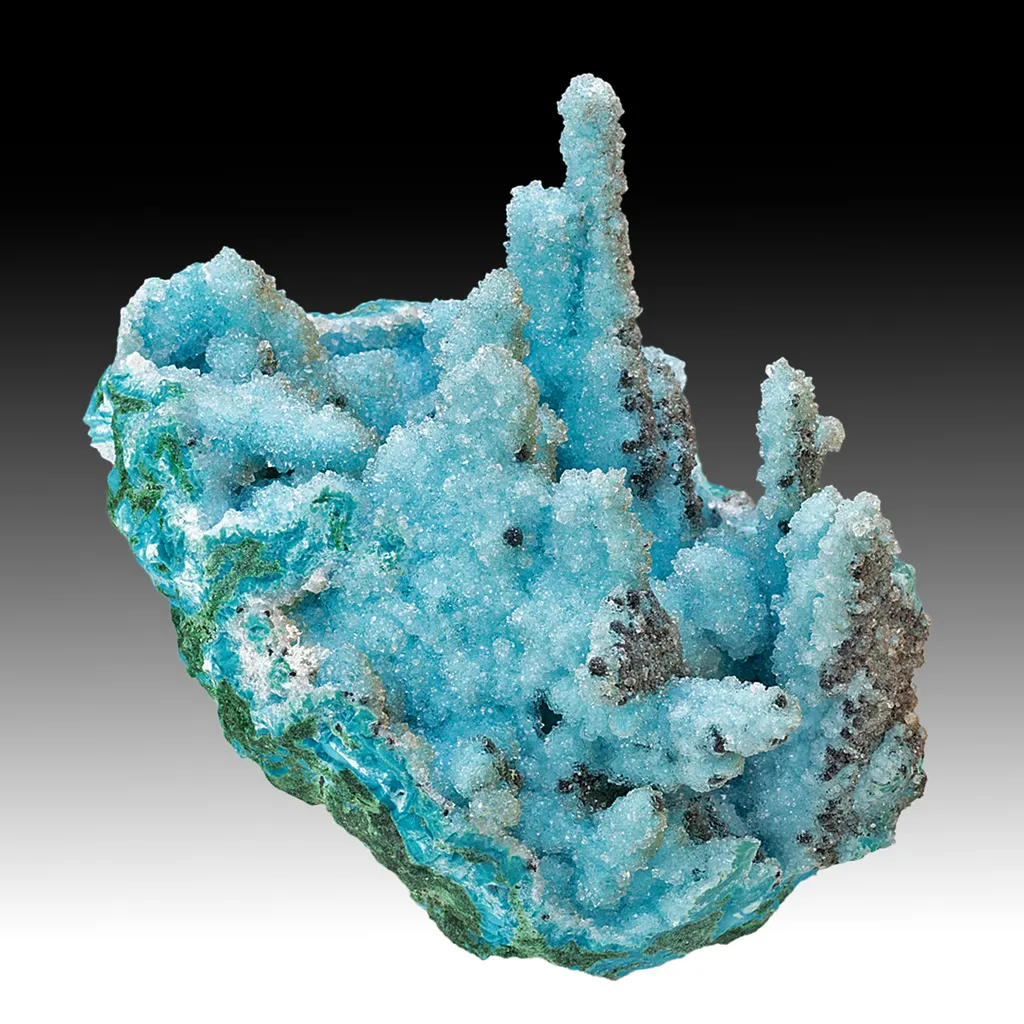
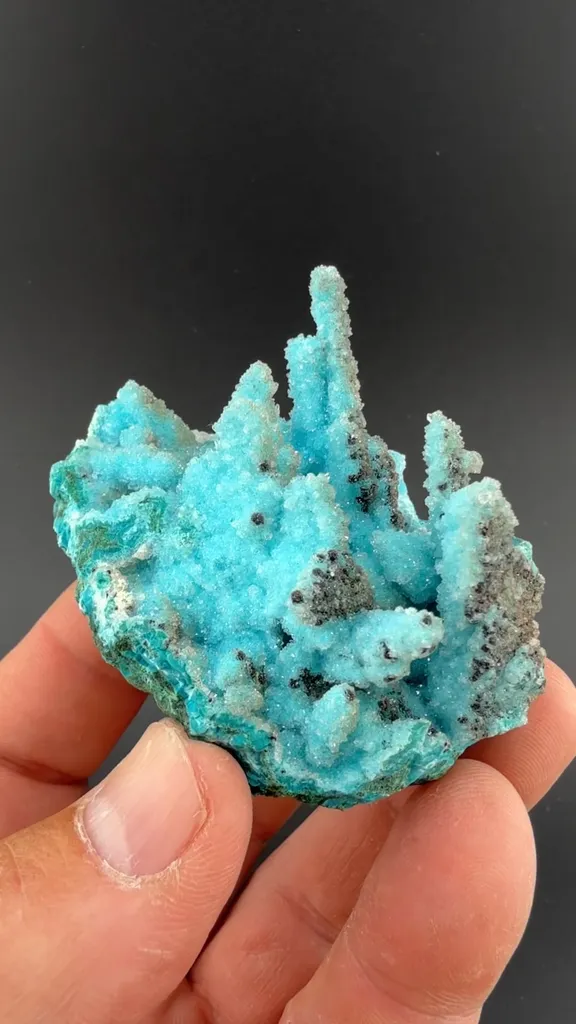
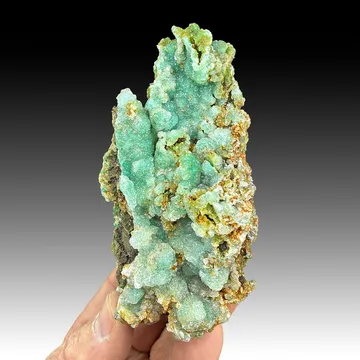
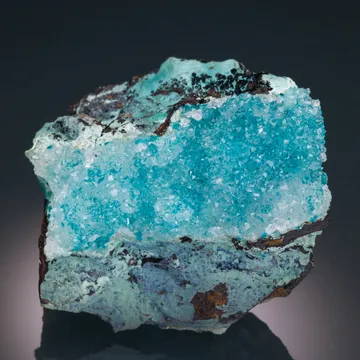
From recent find in the Congo, a beautiful specimen showing bladed crystals of what were likely once azurite or barite measuring to 3.2 cm in length now replaced by sky-blue attractive chrysocolla. Green malachite scattered throughout, the entire specimen coated with a druse of sparkling micro quartz crystals. In very good condition as seen.
The Tenke-Fungurume mining district, located near Kolwezi in the Lualaba Province of the Democratic Republic of the Congo, has an extensive history featuring traditional small-scale copper working dating back over 500 years. Modern industrial exploration and drilling began around 1919, and although a major international consortium attempted development in the 1970s, it was abandoned in 1976 due to political risk. Modern, large-scale industrial open-pit production officially commenced in 2009 and remains actively operational today. Geologically, the deposits are situated within the Central African Copperbelt and the Lufilian Arc, hosted in Neoproterozoic sedimentary rocks of the Roan Group. The mineralization is stratabound, occurring primarily within deformed, thrust-faulted dolomitic shales, siltstones, and carbonate sequences where extensive supergene oxidation has produced world-class concentrations of secondary copper and cobalt minerals such as malachite, chrysocolla, and heterogenite.



 Ships from USA
Comments