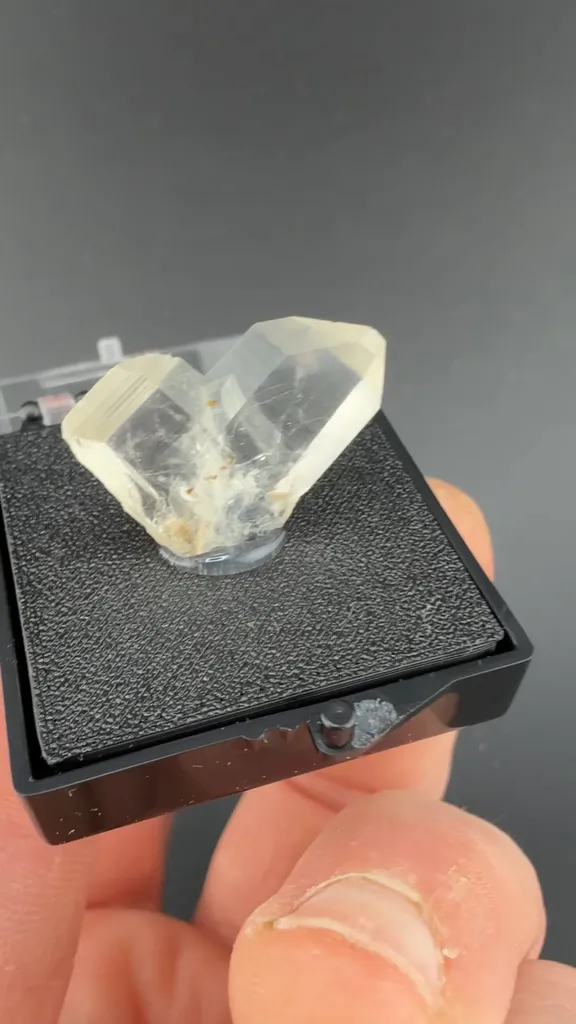
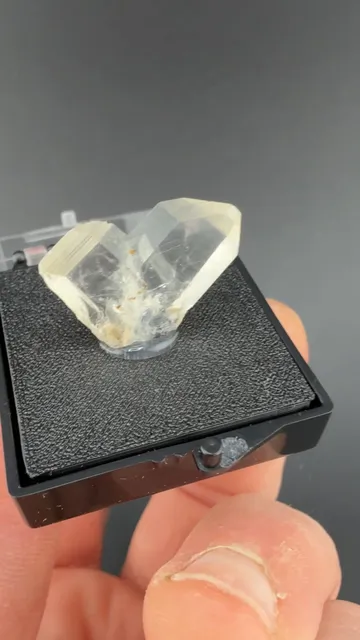
A loose gemmy colorless Japan law twin crystal of quartz. In very good condition.
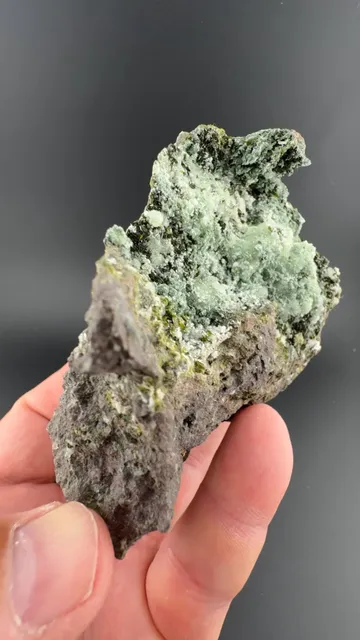
The Flor de Peru I claim, located near Pampa Blanca in the Castrovirreyna Province of Huancavelica, Peru, sits within a rugged, high-altitude Andean metallogenic belt historically renowned for precious and base metal mining dating back to the Spanish colonial era. Geologically, the area is characterized by complex volcanic and sedimentary sequences intruded by tertiary-aged hydrothermal systems, creating favorable conditions for polymetallic vein deposits and skarn formation. Mineralogically, this locality and neighboring claims, such as the Rosario Mabel mine, gained international fame among collectors for producing stunning, world-class specimens of crystallized epidote, often forming deep green, highly lustrous prismatic clusters associated with quartz and calcite.
Regarding Japan law quartz twins, this term describes a characteristic and highly aesthetic twin crystal habit where two individual quartz crystals share a single crystallographic plane at a specific fixed re-entrant angle, typically forming a distinct V-shape or butterfly silhouette. Geologically, Japan law twins can form in various hydrothermal veins, pegmatites, and metamorphic environments worldwide when specific thermal or stress conditions occur during early crystal growth. Mineralogically, they are prized by collectors for their geometric symmetry and rarity, with classic historical localities including mines in Japan, as well as notable occurrences in the Swiss Alps, Peru, and various North American mining districts.

Comments