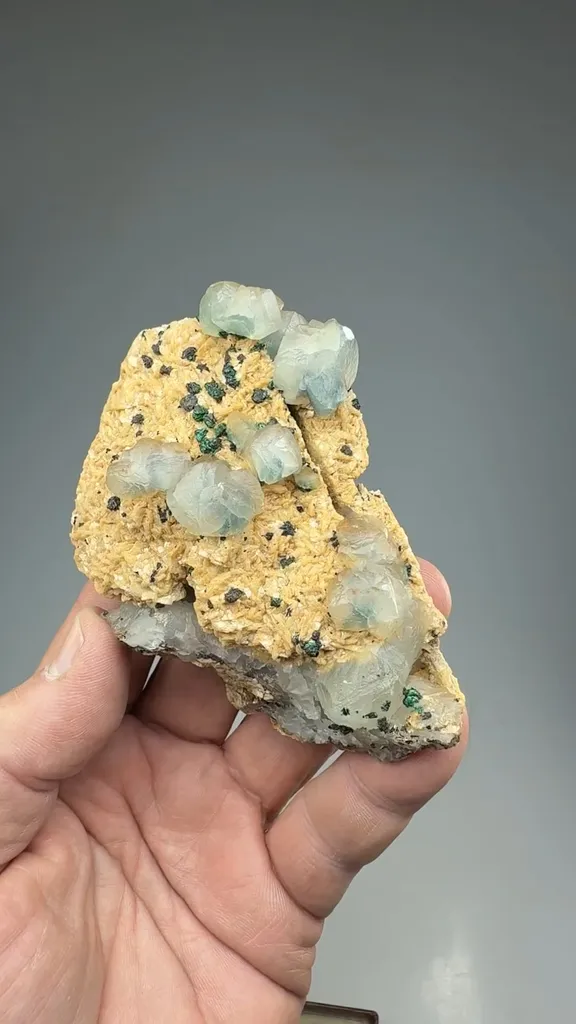

Calcite with Malachite, Chalcopyrite, Dolomite


- Free shipping
- Seller offers an extended return window of up to 14 days
 Ships from USA
W
Weinrich MineralsFeatured
An excellent example from this old classic Welsh locality, rhombohedral crystals of colorless translucent calcite in groupings measuring to 1.7 cm in size across the top of a dolomite crystal covered matrix. Crystals of chalcopyrite are present throughout, these giving way to green malachite. Overall this is in very good condition. The specimen comes with an antique label that dates to 1910. This label however gives the locality as coming from Cornwall. This is undoubtedly a Welsh piece.The Great Orme, a massive limestone headland rising above Llandudno in Conwy, North Wales, is home to one of the largest and most significant prehistoric bronze age copper mining complexes in Europe. Geologically, this prominent headland is composed of Carboniferous-age limestone strata that underwent intense faulting and dolomitization, a process where magnesium-rich fluids altered the limestone into dolomite rock. This structural fracturing created ideal pathways for hot, copper-bearing hydrothermal fluids to ascend and precipitate secondary copper minerals, primarily bright green malachite and deep blue azurite, along with chalcopyrite, within the network of narrow mineral veins and fault fissures. Historically, mining at the site began roughly four thousand years ago during the Early Bronze Age, around 2000 BC, using primitive stone hammers and bone tools to extract the rich copper ores, with operations expanding into an astonishing five-mile subterranean network of tunnels and cavernous stopes. This prehistoric extraction flourished for several centuries before being abandoned around 800 BC, after which the site lay dormant until a brief resurgence of small-scale mining occurred during the Roman occupation and a final period of formal industrial mining took place from 1692 until the economic exhaustion of the deep veins forced a permanent closure of operations in 1881. Following its accidental rediscovery during a landscaping project in 1987, archaeological excavations have transformed the Great Orme into a major underground heritage center, allowing visitors through 2026 to explore the ancient tunnels that yielded the raw copper that fueled the prehistoric Bronze Age economy of the British Isles.Dr. Ludwig Eger (active c. 1870-1915) was a highly respected Austrian mineral dealer based in Vienna who played a significant role in the distribution of Central European and Alpine mineral specimens during the late 19th and early 20th centuries. Operating under the firm name "Dr. L. Eger," his business was situated in the heart of Vienna, a primary hub for scientific exchange during the Austro-Hungarian Empire. Eger was noted for his professional, academic approach to the mineral trade, often supplying high-quality, systematic collections to universities and major museums throughout Europe and North America. His labels are easily recognized by their classic 19th-century typography, typically featuring "Dr. L. Eger, Wien" (the German name for Vienna) and providing detailed locality and species data in a formal, structured format. In addition to minerals, Eger dealt in paleontological and zoological specimens, as was common for the natural history establishments of the time.
Product details
Species
SizeCabinet
Dimensions10.5 x 7.5 x 3.0 cm
Listed on07/16/2026
Locality
SKU1052717
Learn more
Mineral guide
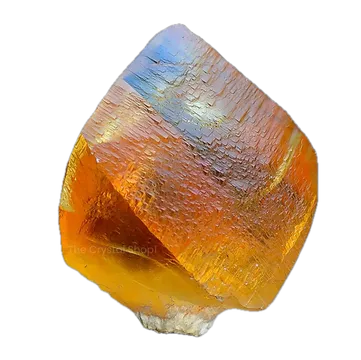
Learn about Calcite
diverse shapes, colors, and optical quirks; widely available yet scarce elite pieces from Elmwood and Charcas drive collecting value and display.Regional guide
Comments