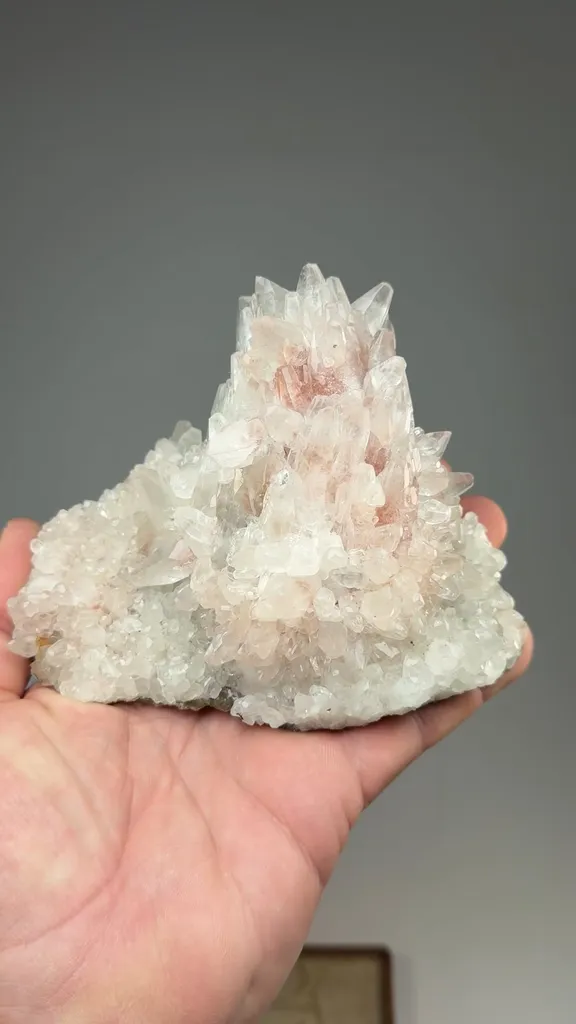

Calcite


- Free shipping
- Seller offers an extended return window of up to 14 days
 Ships from USA
W
Weinrich MineralsFeatured
Classic British specimen with colorless to slightly pinkish mostly gemmy scalenohedral calcite crystals to 2.5 cm in length across the top of matrix. Some cleaving present as seen. This was collected in the 19th century and at one time was part of the collection of Wilhelm Hoyer.The Egremont mining district, situated in West Cumbria, England, was an internationally significant source of exceptionally high-grade iron ore. Geologically, the deposits consist of massive, irregular replacement bodies and fissure-filling veins of hematite hosted within Carboniferous-age Limestone formations, which lie unconformably beneath Permo-Triassic red sandstones. Upward-migrating, iron-rich basinal brines dissolved the carbonate host rocks and precipitated dense, botryoidal masses of hematite (locally called kidney ore), alongside spectacular, highly collectible tabular crystals of specularite, quartz, dolomite, and world-class double-terminated calcite crystals inside vast solution cavities. Historically, while shallow open-cut quarrying and iron extraction in the region date back to the medieval period, large-scale industrial underground shaft mining accelerated rapidly after 1850 to fuel the British industrial revolution and the local Bessemer steelworks. Famous operations around Egremont, including the legendary Hodbarrow, Florence, and Ullcoats mines, employed thousands of miners and operated continuously through both World Wars. Due to the gradual depletion of the richest ore bodies, high underground pumping costs, and the availability of cheaper foreign iron imports, corporate extraction steadily contracted after the 1950s, leading to the permanent cessation of major industrial mining at Egremont by 1968, although localized artisan specimen recovery at the Florence mine continued intermittently until its final commercial closure in 2007.Wilhelm Hoyer was a notable nineteenth-century German engineer, educator, and avid mineral collector based in Hannover who compiled a highly systematic regional and international mineral collection. Geologically, Hoyer focused his personal collecting efforts on the diverse sedimentary, evaporite, and hydrothermal ore deposits of Lower Saxony and the Harz Mountains, amassing carefully documented representative suites of calcite, fluorite, gypsum, and various base-metal sulfides. Historically, his active collecting period spanned the mid-to-late 1800s while he served as a professor of mechanical engineering at the Technische Hochschule Hannover, during which time he maintained active exchanges with leading German mineralogists and commercial dealers to expand his cabinet. Following his death, his curated collection of several thousand meticulously labeled specimens was preserved intact when it was acquired by the major regional natural history museum in Hannover in the late nineteenth century, providing modern researchers with a clean historical record of European mineral localities before many of those historic localities were permanently closed or lost.
Learn more
Mineral guide
Learn about Calcite
diverse shapes, colors, and optical quirks; widely available yet scarce elite pieces from Elmwood and Charcas drive collecting value and display.Regional guide
Comments