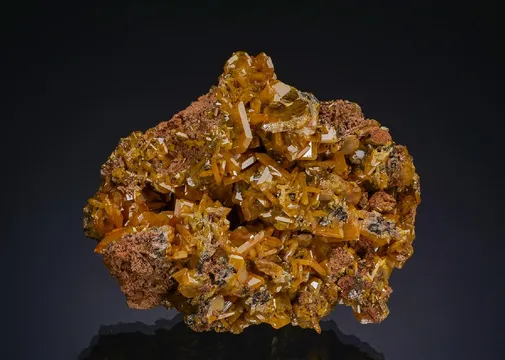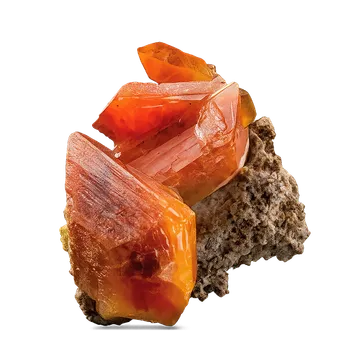
Wulfévite de la mine Rowley, Arizona : lames tabulaires transparents, orange à miel, sur baryte, renommée pour sa transparence, ses arêtes biseautées et l’attrait des collectionneurs de Rowley.
Key facts
La wulfenite de la mine Rowley est un classique pour connaisseurs de l’Arizona : PbMoO4 vert clair à orange vif jaune miel, en lames tabulaires vitrées, souvent perchées sur de la baryte blanche à ferrugineuse et affinées visuellement par des mimétites rouge-orange à jaune. Les plus beaux morceaux portent l’emblème inimitable de Rowley — des plaques fines, transparentes, carrées à rectangulaires avec des arêtes taillées, parfois si claires que les collectionneurs les appellent des vitres, entourées ou surplombées par des jets, boules ou champs drusaires de mimétite.

Photo: Wikimedia Commons
La mine se situe à l’extrémité ouest des Painted Rock Mountains dans le comté de Maricopa, au nord-ouest de Gila Bend et près de Theba. Elle a commencé comme une modeste mais ambitieuse prospection de cuivre-plomb-or-argent-molybdène-baryte-fluorite, mais son intérêt durable a été minéralogique plutôt qu’industriel. La veine Rowley est un système contrôlé par des failles dans des roches volcaniques du Tertiaire, avec une veine de footwall riche en quartz et une veine de hanging-wall épaisse riche en baryte. Cette masse de baryte est devenue la scène sur laquelle l’oxydation ultérieure a assemblé la suite wulfenite-mimétite que les collectionneurs convoitent aujourd’hui.

*Photo: Wikimedia Commons*Pour les collectionneurs, une bonne wulfenite Rowley est d’abord jugée par son intègre et son éclat. Les cristaux sont habituellement fins ; de petites bosses sur les arêtes, des coins manquants et des contacts ayant l’air réallumés sont fréquents. Les meilleures spécimens présentent des plaques nettes et complètes avec un éclat vitreux élevé, une couleur orange saturé à caramel clair, et une présentation cohérente sur baryte ou une matrice sombre contrastante. Les boules de mimétite rouge constituent une associationPremium, surtout lorsqu’elles reposent naturellement sur une wulfenite orange claire sans en gêner la vue.## Spécimens en vedette## Locality Information
Search for specimens: View all wulfenite specimens from Rowley Mine, Arizona, USA
La mine Rowley se situe dans le district minier Painted Rock, à l’extrémité ouest des Painted Rock Mountains, dans le comté de Maricopa, Arizona, à environ nord-ouest de Gila Bend et près de la petite localité de Theba. Les noms historiques incluent Rawley Mine, Reliance Mine, Reliance Copper Mine, Rainbow Mine, Theba Mine et la revendication brevetée de San Carlos. C’est une mine, et non une zone de collecte ouverte; la propriété est privée, et la collecte ou l’entrée dans des travaux souterrains nécessite l’autorisation des titulaires du bail ou des opérateurs.
Le dépôt est un système de veines contrôlé par des failles, hébergé par des roches volcaniques du Tertiaire, en particulier des coulées d’andésite, avec des roches volcaniques rhyolitiques notées régionalement et une couverture basaltique ultérieure dans le district. La veine Rowley suit une zone de faille orientée nord-ouest. La minéralisation est divisée en deux veines adjacentes dans la même structure: une veine de fond de mur en quartz massif et une veine de mur suspendu riche en baryte. La portion quartz est décrite comme mesurant plusieurs pieds de largeur dans le puits principal et au niveau de 125 pieds; elle porte du quartz massif, du jasper léger, de l’hématite speculaire, peu de pyrite, et des bandes ou revêtements de fracture de malachite et de chrysocolle. La veine de baryte est beaucoup plus épaisse, localement de l’ordre de plusieurs dizaines de pieds, et contient de la baryte avec de la galène, de la calcite, de la wulfenite, de la vanadinite, une teinte oxydée de cuivre et un large ensemble de minéraux secondaires du plomb et du cuivre.
L’exploitation a commencé après la découverte vers 1900 et est devenue organisée avec la Rowley Copper Mines Co., incorporée en 1909. Un petit camp s’est développé sur le site, comprenant une baraque de logement, une maison d’hébergement, des cottages, des tentes et des postes électriques. L’eau était un adversaire persistant: les premiers récits décrivent des pompes de Cornish fonctionnant 16 heures par jour et élevant 200 gallons par minute pour empêcher les travaux d’être inondés. Un concentrateur de 75 tonnes a été construit en 1917, après la découverte de la wulfenite, pour traiter le minerai de la mine. En 1922, la Reliance Copper Co. a succédé à la société Rowley, mais les opérations ont rapidement ralenti; une saisie a suivi, et Charles A. Rowley est devenu l’actionnaire majoritaire et président de Rowley Mines, Inc. en 1927.
La production métallique de la mine était modeste. Des récits historiques font état d’une exploitation intermittente de 1909 à 1923 pour le cuivre, le plomb, le molybdène, l’or et les valeurs associées. Un compte rendu USGS note que peut-être entre 8 000 et 10 000 tonnes de matière de veine ont été extraites pendant le développement, avec au moins 2 000 tonnes tirées à l’usine. Les envois comprenaient un petit train de cuivre avec une teneur en cuivre moyenne de 15 pour cent et 30 tonnes de concentré de wulfenite contenant 18,26 pour cent de MoO3. D’ici 1933, un rapport décrivait plus de 1 400 pieds de développement et des expéditions de minerai évaluées à 10 000 dollars, mais l’eau souterraine et des résultats de profondeur médiocres découragèrent une expansion soutenue.Les travaux comprennent des galeries inclinées, une galerie verticale, des boyaux, des travers-bouts et des chambres d’extraction. La galerie inclinée principale, la galerie Jobes ou Jones, et le niveau à 125 pieds reviennent dans les descriptions de la mine. Le niveau à 125 pieds est particulièrement important en minéralogie moderne : de nombreux minéraux post-miniers inhabituels, y compris plusieurs espèces de localité type, y ont été documentés dans un environnement influencé par le guano.
La collecte de spécimens a transformé la réputation de la mine. Pendant une grande partie du XXe siècle, Rowley était une localité de collectionneurs connue en Arizona, et de nombreux collectionneurs appréciaient son wulférite orange et sa mimérite bien après l’arrêt de l’exploitation minière. Plus tard, une récupération de spécimens plus organisée sous contrôle de revendication a produit du matériel supplémentaire de bonne qualité. Les niveaux inférieurs ont été affectés par les inondations et les restrictions d’accès, et les conditions souterraines ont longtemps été dangereuses en raison de baryte fracturée, d’un vieux boisage, d’effondrements et des suites d’incendies et de plusieurs décennies de pression de collecte. La collecte sur les tas de surface a produit du matériel micromount et thumbnail lorsqu’elle est effectuée avec permission, mais la mine doit être traitée comme une localité privée, dangereuse et contrôlée plutôt que comme un site de rockhounding récréatif.## Caractéristiques de la wulfenite de Rowley Mine, Arizona, États-Unis
La wulfenite de Rowley est surtout connue pour ses cristaux tabulaires brillants dans des teintes orange, jaune-orangé, miel, caramel et rouge-orange. L’habitus classique est une fine plaque tétragonale, généralement carrée ou rectangulaire, avec des arêtes biseautées et une lustre vitreux à verre. De bons exemples peuvent être suffisamment gemmeux pour laisser passer la lumière à travers le cristal, en particulier le long des marges plus fines. Certains cristaux présentent une apparence de « vitrine » : des plaques larges et plates, transparentes, avec des arêtes nettes et une couleur orange lumineuse.
La taille des cristaux est généralement modeste. Beaucoup de cristaux mesurent quelques millimètres de diamètre ; les thumbnails et miniatures attrayants présentent couramment des plaques dans la plage 5–10 mm. Des cristaux d’environ 1 cm sont souhaitables, et des cristaux approchant 2 cm sur le bord sont considérés comme grands pour la mine. Les données de localisation de Mindat enregistrent d’excellents cristaux jusqu’à 2 cm sur le bord, ce qui correspond à la plage supérieure observée dans les spécimens publiés et photographiés.
L’association la plus caractéristique est la mimétite, Pb5(AsO4)3Cl. À Rowley, la mimétite peut former de minuscules revêtements drusy, des agrégats « grain de riz » orange à jaune, des faisceaux, des prismes hexagonaux et des spherules rouges à orange. La combinaison la plus prisée est la wulfenite orange transparente avec des billes de mimétite profondes et rouges, d’aspect humide. La mimétite peut orner la wulfenite, la couvrir partiellement ou former une base colorée sous les plaques. Lorsque la mimétite améliore plutôt que de dissimuler la wulfenite, la spécimen adopte le style audacieux et immédiatement reconnaissable de Rowley.
La baryte, BaSO4, est la matrice et le gangue les plus importants pour de nombreux échantillons. La baryte de Rowley peut être blanche, gris-blanc, brunâtre ou tachée de fer, généralement à foliations ou massive. La wulfenite sur baryte à foliations peut être hautement esthétique car les plaques orange se détachent sur un fond pâle et texturé. Certains échantillons reposent sur une matrice volcanique porphyrique plus sombre, où le contraste est différent mais tout aussi attrayant. Le quartz, chalcedony, chrysocolle, malachite, cérussite, anglesite, galène, vanadinite, descloizite, fluorite, calcite, calédonite, linarite, leadhillite, phosgénite, boleite et d’autres espèces secondaires font partie du système minéralier plus large de Rowley.
La palette Rowley peut chevaucher d’autres localités de wulfenite en Arizona, mais la texture est distinctive. La wulfenite Red Cloud est célèbre pour ses plaques d’un rouge profond ; le matériel de la mine Glove montre souvent des plaques plus épaisses orange à rougeâtre sur une matrice limonitique; Rowley concerne plutôt des cristaux tabulaires plus petits, très vitreux, allant de l’orange au caramel, accompagnés de mimétite et de baryte. Les spécimens de Rowley bien développés récompensent un examen attentif : on recherche des arêtes nettes, de la transparence, des faces biseautées, des lames librement montées et la relation spatiale délicate entre la wulfenite et la mimétite.Les facteurs de qualité ne font pas preuve de clémence. L’extrême finesse des cristaux rend les arêtes pristes rares. Une belle pièce Rowley doit présenter plusieurs lames complètes, des angles cassés minimaux, un luster prononcé, une bonne saturation de couleur et un angle d’affichage naturel. La présence de matrice est un plus lorsqu’elle protège les cristaux et offre du contraste. Des plaques isolées peuvent être spectaculaires, mais les spécimens avec matrice sont plus stables et généralement plus souhaitables lorsque la composition est équilibrée.## Notes du collectionneur
La wulfenite de la mine Rowley est disponible, mais les pièces fines ne sont pas courantes. Le marché contient un mélange de spécimens de collections plus anciennes, de pièces issues de périodes de collecte organisées, de stocks de marchands et de miniatures modernes petites. Des exemples ordinaires avec de petites lames orange apparaissent régulièrement; des cristaux vraiment nets, transparents et sans dommages, sur de la baryte esthétique ou avec une mimépite rouge haut de gamme, sont beaucoup plus difficiles à obtenir.
La condition est le problème central. La wulfenite présente une clivage parfait à distinct et les cristaux Rowley sont souvent de fines plaques ; l’ébrutage des arêtes est extrêmement courant. À la loupe, regardez d’abord les coins et les arêtes des lames. Vérifiez si les apparentes « irrégularités de croissance » sont de véritables arêtes en escalier naturelles ou de véritables contusions dues à des chocs. Faites attention aux contacts où les cristaux rencontrent la matrice ou d’autres lames, et méfiez-vous d’un éclairage d’exposition qui masque des marges cassées. Quelques ébrèchures d’arête peu visibles peuvent être acceptables sur une pièce rare ou fortement esthétiqe, mais des coins manquants importants réduisent fortement la valeur.
Les préoccupations d’authenticité concernent surtout la provenance et l’état plutôt que des traitements connus spécifiques à Rowley. Aucune tradition bien établie de fausse wulfenite Rowley ne fait partie de la littérature minéralogique standard, mais les étiquetages erronés peuvent se produire car de nombreuses wulfenites d’Arizona sont orange, tabulaires et superficiellement similaires. Une étiquette Rowley authentique devrait être cohérente avec le style de la mine : plaques tabulaires vitrées orange à jaune, généralement associées à la baryte et à la mimépite, et souvent plus petites que des pièces éblouissantes comparables d’autres mines célèbres d’Arizona. Les anciennes étiquettes provenant de collectionneurs d’Arizona, de marchands reconnus ou de collections documentées dans The Mineralogical Record sont particulièrement précieuses.
Les associations de mimérite nécessitent une inspection minutieuse. Sur les meilleures pièces naturelles, la mimérite est intégrée aux surfaces et cavités de croissance, et non dispersée au hasard. Des billes de mimérite rouge à orange sur la wulfenite sont très recherchées, mais une couverture lourde de mimérite peut masquer une wulfenite cassée ou rendre l’équilibre des espèces moins attrayant. Le vanadinite après wulfenite de Rowley constitue un sous-thème de collecte distinct : ces pièces pseudo-morphes ou de remplacement peuvent préserver les formes de wulfenite couvertes ou remplacées par du vanadinite rouge-brun à orange.
Le nettoyage doit être conservateur. L’attrait du matériel de Rowley dépend du brillant et de la netteté; un nettoyage agressif peut desserrer des plaques fines, détacher la mimépite ou éclairer la matrice d’une manière qui semble artificielle. Évitez le nettoyage ultrasonique pour des spécimens délicats. Manipulez par la matrice, pas par les arêtes de cristal, et montez les miniatures ou thumbnails précieux dans une boîte vive ou sur une base personnalisée pour prévenir les vibrations et le contact des doigts.
Étant donné que la propriété est privée et dangereuse, les spécimens avec une provenance légitime sont importants. Ne traitez pas Rowley comme une destination de collecte occasionnelle. L’autorisation, le contrôle de sécurité et les droits des titulaires de claims sont centraux au statut moderne de la localité.## Stories & Field Notes
A première vue, le cadre désertique de Rowley semble trop sévère pour une localité célèbre pour sa beauté minérale orange et vitrée. La mine est perchée à environ 800 pieds sur la pente ouest d’une colline des Painted Rock Mountains, loin de la politesse d’un étui de musée. Et pourtant, l’endroit n’a jamais été simplement un trou de collectionneur dans le sol. Dans les années de boom initiales, un petit camp s’est développé autour d’elle: baraquement, maison d’hébergement, cottages, tentes, maisons électriques, et les machines nécessaires pour maintenir une mine humide obstinée dans le désert de l’Arizona en vie.
L’eau était l’un des adversaires définissant la mine. Les travaux exigeaient des pompes cornish fonctionnant 16 heures par jour, soulevant 200 gallons d’eau par minute. Pour une mine désormais rappelée pour ses plaques délicates de wulfenite, c’est une image frappante: des hommes souterrain poursuivant le cuivre, le plomb, l’or et le molybdène pendant qu’un cœur mécanique pompait des milliers et des milliers de gallons depuis les travaux simplement pour garder le minerai accessible.
La traînée protectrice autour de la propriété est devenue partie de l’histoire après que Charles A. Rowley ait acquis la mine en tant que propriétaire majoritaire en 1927. Rowley n’était pas casual dans sa tenue. Il embaucha un veilleur de nuit et scella le site avec une clôture en fil barbelé de 6 pieds enfoncée dans le béton. Cette image — le fil barbelé fixé dans le béton autour d’une localité minérale — semble sévère, mais elle dit quelque chose d’important sur la valeur perçue de la mine et le problème d’entrée non autorisée, même avant que la collecte de wulfenite ne devienne la principale renommée de la mine.
D’ici 1933, l’exploitation comptait plus de 1 462 pieds de travaux, y compris des puits inclinés, un puits vertical et des centaines de pieds de galeries et de traverses. Cette année-là, les expéditions minières enregistrées atteignaient 10 000 dollars. Mais la mine n’a jamais pu échapper à la pression combinée de l’eau, des valeurs minières difficiles et des conditions souterraines complexes. Le forage diamant n’a trouvé aucune amélioration encourageante à 360 pieds, et un autre trou de forage à 290 pieds n’a pas montré une meilleure teneur en minerai. La promesse industrielle de la mine s’estompa, tandis que son importance minéralogique attendait toujours d’être pleinement comprise.
Le cadre souterrain qui permettait les spécimens rendait aussi la collecte dangereuse. Le gisement était dans de la baryte fracturée, et le sol de baryte était suffisamment instable pour nécessiter la prudence même lorsque des étais étaient en place. Un rapport de 1971 indiquait que des vandales avaient déclenché un incendie qui détruisit les étais dans la rampe inclinée, rendant la collecte souterraine encore plus redoutable. De plus, la collecte ultérieure élargissait les poches et modifiait les cavités à certains endroits, laissant un paysage souterrain façonné à la fois par l’exploitation minière et la quête des spécimens.Parmi les histoires de collection les plus mémorables figure celle de la célèbre poche de Monnie Speck. Les pièces Rowley que les collectionneurs honorent maintenant — wulfenite orange avec des billes de mimetite rouges profondes et luisantes d’eau — doivent une grande partie de leur mystère à ces découvertes. Une pièce de wulfenite-mimetite de 6,2 cm provenant de la collection Susie Davis, probablement collectée par Monnie Speck, est devenue l’une des pièces Rowley les plus célèbres. Elle a été vendue à l’Institut Smithsonian en 1972 avec le reste de la collection Davis et photographiée plus tard par Rock Currier en 1973. Une autre pièce de 7,2 cm provenant de la même poche célèbre, wulfenite et mimetite luisante sur baryte, se trouvait dans la collection de Wayne Thompson lorsque Currier l’a photographiée en 1973. Ces pièces ont contribué à fixer l’image idéale de Rowley dans l’esprit des collectionneurs : des plaques oranges claires et une mimetite rouge scintillante, compactes mais inoubliables.
Une traverse a reçu un nom qui sonne presque trop poétique pour une mine : la « salle bleue ». Elle était ainsi nommée parce que la chrysocolle tapissait les murs. Dans un gisement célébré pour ses minéraux orange et rouge, cette chambre bleue ajoute une autre couche au caractère de Rowley. La mine n’est pas qu’une localité de wulfenite ; c’est un laboratoire de couleur supergène où le plomb, le cuivre, le molybdène, le vanadium, l’arsenic, le sulfate, le carbonate, le chlorure et même la chimie liée au guano ont créé des zones minérales nettement différentes.
Une tournure moderne est venue de la minéralogie post-mine de la Rowley Mine. Des chercheurs travaillant sur du matériel du niveau à 125 pieds ont trouvé un assemblage inhabituel lié au guano des chauves-souris qui a produit une série de nouveaux minéraux. L’edwindavisite a été nommée d’après F. Edwin Davis, Jr., le collectionneur minéralier basé en Arizona et entrepreneur opérant la mine, crédité d’avoir facilité l’accès, aidé à l’exploration et retiré des spécimens de travaux souterrains difficiles. Dans une localité déjà célèbre pour la wulfenite classique, la mine a acquis une seconde identité en tant que localité scientifique pour des ammoniums rares, oxalates, phosphates et des espèces associées formées dans la chimie particulière d’un environnement minier abandonné.## Registres et publications minéralogiques- Wilson, Wendell E., et Miller, Douglas K. (1974), “Minerals of the Rowley Mine, Arizona,” The Mineralogical Record, 5(1), 10–30. Le traitement classique précoce de collectionneur-minéralogiste, cité à plusieurs reprises dans les dossiers de localité ultérieurs.