Black Pine Mine, Montana — American classic for veszelyite: blue-green, elongated crystals on quartz with oxidized-vein; prized for provenance and rarity.
Key facts
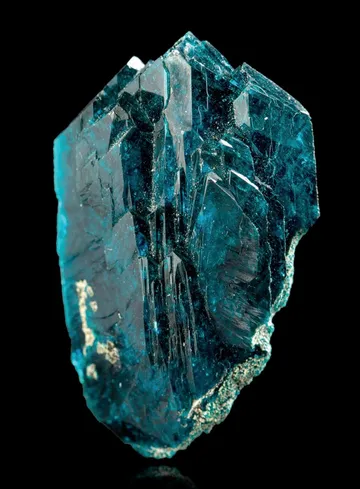
Black Pine Mine is the American classic for veszelyite: not simply a place where the species occurs, but the locality that gave collectors the sharply formed, saturated blue to blue-green crystals by which the mineral is still judged. The finest Black Pine pieces have a look unlike the richer, more massive modern material from China—elongated, lustrous, well-terminated crystals perched on quartz, chrysocolla-rich matrix, or oxidized vein material, often with a depth of color that reads almost black-blue in direct light and electric teal along thin edges.

Photo: Wikimedia Commons
The mine lies northwest of Philipsburg in Granite County, Montana, in a polymetallic vein system worked principally for silver, copper, gold, lead, zinc, and antimony. Its collector fame rests in the oxidized mineral suite: a compact but exceptionally varied environment where copper, zinc, arsenic, phosphate, lead, antimony, tungsten, and tellurium chemistry produced a gallery of rare secondary species. Black Pine is the type locality for philipsburgite and has also yielded type material for auriacusite and joëlbruggerite. That same chemical richness explains why Black Pine specimens are rarely just “blue crystals”; good pieces often sit in a context of quartz, chrysocolla, malachite, philipsburgite, pseudomalachite, mimetite, or iron oxides, giving the locality’s specimens their distinctive American oxidized-vein character.

Photo: Wikimedia Commons
Collectors prize Black Pine veszelyite for four things: strong blue-green color, sharp elongated form, glassy to subadamantine luster, and credible old provenance. Most specimens are thumbnails or small miniatures; true matrix pieces with multiple sharp crystals, balanced aesthetics, and little damage are substantially scarcer. The mine is closed and reclaimed, so the supply reaching the market comes mainly from older collections and dealer stock that has been circulating since the productive collecting years of the late twentieth century.
Search for specimens: View all veszelyite specimens from Black Pine Mine, Montana, USA
Black Pine Mine is in the Philipsburg, or Flint Creek, mining district of Granite County, Montana, roughly 14–15 km northwest of Philipsburg, in the John Long Mountains area. The locality is also historically tied to the Combination Mine, Combination vein, Upper vein, Tim Smith vein, Onyx vein, Lewis shaft, and Combination adit names. Modern locality summaries place it at about 46°26′52″N, 113°21′56″W, with the mine complex extending over patented mining claims and adjoining National Forest lands.
Geologically, the important ore came from the Combination vein, one of several subparallel veins in Belt Supergroup rocks, especially the Mount Shields Formation of the Missoula Group. Older descriptions treated the veins as bedding-plane structures, but later structural interpretation recognizes them as occupying thrust-fault-related zones. The Combination vein produced the richest silver ore; the mine’s primary ore assemblage included silver-bearing tetrahedrite, pyrite, hübnerite, galena, sphalerite, chalcopyrite, and native gold, silver, and copper in quartz veins. The secondary mineral suite that collectors know formed later, by oxidation and chemical remobilization of that polymetallic primary ore.
Mining began after claims were staked in 1882. In November 1885, a 400-ton shipment of ore went to the Hope mill in Philipsburg and showed a profit, drawing wider attention to the property. The Black Pine Mining Company was incorporated in October 1886, and although that company did not endure, subsequent work by the Combination Mining and Milling Company and later operators made the deposit an important silver producer. Reported aggregate production for the mine includes more than 5.6 million ounces of silver, about 3,000 ounces of gold, more than 10.6 million pounds of copper, and lesser lead and zinc.
The mine had both an old historic life and a modern industrial life. Historic underground development included extensive shafts, drifts, and declines, with old reports noting 22 levels and flooded workings by the mid-twentieth century. Later production records show renewed activity from the 1970s into the early 1990s under operators including Inspiration Resources and ASARCO. The Black Pine complex is now inactive and reclaimed; Montana environmental records describe it as an inactive silver mine with patented claims, unpatented lode claims, waste rock, tailings, impacted soils, and ongoing reclamation responsibilities. Collectors should treat the site as closed, reclaimed, and environmentally sensitive, not as an open collecting locality.
The collector discoveries that matter most for veszelyite came from oxidized pockets in the mine’s secondary zone. By the 1980s the locality was already known for rare and unusually well-crystallized species, and preserved material has continued to yield scientific surprises. Black Pine specimens have been central to later mineralogical work on philipsburgite, joëlbruggerite, auriacusite, and related rare secondary phases, which is why a good Black Pine label carries both aesthetic and research significance.
Black Pine veszelyite is typically blue, blue-green, teal, or dark greenish blue. In the best crystals the color is strongly saturated: nearly inky across thicker crystal interiors, bright blue-green along edges, and more luminous where crystals are thin or backlit. The luster can be excellent, and many choice pieces show crisp faces rather than sugary aggregates.
The characteristic habit is elongated prismatic to bladed crystals, commonly in small clusters or divergent groups. Some crystals appear doubly terminated, and better pieces show strongly defined faces with a sharp, almost architectural outline. Rosette-like or fanlike groups occur, but the Black Pine “look” is usually more prismatic and elongated than the dense blue rosettes familiar from newer Chinese material.
Typical crystals on collector specimens are measured in millimeters. Documented display pieces include 6 mm crystals on chrysocolla-quartz matrix, 1.4 cm thumbnail crystals, and matrix specimens around 3 cm across carrying multiple sharp crystals. A 1.5 cm crystal on a 3.0 x 1.7 x 1.6 cm specimen has been singled out in the Mindat photo record as a notably large and aesthetic example. Such crystals are large for the locality and species; most available pieces are considerably smaller.

Photo: Wikimedia Commons
Common matrix and association clues include quartz, chrysocolla, malachite, iron oxides, and other oxidized copper minerals. The wider Black Pine secondary suite includes philipsburgite, pseudomalachite, pyromorphite, mimetite, bayldonite, duftite, beudantite-corkite, tsumebite, rosasite, brochantite, devilline, serpierite, wroewolfeite, linarite, olivenite, pharmacosiderite, stolzite, and rare species such as auriacusite and joëlbruggerite. Quartz matrix is especially desirable when it provides contrast and stability without overwhelming the blue crystals.
Quality is judged first by crystal form, then by color, luster, condition, and matrix. A single sharp, lustrous, undamaged, deep-blue thumbnail crystal can be more important than a larger but dull or broken patch. Multiple crystals on a natural matrix, especially with good spacing and visibility, are rarer. The most desirable Black Pine specimens are not just “rich” in the sense of coverage; they have cleanly isolated crystals, strong contrast, and enough matrix to prove natural context.
Authentic Black Pine veszelyite usually has a recognizable visual grammar: blue to blue-green elongated crystals, commonly on quartz or oxidized copper-rich matrix, with a mine label tying it to Philipsburg or the Black Pine/Combination mine names. Because the locality is also famous for philipsburgite, collectors should be careful with green material. Philipsburgite is bright emerald green and can form attractive crusts or crystal groups; it is not a blue prismatic veszelyite, though both can appear on Black Pine specimens and both are collectible.
No documented, locality-specific treatment or fake industry is known for Black Pine veszelyite. The more common authenticity problem is misidentification. Dark blue-green chrysocolla, malachite-rich crusts, brochantite-group minerals, or philipsburgite can be overenthusiastically labeled as veszelyite, especially in small online lots. For high-value specimens, the safest purchases are those with old labels, reputable dealer histories, published or photographed provenance, or analytical confirmation when the visual evidence is ambiguous.
Condition matters greatly. Veszelyite is a relatively soft, brittle hydrated copper-zinc phosphate, so crystals can bruise, cleave, or lose terminations. On older Black Pine pieces, check for rubbed high points, broken crystal tips, repaired matrix, and loose crystals on pocket clay or friable iron-oxide matrix. Dark lustrous crystals can hide bruising until viewed under strong oblique light. A clean termination, intact edges, and natural contact points are worth a premium.
The mine’s closure and reclamation have made supply finite in any practical collector sense. Fine Black Pine thumbnails appear periodically, but usually as old collection pieces rather than fresh finds. Matrix miniatures with multiple sharp crystals and fine aesthetics are much less available. Prices vary sharply with quality: modest micro or thumbnail material can be reachable for specialized collectors, while elite, lustrous, well-composed examples from old collections can command serious four-figure prices.
The Black Pine story begins like a nineteenth-century mining tale: a new district, a trial shipment, and a small profit that changed everything. Claims were staked in 1882 by Aeneas McAndrews in what was then called the Black Pine district. Three years later, in November 1885, 400 tons of ore were hauled to the Hope mill in Philipsburg. That shipment did not make anyone rich, but it did what a first shipment had to do: it proved the mine had value. By October 1886 the Black Pine Mining Company had been incorporated, and investors had a reason to look hard at the veins in those Belt rocks northwest of town.
The first corporate effort failed, but the mine itself did not. The Combination Mining and Milling Company took over the story and produced more than 2 million ounces of silver. Later operators kept returning to the ground, and the eventual tally became far larger: 5,622,000 ounces of silver, 3,000 ounces of gold, 10,678,000 pounds of copper, plus small amounts of lead and zinc. To ore men, those numbers explain why the workings grew. To collectors, they explain something subtler: the chemistry was never simple. The same complexity that made the ore polymetallic later made the oxidized zone a nursery for rare secondary minerals.
By the mid-twentieth century, the old workings were already a maze with a memory. Historic reports cited 1,000 feet of shafts and 14,000 feet of drifts and declines by 1958. Older descriptions noted 22 levels, and by 1947 the mine was flooded up to Level 15. The Combination Mill left its own physical trace along the South Fork of Lower Willow Creek, where ore had been treated by crushing, roasting, and mercury amalgamation. About 70,000 cubic yards of tailings were placed in an adjacent impoundment, a reminder that specimen localities are also industrial landscapes with long environmental afterlives.
The collector chapter is more intimate: pockets, not tonnage. A few small pockets produced the deep-blue crystals that became the world standard for the species. The crystals were not abundant in the way quartz or pyrite can be abundant; they were discovered, saved, trimmed, traded, and then mostly disappeared into collections. Dealer descriptions from notable photographed specimens preserve the tone of the collecting world after the mine shut: choice thumbnails “seldom turn up,” and matrix specimens were especially scarce. That scarcity is why a Black Pine thumbnail with one sharp crystal can stop a knowledgeable collector in mid-conversation.
The science continued after mining. In 1993, John Dagenais collected material at Black Pine that later became type material for joëlbruggerite, a purple microscopic arsenate named for mineralogist Joël Brugger. The new mineral was not the sort of thing that wins over casual collectors at arm’s length—its crystals are only about 50 microns across—but its discovery revealed how chemically unusual Black Pine really is. The same locality that gave collectors beautiful centimeter-scale blue veszelyite also gave mineralogists a species involving lead, zinc, antimony, tellurium, and arsenic in a highly oxidized secondary environment.
That is the charm of Black Pine: the mine operates on two scales at once. At the cabinet scale, a good specimen is a dark blue jewel on quartz. At the analytical scale, the oxidized vein system is a puzzle of arsenates, phosphates, tellurates, sulfates, and copper-zinc chemistry. The best Black Pine veszelyites carry both stories—the miner’s silver vein and the mineralogist’s rare-species laboratory—in a specimen small enough to fit in a thumbnail box.