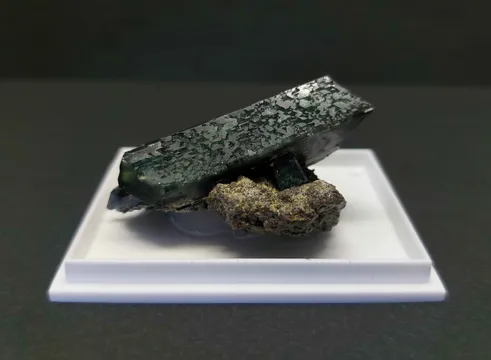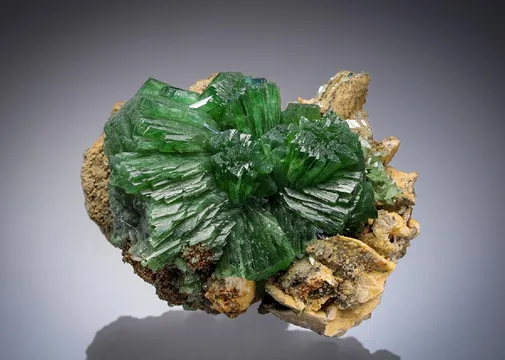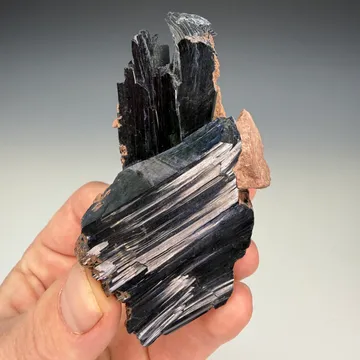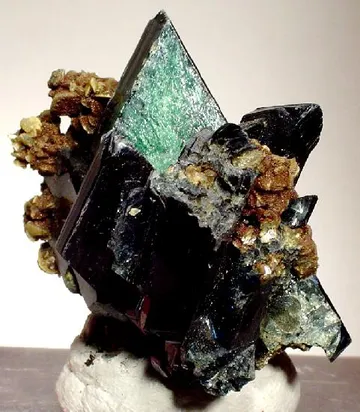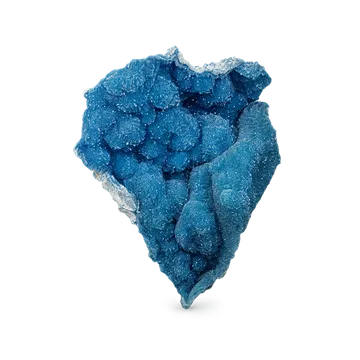
Vauxite - blue hydrous phosphate from Huanuni Mine, Bolivia; prized for delicate blue tabular forms, rarity, and storied provenance in the Bolivian tin belt.
Key facts
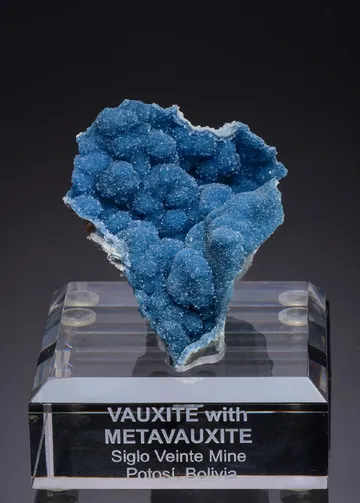
Vauxite attributed to Huanuni Mine occupies one of the more interesting gray zones in Bolivian phosphate collecting. The mineral itself is unmistakable when fine: sky- to cornflower-blue, hydrous iron-aluminum phosphate in tiny tabular crystals, scaly plates, rosettes, and silky druses. On a good specimen the blue reads like a soft bloom across a pale or iron-stained matrix rather than as bold, isolated crystals. Huanuni-labeled pieces have circulated for decades, usually as thin plates or miniature clusters of blue vauxite, sometimes with metavauxite or other phosphate species, and they appeal to collectors precisely because they sit at the intersection of rarity, beauty, and provenance.
The caution is essential: the Huanuni occurrence has been treated differently by different sources. Some dealer records and a modern crystallographic study refer to vauxite from Huanuni, while Mindat currently marks the Huanuni occurrence as erroneously reported and notes that the material may instead trace to the Miraflores adit in the Llallagua-Uncía district. That does not make every Huanuni-labeled specimen worthless or fictitious, but it does mean that the locality should be handled with the same care one would apply to an old-label phosphate from Llallagua: labels, collection history, matrix, associations, and, for important pieces, analytical confirmation matter.
Geologically, the Huanuni district is not a casual phosphate locality; it is one of the great tin systems of the Bolivian Tin Belt. The mine is best known as a vast cassiterite producer in a complex Sn-W-Pb-Ag-Zn hydrothermal system around the Pozokoni hill area. The primary ore story is cassiterite, quartz, tourmaline, arsenopyrite, pyrrhotite, sphalerite, stannite-kësterite, silver sulfosalts, and related tin-belt minerals. The phosphate story belongs to late and secondary processes: alteration of phosphate-bearing phases, oxidizing fluids, and protected cavities where delicate hydrous phosphates could survive.
For collectors, the attraction of a Huanuni-labeled vauxite is not size alone. The best pieces show a coherent surface of blue crystallization rather than isolated smudges; a fresh, non-faded blue; visible crystal texture under magnification; and a believable old provenance. Because vauxite is soft, hydrated, and visually delicate, undamaged rosette edges and intact silky laths carry real weight. A specimen with an old “Miraflores mine, Huanuni” or “Huanuni” label is especially interesting, but it should be cataloged with a provenance note rather than silently merged into unquestioned Huanuni production.
Search for specimens: View all vauxite specimens from Huanuni Mine, Bolivia
Huanuni Mine lies at Huanuni, Pantaleón Dalence Province, Oruro Department, Bolivia, in the central part of the Bolivian Tin Belt. Its coordinates are commonly given near 18°17′S, 66°50′W, and the mine sits immediately by the town of Huanuni. The broader district is structured around Pozokoni hill and contains a dense network of veins and breccias rather than a single simple lode.
The deposit is a polymetallic hydrothermal tin system. Modern work describes the mineralization as hosted mainly by Paleozoic quartzites, shales, and siltstones of the Llallagua, Uncía, and Cancañiri formations, with lesser involvement of Miocene volcanic rocks. The veins and breccias form roughly radial and concentric patterns around the central Pozokoni area, with central and peripheral domains showing different metal emphases. Early and intermediate stages carry much of the cassiterite and base-metal sulfide assemblage; later stages are richer in stannite-kësterite and silver sulfosalts; supergene assemblages include phosphates, sulfates, oxides, oxyhydroxides, arsenates, and carbonates.
That supergene environment is the geological opening for vauxite and its relatives. Vauxite, Fe2+Al2(PO4)2(OH)2·6H2O, is a hydrated phosphate derived from alteration of apatite or other phosphate-bearing material. At Huanuni, confirmed late phosphate species include important collector minerals such as vivianite, ludlamite, wavellite, and the Huanuni type-locality mineral nikischerite. Whether every vauxite specimen labeled Huanuni truly came from the mine is the central locality question, but the chemistry of the district is at least plausible for late phosphate formation.
Mining history at Huanuni is long and economically weighty. The district was developed intensively in the twentieth century and became one of Bolivia’s key tin producers. It passed through private and state-controlled phases, including the Patiño era, nationalization under COMIBOL after Bolivia’s 1952 revolution, later restructuring and private involvement, and renewed state administration in the 2000s. Unlike many Bolivian tin operations damaged by the tin-market crisis of the 1980s, Huanuni remained important because of its unusually rich ore. It is still an active industrial tin mine, not an open collecting locality.
Collectors should assume that casual access is not available. Huanuni is a working state mine with extensive underground workings, security concerns, labor history, and ongoing production priorities. Specimens that reach the market generally come through miners, old collections, dealer inventories, or historical dispersals. For modern acquisitions, the practical “collecting access” is the secondary market, and the locality value depends heavily on documentation.
Production of fine phosphate specimens from Huanuni has been episodic. Vivianite and ludlamite from the mine are better established on the specimen market than vauxite, and Huanuni vivianite in particular had a notable market presence from finds around the 1990s. Vauxite, by contrast, appears rarely and often with locality ambiguity. A few sold specimens have been cataloged as Huanuni or “Miraflores mine, Huanuni,” including thin plates covered with blue crystallized vauxite and small pieces with metavauxite plus minor blue vauxite. These records are useful, but they also reinforce why provenance should be preserved exactly as received.
Huanuni-labeled vauxite is usually described as blue crystallized material on a thin matrix plate or as compact miniature clusters. The strongest visual examples are not large free-standing crystals but dense, glistening surfaces of tiny tabular crystals. Under magnification the best material should show individual laths or scaly plates arranged in rosettes, fans, subparallel aggregates, or soft drusy crusts.
The expected color range is pale blue to deeper sky or cornflower blue. The most desirable Huanuni-labeled pieces are those with a saturated, even blue across the display face. Pale, grayish, or greenish surfaces are less compelling, especially if the crystal texture is weak. Vauxite in general can shift toward greenish tones with exposure, so a rich blue surface on an older specimen is a quality point, provided the color looks natural and is supported by crystal habit.
Specimen sizes documented in the trade tend to be thumbnail to small-cabinet. One sold example attributed to Huanuni was a very thin 75 x 60 x 3 mm matrix plate coated with deep blue crystallized vauxite. Another, labeled Miraflores mine, Huanuni, was a 4.7 x 3.8 x 1.0 cm miniature described as a light-blue crystallized cluster with little matrix. A smaller 2.7 x 2.4 x 0.7 cm thumbnail from Huanuni was described as metavauxite with minor blue vauxite. These dimensions fit the species: vauxite is generally a surface-forming phosphate, and thickness or relief is usually modest.
Associated minerals are important but also part of the locality puzzle. For vauxite as a species, the classic Bolivian associations include wavellite, paravauxite, metavauxite, and other rare phosphate minerals from Llallagua. At Huanuni, the broader phosphate suite includes wavellite, vivianite, ludlamite, and other late secondary minerals, while the primary ore environment supplies quartz, cassiterite, sulfides, sulfosalts, siderite, and iron oxides. A Huanuni-labeled vauxite on a matrix consistent with Bolivian tin-vein secondary phosphate material is more believable than a loose blue mass with no context.
Quality rests on five points: blue color, visible crystallization, coverage, condition, and provenance. A small but richly crystallized blue patch with an old label can be more important than a larger, dull, abraded plate. Because vauxite crystals are tiny and fragile, edge abrasion, rubbing, flattening, and loss of rosette rims are common detractors. Clean, unbruised silky luster is a major premium.
The collector should also distinguish vauxite from superficially similar blue secondary minerals. Blue vivianite, pale turquoise-blue crusts, altered phosphate coatings, and even mislabeled wavellite-bearing material can cause confusion in low-quality photographs. For high-value Huanuni-labeled pieces, Raman, XRD, or other non-destructive analytical confirmation is worth considering, especially when the specimen lacks a strong old provenance.
The main authenticity issue is not a known treatment problem; it is locality authenticity. Modern locality databases do not treat Huanuni vauxite as a settled occurrence. Huanuni-labeled vauxite exists in the specimen trade, and a published study examined a vauxite sample identified as from Huanuni, but Mindat currently flags the occurrence as erroneously reported and suggests likely confusion with Miraflores in the Llallagua-Uncía district. Serious collectors should therefore record the label wording exactly: “Huanuni,” “Miraflores mine, Huanuni,” “Huanuni, Oruro,” or any older province designation should not be normalized away.
No well-documented fake or routine treatment appears to be specific to vauxite from Huanuni. The risk is subtler: misattribution, overconfident relabeling, and specimens from Llallagua or Siglo XX being sold as Huanuni because an old Miraflores label was misunderstood. This is particularly plausible because Llallagua is the historic type area for vauxite, paravauxite, and metavauxite, while “Miraflores” is a name connected in collector discussions with the Llallagua district as well as with Huanuni-area confusion.
Condition is a major concern. Vauxite is soft, hydrated, and occurs in small crystals. Edges crush easily; velvety or pearly luster can be dulled by handling; thin plates can flex or snap; and old matrix can shed grains. Avoid wet cleaning unless you know the matrix and associated minerals can tolerate it. A gentle air bulb and careful storage are safer than brushing. Keep specimens out of direct sun and away from heat. Stable room humidity is preferable to dry heat, especially for hydrated phosphates.
Rarity is high. Vauxite itself is an uncommon phosphate, and Huanuni-attributed examples are much scarcer in the marketplace than ordinary Bolivian phosphates. However, scarcity should not automatically translate into unquestioned locality value. The finest “Huanuni” specimen is one with a chain of evidence: old dealer or collection label, consistent matrix, species confirmation, and preferably a history that predates recent online recycling of locality data.
Current market availability is limited. Most identifiable Huanuni-labeled vauxite records online are sold specimens rather than active stock. When pieces appear, they are usually thumbnails, miniatures, or thin plates. Prices vary widely with aesthetics and confidence in the label, but sophisticated buyers will discount uncertain provenance and reward preserved old labels. A specimen with a questionable or modern-only Huanuni label should be priced as a rare vauxite with locality uncertainty, not as a fully documented second classic locality.
The most memorable story attached to Huanuni vauxite is not a pocket discovery but a label problem. In collector discussions, the phrase “Miraflores mine, Huanuni” became the hinge on which the entire occurrence turned. One experienced Bolivia specialist argued that all Bolivian vauxites he knew were from Llallagua, and that the attractive lots once sold as “Miraflores Mine, Huanuni” were likely victims of geography: a Miraflores adit was known in the Llallagua district, while he could not verify a Miraflores mine or adit at Huanuni. For a collector, that is exactly the sort of detail that changes a specimen label from a statement into a question. A blue phosphate crust may look the same in the case, but the line under it should read with more humility.
A later field-style account complicated the picture rather than resolving it. A collector reported acquiring a vauxite specimen in Bolivia in 2016 from a mining engineer who worked at Huanuni. The engineer reportedly said he had collected the specimen personally inside the mine, likely from the -80 level of the Patiño section. The point of the story is not that it proves the occurrence; it does not. Its value is that it shows why the debate has persisted. Huanuni is not merely a copied name in old dealer stock: there are modern claims from people tied to the mine itself. That is enough to keep the door ajar, but not enough to erase the need for analytical and provenance discipline.
Huanuni’s broader collecting history also carries the ghost of the Vaux expeditions. A pair of rare Huanuni jarosite specimens in the Academy of Natural Sciences Philadelphia lineage were described as having been recovered during the third or fourth Vaux expedition to Bolivia in the late 1930s, accompanied by original Vaux collection labeling. That is a striking connection for a vauxite collector because vauxite was named for George Vaux Jr., the Philadelphia collector whose name became attached to the blue phosphate from Llallagua. Even when the mineral is not vauxite, Huanuni’s old labels show how deeply the Philadelphia-Bolivia collecting network reached into the tin districts.
The mine itself has a much harder modern story. In October 2006, Huanuni became the scene of violent conflict between state-employed miners and cooperative miners fighting for access to rich tin workings. Reports from the time describe dynamite, firearms, stones, and sticks; death tolls were reported in the high teens to low twenties, with dozens more wounded. The government later reorganized the operation, and thousands of cooperative workers were brought onto the COMIBOL payroll. For specimen collectors, that history is a reminder that “access” at Huanuni is not a romantic field-collecting matter. It is a working industrial and social landscape where minerals are embedded in labor, state control, security, and livelihoods.
Mindat: Vauxite from Huanuni mine, Huanuni, Pantaleón Dalence Province, Oruro, Bolivia — The key locality-status record; it currently marks the Huanuni vauxite occurrence as erroneously reported and notes possible confusion with the Miraflores adit in Llallagua-Uncía.
Mindat: Huanuni mine, Huanuni, Pantaleón Dalence Province, Oruro, Bolivia — The main locality page for Huanuni, with coordinates, mineral list, commodity data, references, and the broader mineralogical context of the mine.
Mindat: Vauxite mineral information and data — Species page giving formula, physical properties, type locality, naming information, and the locality list, including the questioned Huanuni entry.
Van Alboom, A., da Costa, G. M., and De Grave, E. (2018), “Deficiency of water molecules in the crystallographic structure of vauxite,” Physics and Chemistry of Minerals, 45, 249–257 — A modern analytical study of a vauxite sample identified as from Huanuni, using XRD, TGA, and Mössbauer spectroscopy.
Cacho, A., Melgarejo, J. C., Camprubí, A., Torró, L., Castillo-Oliver, M., Torres, B., Artiaga, D., Tauler, E., Martínez, Á., Campeny, M., Alfonso, P., and Arce-Burgoa, O. R. (2019), “Mineralogy and Distribution of Critical Elements in the Sn–W–Pb–Ag–Zn Huanuni Deposit, Bolivia,” Minerals, 9, 753 — The best open technical source for Huanuni’s geology, paragenesis, ore mineralogy, and deposit-scale setting.
Ventruti, G., Schingaro, E., Monno, A., Lacalamita, M., Della Ventura, G., Bellatreccia, F., Cuocci, C., Rossi, M., and Capitelli, F. (2016), “Structure refinement and vibrational spectroscopy of vauxite from the type locality, Llallagua (Bolivia),” The Canadian Mineralogist, 54, 163–176 — Important structural and spectroscopic work on type-locality vauxite, useful for comparing any Huanuni-attributed material.
Baur, W. H., and Rama Rao, B. (1968), “The crystal structure and the chemical composition of vauxite,” American Mineralogist, 53, 1025–1033 — Classic structure paper on vauxite, still central to the mineral’s crystallography.
Handbook of Mineralogy: Vauxite — Concise reference sheet for formula, crystallography, optical data, associations, and listed occurrences.
Roberts, A. C., Grice, J. D., Hawthorne, F. C., Huminicki, D. M. C., and Jambor, J. L. (2003), “Nikischerite, a New Mineral from the Huanuni Tin Mine, Dalence Province, Oruro Department, Bolivia,” The Mineralogical Record, 34, 155–158 — Type-mineral publication for Huanuni’s phosphate-sulfate assemblage, cited in the Huanuni locality references.
Wikimedia Commons: Jarosite-202065, Huanuni Mine, ex Academy of Natural Sciences Philadelphia Collection — Not vauxite, but a notable Huanuni museum-lineage specimen tied to the Vaux collection and valuable for understanding historic collecting provenance from the mine.
Mindat locality page for Huanuni Mine — Best starting point for the mine’s mineral list, coordinates, references, and locality hierarchy.
Mindat occurrence page for vauxite at Huanuni — Essential for understanding the current “erroneously reported” status of Huanuni vauxite.
Mindat species page for vauxite — Useful for formula, type locality, naming, properties, and global occurrence context.
Cacho et al. 2019 Huanuni deposit paper — Detailed open-access technical paper on Huanuni’s Sn-W-Pb-Ag-Zn geology, paragenesis, and critical-element mineralogy.
Van Alboom, da Costa, and De Grave 2018 vauxite study — Analytical paper on a vauxite sample reported from Huanuni, important despite the locality debate.
Ventruti et al. 2016 vauxite structure refinement — Modern crystal-chemical study of vauxite from the Llallagua type locality.
Handbook of Mineralogy vauxite PDF — Compact mineral data reference for collectors and catalogers.
FMF discussion: “Vauxite from Huanuni?” — Collector discussion capturing the modern uncertainty around Huanuni-labeled vauxite and a reported 2016 mine-source specimen.
Mindat discussion: “VAUXITE — one locality specie or not?” — Important older discussion of the Miraflores/Huanuni versus Llallagua locality problem.
Minfind archived Huanuni vauxite specimen — Dealer-archive example of a sold Huanuni-labeled vauxite plate, useful for market comparison.
Weinrich Minerals: Vauxite, Miraflores mine, Huanuni — Sold specimen page documenting the “Miraflores mine, Huanuni” label style.
Weinrich Minerals: Metavauxite with vauxite, Huanuni mine — Sold specimen page documenting a Huanuni-labeled metavauxite specimen with minor blue vauxite.
COMIBOL 2026 Huanuni production and management update — Current official context for Huanuni as an active state tin mine.
International Tin Association: 2007 Huanuni dispute report — Useful background on the post-2006 reorganization and production figures.
MercoPress report on the October 2006 Huanuni conflict — Historical context for the labor conflict that shaped modern access and mine administration.
Wikimedia Commons: Category Huanuni Mine — Open image archive of Huanuni specimens, mainly cassiterite, jarosite, vivianite, and associated minerals.