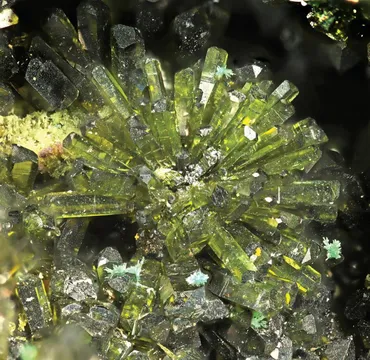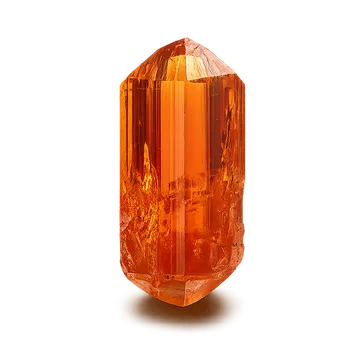
Topaz Mountain, Utah — classic American locality for rhyolite-hosted topaz, with sherry-amber crystals, public collecting access, and a collecting heritage.
Key facts
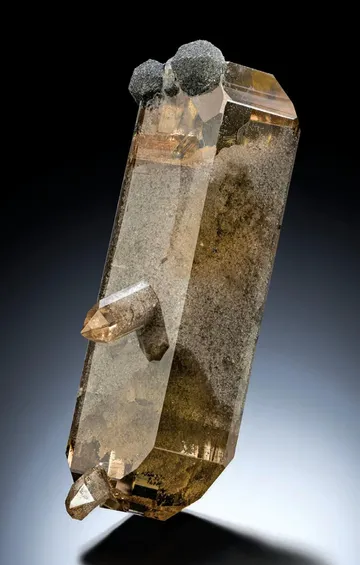
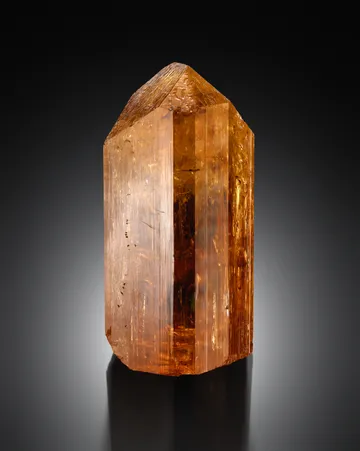
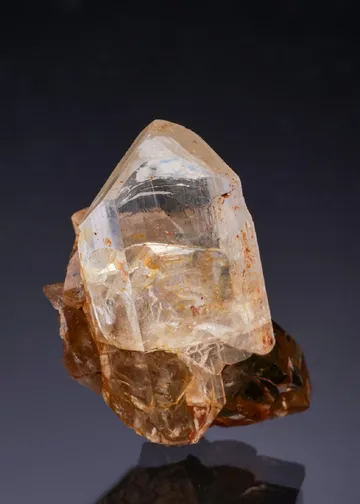
Topaz Mountain is the classic American locality for rhyolite-hosted topaz: bright, glassy orthorhombic crystals released from pale volcanic rock in the empty west desert of Juab County, Utah. The best specimens have the distinctive “sherry” to amber color that collectors associate with the Thomas Range, often with transparent, sharply terminated prisms standing out against gray-white rhyolite. That color is part of the romance and the caution of the locality: fresh crystals can be richly honey-brown when first opened from cavities, but prolonged sunlight commonly fades them toward colorless, so a specimen that still retains natural warm color has extra collector appeal.

Photo: Wikimedia Commons
The host is the Topaz Mountain Rhyolite, a Miocene volcanic unit erupted about six to seven million years ago along faults and fault intersections in the Thomas Range. It is a true topaz-rhyolite environment: fluorine-rich, silica-rich magma cooled as flows, domes, vitrophyre, and tuff, and late vapor-phase minerals crystallized in lithophysal cavities and small vugs. For collectors, that means the “ore” is not a vein in the usual metallic-mining sense but a hard, vuggy volcanic rock whose pockets may contain topaz, quartz, bixbyite-(Mn), pseudobrookite, hematite, fluorite, red beryl, garnet-group minerals, sanidine, opal, and other species.
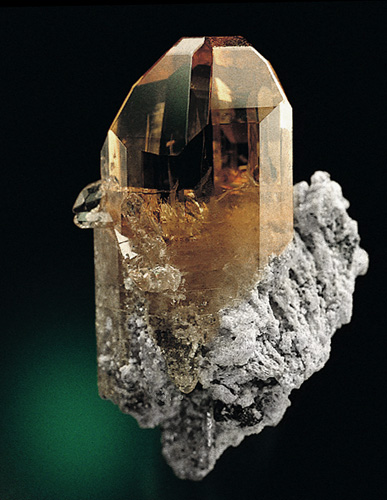
Photo: University of Utah Topaz Mountain gallery
Topaz Mountain also occupies an important place in Utah mineral culture. Topaz became Utah’s official state gem in 1969, and the campaign was encouraged by Utah gem and mineral societies; field trips to Topaz Mountain were planned for visitors to the 1969 American Federation of Mineralogical Societies convention in Salt Lake City. The locality has remained a rite-of-passage dig for Western rockhounds because it combines serious mineralogy with unusually accessible collecting: public BLM ground, famous private claims nearby, and a landscape where a patient eye can still catch loose, colorless crystals sparkling in washes.

For advanced collectors, Topaz Mountain material is most desirable when it preserves a balanced combination of locality character and specimen quality: sherry color, transparency near the terminations, strong luster, undamaged terminations, visible matrix, and, ideally, an association with another Thomas Range species. Matrix specimens are scarcer and more displayable than loose wash crystals. Clusters with several upright prisms on rhyolite, or topaz accompanied by bixbyite, red beryl, quartz, garnet, hematite, or pseudobrookite, are the pieces that carry the strongest locality signature.
Search for specimens: View all topaz specimens from Topaz Mountain, Utah, USA
Topaz Mountain lies in the Thomas Range of western Utah, in Juab County, northwest of Delta and west of the main agricultural valleys. The collecting area is reached from the Delta–Lynndyl side by way of U.S. Highway 6 and the Brush Wellman Road, then by dirt roads toward the mountain. The locality is remote: there is no water, no developed service infrastructure, and desert conditions can change quickly from dusty heat to cold wind or muddy roads.
Geologically, the locality is the type and namesake landscape for the Topaz Mountain Rhyolite. The unit consists of topaz-bearing alkali rhyolite flows and domes, with associated stratified tuffs and vitrophyre. USGS work describes the eruptive sequence as an early explosive phase that deposited stratified tuff, followed by quieter eruption of viscous lava. Within the cooling rhyolite, vapor-phase crystallization produced the lithophysal and vug minerals that made the district famous. The same fluorine-rich volcanic system is part of the broader Thomas Range–Spor Mountain story of lithophile-element enrichment, including fluorine, beryllium, uranium, tin, niobium, rare-earth elements, and related accessory minerals.
The productive collecting is not uniform over the entire mountain. Loose, sun-bleached crystals are found in washes and on slopes where the rhyolite has weathered. Larger amber crystals and clusters are generally obtained by breaking open white to gray rhyolite and working seams, flow-banded zones, and vuggy boulders. The Cove, also called Topaz Valley, is one of the best-known sublocalities at the southern end of the Thomas Range, and the nearby Topaz Mountain Adventures claim has made fresh-blast collecting available by fee arrangement. Public areas remain important, but collectors must pay close attention to land status: BLM public land, Utah School Trust land, and private or leased gemstone claims occur in the broader area, and marked claims should not be entered or collected without permission.
Historically, the locality entered the mineralogical literature early. Charles Palache published “Minerals from Topaz Mt., Utah” in American Mineralogist in 1934, recording topaz with associated species such as beryl, calcite, fluorite, and pseudobrookite. Later USGS work by Staatz, Carr, Lindsey, and others placed Topaz Mountain into the regional volcanic and uranium-mineralization framework of the Thomas Range and northern Drum Mountains. The area also became important for species beyond topaz: the Autunite No. 8 claim at Topaz Mountain is the type locality for weeksite, and Topaz Valley has figured in work on unusual uranium-titanium-calcium-HREE oxides and niobian rutile.
Production here is best understood as collector production rather than a conventional topaz mine. Generations of rockhounds have surface-collected loose crystals, opened vugs by hand, and occasionally worked fresh blasted material on private claims. Commercial-scale gem topaz production has never been the identity of the locality in the way it has been for some Brazilian or Pakistani deposits; Topaz Mountain is instead a specimen and field-collecting locality, with periodic bursts of exceptional finds when a productive vug zone is opened.
Topaz from Topaz Mountain is Al2(SiO4)(F,OH)2 and typically occurs as prismatic orthorhombic crystals, commonly singly terminated or doubly terminated when freed from cavities. The most familiar habit is a transparent to translucent prism with strong vertical development, a bright vitreous luster, and a chisel-like termination. Many crystals show natural etching, frosted zones, or attached rhyolite; the finest examples become clearer and richer in color toward the termination.
Color is central to the locality. Fresh crystals from vugs may be amber, sherry-orange, champagne-brown, or honey-colored. Loose crystals long exposed in washes are often colorless because the natural color centers are unstable under sunlight. Some Thomas Range topaz is pink to pinkish red, and the pink coloration has been treated in the literature as a special mineralogical problem distinct from the ordinary fading sherry-brown color. Pink crystals are far less common than colorless or sherry material and are important when well documented.
Typical loose crystals found by casual collectors are small, often under an inch long, and many wash crystals are only a few millimeters to a centimeter. Better vug specimens can yield crystals several centimeters long, and the literature records fine sherry-orange crystals to 5 cm or more from the Thomas Range. Display-quality matrix specimens are much scarcer than loose singles because extraction from hard rhyolite and the mineral’s perfect basal cleavage both work against survival. A crystal that looks tough because topaz is Mohs 8 can still part cleanly if struck or stressed along cleavage.
The matrix is usually pale gray, cream, or white rhyolite, sometimes flow-banded and sometimes altered to clayey, friable material around pockets. Collectors look for small vugs and seams, especially in flow-banded boulders. Fresh cavities may contain topaz with quartz, sanidine, hematite, pseudobrookite, bixbyite-(Mn), fluorite, calcite, garnet-group minerals, opal, or red beryl. The locality is particularly beloved for these associations: black metallic-looking bixbyite on or near topaz, red beryl perched on rhyolite or topaz, dark pseudobrookite crystals, tiny garnets, and sparkling quartz can turn a simple topaz specimen into a true Thomas Range association piece.
Quality is judged differently for loose crystals and matrix specimens. Loose topaz is evaluated for completeness, transparency, luster, termination quality, color retention, lack of cleavage, and absence of bruising. Matrix specimens add composition: the crystal should be well exposed, aesthetically placed, and visibly anchored in natural rhyolite rather than merely glued or wedged. Retained sherry color is valuable, but only when natural and protected from light after collection. A completely colorless crystal can still be an excellent locality specimen if it is sharp, glassy, and undamaged; many authentic Topaz Mountain crystals are naturally colorless by the time they are found.
Topaz Mountain specimens are common enough that modest loose crystals remain affordable and regularly available, but fine matrix pieces are genuinely selective. The collector market sees many small colorless singles, some sherry loose crystals from recent digs, and fewer strong matrix specimens. Exceptional clusters, crystals over several centimeters, bright sherry crystals still on rhyolite, and specimens with red beryl, bixbyite, or pseudobrookite are much less common.
The most important authenticity issue is not widespread faking but misrepresentation of color, locality, and assembly. Topaz from this locality should fit the Thomas Range visual language: rhyolite matrix, orthorhombic topaz habit, commonly sherry-to-colorless color, and plausible associated minerals. Bright blue topaz is not characteristic of Topaz Mountain specimen production and should be treated as a gem-market treatment issue unless proven otherwise. Much blue topaz in jewelry is irradiated and heat treated; that fact should not be confused with natural Topaz Mountain sherry topaz, whose color is commonly unstable rather than enhanced for permanence.
Color preservation deserves special care. Fresh sherry topaz should be stored away from direct sunlight, ideally in a closed display, box, or drawer. A specimen photographed in rich amber color and then kept in a sunlit case may fade noticeably. For that reason, collectors should ask how a colored Topaz Mountain specimen has been stored and whether the color seen today is current. Old labels that mention “sherry” are not proof that a crystal still retains that color.
Condition is the other major concern. Topaz has perfect basal cleavage, so even a hard crystal can be damaged by a blow, pressure during trimming, or careless extraction from rhyolite. Look closely for flat cleavage breaks masquerading as terminations, bruised prism edges, repaired terminations, and chips hidden by matrix dust. Rhyolite can cling stubbornly to surfaces; aggressive mechanical cleaning can abrade, chip, or undercut a specimen. Ultrasonic cleaning is risky for crystals with fractures, cleavage, or attached matrix.
Matrix integrity also matters. Because the host rock is often rough and altered, some specimens are naturally crumbly, and pockets may shed grains. A little rhyolite dust is normal; a topaz crystal that wiggles in the matrix, shows glue at the contact, or sits in an implausible drilled-looking recess deserves caution. Mounted or repaired specimens should be clearly disclosed.
For field collectors, legality and safety are part of specimen ethics. Collect only where access is permitted, avoid marked claims, and use eye protection when breaking rhyolite. The area is remote, dry, and exposed; water, shade, gloves, sturdy footwear, and a realistic vehicle plan are as important as hammers and chisels. The best specimens are often found by slow, careful work rather than indiscriminate smashing.
A good Topaz Mountain trip begins before the first crystal appears. One account from Rock & Gem Magazine follows a Colorado Mineral Society excursion in late September, with the author leaving Denver for Nephi, meeting a friend named Oren at 7:45 a.m., and driving toward Delta and the lonely west-desert road system. They reached the gravel turnoff from Route 174 after about 37 miles and found the BLM sign reading “Topaz Mountain Rock Hounding Area.” The road itself set the tone: Oren called Route 174 “the loneliest highway on Earth,” and along that stretch they saw only two vehicles.
At the meeting place, about 16 people had gathered on a surprisingly chilly desert morning. The group carpooled another five miles north-northwest toward the Topaz Mountain Adventures commercial claim. The last two miles were rough enough that four-wheel drive was strongly recommended; along the way, the group saw sedans that had tried to push farther than the roads would allow. At the claim were living quarters, a trailer, a generator, two tents, and round-the-clock security—a reminder that fine topaz ground, even in a vast-looking desert, can be actively managed and watched.
Before collecting, the group watched a blast at the area called The Dome. One club member was allowed to set off the charge while everyone waited at a safe distance. Afterward, the group still had to wait 15 minutes while Dave, Rhonda’s husband, cleared high-hanging rocks that might come down as “gravity-powered projectiles.” The dig had a strict capacity: 15 collectors, at $75 per person for that blast area. It was not simply a tourist scrape; the owners were trying to expose a productive continuation of a crystal-bearing zone in hard rhyolite.
The first day did not reward the effort. The rhyolite was difficult, the weather was cloudy with light rain, and the group found only a few small individual topaz crystals. The practical trick was to find boulders with prominent flow banding and tiny parallel vugs, sometimes only 1 mm to 2 mm across, then work into those weaknesses with a chisel or pointed hammer. Not every vug carried gems, and even the right-looking rock could be barren. The author had brought a 10-pound sledgehammer but never needed it; understanding the fabric of the rhyolite mattered more than brute force.
The day’s real drama came on the red beryl slopes. Oren hiked west-northwest toward The Amphitheater while the author stayed on topaz, then later joined him with lunch. On the way they pried colorless “sand topaz” from weathered rhyolite with fingers and, for larger pieces, a screwdriver. The crystals were gemmy only in places and coated with stubborn rhyolitic sand. Higher on the slope they began to see small patches of sand and clay alteration. Oren screened near a small outcrop while the author paused for photographs. Then the shout came across the amphitheater: “Yes!” Oren had found the first red beryl.
The crystals were tiny—2 mm to 4 mm—but euhedral, stubby, and hexagonal, exactly the kind of miniature red beryl that makes the Thomas Range addictive. The two collectors searched the same area and a little upslope, ultimately finding seven small crystals. Then came the kind of moment field collectors remember for decades: while posing for a “victory picture” with the broad mountain landscape behind him, the author found another red beryl at his feet. On the way down, after the author had already passed a clay vug, Oren called out, “Mark, you are going to hate me!” He had found one more pair of crystals in the spot just missed.
The next day showed how narrow a productive topaz zone can be. Rhonda invited the group back for another blast because the first had not produced as hoped. The second blast was only about 50 yards south of the first, but this time the difference was immediate. Within 15 minutes, the author picked up his first productive boulder near another collector’s feet. He wrote that almost every other piece he split yielded crystals. Dave explained that he and Rhonda had been following a crystal vein with their blasts; the previous day they had simply chosen the wrong direction, while the second day hit the true continuation.
That fresh exposure produced both specimens and stories about value. Dave estimated one loose crystal with a small twin at about $25, while a USGS participant found clusters estimated in the $100 to $250 range. Dave also told the group that earlier in the year an independent prospector had visited and found more than $1,000 worth of gem topaz. The appeal of the claim was direct and uncomplicated: collectors kept what they found, regardless of value.
On Sunday morning, with Oren needing to be back in Nephi by 10 a.m., the collecting turned from blasting to the old public-area pleasure of spotting loose crystals in dry washes. They searched washes along both sides of Topaz Road, stopping wherever there was enough sparkle, and stayed within about 75 yards of the road. The stops lasted 10 to 30 minutes each. They found plentiful colorless topaz, the largest just over a centimeter long, each with at least one perfect termination. The field rule from that morning was simple: if it looks like broken glass, it is probably topaz.
Charles Palache, “Minerals from Topaz Mt., Utah,” American Mineralogist, 19(1), 14–15, 1934 — Early formal mineralogical note recording topaz and associated species from the locality.
W. F. Outerbridge, M. H. Staatz, R. Meyrowitz, and A. M. Pommer, “Weeksite, a new uranium silicate from the Thomas Range, Juab County, Utah,” American Mineralogist, 45(1–2), 39–52, 1960 — Description of weeksite, relevant because the Autunite No. 8 claim at Topaz Mountain is its type locality.
M. H. Staatz and W. J. Carr, “Geology and mineral deposits of the Thomas and Dugway Ranges, Juab and Tooele Counties, Utah,” U.S. Geological Survey Professional Paper 415, 188 pp., 1964 — Foundational USGS geologic treatment of the Thomas and Dugway Ranges.
David A. Lindsey, “Tertiary volcanic rocks and uranium in the Thomas Range and northern Drum Mountains, Juab County, Utah,” U.S. Geological Survey Professional Paper 1221, 1982 — Key regional study tying the Topaz Mountain Rhyolite to the area’s volcanic, faulting, and lithophile-element mineralization history.
E. E. Foord, R. R. Cobban, and I. K. Brownfield, “Uranoan thorite in lithophysal rhyolite — Topaz Mountain, Utah, U.S.A.,” Mineralogical Magazine, 49(354), 729–731, 1985 — Describes uranoan thorite in lithophysae of the Topaz Mountain alkali rhyolite flows, associated with sanidine, quartz, topaz, hematite, magnetite, and calcite.
E. E. Foord, W. Chirnside, F. E. Lichte, and P. H. Briggs, “Pink topaz from the Thomas Range, Juab County, Utah,” Mineralogical Record, 26(1), 57–60, 1995 — Important article on the rare pink Thomas Range topaz and the cause of its color.
John Holfert, Walter Mroch, and Jeremy Fuller, “A Field Guide to Topaz and Associated Minerals of the Thomas Range, Utah (Topaz Mountain),” HM Publishing, 1996 — Collector-focused field guide repeatedly cited in locality records for topaz and associated Thomas Range minerals.
Michael A. Menzies, “The Mineralogy, Geology and Occurrence of Topaz,” Mineralogical Record, 26(1), 5–53, 1995 — Broad topaz treatment cited by Mindat for Utah occurrences and useful for placing Thomas Range topaz in global context.
“Field collecting video on Topaz Mountain” — The Crystal Collector — YouTube field-collecting video listed in Mindat’s references for the Topaz Mountain locality.
University of Utah Topaz Mountain specimen gallery — Photo gallery of topaz and associated Thomas Range minerals, including images credited to John Holfert, Jeff Scovil, Dave Richerson, and Joe Marty.
Bureau of Land Management: Topaz Mountain — Current public-agency overview of the collecting area, access cautions, and basic directions.
Utah Geological Survey: The Rockhounder — Topaz and other minerals found at Topaz Mountain, Juab County — Concise UGS collecting guide covering geology, where to collect, land status, maps, and precautions.
Utah Geological Survey: Utah’s State Symbols — Topaz — State-gem context and a short explanation of topaz formation and color behavior in the Thomas Range.
Utah’s Online Public Library: Topaz, Utah State Gem — Useful history of the 1969 state-gem designation and supplementary links to legislation, museum resources, and Utah topaz references.
Mindat: Topaz Mountain, Thomas Range, Juab County, Utah, USA — Locality database page with mineral list, sublocalities, photographs, references, and associated rock types.
USGS: Photographs of Topaz Mountain Rhyolite — Geological photo notes on the Topaz Mountain Rhyolite, including flows, tuffs, vitrophyre, and vapor-phase cavity minerals.
USGS Publications Warehouse: Tertiary volcanic rocks and uranium in the Thomas Range and northern Drum Mountains — Authoritative regional geologic framework for the volcanic history and mineralization.
USGS Professional Paper 415: Geology and mineral deposits of the Thomas and Dugway Ranges — Foundational geologic report for the ranges that host Topaz Mountain.
Rock & Gem Magazine: Topaz Mountain Rockhounding Adventure — Vivid modern field account of collecting topaz and red beryl in the Topaz Mountain area.
Wikimedia Commons: Topaz-27db.jpg — Licensed photograph and description of a notable Topaz Mountain sherry topaz cluster on rhyolite.