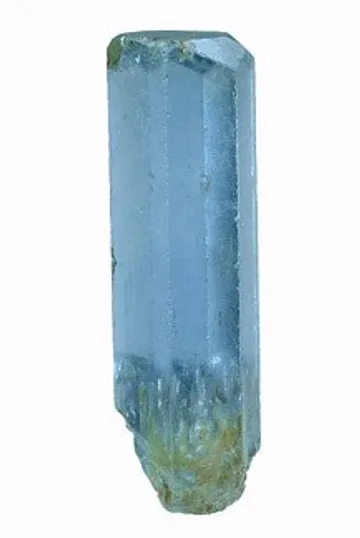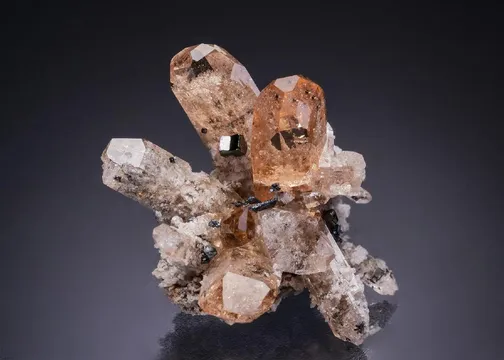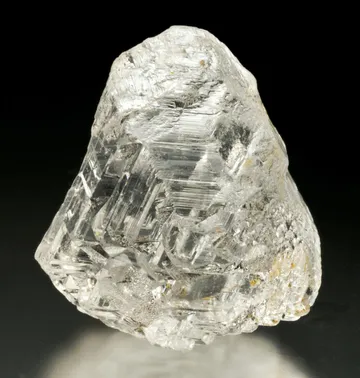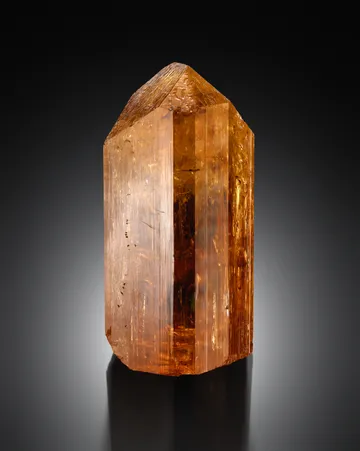
Jos Plateau topaz, Nigeria - famed for glassy colorless to pale blue crystals; durable, with fluorite inclusions and willemite findings.
Key facts
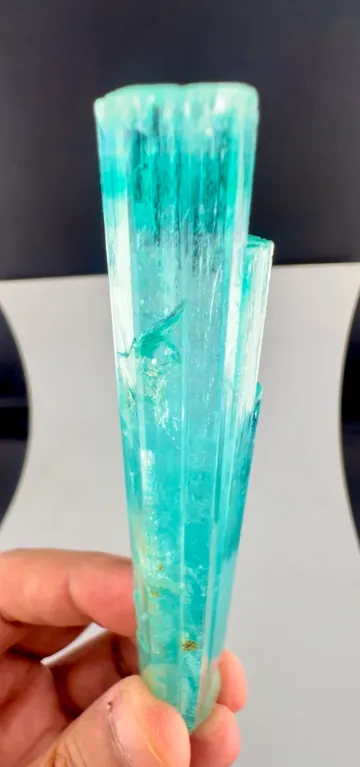
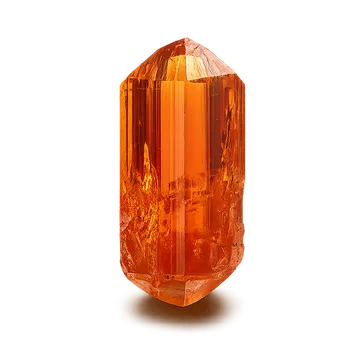
Topaz from the Jos Plateau is one of the classic West African gem-mineral occurrences: usually clean, glassy, colorless to pale blue or champagne-yellow, and often recovered as loose crystals or stream-worn pebbles from the old tin fields around Rop/Ropp, Bukuru, and the broader Jos Plateau. It is not the deep “London blue” material familiar from treated jewelry parcels; its appeal is quieter and more mineralogical—high luster, water-clear interiors, etched or silky faces, and the unmistakable robust orthorhombic topaz form when the crystal has survived transport.

Photo: Wikimedia Commons
The locality belongs to the tin-granite world of the Jos Plateau, a province famous far beyond specimen collecting for cassiterite and columbite mining. The best-understood topaz is tied to Jurassic Younger Granite intrusions, especially altered biotite granites, greisen veins, and tin-mineralized systems. Erosion released hard, chemically durable topaz crystals into streams and alluvial gravels, so many pieces are not matrix specimens but natural survivors of the tin-field gravels—bright, dense, sometimes rounded, often cleaved, and occasionally gemmy enough to tempt a cutter.
What distinguishes Jos Plateau topaz for collectors is the combination of African tin-field provenance, gem clarity, and texture. Some crystals are sharply formed and complete; others show the pleasant contradiction of a mineral that is both hard and fragile—water polish on exposed edges, a silky or frosted face, and a basal cleavage scar where topaz’s perfect cleavage has done what quartz never would. Inclusions add another layer of interest: Nigerian topaz is a famous host for fluorite inclusions, and a modern GIA study documented willemite in a Jos topaz—the only known example of willemite as an inclusion in topaz from any locality.

Photo: Wikimedia Commons
Collectors generally look for four things: undamaged termination, strong glassy luster, genuine natural color, and honest locality history. A small, complete 2–3 cm Jos crystal with bright faces can be more desirable than a larger battered pebble; but large water-worn pieces with good translucency, pale blue color, or champagne warmth also have a dedicated following because they speak directly to the alluvial mining history of the plateau.
Search for specimens: View all topaz specimens from Jos Plateau, Nigeria
The Jos Plateau lies in Plateau State, north-central Nigeria, and forms one of Africa’s most important historic tin-mining districts. The topaz-producing environment is closely connected with the Younger Granite province rather than with a simple pegmatite-pocket model. Published work on Nigerian topaz describes colorless topaz crystals and rolled pebbles from the surroundings of the Rop tin workings, with primary crystals occurring in altered biotite granites and greisen veins related to the Younger Granite intrusions of the plateau. The stream and gravel material derives from the weathering and erosion of those mineralized granites.
The Ropp Tin Mines at Bukuru are a named mineral locality for cassiterite and topaz. On Mindat, Ropp is recorded as a group of mines, with tin as the exploited commodity and cassiterite and topaz as the listed minerals. Historic photographs associated with the locality show the Bukuru tin-mining area around 1930, a reminder that the mineral-specimen story is inseparable from the much larger industrial and colonial history of the tin fields.
Bukuru itself sits a short distance south of Jos and was one of the key tin and columbite centers of the plateau. The Bauchi Light Railway, completed in 1914 to move tin from Bukuru toward Zaria, and the later rail connection completed in 1927 linking the Jos-Bukuru mines to Port Harcourt for export, illustrate the scale of the mining system that exposed and processed the alluvial gravels. Topaz was not the main economic mineral; it was a durable gem accessory recovered from the same tin-field environment that produced cassiterite and associated heavy minerals.
Collecting access should be treated cautiously. The old tin workings include private, active, abandoned, flooded, and environmentally disturbed ground. Historical mineral material reached collectors through mining, local gem trading, estate collections, and dealer networks rather than through casual tourist collecting. Serious collectors should not assume any open access to Ropp, Bukuru, or other Jos Plateau workings without current permission from landholders and mineral-rights holders, and without local guidance on safety. Abandoned tin pits and water-filled mine ponds are a real hazard across the plateau.
Production periods for collectible topaz are difficult to separate cleanly from tin mining because most pieces moved as byproduct or gem material rather than as a documented mine product. The tin industry began in the early twentieth century and shaped Jos and Bukuru for decades; collectible topaz specimens in circulation include old-time pieces, specimens described as mined in the 1990s, and contemporary dealer material. The market therefore includes both older collection crystals and newly offered alluvial pieces, but exact recovery dates are often unknown unless an old label or dealer record accompanies the specimen.
Notable finds include sharp thumbnail to small-cabinet crystals, water-worn colorless pebbles used in inclusion studies, pale blue gem crystals, and champagne-colored crystals with old collection labels. The most scientifically notable stones are not necessarily the biggest: the Nigerian topaz pebbles studied for fluorite inclusions and the GIA-examined Jos topaz with chlorite, willemite, hematite, sphalerite, and possible amazonite patches are among the locality’s most interesting mineralogical records.
Jos Plateau topaz is usually encountered as single crystals, cleaved fragments, and rolled alluvial pebbles rather than as matrix specimens. The best crystals show stout orthorhombic form, bright vitreous luster, and broad faces that can act like windows into the interior. Some have textbook terminations; others are modified by natural contact, breakage, abrasion, or stream polish. Basal cleavage is common and important: topaz has perfect cleavage, and Jos pieces frequently show a flat cleaved base or cleaved front/back surfaces, especially where alluvial transport or mining has stressed the crystal.
Color ranges from colorless and water-clear to pale blue, faint bluish green, and champagne to golden yellow. Colorless material is especially characteristic in the literature on Nigerian topaz pebbles. Pale blue crystals appear regularly in the specimen trade, but collectors should distinguish the delicate natural look of many Jos crystals from the saturated blue of treated commercial topaz. Champagne-yellow pieces are less common but especially attractive when they retain silky luster and old labels.
Typical collectible crystals fall in the thumbnail to small-cabinet range. Documented examples include 2.0 cm, 2.1 cm, 2.6 cm, 3.3 cm, and 3.8 cm crystals, often weighing roughly 13–27 grams for the smaller complete pieces. Larger alluvial pieces occur; one recently offered specimen measured 6.2 x 4.4 x 2.1 cm and weighed 124 grams. Size alone does not determine quality. A clean, complete, sharply terminated 2.6 cm crystal may be more desirable than a heavier abraded pebble, while a large translucent water-worn piece can be attractive when it has strong body color, polish, or visible internal features.
The most relevant mineral associations are cassiterite, fluorite, greisen minerals, and other minerals of the Younger Granite/tin-field environment. At Ropp, cassiterite and topaz are the documented locality minerals. Fluorite is particularly important as an inclusion phase: published Nigerian topaz studies identified small cubic, octahedral, rhombic-dodecahedral, and combination-form fluorite crystals inside colorless water-worn topaz pebbles. These inclusions occur singly and in clusters, and some contain their own two-phase fluid inclusions.
Inclusions can be a major quality and identification feature rather than a flaw. Hornytzkyj’s fluorite work made Nigerian topaz a reference point for recognizable fluorite inclusions in topaz. GIA’s 2021 Jos topaz study documented a 28.61 ct custom-cut colorless topaz block containing a large forest-green chlorite inclusion partly rimmed by near-colorless willemite crystals, with bright yellow-green short-wave UV fluorescence, plus hematite in a cleavage crack and tiny sphalerite crystals. For collectors of inclusions, Jos topaz can be more interesting under magnification than it first appears in the hand.
Quality factors are straightforward but unforgiving. The finest specimens combine clarity, natural luster, intact termination, minimal cleavage damage, attractive color, and good provenance. Alluvial wear is acceptable—even desirable—when it produces a naturally polished, old-field character without destroying the form. Damage becomes a problem when the termination is broken, the cleavage is fresh and distracting, or chips scatter across the display faces. In hand, the best Jos material has a cool, dense, glassy presence: not flashy in the way of imperial Brazilian topaz, but elegant, geological, and unmistakably tied to the tin granites of Nigeria.
The main authenticity issue is not a documented flood of Jos-specific fakes, but rather mislabeling, treatment ambiguity, and mineral confusion. Pale blue or colorless topaz from Jos should not be confused with irradiated commercial blue topaz simply because both are “blue topaz.” Strong London-blue or Swiss-blue color in a specimen or cut stone demands skepticism unless treatment history is explicitly disclosed. Irradiation and heat treatment are routine in the broader blue-topaz trade, and the treatment can be difficult to recognize by appearance alone.
For rough specimens, the first question is species identity. Topaz can resemble quartz, pale aquamarine, goshenite, and some pale feldspar fragments to non-specialists. Topaz is harder than quartz but has perfect basal cleavage and high density; quartz lacks that cleavage and has different crystal habit and fracture. Aquamarine and goshenite have hexagonal beryl habit and different optical properties. A serious purchase, especially a pale blue transparent specimen, benefits from a tested specific gravity, refractive index if cut, or Raman/FTIR confirmation for high-value material.
Condition issues are common and should be evaluated with a loupe. The perfect cleavage of topaz means that flat cleaved bases are normal on Jos specimens; several dealer records explicitly note cleaved bases or cleaved front/back surfaces. Do not automatically reject a cleaved base if the display faces and termination are good, but be cautious of fresh-looking breaks, edge chips, or repaired cleavage surfaces. Alluvial examples may show water polish, rounded edges, frosted areas, or silky faces; these can be natural and attractive, but should be distinguished from later tumbling or polishing.
Rarity is relative. Jos Plateau topaz is available, but fine complete crystals with good form and natural color are not abundant in the way Brazilian or Pakistani topaz specimens can be. Small colorless or pale blue thumbnails appear from time to time, and larger water-worn pieces are offered intermittently by dealers. The best old-label crystals, inclusion-rich study pieces, and attractive champagne examples are much less common. Current market availability ranges from modest thumbnails and alluvial pieces to more carefully selected gem crystals; prices vary strongly with completeness, color, clarity, and provenance.
For provenance, old labels matter. A specimen labeled simply “Nigeria” or “Jos” may be correct, but “Jos Plateau, Plateau State, Nigeria,” “Rop/Ropp,” or “Ropp Tin Mines, Bukuru” is stronger. Older collection labels such as the Hugh Ford-labeled material documented in Wikimedia/Mindat-derived records add value because they anchor the specimen in the long-standing trade history of African gem minerals.
The story of Jos topaz begins with tin, not with specimen cabinets. Around Bukuru and Ropp, the mineral that built the district was cassiterite, and the landscape was reorganized around its recovery. Tin moved by rail: first by the Bauchi Light Railway, built in 1914 to carry tin from Bukuru toward Zaria, and later by the railway completed in 1927 that tied the Jos-Bukuru mines to Port Harcourt for export. Topaz was the hard, glassy passenger in that system—a mineral too tough to dissolve away, too brittle to escape cleavage, and too gemmy to be ignored when it emerged from the gravels.
A historic image associated with the Ropp Tin Mines shows the Bukuru tin-mining area around 1930. It is easy to read that photograph only as industrial history, but for the mineral collector it is also a locality photograph for topaz. The old cuts, gravels, water systems, and sorting grounds were the route by which many Nigerian topaz crystals entered commerce. A clean 2–3 cm topaz on a modern shelf may look like a self-contained gem crystal, but its backstory is the open-cut tin field.
One of the most evocative scientific stories comes from the microscope. S. Hornytzkyj examined colorless, water-worn Nigerian topaz pebbles and noticed tiny transparent inclusions—light yellow, light green, colorless, or milky—ranging from 41 µm to 595 µm. Their forms were the clue: cubes, octahedrons, rhombic dodecahedrons, and combinations of the three. Some looked etched; some held their own liquid-and-gas inclusions. To identify them, topaz pebbles rich in inclusions were cleaved into thin plates, and whole inclusions were hand-picked for study. Refractive-index work suggested fluorite, and x-ray precession photographs confirmed it. The conclusion was memorable for collectors: well-formed fluorite inclusions in colorless Nigerian topaz could indicate the Rop source.
The modern inclusion story is just as striking. GIA examined a 28.61 ct transparent freeform study block of colorless topaz from Jos, measuring 21.36 x 14.94 x 9.44 mm. Inside it was a large forest-green chlorite inclusion with an intricate stepped surface. Along part of that chlorite were transparent near-colorless crystals identified by Raman microspectrometry as willemite, Zn2SiO4. Under short-wave ultraviolet light, the willemite fluoresced bright yellow-green and gave the chlorite a partial glowing halo. The same stone also held bright red hematite in a surface-reaching cleavage crack, tiny brownish yellow sphalerite crystals, and metallic-looking opaque inclusions. A locality known to many collectors for simple colorless topaz pebbles had produced an inclusion specimen unlike any other topaz studied from anywhere.
There is also the quieter story of labels and survival. One old-time champagne crystal from the Jos Plateau, 2.6 x 1.6 x 1.5 cm and weighing 15 grams, was documented with an old Hugh Ford label. Its bottom contact was described as naturally healed, probably after time in a stream bed. That is the sort of detail collectors remember: a crystal born in greisen, broken or released, rolled by water, collected from an African tin-field district, preserved with a label, and eventually recognized not just as “topaz,” but as Jos Plateau topaz.