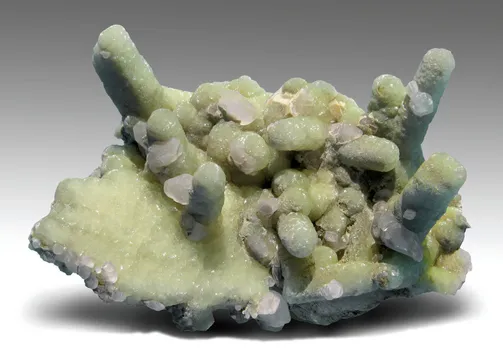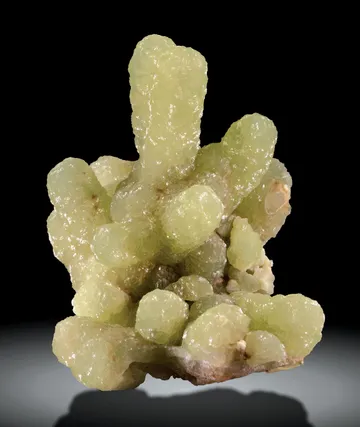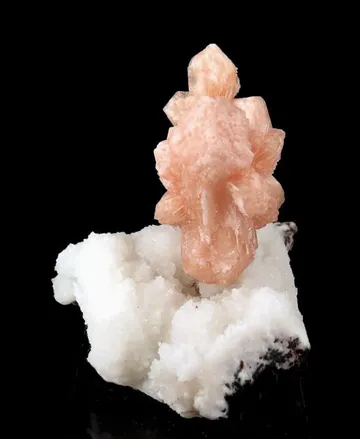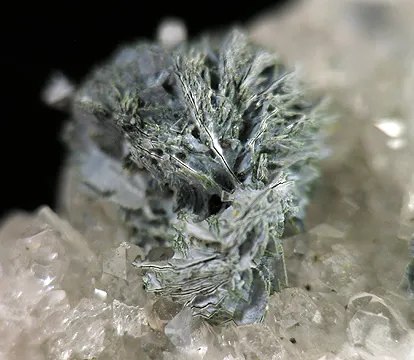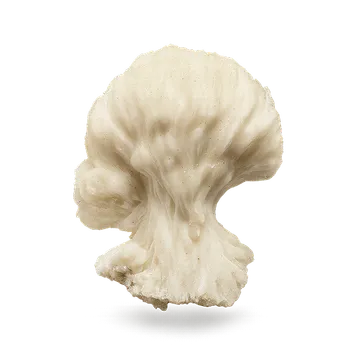
Prospect Park stilbite, New Jersey — tan to cream bow-tie stilbite in basalt pockets, with datolite and laumontite, a notable Paterson district locality.
Key facts
Prospect Park stilbite belongs to the classic trap-rock tradition of northern New Jersey: zeolite minerals growing in open pockets in dark Watchung basalt. The best specimens have the locality’s unmistakable contrast—warm tan, honey, straw-yellow, caramel, or cream-colored stilbite sheaves standing against white quartz, pale laumontite, green prehnite or datolite, and black basalt. They are not usually the oversized, peach-colored display pieces familiar from the Deccan Traps of India; their appeal is more old-American, more geological, and often more association-driven. A good Prospect Park specimen looks like it came from a basalt cavity, not from a generic zeolite flat.

Photo: Wikimedia Commons
The quarry cut the Orange Mountain Basalt of First Watchung Mountain, an Early Jurassic lava sequence in which the upper parts of flows preserve vesicular zones, pahoehoe structures, and pillow basalt. Those physical features mattered directly to collectors. Stilbite and the associated zeolites formed in open spaces: interiors of pillows, junction pockets between pillows, veins, cavities in amygdaloidal basalt, and related low-temperature hydrothermal openings. The finest pieces are really pocket specimens—minerals that grew into space, with room for luster, curvature, and the characteristic “bow-tie” or wheat-sheaf form.
Prospect Park is especially valued because it sits in the Paterson–Passaic County zeolite district, one of the most storied mineral districts in the United States. Older labels may say “Paterson,” and many collectors still use Paterson in a broad historical sense, but the quarry itself is in the borough of Prospect Park, about two miles north of Paterson. That distinction matters: Prospect Park material has its own look, especially the tan to gemmy brown stilbite sheaves, bow-ties, and association pieces with datolite, laumontite, heulandite, quartz, calcite, prehnite, and less common accessory minerals.

Photo: Wikimedia Commons
Collectors look for three things above all: sculptural sheaf form, undamaged silky-to-pearly surfaces, and good placement on matrix. A single clean bow-tie perched on quartz can be more desirable than a crowded plate of bruised crystals. Large sheaves from pillow pockets are particularly important, while the most symmetrical bow-ties are strongly associated with junction-pocket material. Rare pale green stilbite from Prospect Park, reported historically and attributed to inclusions of a chlorite-group mineral, is a specialized sub-variety for collectors who know the locality well.
Search for specimens: View all stilbite specimens from Prospect Park Quarry, New Jersey, USA
Prospect Park Quarry was a trap-rock aggregate quarry in the Orange Mountain Basalt, the basalt forming First Watchung Mountain. The quarry is historically also associated with the Sowerbutt, Vandermade, Warren Brothers, and Tilcon names, but serious mineral collectors generally know it simply as Prospect Park. The recorded coordinates place it in Prospect Park, Passaic County, New Jersey, very close to the classic Paterson trap-rock collecting district.
The quarry opened in 1901 under James A. Sowerbutt. After Sowerbutt’s death in 1916, the operation passed to his son-in-law Abraham Vandermade and then to James Vandermade. Warren Brothers acquired it in 1969, and Tilcon New Jersey later purchased the quarry in the early 1980s. It remained a productive crushed-stone operation long enough to expose fresh basalt and fresh pockets for generations of collectors, but it is now a closed and built-over or reclaimed locality rather than an active collecting site. By 2021, borough planning documents described extraction as ceased, reclamation under way, and redevelopment planning for the quarry site already adopted.
Geologically, the quarry exposed dark greenish-gray to greenish-black Orange Mountain Basalt dominated by calcic plagioclase and clinopyroxene. The formation consists of multiple flows, with massive and columnar basalt in lower portions, vesicular tops and bottoms, pillow structures in the lower part of the uppermost flow, and pahoehoe structures higher in the sequence. Prospect Park’s mineral interest is tied to those open-space structures. Stilbite, quartz, calcite, prehnite, laumontite, heulandite, datolite, babingtonite, apophyllite-group minerals, and related species crystallized in cavities within the basalt after the lava had cooled enough for circulating mineralizing fluids to deposit zeolites and associated silicates.
Collectors distinguish two important pocket settings. Pillow pockets occur within the interiors of individual pillow structures and could be relatively spacious; these produced some of the largest stilbite sheaves. Junction pockets formed where pillows met; these were commonly lined first by quartz and calcite, with zeolites and associated minerals growing later on those earlier surfaces. The difference is visible in specimens: large, looser sheaves suggest roomier cavities, whereas crisp bow-ties on quartz-lined matrix often point to tighter but cleaner junction-pocket environments.
Notable finds include tan to gemmy brown stilbite sheaves up to about 10 cm across, symmetrical bow-ties commonly around 5 cm long, golden-brown sheaf groups with datolite, cream stilbite with laumontite and heulandite, and rare pale green stilbite. Prospect Park also produced important non-stilbite specimens—prehnite after anhydrite, datolite, heulandite, calcite, babingtonite, and unusual trap-rock associations—but stilbite remains one of the locality’s signature zeolites.
Collecting access today should be treated as closed. The site is no longer an operating collecting locality, and it has been subject to backfilling, reclamation, and redevelopment. Modern specimens on the market come from older collections, dealer stock, estate dispersals, museum deaccessions, or material collected during the quarry’s active years.
Prospect Park stilbite is best known as stilbite-Ca, NaCa4(Si27Al9)O72·28H2O, although older labels often simply say “stilbite.” In hand specimens the classic habits are sheaves, fans, bow-ties, and radial bundles of bladed crystals. The blades may flare outward into wheat-sheaf forms with rounded, silky terminations, or form compact paired bow-ties. Individual crystals can be translucent, and the best specimens have a pearly to silky luster that brightens when lit from the side.
Color is one of the locality’s strongest identifiers. Typical Prospect Park stilbite ranges from tan and cream through honey-brown, straw-yellow, golden-brown, and caramel. Some pieces are gemmy brown or oxide-tinted. Pale green stilbite is rare and historically noted from the quarry; the green color has been attributed to inclusions of a chlorite-group mineral rather than to a different zeolite species. White to cream stilbite occurs as well, especially in association pieces with laumontite and heulandite.
Size varies widely. Small bow-ties under 2.5 cm are common in surviving collector material. Attractive miniatures may show bow-ties or sheaves in the 2–5 cm range. Published locality descriptions and documented dealer specimens show that larger sheaves reached roughly 10 cm across, but large, undamaged, well-composed examples are now much scarcer than small cabinet or miniature pieces.
The most important associated minerals for stilbite collectors are quartz, calcite, laumontite, heulandite-Ca, prehnite, datolite, babingtonite, and apophyllite-group minerals. Quartz provides the cleanest visual contrast, especially when a honey-colored stilbite bow-tie rises from a sparkling white druse. Datolite adds high collector interest when it appears as glassy pale green crystals with brown stilbite. Laumontite associations are attractive but require more caution because laumontite can be fragile and may dehydrate or chalk with poor storage.
Quality is judged by form first. A Prospect Park stilbite should have readable geometry: a fan, bow-tie, wheat sheaf, or radial burst that is not merely a bruised aggregate. Luster is second; silky, pearly, reflective blades outperform dull or sugary surfaces. Color is third, with warm tan to golden-brown and rare green tones drawing attention. Finally, matrix and association matter enormously. A single crisp bow-tie on quartz or a balanced stilbite–datolite combination is more collectible than an isolated mass without locality character.
The central authenticity issue is provenance, not treatment. Prospect Park lies within the broader Paterson trap-rock collecting region, and old labels often use “Paterson” loosely. Some specimens labeled Paterson may indeed be Prospect Park; others may be from Upper New Street, Lower New Street, Great Notch, Haledon, or another Watchung basalt locality. For a serious locality suite, a Prospect Park label should ideally be backed by an old collection label, dealer history, collection number, or a visual match to known Prospect Park associations.
No well-established tradition of treated, dyed, or fabricated Prospect Park stilbite is part of the collector literature. The mineral itself is not a common target for enhancement. Still, routine caution applies: avoid specimens with suspiciously glued bow-ties, repaired sheaves not disclosed by the seller, or composite zeolite pieces where stilbite has been attached to an unrelated quartz or basalt matrix. Repairs are possible because the blades are brittle and protruding.
Condition is the most frequent problem. Stilbite has modest hardness, excellent cleavage, and delicate bladed terminations. Prospect Park bow-ties often show edge chipping, rubbed tips, bruised luster, broken fans, or incomplete smaller crystals around the main display group. Matrix plates with laumontite may include powdery or dehydrated areas. Calcite and quartz associations are generally more stable, but they can hide contact damage around the base of the stilbite.
Rarity depends strongly on quality. Small honey-brown bow-ties and modest sheaf groups still appear from old collections, and some remain affordable. Fine, undamaged miniatures with sharp form, attractive matrix, and secure provenance are much less common. Large cabinet specimens, old museum or major-collection pieces, and association specimens with excellent datolite, heulandite, or quartz can be genuinely difficult to replace.
Recent market records show a wide spread. Modest Prospect Park stilbite and stilbite-with-datolite pieces have sold at auction in the tens of dollars, while larger or better-provenanced specimens have reached the low hundreds. Rich association pieces, especially where stilbite accompanies fine heulandite or other desirable trap-rock minerals, can bring more. The quarry’s closure and redevelopment mean that new production should not be expected; the supply is now a collector-market supply, not a field supply.
The story of Prospect Park is partly the story of a working quarry that outlived most of its neighbors long enough to keep surprising collectors. It began in 1901 with James A. Sowerbutt, then moved through the Vandermade family, Warren Brothers, and Tilcon. That succession of owners left a corresponding succession of labels: Sowerbutt Quarry, Vandermade Quarry, Warren Brothers Quarry, and Prospect Park Quarry. On older mineral cards, the name can be as revealing as the specimen.
The quarry’s best mineral stories are written in basalt architecture. The productive pockets were not random holes. Some opened inside pillow structures; others formed at the junctions where pillows pressed against one another. In the pillow pockets, the openings could be larger, giving stilbite room to build broad sheaves. In the junction pockets, quartz and calcite often lined the walls first, and the zeolites followed, leaving the balanced bow-tie-on-quartz specimens collectors prize today. A good Prospect Park stilbite is therefore a small map of the lava flow: pillow interior, junction seam, vapor space, late fluid, zeolite growth.
By 2011, the last chapters were visible in photographs and planning documents rather than fresh pockets. Images from that year record “Final days of blasting,” “Advancing Backfill,” and exposed diapirs in the quarry walls. For collectors, those captions carry a blunt message: the locality did not merely become inconvenient; it was physically being filled, reclaimed, and folded into redevelopment plans. The specimens now in drawers and display cases are the surviving record of openings in basalt that no longer exist.