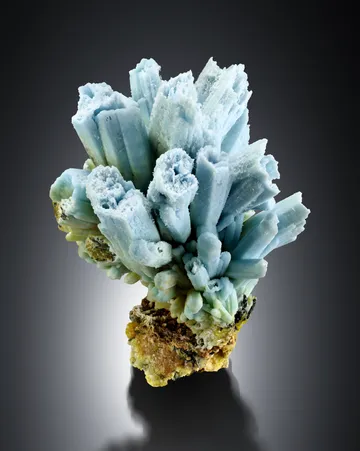
Plumbogummite Collectors Guide
Plumbogummite is a lead–aluminum phosphate of the alunite supergroup, best known to collectors for its sky-blue to turquoise botryoidal coatings and dramatic pseudomorphs after pyromorphite. Its classic appearance ranges from silky, satiny spheres and crusts to porcelain-like coatings; less commonly it forms tiny crystals, but the most coveted pieces are sharp pyromorphite prisms entirely replaced by plumbogummite while retaining the original hexagonal form. Colors span powder-blue, robin’s-egg blue, teal, sea-green, apple-green, and gray-white; the most vivid blues from southern China became modern icons around 2014–2016.
Most plumbogummite forms as a secondary mineral in oxidized lead deposits, often altering or replacing pyromorphite and other lead phases near the surface. Aesthetic contrast is a hallmark: blue coats on tan/iron matrix or blue-on-green pyromorphite cores. It is moderately heavy (SG around 4+) and relatively soft (hardness ~4–4.5), with luster from waxy to vitreous. Fine, colorful, and well-formed pseudomorphs are the top-tier specimens and can command strong prices, while attractive botryoidal crusts remain accessible to newer collectors.
The species was a connoisseur’s phosphate for decades—classic but subtle—until discoveries in Guangxi, China, unleashed a wave of intensely colored pseudomorphs after pyromorphite that electrified the market. That material pushed plumbogummite squarely into the mainstream of fine mineral collecting, with top pieces rapidly entering major collections. Historic European localities (Caldbeck Fells in the U.K., Les Farges in France) built its reputation with beautiful botryoidal coatings and replacements on pyromorphite. Tsumeb also contributed attractive, often unique associations.
Today, collectors chase three main aesthetics:
- Sharp pseudomorphs after pyromorphite with strong sky-blue color and good luster (China).
- Classic botryoidal to reniform crusts in soft blues to blue-green on iron-rich matrix (U.K./France).
- Unusual associations or historic provenance (Tsumeb, Phoenixville/Wheatley Mines).
Supply from the headline Chinese pockets has waxed and waned; premium pieces with rich color, complete terminations, and balanced composition remain scarce and keenly contested.
While plumbogummite occurs widely, the following localities are especially sought after for distinctive colors, forms, or historic importance.
Near Guilin, the Yangshuo Mine produced closely related material to Daoping, including vivid blue plumbogummite after pyromorphite. Crystals are frequently slender prisms with flat to slightly hoppered terminations, sometimes in radiating groups. Partial replacements can create attractive gradients: green pyromorphite transitioning to blue plumbogummite caps. Fine matrix pieces show strong composition—blue crystals standing off limonitic matrix with quartz or minor hemimorphite adding sparkle. Availability was episodic; top-quality clusters with multiple pristine terminations are particularly prized.
-
Color and saturation:
- Vivid sky-blue to turquoise hues are most sought after, especially in Chinese pseudomorphs. Even, saturated color across the display face is ideal.
- Two-tone specimens (blue plumbogummite over green pyromorphite) can be spectacular when the zoning is crisp and balanced.
- Softer blue-green or pale blue botryoids (U.K./France) are prized for patina and classic feel; look for uniformity and pleasing tone.
-
Form and habit:
- For pseudomorphs after pyromorphite: seek sharp hexagonal prism geometry with complete, undamaged terminations. The replacement should preserve the “pyromorphite look” cleanly.
- For botryoidal crusts: choose fine, tight, well-developed spheres with silky to satiny luster. Symmetry and depth of botryoids add to visual appeal.
- Matrix composition matters: contrast (blue on warm iron oxides, or blue caps on green crystals) and a balanced arrangement elevate a specimen.
-
Luster and surface:
- Best pieces have a velvety to glossy satiny sheen that “lights up” in a case. Chalky, powdery surfaces appear dull and are less desirable.
- Natural micro-etching can be attractive; avoid heavily pitted or decomposed surfaces unless the piece is otherwise exceptional.
-
Condition:
- Inspect crystal tips and edges carefully—chips or bruises on pseudomorph terminations are significant detractions.
- On crusts, look for clean, intact botryoids without spalls. Check for hidden glue on reattached crystals.
- Because the species is relatively soft and can be porous, pristine condition is uncommon on older matrix pieces—minor, non-distracting rubs may be acceptable.
-
Size and composition:
- Miniatures and small cabinets with top color and pristine terminations often outperform larger but imperfect examples.
- Aesthetic clusters showing multiple terminations at varying heights, or a standout single on contrasting matrix, tend to display best.
-
Reattachments and repairs:
- Many Chinese pseudomorphs are reattached to matrix; look for thin glue films at the base, slight misalignments in growth striations, or glossy seams under a loupe. Some epoxies fluoresce under LW-UV.
- A single clean, disclosed repair on a major piece is common and generally acceptable; multiple repairs reduce value.
-
Stabilizers and fillers:
- Because plumbogummite can be porous, preparators may apply clear consolidants to strengthen fragile surfaces. Examine for uneven sheen or “plastic” gloss in localized areas.
- Fracture fills may show a different luster or RI; oblique light helps reveal filled lines.
-
Dyed or enhanced color (uncommon but worth checking):
- Suspect overly uniform, intense color confined to surface pits or cracks. A gentle swab with acetone on an inconspicuous area can test for dye; any color transfer is a red flag.
- Natural pieces typically show subtle internal variation in color and a consistent hue through chips or broken areas.
-
Assemblages:
- Beware of mounted “marriages” of crystals and matrix from different sources. Know the typical matrix and associations for each locality.
Buy from reputable sources, ask for disclosures, and examine under magnification and different lighting.
-
Handling:
- Plumbogummite is relatively soft and may be delicate when botryoidal or porous. Handle with two hands and avoid touching tips of pseudomorphs. Use mineral tack or a custom base to secure display pieces.
-
Cleaning:
- Dust gently with a soft brush or air bulb. If needed, rinse briefly in lukewarm water with a drop of mild soap; avoid soaking porous matrix for long periods.
- Do not use ultrasonic or steam cleaners; vibrations and heat can cause cracking or detach repairs. Avoid acids—phosphates and their matrices can be sensitive.
-
Light and temperature:
- Colors are generally stable under normal LED case lighting, but avoid prolonged direct sunlight and high heat. Thermal shock can fracture crystals or weaken repaired joints.
-
Storage:
- Provide padded, compartmentalized storage. Keep away from harder specimens to prevent scratching, and from very soft minerals that could be scratched by it.
- For repaired or stabilized pieces, avoid hot display cases; check adhesives seasonally.
With careful handling, plumbogummite’s soft luster and captivating blues will remain a highlight of any case—equally at home as a modern Guangxi showpiece or a classic European antique.