Plumbogummite sold under the Yangshuo Mine label is one of the great modern Chinese phosphate aesthetics: pale sky-blue to powder-blue plumbogummite preserving the long hexagonal geometry of pyromorphite, often with yellow-green pyromorphite still visible in broken ends, hollows, or unreplaced cores. The best specimens are not merely blue coatings. They are sculptural replacements—radiating sprays, bundles, and bouquets of pyromorphite prisms transformed into a soft, porcelain-like blue while retaining etched faces, skeletal growth, and hoppered terminations.
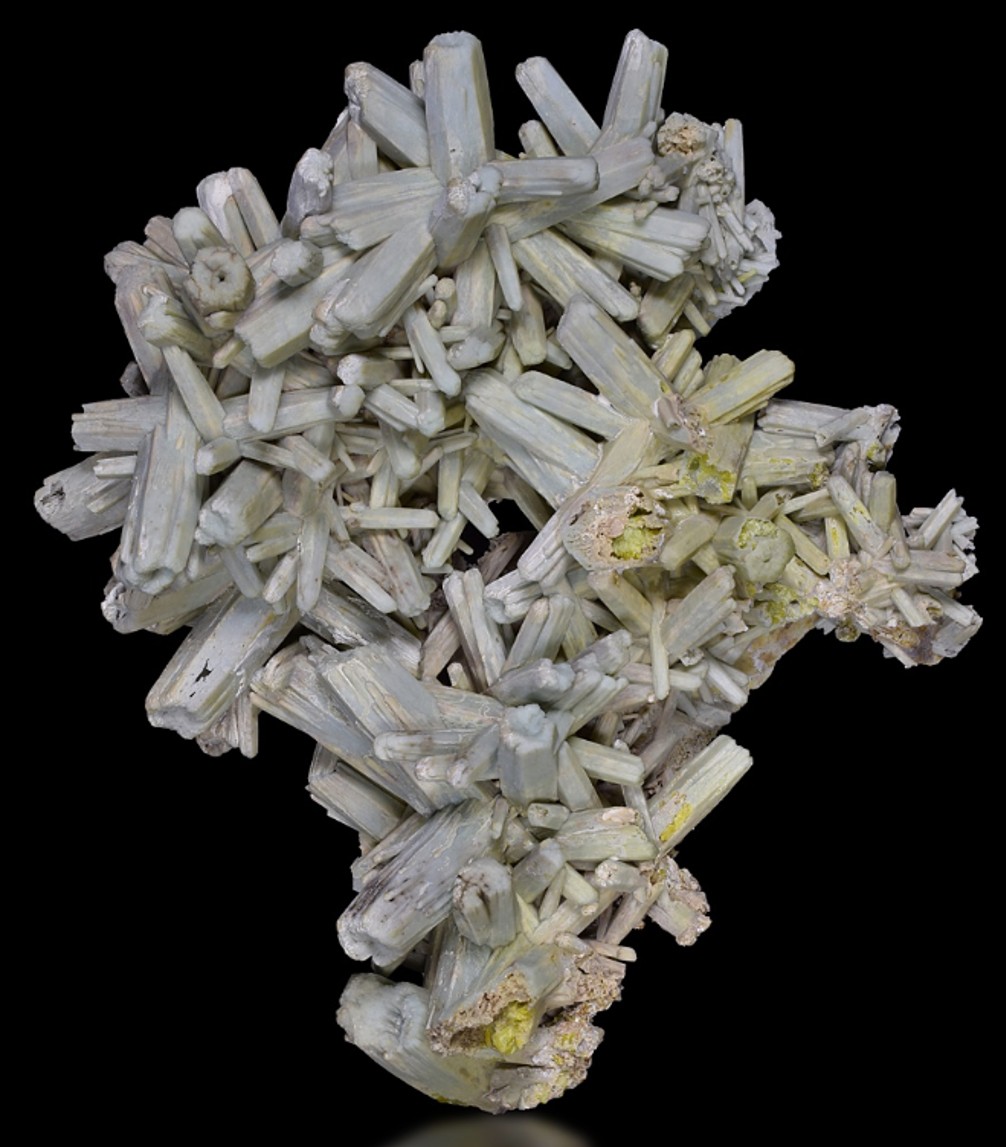
Photo: Fluorescent Mineral Society
The locality name deserves care. For many years these specimens were widely labelled Yangshuo Mine, Daoping Mine, or simply Guilin, Guangxi. Modern locality work has sharply revised that picture: the classic plumbogummite-after-pyromorphite specimens marketed under those names are now generally attributed to the Laohuan workings on Laohu Hill in Gongcheng County, a small group of artisanal adits and excavations rather than the main Yangshuo lead-zinc mine itself. The Yangshuo label remains historically important in the market, and many cabinet and auction specimens still carry it, but serious collectors should understand that “Yangshuo Mine” on an old label often points to a trading or district attribution rather than the confirmed pocket locality.
That caveat does not diminish the specimens. It makes them more interesting. The broader Guilin–Gongcheng–Yangshuo district is famous for Chinese pyromorphite, and the plumbogummite material fits naturally into that oxidized lead-mineral story: pyromorphite crystals formed first, then later supergene fluids altered, coated, or replaced them with PbAl3(PO4)(PO3OH)(OH)6. In the finest examples the replacement is partial enough to show the process in cross-section—yellow-green pyromorphite cores, blue plumbogummite skins, hollow casts, and broken terminations revealing where chemistry outran crystal growth.
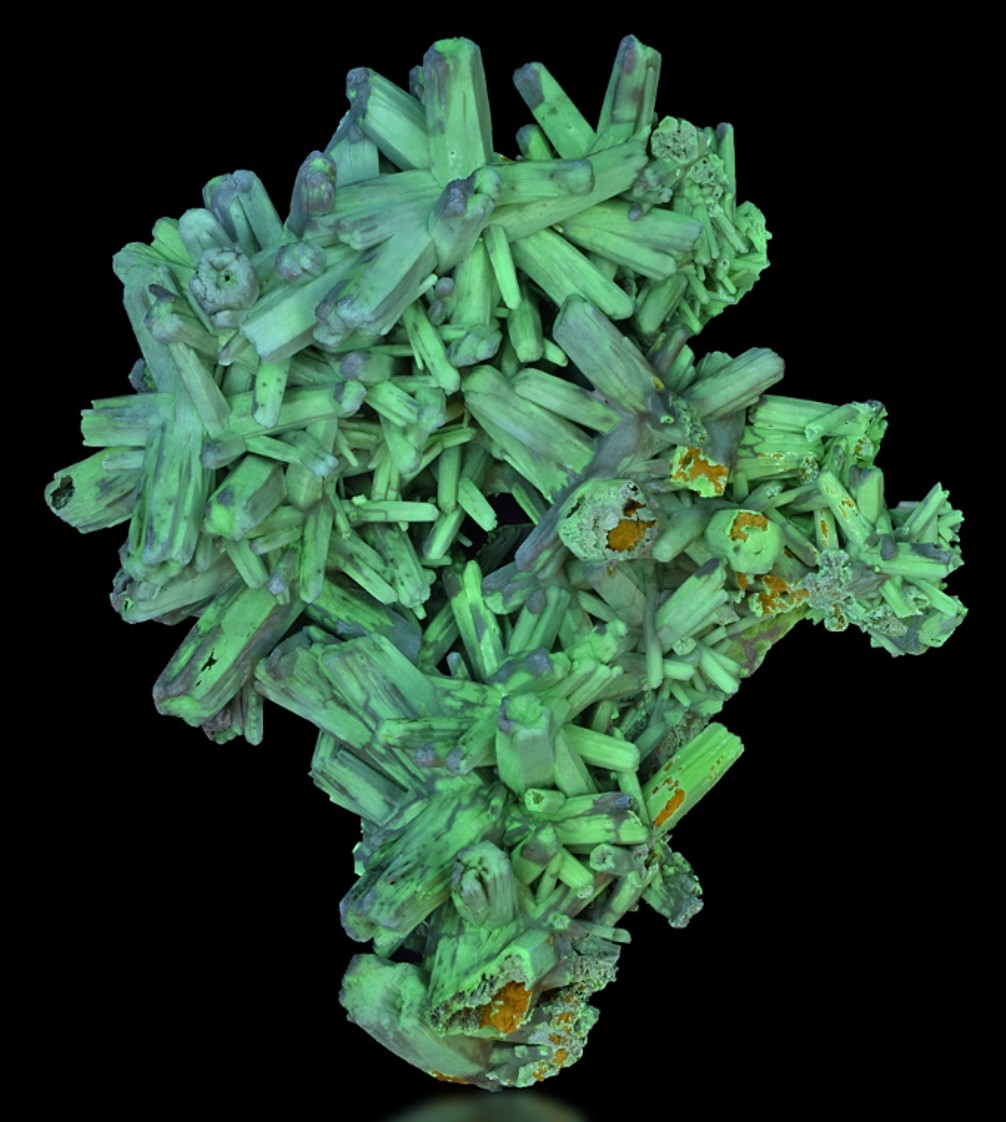
Photo: Fluorescent Mineral Society
Collectors look first for form: sharp pyromorphite morphology, complete terminations, and crystals standing freely in three dimensions rather than crushed into a flat plate. Color comes next. The most prized pieces show an even sky-blue to blue-green plumbogummite surface with enough contrast from yellow-green pyromorphite or warm gossan matrix to read instantly across a case. The best specimens can be surprisingly large for plumbogummite: crystals several centimeters long are known, and exceptional cabinet pieces carry clusters of elongated, hoppered prisms of a scale that reset expectations for the species.
Search for specimens: View all plumbogummite specimens from Yangshuo Mine, China
The Yangshuo Mine is recorded as a hydrothermal lead-zinc deposit in Guangxi, hosted by Devonian rocks of the Wuzhishan Formation: limestone, sandstone, and shale, locally intruded by granite and lamprophyre dikes. The deposit sits in the classic Guilin mining region and is closely linked underground with the Daoping Mine; since the early 2000s, the two have often been treated by Chinese miners and dealers as a combined Daoping–Yangshuo operation.
That geological setting explains the district’s pyromorphite, but the blue plumbogummite specimens that made the “Yangshuo” name famous on the mineral market are now best treated separately from the main commercial mine. The accepted modern interpretation is that the classic plumbogummite pseudomorphs after pyromorphite came from Laohuan, a group of small artisanal workings on Laohu Hill in Gongcheng County. Laohuan was originally worked for lead, zinc, silver, and baryte, but the ore was low-grade; once specimen-quality pyromorphite and plumbogummite were recognized, local work shifted toward crystal recovery rather than industrial ore.
Production appears to have been episodic. The locality was known for plumbogummite and pyromorphite specimens by the early 2000s. Botryoidal plumbogummite on quartz and pyromorphite appeared in the market before the great pseudomorph wave. Around the 2010s, and especially in the period dealers commonly describe as the 2014–2015 finds, large pale-blue plumbogummite replacements after hoppered pyromorphite became one of the most discussed Chinese mineral discoveries of the decade. By the early 2020s, the main productive adit at Laohuan was described as largely mined out, though scattered workings in the area remained possible sources of lesser or different habits.
Collecting access should be regarded as private, hazardous, and not open to casual collecting. These are active or formerly active underground and hillside workings, not public fee-dig sites. Specimens reached collectors through local miners, Chinese dealers, and the international show and auction circuit; the practical way to collect this material is through established dealers, old collections, and documented auction offerings rather than field collecting.
Notable finds include large three-dimensional sprays of replaced pyromorphite with individual prisms reaching several centimeters, botryoidal blue plumbogummite crusts over quartz matrix, and partial replacements where the pyromorphite-plumbogummite boundary is visible as a thin blue skin over a yellow-green core. The finest pieces combine scientific clarity and display power: they show the chemistry of replacement while remaining visually dramatic.
The signature habit is plumbogummite after pyromorphite. The original crystals are elongated hexagonal prisms, commonly parallel-grown or radiating, with flat to deeply hoppered terminations. Many show etched or skeletal sides, suggesting that pyromorphite was partly resorbed before or during replacement. The plumbogummite may be a complete pseudomorph, a partial pseudomorph, a thin perimorphic crust, or a botryoidal coating that masks the pyromorphite beneath while preserving its outline.
Colors range from nearly white with a blue cast to powder-blue, sky-blue, pale turquoise, blue-green, olive-green, and deeper saturated blue in botryoidal material. Some specimens are dramatically two-tone: blue plumbogummite on yellow-green pyromorphite, with broken ends or unreplaced lower crystals giving a natural cross-section through the replacement sequence. On others the pyromorphite is almost entirely hidden, but the prismatic form betrays the original mineral.
Common forms include:
Typical collector specimens range from thumbnails and toenails with one or two strong crystals to miniatures and small cabinets with multiple diverging sprays. Cabinet pieces exist and can be spectacular; documented examples include clusters well over 10 cm across, and exceptional individual pyromorphite-form crystals in the 4–5.5 cm range have appeared in dealer and auction descriptions. Larger pieces are not automatically better: balance, termination quality, color, and undamaged crystal tips matter far more than raw size.
Associated minerals are led by pyromorphite and quartz. In the broader Yangshuo–Daoping mine listing, baryte, calcite, cerussite, galena, sphalerite, willemite, malachite, dolomite, hematite, chrysocolla, chalcopyrite, and descloizite are also recorded, but the plumbogummite collector material itself is most meaningfully judged in relation to pyromorphite, quartz, baryte, and oxidized gossan or limonitic matrix. At Laohuan, the compact confirmed mineral list is much narrower: baryte, plumbogummite, pyromorphite, and quartz.
Quality is a matter of preservation and transformation. The best pieces show complete, readable pyromorphite morphology under the plumbogummite; strong, even blue color; clean three-dimensional composition; and limited contact. Hoppered terminations are highly desirable when intact. Partial replacements are especially valued when they are legible—blue caps or skins over green-yellow pyromorphite, broken crystal mouths showing the core, or unreplaced pyromorphite crystals at the base of a cluster. Botryoidal pieces are judged by richness of coverage, depth of color, luster, and absence of spalling.
Fluorescence is an added specialty interest. At least one well-documented large specimen shows green fluorescence from plumbogummite under midwave and shortwave UV, with residual pyromorphite contributing yellow to orange responses; longwave UV produced a pale blue response. Such reactions should not be assumed for every specimen, but they make the material attractive to collectors who bridge fine minerals and fluorescent minerals.
The chief authenticity issue is locality, not species. The plumbogummite itself has been analytically confirmed in the market, but many labels saying “Yangshuo Mine” or “Daoping Mine” are now understood to represent older or commercial attributions for material better assigned to Laohuan or Laohu Hill. A serious label should ideally preserve both truths: the historical market label and the revised locality interpretation. A good modern label might read “Laohuan Mine, Gongcheng County, Guangxi, China; formerly sold as Yangshuo Mine” or “Yangshuo Mine label, now attributed to Laohuan.”
For older collection labels, do not automatically discard the Yangshuo name. It is part of the specimen’s collecting history. But for cataloging, insurance, resale, or publication, note the locality controversy explicitly. Specimens advertised simply as “Yangshuo” without comment are common; specimens with a thoughtful provenance note are preferable.
No well-documented, locality-specific artificial fakes dominate the literature for this material. The practical risks are more ordinary and more important: repairs, reattached crystals, hidden glue, stabilized crumbly matrix, sawn bases, and concealed contact damage. The long pyromorphite-form prisms are vulnerable at their tips, edges, and hollow ends. Blue plumbogummite surfaces can be soft-looking, microcrystalline, and porous; rubbing, small edge chips, and spalled botryoids are common condition concerns. Periphery wear may reveal attractive yellow pyromorphite cores, but it should be priced as wear unless the exposure genuinely improves the specimen’s visual or educational value.
Inspect under magnification for:
Market availability remains active but uneven. Ordinary miniatures and partial replacements still appear from dealer inventories and older stock, while top-quality three-dimensional sprays with large, pristine, hoppered crystals are much scarcer. Fine cabinet examples have crossed from the dealer market into major auctions. A large 21 x 14 x 13 cm specimen from the Dan Kennedy Collection, with pyromorphite-form crystals to 4.4 cm and strong blue replacement, sold in March 2025 for $47,500, illustrating how strongly elite examples are now valued. At the same time, smaller or more contacted specimens can trade in the low hundreds to low thousands depending on color, condition, and composition.
For care, avoid acids, ultrasonic cleaning, steam, and aggressive brushing. Dust with an air bulb or a very soft brush. Handle from the matrix or base, not by the crystal sprays. The combination of soft microcrystalline plumbogummite, hollow pyromorphite forms, and repaired or contacted crystals makes these specimens less forgiving than their robust appearance suggests.
The most memorable story of Yangshuo plumbogummite is that the locality name itself became a mineralogical detective case. For years, dealers and collectors repeated what the labels said: Yangshuo Mine, Daoping Mine, Guilin, Guangxi. The specimens looked plausible beside the region’s famous pyromorphite. They were lead phosphates, they preserved pyromorphite crystals, and they came through the same market channels. But careful locality work gradually moved the center of gravity away from the big commercial lead-zinc mines and toward Laohu Hill.
The revised setting is far more intimate than the old labels suggested. Instead of a major mine producing ore and specimens side by side, the confirmed source is described as a collection of small adits and excavations dug into the slope of Laohu Hill—“Old Tiger Hill.” One Chinese locality explanation preserved in the fluorescent-mineral literature gives the name as “Laohuyan,” with “Laohu” meaning tiger and “yan” meaning big rock or cliff, and stresses that the source was not a formal mine in the industrial sense. The image is not of a conveyor-belt operation, but of small caves, back-of-the-mountain openings, and local miners following crystal pockets.
The economic turn is equally vivid. Laohuan had been worked for lead, zinc, silver, and baryte, but the ore was poor enough that commercial mining faded. Then the crystals changed the value of the hill. Pyromorphite, plumbogummite, cerussite, minor malachite, and sparse wulfenite turned a low-grade ore prospect into a specimen locality. Instead of ore, miners chased pockets. That shift matters to collectors because it explains why so many pieces are sculptural and hand-recovered: the locality was being worked for crystals, not merely stripped for metal.
The market arrival unfolded in waves. Early blue botryoidal material on quartz and pyromorphite circulated before the great pseudomorph finds. Then came the large replacements—the pieces that looked like pyromorphite sprays dipped in pale blue porcelain. Some dealer accounts describe a trickle around 2010 followed by a stronger supply in the early 2010s; others identify a major 2014–2015 find. However the chronology is parsed, the effect was immediate: plumbogummite, once a connoisseur’s secondary lead phosphate, suddenly had spectacular cabinet specimens with centimeters-long crystals.
One of the most telling specimens documented by the Fluorescent Mineral Society is a 14.5 x 7.9 x 16.3 cm cluster weighing 652 g. In white light it is a pale sky-blue mass of replaced pyromorphite prisms with yellow-green remnants still visible at some crystal ends. Under midwave UV, the plumbogummite glows green while residual pyromorphite adds orange accents; under shortwave UV, the contrast shifts again. It is the same specimen, but three different mineral stories appear depending on the light: morphology in daylight, replacement chemistry in broken cores, and activator chemistry under ultraviolet.
The high end of the market supplied its own punctuation mark in 2025, when a 21 x 14 x 13 cm Dan Kennedy Collection specimen sold at Heritage for $47,500. The description reads like a checklist of the locality’s ambitions: several large bouquets, yellow-green pyromorphite crystals reaching 4.4 cm, bright sky-blue plumbogummite replacement, gossan matrix, hoppered terminations, and unreplaced pyromorphite along the bottom for contrast. That one piece shows why the material moved beyond curiosity into modern-classic status.
 Amethyst
 Quartz
 Fluorite
 Tourmaline
 Malachite
 Azurite
 Rhodochrosite