






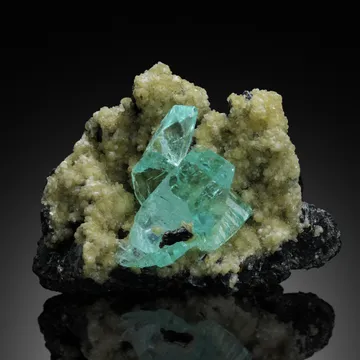
Phosphophyllite: rare sea-green to mint-blue crystals with glassy luster; fragile (hardness 3.5, perfect cleavage), prized Bolivian specimens and micromounts.
Key facts
Phosphophyllite is one of the great rarities in mineral collecting. Coveted for its ethereal sea‑green to mint‑blue color and elegant crystal form, it combines gemmy translucency with a delicate, glassy luster. Crystals are typically prismatic to bladed and may occur as striking V‑shaped “butterfly” twins. Despite its beauty, phosphophyllite is fragile: hardness is low (~3.5), and it has perfect cleavage, making pristine pieces scarce and highly prized. The finest examples—classic green crystals on iron‑oxide or quartz matrix from Cerro de Potosí, Bolivia—are legendary, sitting in museums and top private collections. Even micromounts from European zinc deposits are sought by species collectors due to the mineral’s rarity and distinctive hue.
Phosphophyllite holds near‑mythic status among collectors. The combination of beautiful color, rarity, and notorious fragility ensures enduring demand. Production of cabinet‑sized crystals has been effectively historical: most iconic pieces were mined decades ago at Cerro de Potosí. As a result, the market consists largely of older collections changing hands, with condition and provenance driving prices sharply upward. Micromounters appreciate phosphophyllite for its scarcity and science value; Bolivian matrix specimens command the strongest premiums. Because crystals break easily, unrepaired, undamaged examples are exceptionally rare and fiercely competed for. Occasional small finds or releases from old stock can electrify the market, but fresh supplies of top material are unlikely—cementing phosphophyllite’s position as a classic, blue‑chip species.
While phosphophyllite is known from a handful of deposits worldwide, only a few localities have produced specimens that are broadly recognized and traded in the collector market.
The undisputed source of the world’s finest phosphophyllite. Classic pockets—mostly early to mid‑20th century—yielded gemmy, bluish‑green crystals from thumbnails to multi‑centimeter singles and twins. Aesthetics are unmatched: sharply terminated prisms and V‑twins with a silky‑glass luster, sometimes perched on limonite, quartz, or sulfide matrix. Most large crystals exhibit internal stress and cleavage; consequently, unrepaired pieces are extraordinarily rare. Aesthetic matrix specimens with strong color, translucency, and good placement define the species at the highest level.
Color: Saturated bluish‑green to mint‑green is most prized, especially with even coloration from base to tip. Pale or gray‑green examples are less valuable. Backlighting can enhance the glow in gemmy crystals, but top pieces look vibrant even in ambient light.
Clarity and Luster: Phosphophyllite spans translucent to gemmy; higher clarity in the upper portion of the crystal amplifies the color and “inner light.” A crisp, vitreous luster on prism faces and terminations is highly desirable. Internal fractures are common; the fewer and less conspicuous they are, the better.
Crystal Form: Sharp, well‑terminated prismatic or bladed crystals are the standard. V‑shaped “butterfly” twins are iconic and very desirable when balanced and intact. In micromounts, look for textbook habit and clean faces; at cabinet scale, aesthetics and symmetry are paramount.
Matrix and Composition: For Bolivian material, pleasing contrast—mint‑green crystals against iron‑oxide gossan, quartz, or sulfides—adds significant appeal and value. A single dominant crystal well‑placed on a stable matrix usually outperforms clusters with scattered damage or awkward composition.
Size: Because large crystals are so prone to cleavage, size commands an exponential premium only when matched by color, clarity, and condition. A smaller, pristine, vividly colored crystal is often more valuable than a larger but cracked or dinged piece.
Condition: This is critical. Even tiny nicks on terminations are very noticeable due to the mineral’s glassy luster. Undamaged terminations and edges carry a strong premium. Surface‑reaching cracks, cleaves, or edge rubs reduce desirability, though some tolerance exists for historically important matrix specimens.
Repairs are common due to perfect cleavage and extraction stresses, particularly on larger Bolivian crystals and on matrix pieces.
Reattachment lines: Inspect with a 10× loupe for straight, planar seams or slight misalignments in striations. Epoxy residues can appear as glossy films along a junction; some adhesives may fluoresce under longwave UV.
Repaired twins: V‑twins that separated along the contact plane are often rejoined. Check the twin junction and terminations carefully for dead‑straight lines or subtle offsets.
Polished terminations: Rare, but watch for unnaturally perfect, mirror‑like flats lacking micro growth features. Polishing should be disclosed and generally lowers desirability.
Assembled matrix: Crystals glued to unrelated or “improved” matrices occur. Verify that matrix minerals and textures are consistent with known associations from the locality.
Treatments such as heating or irradiation are not part of normal specimen trade for phosphophyllite; fakes are uncommon. As always, provenance and reputable sources matter.
Phosphophyllite is fragile. Appropriate handling and an ultra‑gentle approach to cleaning are essential to preserve value.
Handling:
Light and Temperature:
Cleaning:
Storage:
Given phosphophyllite’s rarity and delicacy, a conservative, hands‑off philosophy is best: display securely, dust gently, and resist aggressive cleaning or re‑trimming. This approach preserves both the beauty and the integrity of one of the most cherished minerals in the collecting world.