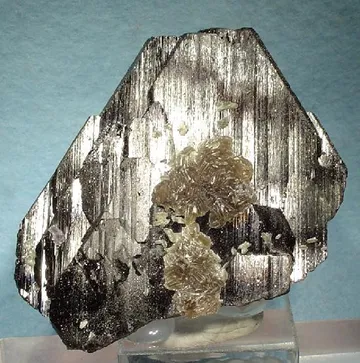
Muscovite — classic white mica with perfect basal cleavage and pearly luster; elegant rosettes and sheets, with rare, high‑quality pieces for collectors.
Key facts
Muscovite is the classic “white mica,” a sheet silicate renowned for its perfect basal cleavage, pearly luster, and ability to split into flexible, elastic sheets. In pegmatites and alpine clefts, it forms attractive books, rosettes, and stacked plates that can serve as elegant backdrops to showy species like aquamarine, fluorite, cassiterite, and spessartine. Colors range from silvery-white to pale green, tan, or bronze; transparent windows are uncommon but striking when present. Collectors appreciate muscovite both as a primary aesthetic mineral (star-shaped rosettes, lustrous books) and as a matrix that elevates the composition of a specimen. While common worldwide, truly fine, lustrous, undamaged muscovite with sophisticated form and strong associations can be surprisingly scarce and very desirable.
Muscovite enjoys steady popularity as a versatile display species. It is accessible for new collectors—clean, bright books are widely available at modest cost—yet connoisseurs also compete for exceptional pieces: razor-lustrous rosettes, six-rayed “star” muscovites from classic Brazilian pegmatites, gemmy window-like books from alpine clefts, or sculptural plates hosting vivid fluorite or spessartine crystals. Iconic combinations (e.g., spessartine on muscovite from Fujian, China; fluorite on muscovite from Hunan; aquamarine on muscovite from Pakistan) are time-tested cabinet favorites. Because muscovite is comparatively fragile along its perfect cleavage, pristine, sharply edged plates on balanced matrix—and especially those with dramatic contrast—command a premium. The species’ broad availability, coupled with pockets that occasionally produce museum-caliber associations, keeps muscovite perennial in the collector spotlight.
Below are celebrated sources known for producing muscovite specimens with standout form, luster, or associations. Each locality’s identity is verified with an ID so you can explore further.
This classic scheelite–cassiterite–fluorite district in Sichuan is also a top source of elegant muscovite plates and rosettes. The best pieces show bright, silvery luster and sharp hexagonal outlines, often framing or supporting glassy quartz, mint to purple fluorite, or blocky cassiterite. Rosette stacks can be highly architectural, displaying crisp edges that catch the light. When coupled with transparent fluorite cubes or octahedra, the silvery muscovite adds superb contrast and sophistication to the composition.
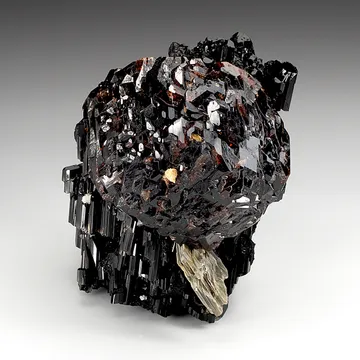
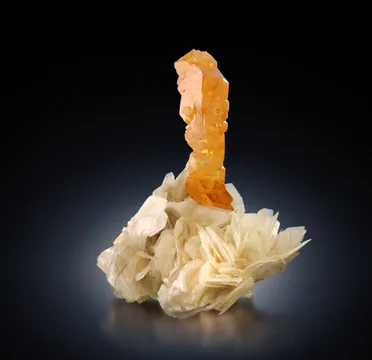
Fujian Province’s Wushan area is famous for fiery orange to red spessartine garnets perfectly sprinkled across lustrous muscovite plates. These specimens epitomize color contrast: bright red garnets perched on mirror-like silver mica. Muscovite forms flat, reflective books or stacked plates, sometimes with crenulated edges that add texture. Top pieces present immaculate mica luster and a well-placed garnet “constellation,” making this combination one of the most recognizable muscovite associations of the last two decades.
A titan of Chinese mineralogy, Yaogangxian is renowned for fluorite, but muscovite here is a star supporting actor. Silvery to pale-green muscovite plates and rosettes often cradle glassy quartz and sharp fluorite cubes in greens, purples, or blues, producing refined, balanced arrangements. The mica’s satiny sheen and crisp edges elevate the aesthetic, especially on matrix clusters where muscovite frames the fluorite without overwhelming it.
The granitic pegmatites of northern Pakistan (Gilgit–Baltistan) produce classic aquamarine-on-muscovite combinations. Muscovite occurs as stout, bright books or layered plates, often perfectly arranged to support gemmy beryl prisms, topaz, or quartz. Many specimens are remarkably architectural—clean lines, sharp terminations, and a metallic-silver sheen that contrasts beautifully with the cool blue of aquamarine. Large, intact books without edge flaking are especially coveted.
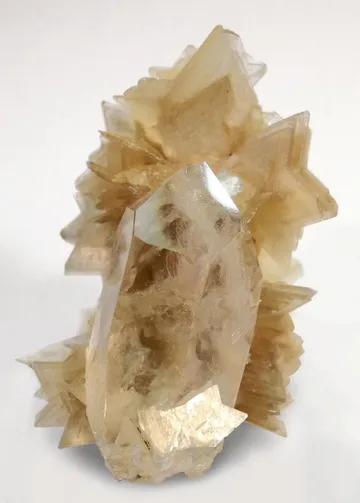
The Itinga–Jequitinhonha Valley pegmatites are classic for muscovite “stars” and aesthetic book crystals. The celebrated six-rayed, stellate muscovite aggregates—formed by sector growth and rosette stacking—are unique collectibles. Colors are typically silvery-white to tan with a silky sheen, sometimes on quartz or albite. Well-centered, symmetric stars with crisp, undamaged rays are scarce and highly prized, representing a distinctive muscovite habit that collectors seek out specifically.
Luster and surface freshness: Muscovite should display a bright pearly to vitreous sheen on cleavage surfaces. Dull, matte, or oxidized faces are less desirable unless compensated by exceptional form or associations. The best plates look almost metallic-silver and “flash” when rotated.
Form and architecture: Desirable habits include sharp hexagonal books, neatly stacked plates, well-centered rosettes, and rare stellate “stars.” Assess symmetry, definition of edges, and the overall geometry. Stacks that step like terraces or rosettes that read clearly at a distance display best.
Edge integrity and cleavage condition: Perfect basal cleavage makes muscovite prone to edge nibbling and layer flaking. Inspect margins and corners—crisp, unfrayed edges are a major plus. Delamination, missing corners, or “fuzzy” edges lower appeal, especially on the primary display side.
Thickness vs. transparency: Thin books can show attractive semi-transparency and light transmission; thicker ones provide bolder geometry and reflectivity. Either can be excellent—what matters is consistency of the habit and a clean, undamaged surface.
Color: Classic muscovite is silvery-white to pale tan or greenish. Strong bronze tints can be striking; uniform tone is generally preferred over blotchy coloration. Note that chromium-rich green mica is usually classified as fuchsite (a variety/species distinct from muscovite in some databases), so verify labeling if vivid green is claimed.
Associations: Muscovite is a superb “framing” matrix. High-impact combos include:
Size and display: Larger books and plates are common, but large and pristine is not. A smaller specimen with razor-sharp edges and excellent luster often outclasses a bigger but ragged piece. Look for a natural, stable base and a prime display angle where the mica flashes and the associated crystals present cleanly.
Reattached layers: Because muscovite splits easily, loose layers are sometimes re-glued. Under magnification, look for thin, glossy glue lines between laminae or localized wet-looking areas along an edge. UV light may reveal fluorescing adhesive seams.
Consolidation and coatings: Clear consolidants or lacquers may be used to stabilize flaking edges or enhance luster. Tell-tales include uneven gloss, a “plastic” shine out of character with natural pearly luster, or dust trapped in a film. Lightly breathing on a suspect area can sometimes reveal a hazy film as moisture condenses.
Polished faces: Fresh cleavage is naturally silky, with subtle growth textures. Perfectly mirror-flat surfaces on broken or irregular planes may indicate polishing. Compare luster and micro-texture across faces; unnatural uniformity can be a clue.
Assembled matrix: Muscovite plates are occasionally used as a stage for unrelated crystals. Check junctions between hosts and guests for incongruent mineral associations or traces of epoxy. Provenance and reputable dealers help mitigate this risk.
Muscovite is soft (Mohs ~2–2.5) with perfect basal cleavage, so careful handling is essential.
Handling:
Cleaning:
Light, heat, and environment:
Display and storage:
By favoring crisp luster, sharp edges, and balanced associations—and by handling with care—collectors can assemble a muscovite suite that ranges from elegant architectural books to iconic color-contrast combinations that shine in any cabinet.