Muscovite from Shigar District is best understood as the luminous architecture behind many of Pakistan’s most admired pegmatite specimens. Collectors usually encounter it not as isolated mica “books” alone, but as silvery, beige, bronze, or faintly metallic blades and rosettes that set off aquamarine, topaz, fluorapatite, quartz, albite, schorl, fluorite, and garnet. On the best pieces, the muscovite is not merely matrix: it is a sculptural foil, a reflective base of stacked sheets and bladed sprays against which pale blue beryl or pink apatite seems to float.
The setting is the Shigar–Braldu–Basha pegmatite belt of Gilgit-Baltistan, in the high Karakoram north of Skardu. These are granitic pegmatites emplaced into metamorphic rocks, including the Dassu orthogneiss and broader Karakoram Metamorphic Complex. The gem-bearing pegmatites are characteristically zoned and miarolitic, with pockets and vugs that allowed open-space growth of beryl, topaz, fluorapatite, tourmaline, quartz, albite, and mica. In the more evolved, gem-producing pegmatites, albite and muscovite become especially important constituents, while biotite is diminished or absent. That geological distinction is one reason the glittering mica matrix on Shigar specimens is more than decoration: it is part of the mineralogical signature of the productive pegmatite class.
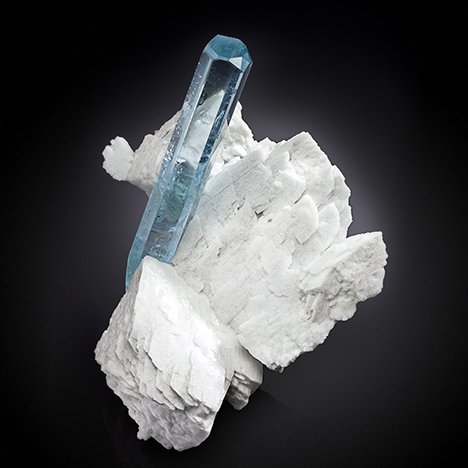
Photo: GIA, Gems & Gemology
Historically, Shigar has become one of the world’s essential names for aquamarine on matrix, and muscovite is a recurring part of that identity. The district’s specimens helped change collector expectations for aquamarine: instead of loose, off-matrix crystals, Shigar and neighboring northern Pakistan localities supplied gemmy blue beryls standing on natural pegmatite matrix, commonly albite with muscovite and schorl. The finest muscovite-bearing combinations are valued for their balance of color, geometry, and texture: icy blue beryl, snowy albite, black tourmaline, pink fluorapatite, and satin-bright mica all in one pocket-grown composition.
For serious collectors, the appeal lies in natural association. Muscovite should look integral to the matrix, with blades or books emerging coherently from albite, feldspar, quartz, or pegmatite material rather than serving as a convenient platform for an added crystal. Good Shigar muscovite is crisp, reflective, and undulled, with visible layered cleavage and minimal crushing. Its best role is to animate the specimen: a flash of mica behind a transparent aquamarine, a silvery rosette under fluorapatite, or a bladed fan that gives a matrix piece depth and movement.
Search for specimens: View all muscovite specimens from Shigar District, Pakistan
Shigar District lies in Gilgit-Baltistan, northern Pakistan, and many older specimen labels still read “Skardu District,” “Northern Areas,” “Shigar Valley,” or simply “Skardu, Pakistan.” For modern locality work, the important collecting region includes the Shigar Valley and its upper branches, especially the Braldu and Basha valleys, with names such as Dassu, Yuno, Haiderabad, Goyungo, Gone, Nyet, Apo Ali Gun, Alchuri, and Basha appearing on mineral labels. The spelling of villages can vary substantially in the trade because Balti names have passed through Urdu and English transliteration; Dassu, for example, appears in older sources as Dusso, Daso, or Dasso.
The productive deposits are granitic pegmatites, locally simple but, in the important specimen-producing zones, evolved and zoned. Field and petrographic work divides Shigar pegmatites into gemstone-bearing muscovite-schorl-beryl-garnet and muscovite-schorl types, contrasted with more biotite-bearing, gemstone-barren pegmatites. The gem-bearing pegmatites are coarse-grained, commonly zoned, and intruded into Dassu orthogneiss with sharp contacts. Border zones may be fine-grained or aplitic, while the intermediate zones and miarolitic cavities are the key sites for gem crystals and collector specimens.
Muscovite is not an incidental accessory in this setting. In the gemstone-bearing pegmatites it is a prominent mineral, and higher muscovite content, together with the absence or near-absence of biotite, has been used as an exploration guide for gem-bearing pegmatites. Petrographic descriptions record large, well-cleaved muscovite flakes with intergrowths and overgrowths, and field descriptions note cleavable muscovite sheets on the order of several centimeters.
Mining is small-scale, local, and physically demanding. The high mines are reached by steep paths above villages and river valleys, and access is not comparable to a public collecting site. Specimens enter the market through local miners, village dealers, Skardu dealers, Peshawar and Namak Mandi trade channels, and international dealers. In the Braldu and Shigar valleys, work has traditionally depended on seasonal access, local labor groups, investors, supplies, and the condition of mountain roads, bridges, and checkpoints.
Production has been active for decades. Collector literature and dealer records point to a strong market presence from at least the late 1980s and 1990s, with continued production through the 2000s and active new-find material still appearing in auctions and dealer inventories in the mid-2020s. Haiderabad is especially noted for slender “bic-pen” aquamarines, Yuno for topaz and aquamarine associations, Dassu for major aquamarine and rare phosphate occurrences, and Basha for pegmatite minerals as well as alpine-cleft species in the Haramosh range.
Notable Shigar material includes gem aquamarine on albite and muscovite matrix, aquamarine with schorl, topaz with cleavelandite and muscovite, fluorapatite on muscovite, and large multi-species plates where muscovite forms a thick bladed bed under aquamarine, fluorite, and fluorapatite. A 2026 Heritage Auctions lot from Shigar described aquamarine, fluorite, and fluorapatite resting on a thick bed of bladed muscovite; the 13.7 x 15.4 x 7 cm specimen sold for $1,062.50 and came from the William and Ruth Loomis Collection. Such examples show the collector role of Shigar muscovite at its best: not rare as a species, but highly desirable when it gives structure, sparkle, and contrast to a complete pegmatite association.
Shigar muscovite most often appears as bladed aggregates, stacked books, leafy plates, rosettes, and reflective coatings on albite or feldspar matrix. In hand specimens it ranges from silvery white and pale beige to bronze-gray, smoky beige, or slightly brownish; the best pieces have a bright, almost metallic sheen across the cleavage faces. Individual mica books and sheets may be only millimeters across on miniature combination specimens, while field descriptions document cleavable sheets several centimeters wide. Large cabinet plates can carry broader carpets of bladed mica, but the mica itself is still fragile and layered rather than blocky.
The associated minerals are central to the identity of the material. Aquamarine is the classic partner, usually pale blue to greenish blue and prismatic, commonly with albite, cleavelandite, quartz, schorl, and muscovite. Topaz from Shigar and Dassu is commonly associated with albite or cleavelandite, quartz, fluorite, and muscovite. Fluorapatite occurs as sharp, often pink to pale pink or greenish crystals on muscovite or with albite and aquamarine; on some pieces it shows strong yellow fluorescence under ultraviolet light. Schorl adds black vertical contrast, while spessartine or almandine-spessartine garnets supply red-orange accents on feldspar and mica-bearing matrices.
In thin section and field descriptions, muscovite from the productive pegmatites is described as the dominant accessory mica, forming large well-cleaved flakes and showing intergrowths and overgrowths. Some muscovite flakes contain inclusions of quartz or biotite. Feldspars in the pegmatites may be altered along margins and microfractures to muscovite, sericite, epidote, and kaolinite, so a specimen may include both primary mica books and finer secondary mica or sericitic alteration.
Collector quality depends on the role the muscovite plays in the whole specimen. The most desirable examples show sharp, undamaged, reflective blades that are clearly natural to the matrix and that enhance a major crystal rather than hiding it. A muscovite rosette under a gem aquamarine, a silvery fan beside pink fluorapatite, or bronze mica contrasting with snowy albite gives a specimen visual complexity that a loose aquamarine crystal cannot offer. Pieces with mica that is dull, crushed, iron-stained, or packed with pocket clay are less desirable unless the associated crystal is exceptional.
Typical Shigar muscovite-bearing specimens range from thumbnails and miniatures with a single aquamarine or fluorapatite on mica, to small-cabinet and cabinet combinations with multiple aquamarines, albite, quartz, schorl, and mica. Dealer and auction records show matrix aquamarines commonly in the 3–8 cm crystal range, with some Shigar aquamarines reaching a dozen centimeters or more; muscovite-bearing matrix specimens can exceed 10 cm and occasionally form large cabinet plates. For muscovite itself, however, crispness and integration matter more than raw size.
The main authenticity concern is not fake muscovite as a species; muscovite mica is common and inexpensive compared with fine aquamarine, fluorapatite, or topaz. The concern is assembly. Because Pakistani-style aquamarine-on-mica specimens are popular, buyers should examine whether the principal crystal is naturally rooted in the mica-albite matrix or has been glued onto a convenient mica base. Look for continuous growth relationships, undisturbed mica blades around the contact, pocket clay in natural crevices, and compatible wear patterns. A suspiciously clean junction, glossy adhesive, scraped mica around the base, mismatched luster, or a crystal sitting on top of mica without penetration into the matrix should prompt close inspection under magnification.
Repairs are a normal issue in high-relief Shigar matrix specimens. Aquamarine crystals can be reattached, mica blades can be stabilized, and small feldspar or quartz elements can be restored. Reputable dealers usually disclose repairs, and many auction descriptions explicitly note “no repairs” when that is a selling point. For valuable pieces, request multiple views, ultraviolet examination if fluorapatite is involved, and a clear statement on repairs, restorations, and any glued contacts.
Condition is especially important because muscovite is perfectly cleavable and easily bruised. Edge chipping, crushed blade tips, missing mica books, flaked-off sheets, and compressed areas are common. A few peripheral losses on muscovite matrix may be acceptable, especially on older or large pieces, but fresh-looking scars on the display face can be distracting. Cleaning should be conservative: aggressive brushing can peel mica; ultrasonic cleaning is inappropriate for most matrix specimens; and soaking can loosen clay-supported aggregates or older repairs.
Locality accuracy also deserves attention. Shigar, Skardu, Braldu, Basha, Dassu, Yuno, Haiderabad, and Alchuri labels may refer to different scales of locality, while older specimens often carry broad labels such as “Skardu District” or “Northern Areas.” Do not automatically reject older labels, but keep the historical geography in mind. Also distinguish Shigar material from similar Pakistani aquamarine-on-muscovite specimens from Nagar, Hunza, Haramosh/Stak Nala, or other Gilgit-Baltistan districts.
In the market, muscovite from Shigar is common as matrix and uncommon as the featured collectible species. The best value is usually in well-composed combinations: aquamarine with clean albite and bright mica; fluorapatite sitting sharply on muscovite; topaz with cleavelandite and mica; or schorl-aquamarine-muscovite groupings with good contrast. Small but honest examples remain obtainable, while large, balanced, damage-free matrix specimens with gemmy aquamarine and crisp muscovite can command strong prices.
Dudley Blauwet’s 2006 account of the Shigar and Alchuri mineral country captures the atmosphere behind many of the specimens that later reached Western collections. In Skardu, news of his arrival moved through what he jokingly called the local “BBC network,” and dealers began appearing with aquamarines, tourmalines, apatites, and the occasional surprise. The trade was not a matter of wandering into a shop and choosing from orderly drawers; it was tea, waiting, bargaining, whispered provenance, and small paper packets emerging from waistcoat pockets late at night.
At Yuno, he was told that miners were working the south-facing ridge above the village and that material might become available in a few days. Three days later, the promise became real: “bic pen” terminated aquamarines appeared, a style associated with the Haiderabad-Yuno part of the Shigar mineral world. That small detail says much about Shigar production. A village may show nothing one afternoon, and a few days later a pocket’s worth of slender aquamarines may begin to move through hands, across floors, into cloth wraps, and eventually into the international specimen trade.
In Nyet, the beauty of the mineral trade was inseparable from its danger. Blauwet met a 28-year-old man with prosthetic limbs who had lost both arms after misjudging the detonation time of an explosive charge. The man was amiable and smiling, and instead of dwelling on the accident he reminded Blauwet about a camera he had asked him to bring. Blauwet had forgotten to buy it while passing through Dubai and apologized, later bringing a better one on a return trip. The episode is a hard reminder that the glitter of mica and aquamarine is tied to high-risk hand mining in steep terrain, often with limited equipment and little margin for error.
The Alchuri climb is one of the most vivid field passages in modern Pakistan mineral literature. Blauwet and the schoolmaster Master Najaf followed a pipeline, then a goat-like trail, then loose talus that steepened until every handhold mattered. Rain began to slick the rock, wind rose, and the ridge forced a choice between an invisible route around a pinnacle and a direct but frightening class-five slab. Master Najaf called out “Bahut khatternak” — “very dangerous” — while a miner above signaled that their route was a bad idea.
Only a few meters from the pockets, Blauwet froze. His nose was about 15 cm from a near-vertical face, one foot had a foothold of only about 10 cm, and the drop fell away to the avalanche field below. A miner used an iron tool to scrape a tiny pad into the incline, just large enough for the ball of a foot. Blauwet stepped into space, swung across the corner, and reached the excavation. The productive zone was only about 3 to 4 meters across, but miners said they had worked portions of it for up to 2 kilometers along the ridge over 12 years. The working tool was humble: a 60-cm iron rod, pointed at one end and hooked at the other, enough to pry fist-sized chunks from shattered, rust-colored schist.
Not every Shigar story is an aquamarine story. In a dark back room at Dassu, lit by the flame of a gas lamp because electricity was absent in the Braldu Valley, Blauwet examined dirty minerals from local dealers. A dynamite blast rumbled off the cliffs outside. Among garnets and hydroxylherderite, he saw a battered orange-brown phosphate in black manganese oxide matrix and suspected triplite. The dealer named Namlook, a mine above the north side of Dassu, and added that it was an eight-and-a-half to nine-hour walk one way even for strong local people. For a locality detective, the clue was gold: a rare phosphate long rumored from Alchuri suddenly had a more plausible Braldu Valley source.
A newer field account from Origin Gems describes the Goand mining area opposite the Braldu River and the story of the “King of Kashmir” aquamarine. According to a geologist at the mine, the specimen was bought around 2019 for about 7 crore Pakistani rupees, roughly $450,250 at the time, after hard negotiations at the mine site. The writer stresses that many people are involved in such a find: some provide wages, some fund dynamite, some supply rations, and miners may divide production by investment share or work on consignment. In that social world, a great crystal is not simply “found”; it passes through a web of labor, risk, secrecy, village finance, negotiation, and regional pride before it receives a famous name.
The same account describes the Goand cliff as a daily commute for local miners, with a wooden bridge across the Braldu and steep approaches to mine entrances. At Dassu, the authors entered a mine where the floor was unstable with tailings and debris, and a black tourmaline pocket remained embedded in the wall — material that might be discarded as waste while miners chase more valuable aquamarine. For collectors, those scenes put the mica matrix in perspective. The muscovite on a Shigar specimen is not a decorative afterthought; it is part of the pegmatite body that miners break, sort, carry, bargain over, and sometimes overlook while seeking the blue crystals that made the valley famous.
 Amethyst
 Quartz
 Fluorite
 Tourmaline
 Malachite
 Azurite
 Rhodochrosite