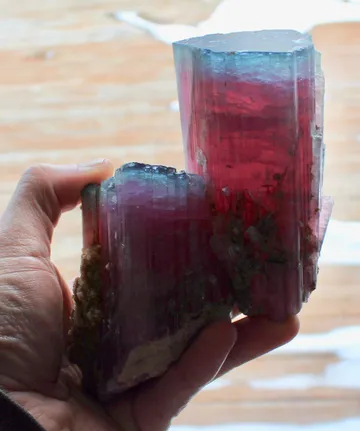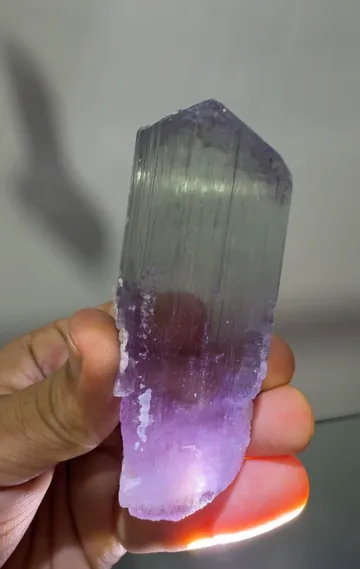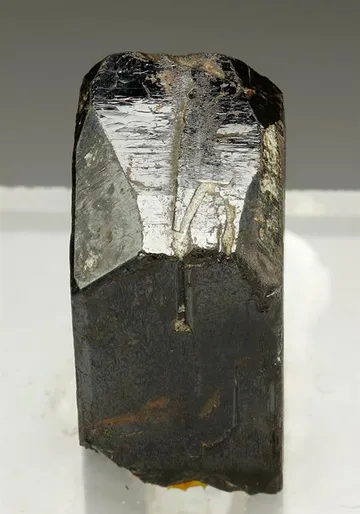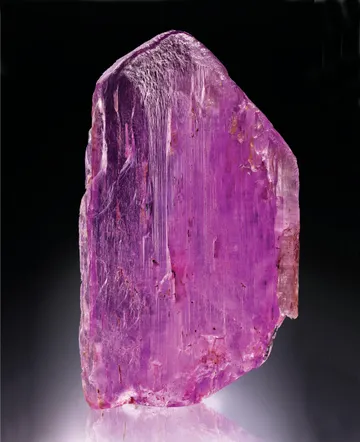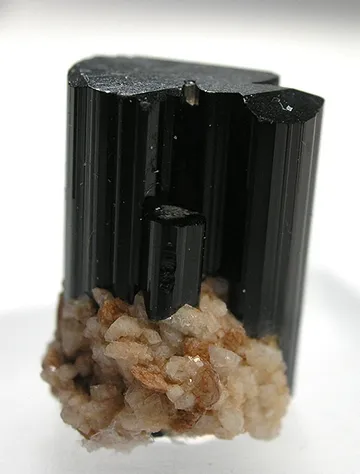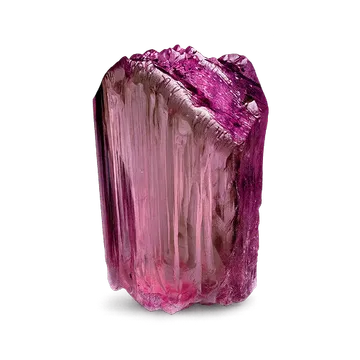
Kunzite from Pala Mining District, San Diego County — lavender to pink bladed crystals, rare historic locality material, and prized collecting quality.
Key facts
Kunzite from the Pala Mining District is one of the defining American gem-mineral classics: lavender to pink, sometimes bluish purple, often in glassy, bladed crystals of spodumene with the unmistakable delicacy and risk that make the species so compelling. The color is not merely a pretty accessory here; it is part of the locality’s identity. Pala is the district that brought lilac gem spodumene to science and commerce, tied the mineral forever to George Frederick Kunz, and supplied the early crystals and cut stones that made “kunzite” a named gemstone rather than a mineralogical curiosity.
The material comes from rare-element granitic pegmatites of the Southern California pegmatite province. In the Pala district these dikes occur principally in gabbroic rocks of the southern California batholith and related crystalline terranes. They are lithium-rich, pocket-bearing bodies: layered “line rock,” graphic granite, quartz-perthite cores, cleavelandite, lepidolite, tourmaline, beryl, quartz, and spodumene appear in a complex sequence of crystallization, pocket formation, and later alteration. The best kunzite is the fraction of spodumene that escaped alteration—transparent, saturated enough to show color down the length of the blade, and still sharp enough to keep its identity as a crystal rather than just cutting rough.
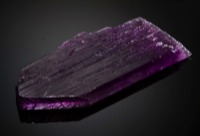
Photo: Oceanview Mine
Collectors value Pala kunzite on several overlapping levels. A fine specimen may be a historic Pala Chief crystal, a later Oceanview Mine piece from the Big Kahuna zones, a matrix crystal on cleavelandite or lepidolite, or a smaller but complete floater showing luster, etching, color concentration, and termination. Pala material is not usually judged like mass-market faceting kunzite from later world sources. The best pieces carry locality character: flat bladed habit, strong pleochroic color, etched prism surfaces, association with Pala pocket minerals, and, for the strongest modern Oceanview examples, a depth of purple that revived the district’s reputation a century after the original rush.
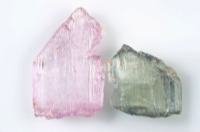
Photo: Oceanview Mine
Search for specimens: View all kunzite specimens from Pala Mining District, San Diego County, USA
The Pala Mining District lies in northern San Diego County, near the village of Pala, and includes the classic gem pegmatites of Chief Mountain, Hiriart Mountain, Queen Mountain, and nearby ground. For kunzite collectors the key names are Pala Chief, White Queen, San Pedro, Anita, Elizabeth R, and Oceanview, with Pala Chief and Oceanview standing out as the two most important sources of large, highly regarded gem spodumene from Chief Mountain.
The deposit type is LCT rare-element granitic pegmatite—lithium, cesium, and tantalum enriched. In the Pala district, many pegmatite dikes trend roughly northward and dip gently to moderately westward, commonly in gabbroic host rocks. Jahns and Wright’s classic district study recorded at least 400 pegmatite dikes over an area of about 13 square miles. The pegmatites range from thin stringers to thick, bulging bodies, and the valuable minerals are not evenly distributed through them. Gem spodumene belongs to the inner quartz-spodumene cores and pocket-bearing zones, especially where the original spodumene remained clear rather than being replaced or altered.
Pala Chief sits near the summit area of Chief Mountain, about two miles northeast of Pala. The old workings were described as interconnected bench-like open cuts on the southwest face of a nearly flat-topped ridge, with underground drifts and inclines developed from the main cut. The classic Pala Chief dike is a complex body rather than a simple vein: it branches, joins, rolls, and changes dip, with graphic granite in the upper part, line rock in the lower part, and locally a thin spodumene-rich pocket-bearing unit between them. Jahns and Wright described the pocket-bearing unit in places as only one to three feet thick—an important reminder that the finest material came from narrow, selective zones rather than from bulk ore.
Mining history here is intertwined with the birth of kunzite. Lilac spodumene was first recognized from the Pala area around 1902, with priority connected to Hiriart Mountain and the White Queen claim, while Pala Chief soon became the great commercial source of large, fine crystals. Pala Chief was located in May 1903 by John Giddens, Frank A. Salmons, Bernardo Hiriart, and Pedro Peiletch, and it was developed heavily until about 1914. Early production included kunzite, triphane, green and colorless spodumene, tourmaline, beryl, quartz, and lepidolite. Some of the best rough was sold into the Tiffany orbit, and George Kunz’s name became inseparable from the gem.
The district’s peak mining period ran from roughly 1900 to 1922, with later intermittent work. Jahns and Wright recorded by 1947 a district output that included 23,480 short tons of lepidolite, 2,980 pounds of tourmaline, and 1,325 pounds of gem spodumene. Pala Chief was largely quiet after the original boom, aside from assessment work and sporadic mining; Bob Bartsch found triphane and kunzite in the 1960s, Pala International worked there in the early 1970s with minor finds, and Bob Dawson owned the mine from the 1980s until its 2011 sale to Oceanview Mines, LLC.
Modern Pala kunzite collecting was transformed by the Oceanview Mine on Chief Mountain. The Oceanview workings began as a new adit in the early 2000s, and the mine became famous for the 49er Pocket and later the Big Kahuna zones. In spring 2010, the Big Kahuna zone produced a major kunzite find, followed later that year by Big Kahuna II on the Baker Boulevard level. The most famous single specimen, the “Big Kahuna” kunzite, measures 28 x 15.6 x 2 cm and weighs about 2.2 kg, placing it among the great American kunzite crystals.
Collecting access is controlled by private operators. Pala Chief is not an open public collecting locality in the casual sense; special fee digs have been offered seasonally, and visitors should treat all mine areas as private property requiring permission. Oceanview has offered public fee digging in mine dump material, while Pala Chief digs are separate events with different conditions and less provided equipment. Serious collectors should verify access directly with the operators before planning a trip, because schedules, rules, and mine status change.
Pala kunzite is spodumene, LiAlSi2O6, and its collector appeal depends on the marriage of crystal form and color. The classic crystals are bladed to tabular, commonly flattened, with prismatic faces and a strong long-axis color direction. Schaller’s early crystallographic study of the Pala material emphasized the well-developed prismatic zone, tabular habits, vertically furrowed orthopinacoid faces, and abundant natural etch figures. Those etched surfaces—triangular pits, strings of pits, softened terminations, and grooved faces—are not defects by default; in Pala material they are part of the visual language of the locality.
Color ranges from very pale rose-pink through lilac to pale purple, with some crystals showing a bluish cast. Oceanview material extended the district’s palette dramatically, producing deep purple, blue-purple, greenish to blue-green, and bicolored examples, some of which changed toward pink or purple with sunlight exposure. The strongest color is seen down the length of the crystal, so cutters orient stones to take advantage of the pleochroism; specimen collectors likewise admire blades that glow when lit along the long axis.
Typical specimen sizes vary widely. Small cleavage fragments and thumbnail pieces are commoner than display-quality crystals. Jahns and Wright noted that many clear spodumene fragments were under two inches long, but also recorded exceptional gem-quality crystals from Pala Chief, Vanderburg, and Katerina that reached at least 15 inches and weighed 16 to 27 ounces, with some yielding flawless cut stones of 75 to 250 carats. Modern Oceanview finds brought the scale back into headline territory, with Big Kahuna crystals ranging from fine miniatures to major cabinet specimens and the 2.2 kg “Big Kahuna” as the celebrated extreme.
Associations are central to value. Pala kunzite may occur with quartz, albite or cleavelandite, microcline, orthoclase/perthite, muscovite, lepidolite, beryl, elbaite, schorl, and pocket clays. In the Pala Chief dike, kunzite and other clear spodumene varieties can occur as unaltered parts of larger lath-shaped spodumene crystals encased in massive quartz, or as more isolated crystals projecting inward into clay-filled pockets. Matrix pieces are rarer and more prized than loose blades when the crystal is well positioned and the matrix is unquestionably Pala pegmatite.
The most desirable specimens show several of the following qualities: genuine Pala locality provenance, transparency or translucency, saturated pink-lilac to purple color, visible pleochroic depth down the blade, intact termination, minimal cleavage bruising, attractive etching rather than dull corrosion, and association with cleavelandite, lepidolite, quartz, or tourmaline. Old Pala Chief pieces with early labels are especially desirable even when paler, because the locality is historically foundational. Modern Oceanview pieces are prized for dramatic color and documented pocket history.
The first caution with Pala kunzite is condition. Spodumene has perfect cleavage in two directions and is prone to bruising, splitting, and edge chipping. A specimen can look clean from the front but carry a cleavage crack along the blade, a repaired termination, or a sawn base disguised as a contact. Always inspect Pala kunzite with raking light and a loupe. Cleavage flashes are common; the question is whether they are natural internal character, healed-looking growth features, or structural damage that threatens the specimen.
The second caution is color stability. Kunzite can fade with prolonged exposure to strong light or heat. Pala material has a complicated reputation because some Oceanview crystals were recovered in greenish, blue-green, blue-purple, or deep purple colors and then shifted toward pink or purple after light exposure. This does not make them fake, but it does mean display decisions matter. Avoid direct sunlight, hot cases, intense LED spots placed too close to the specimen, and long-term window display. Store important pieces in low light, and photograph them when acquired so future color changes can be recognized.
Treatment is a real issue for kunzite as a gem species. Irradiation followed by heating can enhance color, and treated kunzite may fade under light and heat much as natural-color material can. For cut stones, a lab report may be appropriate for significant value. For crystals, the more important questions are locality documentation, natural surface preservation, and whether the piece has been artificially irradiated or artificially recolored after mining. Deep color alone is not proof of treatment, especially for documented Oceanview Big Kahuna material, but strong claims deserve provenance.
No serious collector should buy “Pala kunzite” on color alone. Afghanistan, Brazil, Madagascar, and other localities have produced abundant kunzite, and loose blades without labels can be difficult to assign by appearance. Pala Chief pieces tend to circulate with old labels, historical collection notes, or distinctive associations; modern Oceanview pieces often have pocket names, mine-owner provenance, or published photographs. A specimen labeled simply “Pala, California” is less desirable than one tied to Pala Chief, Oceanview, Elizabeth R, San Pedro, Anita, White Queen, or another specific mine.
Matrix and association should be evaluated carefully. Cleavelandite, lepidolite, quartz, elbaite, and pocket clay are consistent with the district, but they do not independently prove locality. Conversely, a loose, pale blade with no label may still be authentic Pala but will not command the same confidence or price as a well-documented specimen. Old Pala Chief labels, Ward’s labels, Pala International provenance, Oceanview Mines provenance, or a published collection history materially affect value.
Market availability is uneven. Small fragments, pale blades, and fee-dig material appear regularly. Fine terminated crystals, richly colored Oceanview pieces, old Pala Chief classics, and matrix specimens are much scarcer. The strongest modern Oceanview kunzites entered collections rapidly after the 2009–2011 pockets, and the most important examples now trade privately or appear only occasionally through high-end dealers and auctions. For serious collectors, patience and documentation matter more than chasing the largest blade.
The origin story of Pala kunzite is wonderfully untidy. Frederick M. Sickler, Frank A. Salmons, Bernardo Hiriart, Pedro Peiletch, John Giddens, George Frederick Kunz, and Charles Baskerville all move through the record, and the question of “who discovered kunzite” becomes less a single answer than a frontier argument conducted by letters, specimens, and commerce. Sickler’s side of the story is particularly vivid. In a September 26, 1904 letter to Kunz, he complained that Frank Salmons had been called the “discoverer of Kunzite” in a San Diego paper, and insisted that he had brought the stone before local lapidists and experts a year before the Pala Chief produced any kunzite. He also bristled that Salmons & Ernsting were advertising the Pala Chief as the only kunzite deposit in the world.
H. C. Gordon, one of Kunz’s key California correspondents, complicated the matter further. Writing to Kunz on October 24, 1902, Gordon credited Pedro Peiletch and Bernardo Hiriart, “Frenchmen,” with finding the gem spodumene on the White Queen claim in section 24, T9S R2W, before the Pala Chief claim in section 14 was located in May 1903. That timing has become important to modern locality historians: the first recognition belongs to Hiriart Mountain and the White Queen area, but the Pala Chief furnished the large, fine, gemmy crystals that made the new gem famous.
The naming itself had a theatrical quality. The lilac spodumene might have passed through history under another name—Sicklerite, Salmonite, or simply lilac spodumene—but Charles Baskerville named it kunzite in 1903 in honor of George Frederick Kunz. Baskerville, still analyzing the material, wrote to Kunz asking for more colored pieces, saying that small refuse pieces from cutting would do. According to Lawrence Conklin’s later account, Kunz supplied more than scraps: a cut and polished prism used by Baskerville in 1903 was still being shown decades later in an optical mineralogy course at City College of New York.
At the Pala Chief itself, the early mine photographs feel almost staged for legend. One image from around 1903 shows Frank A. Salmons, Bernardo Hiriart, and Pedro Peiletch working a pocket on the pegmatite face. Another shows M. S. McLure, Hiriart, Peiletch, and Salmons at the open face where early kunzite was found. The mine’s original surface workings followed exposed pocket zones, and at least one giant pocket earned the name “Bridal Chamber.” For all the romance, the actual geology was tight and selective: thin pocket-bearing horizons, rolls in the dike, and places where clear kunzite survived as unaltered remnants inside larger spodumene masses.
A century later, the Oceanview Mine gave Pala kunzite a second act. In late 2001 Jeff Swanger’s crew began a new lower adit on the Ocean View pegmatite system. For nearly two years they drilled and blasted through barren rock before reaching the first real pocket. Then came a series of modern finds, and in spring 2010 the Big Kahuna zone opened. The name honored Swanger’s father, nicknamed the Big Kahuna; the pocket returned not only kunzite but also striking bicolored elbaite.
The sequel was even more dramatic. In late 2010, miners reached the down-dip extension known as Big Kahuna II on the Baker Boulevard level. On December 20, 2010, the famous “Big Kahuna” kunzite crystal came out: 28 cm tall, 15.6 cm wide, 2 cm thick, and about 2.2 kg. It was deep, glassy, and broad enough to look almost unreal for an American kunzite. Pala International quickly recognized the moment, noting that the December 2010 find produced fine miniatures, deep purples, blue greens, bicolored crystals, and specimens that might rank among the largest ever recovered in San Diego County.
Modern field collecting at Pala retains some of the old hardship in miniature. A San Diego Mineral & Gem Society trip report from 2012 records a group of 25 members and friends meeting at Pala Casino, signing waivers, counting money, recounting money, and eventually finding the non-paying participant asleep in his car. At the mine, people began finding kunzite, tourmaline, and quartz, but the day turned brutal. By 1:00 p.m. the overheated rockhounds were leaving; the rocks were described as so hot they were hard to pick up. Another trip later that year, under better weather, produced a much happier list: beryl, hiddenite, kunzite, triphane, graphic granite, muscovite, microcline, smoky quartz, lepidolite with cleavelandite, rubellite, aquamarine, morganite, and dark tourmalines—an almost perfect small-scale cross-section of what makes the Pala pegmatites irresistible.