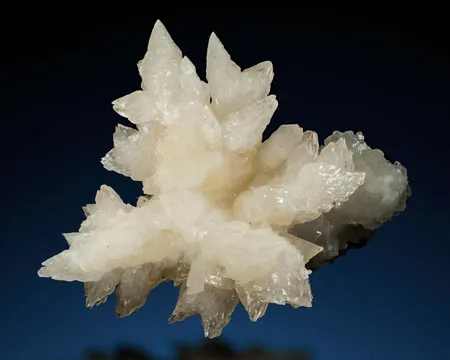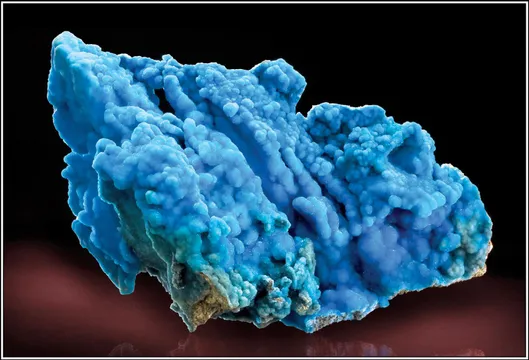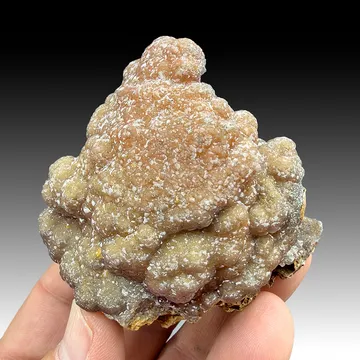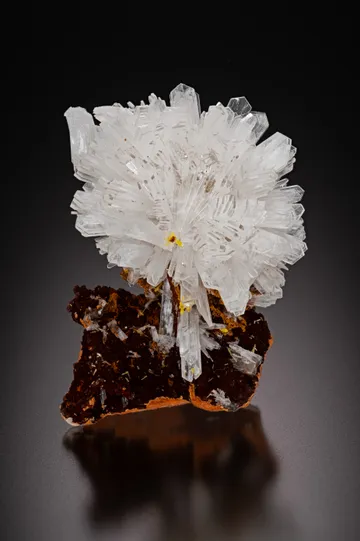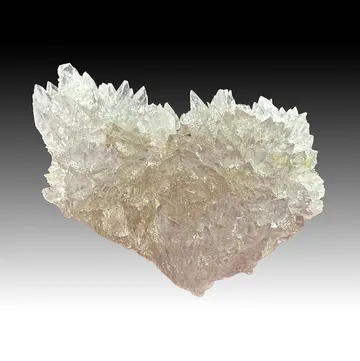
Hémimorphite — Santa Eulalia, Mexique : aérosols brillants, incolores à teintés, avec des lames prismatiques acérées sur le gossan, prisée pour ses poches aérées et son éclat vif.
Key facts
L’hémimorphite de Santa Eulalia est l’une des expressions les plus classiques du genre au Mexique : silicate de zinc incolore à blanc brillant en gerbes, éventails, moulinets et amas en forme de jeux de morpions sur un gossan rouille. Les meilleurs échantillons présentent l’acuité que recherchent les collectionneurs dans l’hémimorphite cristallisée — lames prismatiques acérées, éclat scintillant, terminaisons translucides et un contraste sculptural contre les oxydes de fer ocre-brun. En main, les pièces les plus spectaculaires affichent une apparence vitreuse étonnamment “mouillée ;” sous une lampe d’étui, les gerbes peuvent paraître presque comme des fontaines gelées puisant dans le minerai oxydé.

Photo : Wikimedia Commons
La raison pour laquelle Santa Eulalia a produit une hémimorphite aussi mémorable est inscrite dans l’architecture du district. Il s’agit d’un vaste système de remplacement carbonate de argent-plomb-zinc, enfoui dans du calcaire et de la dolomite, avec une oxydation profonde, des impulsions minéralisantes répétées et un espace ouvert abondant. Ces conditions ont créé des cavités, des poches et des cavités de remplacement où des minéraux secondaires de zinc pouvaient se cristalliser au lieu de former de simples masses terreuses. L’hémimorphite s’est développée dans les portions oxydées des minerais contenant du zinc, particulièrement là où des masses sulfureuses riches en sphalérite et des zones de zinc supergéniques étaient attaquées par l’eau souterraine et des fluides oxygénés.
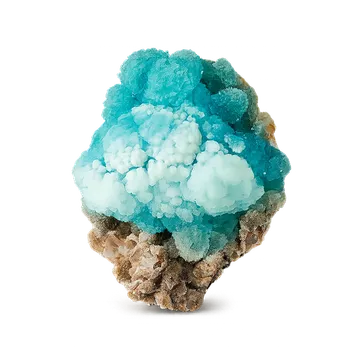
Les collectionneurs répartissent généralement l’hémimorphite de Santa Eulalia en quelques familles visuelles. Les plus familières sont des gerbes blanches à incolores de cristaux en lames sur de la limonite ou du gossan. Des exemples plus colorés affichent des teintes miel, orange, rose ou brun dues à une poussiérisation d’oxyde de fer ou à des inclusions, et non à l’hémimorphite elle-même. Moins communes sont des revêtements botryoïdes, mousseux, d’un bleu pâle, et particulièrement convoitées sont des lames robustes isolées ou de grands groupes cristallins indépendants issus des mines de Potosí et de San Antonio. Les meilleurs échantillons ne sont pas simplement de « l’hémimorphite mexicaine »; ils se distinguent comme Santa Eulalia par leurs gerbes aérées, leur matrice riche en fer et leur composition en parois de poche tridimensionnelles.
Historiquement, Santa Eulalia est bien plus vaste qu’un seul lieu d’obtention. Le district a favorisé la fondation de Chihuahua City, approvisionnait en minerai argent-plomb-zinc pendant plus de trois siècles et a livré des spécimens de classe mondiale de nombreuses espèces, notamment la calcite, la creedite, le gypse, la mimérite, la rhodochrosite, la smithsonite et l’hémimorphite. Pour les collectionneurs d’hémimorphite, il demeure un lieu de référence : pas habituellement la source du matériau bleu botryoïde qui a rendu célèbres d’autres districts, mais l’un des standards mondiaux pour une hémimorphite prismatique blanche bien cristallisée et adaptée à l’exposition.## Échantillons en vedette
Rechercher des spécimens : Voir tous les spécimens d'hémimorphite du district minier Santa Eulalia, Mexique
Santa Eulalia se situe au centre du Chihuahua, à l’est de la ville de Chihuahua, dans la rude Sierra Santa Eulalia. Le district est conventionnellement divisé en l’Ancien Camp ou West Camp, le Camp du Milieu et l’Ancien Camp ou East Camp. Pour les collectionneurs, les noms qui comptent le plus sont les grandes mines du West Camp telles que Potosí et Buena Tierra, et la mine San Antonio du East Camp. Les spécimens d’hémimorphite sont particulièrement associés à Potosí dans le West Camp et à San Antonio dans l’East Camp, bien que les étiquettes au niveau du district soient courantes sur des pièces plus anciennes.
Géologiquement, Santa Eulalia est une dépression de substitution carbonatée : une minéralisation argent-plomb-zinc emplie dans des roches carbonatées du Crétacé, modifiée par l’activité intrusive, le développement de skarns, les contrôles structuraux et une oxydation extensive. Le West Camp est connu pour des gisements massifs de sulfures en manteau et en cheminée avec des skarns localement à haute teneur en fer-calcium. L’East Camp est dominé par la zone minière San Antonio, avec des skarns à cœur intrusif et bilatéralement zonés et des masses de sulfures périphériques massifs. Cette distinction n’est pas académique pour les collectionneurs : elle explique pourquoi les étiquettes de Potosí et de San Antonio peuvent représenter des parties liées mais visuellement différentes d’un grand et complexe système de minerai.
Les zones oxydées ont été cruciales pour la formation des spécimens. L’exploitation précoce suivait un minerai oxydé riche près de la surface dominé par des carbonates et des sulfates de plomb avec des halogénures d’argent. Plus tard, à mesure que l’exploitation atteignait des zones sulfureuses plus profondes, la production de plomb-zinc-argent a continué à partir de la galène, de la sphalérite et des sulfures apparentés. Dans la mine San Antonio, l’oxydation atteint une nappe phréatique haute et bien définie à la 8e Niveau, environ 400 mètres sous la surface, où une zone zinc supergénique notable s’est développée. Dans le West Camp, l’oxydation est plus irrégulière et a été rapportée comme s’étendant à des profondeurs très différentes en fonction de la perméabilité et de l’épaisseur des roches volcaniques supérieures.
L’exploitation a commencé à l’époque coloniale et s’est poursuivie, avec des interruptions et des changements d’accentuation, pendant plus de 300 ans. Le Santa Eulalia précoce était un camp d’argent ; la production moderne mettait aussi l’accent sur le plomb et le zinc. La production cumulative du district est énorme — bien plus d’un demi-milliard d’onces troy d’argent et près de six millions de tonnes de plomb et de zinc ont été signalées dans ses mines. La récupération des spécimens a été particulièrement importante au cours du siècle dernier, lorsque des mineurs et des marchands ont extrait des quantités allant des microminéraux à des accumulations de taille cavernicole de matériaux collectionnables.L’accès à la collection doit être compris comme contrôlé par la mine et non comme une opportunité de cueillette sur le terrain occasionnelle. Santa Eulalia est un district minier actif et historiquement industriel, avec des galeries souterraines, des propriétés privées ou contrôlées par l’entreprise, des zones oxydées instables et d’importants risques pour la sécurité. Les spécimens accessibles aux collectionneurs proviennent généralement des mineurs, des marchands, d’anciennes collections et de matériel d’enchères plutôt que de la collecte récréative. Des étiquettes indiquant une mine spécifique, un camp, un niveau et l’historique de collection apportent une valeur réelle.
Les découvertes notables de hémimorphite documentées sur le marché des spécimens incluent le matériel de la mine de Potosí des années 1980, une découverte du début des années 1990 considérée par les marchands comme l’une des meilleures périodes pour l’hémimorphite de Santa Eulalia, une découverte de Potosí de 2013 provenant des niveaux 13–17, et du matériel de San Antonio provenant de l’association du 8e niveau avec de la smithsonite. Les spécimens avec des données de niveau précises — telles que « 16e niveau, mine de Potosí » ou « Mine de San Antonio, 8e niveau » — sont particulièrement souhaitables car une grande partie du matériel plus ancien de Santa Eulalia était simplement étiqueté « Santa Eulalia, Chihuahua, Mexique ».## Caractéristiques de l’hémimorphite du district minier de Santa Eulalia, Mexique
L’habitus classique est une gerbe divergente de cristaux en lames jusqu’à prismatiques, habituellement blancs, incolores ou légèrement crème, qui poussent sur de l’limonite brunâtre ou du gossan. De nombreux spécimens montrent des agrégats en éventail, des rosettes radiantes, des groupes en moulin à vent ou des grappes en échalas de lames qui se chevauchent. Les cristaux sont typiquement brillants et translucides; les pièces de meilleure qualité présentent des terminaisons vitrées et suffisamment de transparence sur les bords pour scintiller fortement sous une lumière ponctuelle.
La plupart des pièces de cabinet collectables et de petite taille ont des cristaux individuels allant du millimètre au centimètre faible. Une bonne pulvérisation moyenne peut avoir des lames d’environ 6 mm à 1,1 cm. Les spécimens de meilleure qualité présentent généralement des cristaux d’environ 1,8 à 2,7 cm. Des pièces exceptionnelles de Santa Eulalia ont des cristaux documentés d’environ 3,3 à 4,7 cm, et des matériaux rares de Potosí ont été décrits avec une lame proéminente aussi longue que 8,4 cm. Des cristaux libres, isolés, mesurant près de deux pouces, sont rares dans ce district car de nombreux cristaux de Santa Eulalia poussent en éventails interconnectés et en gerbes grouillantes plutôt que comme des prisms verticaux isolés.
La couleur est un indice de localité clé. La hémimorphite fine de Santa Eulalia est généralement blanche à incolore, parfois réchauffée par des oxydes de fer vers des teintes miel, brun orange, rose-rouge ou brown plus foncé. Ces couleurs sont couramment des revêtements, des inclusions ou des poussières liées à la limonite, à l’hématite ou à d’autres oxydes de fer, et non une couleur corporelle forte dans l’hémimorphite. Certains spécimens présentent une étincelle rouge ou rose due à l’hématite incluse. Une hémimorphite bleu pâle botryoïdique du district existe et est nettement moins courante, mais une couleur bleu électrique vive doit être traitée avec prudence à moins d’être étayée par une provenance et des tests solides.
Les minéraux associés incluent la calcite, la smithsonite, la mimérite, la limonite, l’hématite, la goethite et d’autres espèces de la zone oxydée. Les spécimens de San Antonio peuvent apparaître avec la smithsonite caractéristique du district, y compris la smithsonite de couleur bleu verdâtre en grains de riz avec des gerbes d’hémimorphite incolore. Les spécimens de Potosí peuvent présenter de l’hémimorphite avec de la calcite, de la mimetite, des oxydes de fer ou des revêtements secondaires de calcite couleur miel; il a été noté que certaines calcites sur l’hémimorphite présentent une fluorescence jaune pâle.
La qualité de l’hémimorphite de Santa Eulalia est jugée d’abord par son architecture. Un spécimen fin doit présenter une géométrie de gerbe ouverte et tridimensionnelle plutôt qu’un tapis plat de lames cassées. La brillance doit être vitreuse, et non chalky. Les cristaux doivent être nets, avec des terminaisons visibles et une usure des arêtes minimale. Un bon contraste entre l’hémimorphite blanche et le gossan brun rougeâtre est fortement souhaitable, tout comme une composition équilibrée qui se montre naturellement sans nécessiter de support. La coloration au fer peut soit améliorer soit diminuer la valeur: une poussière légère miel ou rosée peut ajouter de la chaleur, mais des revêtements bruns lourds peuvent obscurcir la transparence et rendre l’évaluation des dommages plus difficile.La matrice compte. Des plaques fines de gossan avec des pulvérulences intactes sont classiques, mais les meilleures pièces d’exposition ont suffisamment de matrice pour créer du relief et du contexte sans dominer les cristaux. Les morceaux de paroi de poche taillés sont courants, donc les collectionneurs doivent distinguer l’usure périphérique normale d’un véritable dommage sur le cristal. Une étiquette nette nommant la Mine de Potosí ou la Mine de San Antonio est préférable à une étiquette de district générale, et une désignation au niveau de la mine est encore meilleure.## Notes du collectionneur
L’hémimorphite de Santa Eulalia est disponible mais peu commune en véritablement bonne qualité. Des spécimens modestes de petit cabinet apparaissent régulièrement chez les marchands et aux enchères, tandis que les grands échantillons brillants, intacts et bien composés avec des étiquettes de mines spécifiques sont beaucoup plus rares. Les annonces récentes d’enchères et de marchands montrent une large plage : des morceaux petits ou modestes se vendent ou se listent dans les quelques centaines de dollars, tandis que les exemples plus forts avec des cristaux exceptionnellement gros, des bouquets attrayants ou une provenance de collection ancienne peuvent être évalués ou pricés bien plus haut. Comme toujours avec les minéraux mexicains secondaires classiques, l’état et l’esthétique peuvent importer plus que la taille seule.
La principale préoccupation d’authenticité n’est pas l’existence d’un faux documenté spécifique à Santa Eulalia, mais le problème plus général du marché de l’hémimorphite, à savoir le matériel bleu teinté. L’épisode largement discuté de l’hémimorphite mexicaine teinte bleue impliquait de l’hémimorphite naturelle traitée avec un colorant synthétique et vendue comme une découverte bleue spectaculaire. Puisque l’hémimorphite cristallisée normale de Santa Eulalia est blanche, incolore, teintée au fer ou seulement rarement légèrement bleutée, tout spécimen “Santa Eulalia” fortement bleu doit être examiné avec scepticisme. Recherchez une concentration de teinture dans les fractures, une couleur anormalement homogène, une coloration qui se déverse dans la matrice poreuse, et un bleu particulièrement vif là où l’espèce et la localité ne sont pas connues pour cela.
La substitution de localité est une autre problématique réaliste. L’hémimorphite mexicaine provenant d’Ojuela, Mapimí, Santa Eulalia et d’autres districts peut être superficiellement semblable : des sprays blancs sur le gossan, des cristaux en lames, et des associations d’oxyde de zinc oxydé. Une étiquette vague “Mexique” ultérieurement mise à jour en “Santa Eulalia” ne devrait pas être acceptée sans preuve étayée. Des étiquettes manuscrites plus anciennes, des dossiers de marchands, des numéros de collection ou une documentation minID sont précieux. Des attributions spécifiques telles que “Mine de Potosí, West Camp” ou “Mine de San Antonio, East Camp” sont plus significatives qu’un simple nom de district.
L’état est le défi quotidien. L’hémimorphite n’est pas exceptionnellement tendre, mais l’habitus de Santa Eulalia est souvent délicat : des lames fines rayonnent vers l’extérieur, les terminaisons sont exposées, et des sprays sortent couramment d’une fine plaque de gossan. L’usure des arêtes autour de la matrice est normale là où un mur de poche a été tronqué, mais des extrémités de cristaux cassées sur la face d’exposition réduisent fortement la valeur. Vérifiez les pointes de spray les plus élevées, les bords extérieurs du éventail et les lames isolées. Les couches de fer peuvent masquer de petites échoppes ; utilisez un éclairage de côté et une loupe.
Le nettoyage doit être conservateur. La matrice rouillée fait partie de l’esthétique classique, et un nettoyage acide agressif peut enlever le contraste d’oxyde de fer souhaitable, déstabiliser la matrice ou affecter le calcite associé. Évitez de plonger des pièces incertaines, surtout celles portant du calcite, du gossan argileux ou de l’illite friable. L’élimination de poussière avec un souffleur, une brosse douce ou un soin mécanique léger est généralement plus sûre qu’un traitement chimique.Sur le plan visuel, l’hémimorphite de Santa Eulalia se révèle avec un bon éclairage. Les pulvérulences blanches peuvent s’aplatir sous une lumière diffuse mais prennent vie sous une lumière ponctuelle angulaire qui attrape les facettes prismatiques vitreuses. L’éclairage par l’arrière peut révéler la translucidité des cristaux teintés par le fer, en particulier les pièces aux teintes miel et rose. Comme de nombreux échantillons reposent sur un gossan inégal, des bases personnalisées valent souvent la peine d’être utilisées pour une meilleure orientation et une manipulation plus sûre.## Stories & Field Notes
La première grande histoire de Santa Eulalia est qu’un district minier, et non une capitale planifiée, a fait sortir une ville du désert. Les mines dans les montagnes étaient suffisamment riches pour attirer les habitants après un abandon antérieur, mais Santa Eulalia elle-même se situait dans un terrain accidenté où l’expansion était difficile. En 1709, le gouverneur Antonio de Deza y Ulloa réunit 16 résidents notables — mineurs, commerçants, fonctionnaires et prêtres — pour décider si le nouveau centre administratif devait rester à Santa Eulalia ou être fondé dans la vallée voisine où se rejoignent les rivières Chuvíscar et Sacramento. Le vote se répartit exactement huit contre huit. Deza y Ulloa rompit l’égalité en faveur de la vallée et, le 12 octobre 1709, la nouvelle Real de Minas de San Francisco de Cuéllar fut fondée. Cette colonie devint Chihuahua City. En un sens très réel, l’or de Santa Eulalia choisissait la scène sur laquelle l’histoire civique de Chihuahua se déploierait, tandis que les mines restaient dans les collines.
Les premières années d’argent furent aussi des années de pénurie de travail, de dette de mercure, de pénuries de carburant et de négociations ardues entre propriétaires de mines, travailleurs et officiiels coloniaux. Une étude des archives de la grève minière de Santa Eulalia en 1730 révèle que dix mineurs de Santa Eulalia et de Chihuahua devaient au trésor royal 134,5 quintales de mercure sur une période de deux ans. Plus de 71 pour cent de cette dette était concentré chez six mineurs, et seulement trois opérateurs — Rosa Ortiz de Campos, Ignacio Alfonso de Riaza et Manuel de San Juan de Santacruz — expliquaient à eux seuls 51 pour cent du mercure dû. Ces chiffres ne relèvent pas de la comptabilité sèche; ils montrent à quel point les moulins à argent dépendaient de l’amalgame au mercure et comment rapidement les fortunes minières privées devenaient entremêlées avec le crédit royal.
La même dispute de 1730 révèle la texture d’un camp minier en activité. Les employeurs s’inquiétaient que des hommes s’engagent auprès de deux patrons à la fois. Des ordonnances discutaient de marquer l’étain et l’argent avec la marque propre de chaque mineur, de réguler la vente de charbon et de bois de chauffage pour la fusion, de restreindre l’accumulation spéculative dans les magasins et les maisons privées, et d’imposer le sel, le maïs, les haricots et la viande dans des canaux d’approvisionnement plus fiables pour les mines. Le district avait même une histoire d’importation de main-d’œuvre venue de loin : en 1716, environ 100 travailleurs Yaqui furent amenés du Sonora vers les mines de Santa Eulalia. Derrière l’ourlet poli de la houe d’hamail dans une vitrine moderne se cache ce monde plus ancien de mercure, de charbon, de dépôts de sel, de fondeurs, de caravanes et de propriétaires de mines essayant de maintenir ensemble une main-d’œuvre dans un camp d’argent isolé.Une histoire de collecte ultérieure appartient aux spécimens eux-mêmes. Les travaux miniers de Santa Eulalia sont devenus un labyrinthe de cavités oxydées, de corps de remplacement de sulfures, de skarns et d’anciennes galeries d’exploitation. Au cours du siècle dernier, les mineurs ont récupéré non pas seulement des vugs occasionnels mais des quantités de spécimens suffisamment importants pour qu’un résumé mineralogique moderne décrive une production allant des microminéraux individuels au contenu de cavernes entières. Les meilleurs hémimorphites du district proviennent de ces ouvertures : des gerbes extraites des poches de gossan, des cristaux émergents des parois tachées de fer, et des croissances de silicate de zinc qui ont survécu aux dynamitages, à l’exploitation, à l’élagage, au transport et à des décennies de turnover de collection.
Une de ces fils de collectionneurs modernes est visible dans le matériel d’époque. Une hémimorphite de Santa Eulalia provenant de la collection Jack Halpern, cataloguée No. 970, portait une étiquette manuscrite ancienne indiquant « Hemimorphite avec Calcite / Santa Eulalia / Chihuahua / Mexique ». Le spécimen lui-même était une pièce de cabinet avec des gerbes de fines lames blanches et des calcites éparses sur gossan. Sa description d’enchère mettait en avant l’œil de Halpern pour « la couleur, la qualité et le style/esthétique », ce qui est exactement la lentille à travers laquelle l’hémimorphite de Santa Eulalia devrait être jugée. Ces pièces ne sont pas seulement des représentants chimiques de Zn4Si2O7(OH)2·H2O ; elles sont de petites compositions en équilibre, lumière et histoire minérale.## Dossiers et Publications Minéralogiques
“Hemimorphite (classic locality)” — Mineralauctions.com / The Arkenstone — Vidéo d’enchères courte d’une hemimorphite de Santa Eulalia provenant de la collection Jack Halpern, montrant la structure en spray tridimensionnel que les photos fixes ne peuvent pas saisir.
“Hemimorphite (classic locality)” — Mineral Auctions listing — Page d’enchères avec images fixes, dimensions, provenance, enregistrement des enchères et description d’une hemimorphite cabinet de Santa Eulalia avec calcite.## Lectures complémentaires et liens externes
Mindat: Santa Eulalia Mining District, Aquiles Serdán Municipality, Chihuahua, Mexico — Meilleur index de localités en ligne pour les mines de Santa Eulalia, listes d’espèces, références et photos.
Mindat: Hemimorphite de Santa Eulalia Mining District — Entrée espèce‑localité pour l’hémimorphite dans le district de Santa Eulalia.
Mindat: Potosí Mine, West Camp, Santa Eulalia Mining District — Page de localité pour l’une des mines clés de Santa Eulalia représentées sur les étiquettes d’hémimorphite.
Mindat: San Antonio Mine, East Camp, Santa Eulalia Mining District — Page de localité pour la mine East Camp, célèbre pour ses séries de spécimens Santa Eulalia classiques.
Rock & Gem: “De Colores: Santa Eulalia, Chihuahua” — Vue d’ensemble conviviale pour les collectionneurs de Santa Eulalia en tant que classique mexicain de remplacement carbonate.
New Mexico Bureau of Geology: Peter K.M. Megaw, “Mineralogy of the Santa Eulalia Mining District, Chihuahua, Mexico” — Résumé technique court mais riche sur la géologie du district, sa production, l’oxydation et les minéraux des spécimens.
Mineral Auctions: Hemimorphite from Potosí Mine, West Camp — Enregistrement de marché utile pour l’hémimorphite de Potosí avec taille des cristaux, provenance et informations de vente.
Mineral Auctions: Hemimorphite from San Antonio Mine, East Camp — Exemple récent de marché d’hémimorphite de San Antonio avec attribution minière et données de taille.
Rock & Gem: “Dyed Hemimorphite Crystal: Spotting Fakes” — Article d’avertissement important sur l’hémimorphite bleue teintée dans le marché mexicain des spécimens.
Rock & Gem: “Calamine: Beyond An Anti-Itch Mineral” — Contexte utile sur l’hémimorphite, la terminologie de la calamine et le problème de l’hémimorphite bleue teintée.