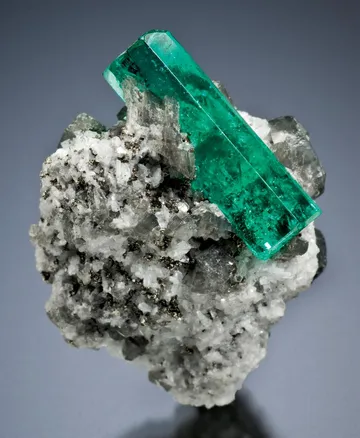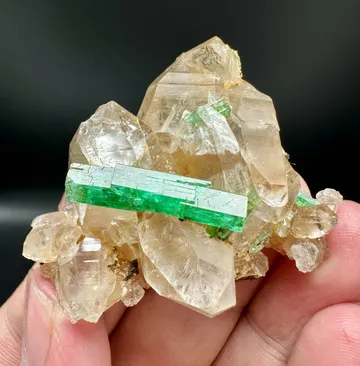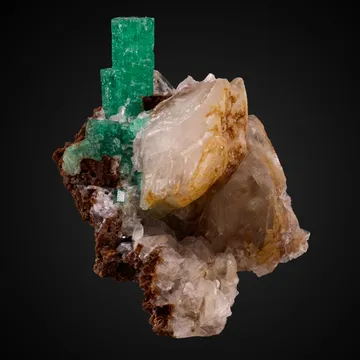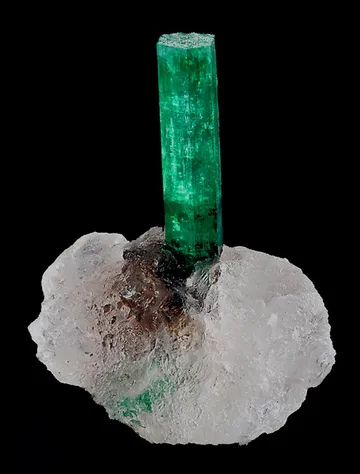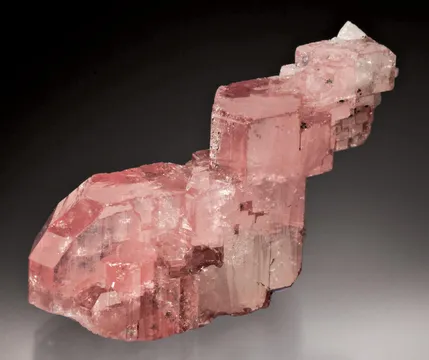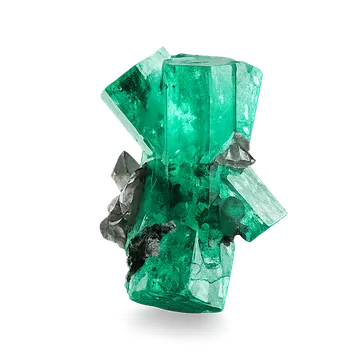
Smaragd aus der Muzo-Mine, Kolumbien: lebendiges Grün mit innerem Glanz, gebildet in sedimentären Schiefergesteinen und Calcit, oft mit Pyrit und parisit-(Ce) auf Calcit.
Key facts
Emerald aus dem Muzo-Minenviertel ist der klassische kolumbianische Smaragd, an dem sich viele andere Smaragde noch messen lassen: lebendiges, sat urgrünes bis leicht bluish-grünes, mit einem sanften inneren Glühen, das von hohemChromium- und Vanadium-Farbton sowie vergleichsweise niedrigem Eisenanteil stammt. Für Sammler liegt der große Reiz nicht einfach im abstrakten „kolumbianischen Farbton“, sondern darin, wie Muzo-Kristalle aus blassem Kalkspat und Carbonat-Gangwerk hervortreten, oft mit dunklem Schiefer und Pyrit, die sich noch an der Matrix festhalten. Die besten Exemplare besitzen das Drama eines Edelsteinklasteins an seinem geologischen Geburtsort: hexagonaler grünlicher Beryll, der sich gegen weißen Kalkcalcit, schwarzen kohlenstoffhaltigen Wirtsgestein und bräunlich glänzendem Pyriten abhebt.

Foto: Didier Descouens, Wikimedia Commons
Muzo gehört zum westlichen Smaragdgürtel der Ostkordillere Kolumbiens, eine geologische Anordnung, die sich stark von den pegmatit- und Schiefer-Vererzungen unterscheidet, die in vielen anderen Teilen der Welt bekannt sind. Hier formten sich die Smaragde in einem sedimentären Becken, in schwarzen organisch-reichen Kreidekalk-Schiefern und Carbonaten, durchzogen von Verwerfungen, Breccien und Carbonat-Gängen. Hydrothermale Salzwässer bewegten sich durch diese Bruchgesteine, wechselwirkten mit verdunstungssalzen, Schwefel, organischer Substanz und Spurenelementen im Schiefer. Das Ergebnis war eine der großen Anomalien der Mineralogie: weltklasse Smaragd, abgelagert ohne nahegelegene exponierte Magmasquelle.
Die mineralogische Persönlichkeit von Muzo ist stark kolumbianisch, aber zugleich eindeutig eigenständig. Sammler lernen, Smaragd in Kalkspat-Dolomit-Gängen, Hohlräumen und Brekzien zu erkennen, üblicherweise mit Pyrit, Quarz, Albit, Fluorit, Baryt, Bitumen, weißer Muskovit, Graphit und dem seltenen Fluorcarbonat Parisit-(Ce). Parisit-(Ce) ist hier historisch bedeutsam: Es wurde erstmals aus dem Muzo-Bezirk beschrieben und gehört bis heute zu den diagnostischen Mineralverbindungen, die Smaragde aus Muzo sowohl für Mineralogen als auch für Juwellensammler so attraktiv machen.

*Foto: M.M., Wikimedia Commons*Historisch gesehen ist Muzo untrennbar verbunden mit der Geschichte der Smaragde in den Amerikas. Indigenes Bergbauhandwerk ging der spanischen Eroberung voraus; das spanische Interesse wandte sich im sechzehnten Jahrhundert den grünen Steinen zu; spätere Jahrhunderte sahen königliche Kontrolle, Staatssukzessionen, ausländische Unternehmen, Gewalt, Informalität, Modernisierung und das Aufkommen von operationen mit Fokus auf Nachverfolgbarkeit. Der Name „Muzo“ trägt heute sowohl mineralogisches als auch kommerzielles Gewicht, weshalb Sammler zwischen Exemplaren unterscheiden sollten, die tatsächlich aus dem Muzo-Minen- oder Puerto Arturo-Muzo-Betrieb stammen, und Steinen, die lediglich als „Muzo-Typ“, „Muzo-Grün“ oder allgemein kolumbianisch verkauft werden.
Ein ernsthafter Sammler sucht zuerst nach ehrlicher Fundstelle, dann nach Kristallintegrität. Die besten Mineralproben zeigen scharfe hexagonale Formen, starke Transparenz für die Art, intensive, aber nicht schwarzhafte Sättigung, minimale Absplitterungen, angenehme Platzierung auf der Matrix und kein übermäßiges Reinigen oder künstliches Inszenieren. Ein Kristall, der noch natürlich in Calcit eingesetzt ist, ist im Allgemeinen begehrenswerter als ein losgelöster Kristall ähnlicher Größe, es sei denn, der lose Kristall ist außergewöhnlich scharf und glänzend. Trapiche-Smargarde, wenn sie wirklich aus dem Muzo-Gebiet stammt und gut gemustert ist, bilden eine eigene Sammelkategorie: ihre sechstrahlige Speichenstruktur ist begehrt, aber Attribution und Natürlichkeit müssen besonders sorgfältig dokumentiert werden.## Ausgewählte Exemplare
Nach Exemplaren suchen: Alle Smaragdexemplare aus dem Muzo-Minengebiet, Kolumbien ansehen
Die Smaragdablagerungen von Muzo liegen am Westhang der Ostcordillera Kolumbiens, im westlichen Boyacá, nordwestlich von Bogotá. Das klassische Minengebiet befindet sich in steilem, feuchtem Bergland, das von Bächen des Río Minero-Systems entwässert wird; frühe geologische Berichte beschreiben die Vorrichtungen westlich des Dorfes Muzo im Itoco- oder Desaguadero-Tal, wo smaragdführende Gesteine durch große offene Abbaustellen freigelegt wurden, bevor der moderne Wechsel zum Untertagebergbau erfolgte.
Geologisch gesehen ist Muzo ein hydrothermal- sedimentgefäßtes Smaragdvorkommen. Smaragd tritt in schwarzem, organikreichem Schiefer interbedded mit dolomitischem Kalkstein alter Kreidezeit auf, innerhalb des Rosablanca-, Paja- und Muzo-Stratigraphie-Rahmens, wie in verschiedenen historischen und modernen Quellen behandelt. Die wirtschaftlich bedeutsamen Smaragdzonen sind strukturell kontrolliert: Verwerfungen, Falte, Scherflächen, hydraulische Brekzien, Karbonat-Gänge, sigmoide Spannungsrisse und Zugfaltungen schufen Wege und Fallen für mineralisierende Salze. Die smaragdführenden Adern sind überwiegend karbonathaltig, insbesondere Kalk- und Dolomit, mit Pyrit nahezu allgegenwärtig und begleitendem Quarz, Albite, Fluorit, Barit, Bitumen, Cr-haltigen Glimmern und Parisit-(Ce).
Der Vorkommenstyp ist berühmt, weil er nicht dem älteren Lehrbuchmodell eines Smaragds als Beryl-Varietät entspricht, die in granitischen Pegmatiten eingedrungenes Chromium-haltiges Gestein ist. In Muzo migrierten hypersaline Fluide, teils aus evaporitischen Quellen stammend, durch organikereiche Sedimentgesteine. Schwefelreduktion, Reaktion mit organischer Materie, Freisetzung von Beryllium, Chrom und Vanadium sowie die Veränderung des Alkalitätsbereichs in Bruchsystemen führten zusammen zur Ausfällung von Smaragd. Dieses hydrothermal-sedimentäre Modell ist nun zentral für das Verständnis kolumbianischer Smaragdvorkommen.
Die Bergbaugeschichte ist lang und ungleichmäßig. Ureinwohner schürften Smaragde, noch bevor Europäer ankamen, und die Spanier erkannten schnell, dass die grünen Steine in den ortstypischen Ornamenten eine Quelle in den Bergen des heutigen Boyacá hatten. Die spanischen Bemühungen im Muzo-Gebiet im sechzehnten Jahrhundert wurden durch Widerstand, Klima, Gelände und Zugang behindert, aber gegen Ende des 16. Jahrhunderts wurden die Minen ausgebeutet und Smaragde traten in das spanische imperialistische System ein. Während der Kolonialzeit behielt die Krone einen Anteil der Produktion, und die Minen wechselten zwischen aktiver Ausbeutung, Misswirtschaft, Arbeitsproblemen, Aufgabe und erneuter Belegung.Nach der Unabhängigkeit Kolumbiens im Jahr 1819 durchliefen die Minen eine Abfolge von Staatsträgerschaften, Pachtverträgen, privaten Konzessionen und ausländischer Beteiligung. Frühe Schriftsteller des frühen zwanzigsten Jahrhunderts beschrieben den Zugang von Bogotá aus noch als eine anspruchsvolle Maultierreise nach der Bahnreise, da der Dschungel rasch stillgelegte Abbaustätten zurückeroberte. Zu jener Zeit waren die Abbaustätten große terrassenförmige offizielle Schnitte, die von Arbeitern mit Eisenstangen statt Sprengungen angegriffen wurden, weil Smaragd-Kristalle zu zerbrechlich sind, um grobe Gewinnung zu tolerieren.
Der moderne Betrieb Puerto Arturo-Muzo ist unterirdisch. Die aktuelle Beschreibung der Muzo Companies / Esmeraldas Mining Services positioniert die Mine Puerto Arturo zwischen den Dörfern Sábripa in Muzo und Mata de Fique und Note in Quípama. Der Betrieb wird als mehr als 55 Hektar beschrieben, mit fünf Haupt-Tiefengalerien: Tequendama, Catedral, Volveré, Puerto Arturo und La Rampa. Tequendama, Catedral und Volveré erreichen Tiefen von mehr als 90 Metern, Puerto Arturo geht tiefer als 150 Meter hinab, und La Rampa ist eine Spiralfahrt von mehr als 900 Metern, die Galerien verbindet und den Zugang für Maschinen ermöglicht. Unter Tage folgen Bergleute den Hinweisen in der schwarzen Schiefer- und weißen Calcit-Ganglücke mit Presslufthämmern und Handwerkzeugen, trennen dann Smaragd vom Carbonatgestein unter kontrollierten Sicherheits- und Rückverfolgbarkeitsprozeduren.
Der Zugang zur Sammlung ist als eingeschränkt zu verstehen. Muzo ist ein aktives Bergbaurevier, kein casual Sammlungsort. Formeller Minenzugang wird von Betreibern, Sicherheit, Sicherheitsvorschriften und kolumbianischen Bergbauregeln kontrolliert. Muster gelangen über Bergleute, Schnitzer, Händler, alte Sammlungen und spezialisierte Mineralienkanäle zu Sammlern, statt durch öffentlich offenes Sammeln. Informelle Guaquearía—die Suche in Abraum, Flusskieseln und entsorgtem Minemüll—ist Teil der sozialen Realität der Region, aber nicht dasselbe wie legaler Sammlungszugang für Besucher von außen.
Die Produktion war episodisch statt kontinuierlich. Pogue beschrieb 1916, dass der gesamte historische Output nicht berechnet werden konnte, dass einzelne produktive Jahre jedoch Werte im Bereich von zwei Millionen Dollar oder mehr im damaligen Fünfziger- bzw. frühen Zwanzigsten-Jahrzehnten erreichten. Die moderne Produktion umfasst sowohl Fass-Steinrohmaterial für die Verarbeitung als auch Sammlerexemplare, wobei letztere jedoch nur einen kleinen Teil des wirtschaftlichen Fokus der Mine darstellen. Bemerkenswertes modernes Material umfasst hochklare, geschnittene Steine aus Puerto Arturo, während historischer Ruhm durch große kolumbianische Smaragde aus der Zeit von Muzo verstärkt wird, darunter der Duke of Devonshire Emerald, der Chalk Emerald, der Mackay Emerald und der moderne Tiffany Muzo Emerald aus dem Puerto Arturo-Schacht.## Eigenschaften von Smaragd aus der Muzo-Mine, Kolumbien
Der Muzo-Smaragd ist Beryll, Be3Al2(Si6O18), hauptsächlich farbig durch Chrom und Vanadium. Im besten Material ist die Farbe lebendiges Grün bis leicht grün-bläuliches Grün, gesättigt und dennoch leuchtend, mit dem „Glanz“, den Sammler und Edelmetallhändler mit Top-Steinen aus Kolumbien verbinden. Die begehrenswerteste Farbe ist kräftig, ohne zu dunkel, grau oder gelblich zu werden. Blasse Kristalle kommen vor, ebenso dunkle eingeschlossene Kristalle, aber das ideale Marktbild bleibt ein helles, gesättigtes Grün, das im normalen Licht lebendig bleibt.
Der Kristallhabit ist typischerweise hexagonal prismatisch, oft mit flachen basal-ten Terminationen und longitudinalen Streifen auf Prismenseiten. Feine Kristalle können einzeln in Kalzit sitzen, teilweise in Karbonat eingebettet oder gemeinsam mit anderen Smaragden auf einer gemeinsamen Matrix gruppiert sein. Das klassiche Erscheinungsbild des Exemplars ist ein grüner hexagonaler Prism mit weißem Kalzit, manchmal mit schwarzem Schiefer, Pyrit-Einschüben oder -Kristallen und oxidierter gelb-brauner Verfärbung. Manche Stücke zeigen Kristalle, die teilweise durch natürliches Taschenwachstum vom Matrix gelöst wurden; andere sind massiver oder aus Kalkspat-Venen gebrochen.
Die Größen variieren stark. Viele echte Exemplarkristalle sind nur wenige Millimeter bis 2 cm breit oder lang, und selbst diese können wichtig sein, wenn sie scharf, durchsichtig und auf Matrix sind. Attraktive Kabinettstücke mit Kristallen im Zentimetermaßstab sind deutlich seltener als lose facettierte Steine aus dem breiteren kolumbianischen Handel. Edelsteinkristalle über ca. 2 cm, die scharf, glänzend, natürlich sitzend und nur leicht eingeschlossen sind, sind selten und teuer. Außergewöhnliche Kristalle und geschliffene Steine können dramatisch größer sein, aber diese sind Museum- oder High-Jewelry-Objekte und keine routinemäßiges Sammler-Material.
Begleitmineralien sind ein entscheidender Teil der Identität des Fundorts. Kalzit dominiert als visuelles Matrix-Material bei vielen Exemplaren, Dolomit und Karbonat-Gemenge sind ebenfalls häufig. Pyrit kommt häufig vor als verteilte Körner, Fugen, Noden und Kristalle; seine messingfarbigen Funken vor schwarzem Schiefer und weißem Karbonat machen viele Muzo-Exemplare visuell reicher. Quarz kann als farblose bis leicht grünliche Kristalle in Smaragdtälern vorkommen. Albit, Fluorit, Barit, Chalkopyrit, Graphit, Bitumen, Weiß-Muscovite und das seltene Parisit-(Ce) gehören zum dokumentierten Mineralensystem. Parisit-(Ce), CaCe2(CO3)3F2, ist historisch und mineralogisch besonders wichtig, da Muzo dessen Typ-Lokalität ist.Inclusions in Muzo emeralds are not defects in the collector sense; they are evidence of natural origin and geological environment. Colombian emeralds commonly show multiphase fluid inclusions, often with liquid, gas bubble, and a halite daughter crystal. Jagged three-phase inclusions, calcite, pyrite, and rare parisite inclusions are important clues in gemological study, though no single inclusion scene should be used carelessly to prove a precise mine. In mineral specimens, internal veils, partially healed fractures, and tiny fluid inclusions are normal. The collector’s question is whether the inclusions add character without destroying transparency or threatening stability.
Trapiche emeralds from Colombian deposits, including Muzo, are a prized specialty. A trapiche emerald shows a six-rayed pattern, usually with green emerald sectors separated by darker arms of inclusions or matrix material radiating from a central core. Fine trapiche specimens require symmetry, distinct rays, pleasing green sectors, and credible locality documentation. Because trapiche patterns are visually striking and marketable, they deserve careful scrutiny for natural formation, cutting, polishing, and origin claims.
Quality factors for Muzo specimens differ from those for faceted stones. For a specimen, the strongest combination is a lustrous, sharply terminated, saturated crystal with enough transparency to glow, naturally attached to attractive matrix, undamaged at the termination and prism edges, and aesthetically placed. Calcite matrix should look natural, not over-cleaned, acid-etched beyond recognition, glued, or reconstructed. For loose crystals, termination, edge preservation, color, transparency, and absence of sawn or polished surfaces matter greatly.## Collector Notes
Das Wort „Muzo“ zieht einen Aufpreis nach sich, daher ist Herkunftssicherheit das erste Anliegen. Ein Etikett, das Muzo lautet, eine Farbbeschreibung wie „Muzo Grün“ und eine mündliche Zusicherung des Verkäufers sind nicht gleichwertig. Seriöse Sammler sollten Exemplare mit alten Sammlungsetiketten, Händlerrokumentationen, Mine-zu-Markt-Unterlagen oder Laborberichten für wichtige geschliffene Steine bevorzugen. Bei facettierten Edelsteinen können renommierte Labors die kolumbianische Herkunft anhand von Einschlüssen, Spektroskopie und Spurenchemie unterstützen, aber die Zuordnung eines Steins zur genauen Muzo-Mine statt zum breiteren kolumbianischen westlichen Gürtel kann schwieriger sein und sollte vorsichtig behandelt werden, sofern die Herkunftskette stark ist.
Die Klarheitserhöhung ist das zentrale Behandlungsproblem für Smaragd als Art, und kolumbianische Smaragde bilden da keine Ausnahme. Öle und Harze werden verwendet, um oberflächennahen Brüchen Füllung zu geben und die scheinbare Klarheit zu verbessern. Traditionelles Ölen mit farbiglosem Öl kommt weit verbreitet vor; dauerhaftere Harz- oder Polymerfüller können den Wert und die Langzeiterhaltung stärker beeinflussen. Für fein facettierte Muzo-Smaragde hat der Unterschied zwischen keinem Öl, unbedeutendem bis geringem Öl, moderater Verbesserung und signifikanter Füllung enorme Marktauswirkungen. Bei Mineralienproben kann Ölung, Harzimpregnation, Bruchfüllung und künstliche Glanzsteigerung visuell schwerer zu erkennen sein, besonders bei dunkler Matrix, daher sind Vergrößerung und Offenlegung wichtig.
Synthetische Smaragde und natürliche Smaragde, die nicht aus Muzo stammen, gehören ebenfalls zum Risikobereich. Hydrothermale und flussgezüchtete Smaragde können dem Laien überzeugend erscheinen. Ebenso können feine Smaragde, die kolumbianisch wirken, aus anderen kolumbianischen Distrikten stammen, und feine Smaragde aus Afghanistan, Sambia, Brasilien oder anderen Gebieten können unter romantisiertem „Muzo“-Vokabular verkauft werden. Dreiphasige Einschüsse galten früher von vielen Käufern als einfacher kolumbianischer Indikator, aber ähnliche Einschlussarten können auch in Smaragden aus anderen Ländern vorkommen, weshalb moderne Herkunftsanalysen eine Kombination aus Mikroskopie, Spektroskopie und Chemie verwenden.
Der Zustand ist kritisch, weil Smaragd spröde ist, oft Einschluss enthält und häufig bricht. An Exemplaren sollten Sie die Endflächen auf Prellungen, Kantenschäden, Klebereparaturen, Sägespuren und unnatürliche Matrixzuschnitte prüfen. Ein Kristall, der aus dem Calcit zu aggressiv „befreit“ wurde, kann seinen natürlichen Sitz verloren haben und viel von seinem Sammlungswert einbüßen. Calcitematrix kann anfällig für Säurereinigung, Abrieb und erneute Befestigung sein; Weißer Calcit, der zu frisch graviert oder zu gleichmäßig sauber aussieht, sollte sorgfältig geprüft werden. Pyrit-haltige Stücke sollten trocken und stabil gehalten werden, insbesondere wenn Pyrit verändert aussieht, obwohl Muzo-Pyrit oft stabil bleibt, wenn er unter normalen Innenbedingungen erhalten wird.Rarität ist gestaffelt. Kleine Smaragd-in-Calcit-Exemplare aus Muzo sind gelegentlich verfügbar, aber wirklich feine, unbeschädigte, glitzernde Matrix-Exemplare sind selten. Lose, geschnittene Steine mit der Bezeichnung Muzo sind im Edelsteinhandel häufiger anzutreffen als Spitzenmineralien im Sammlungsmarkt. Trapiche-Smargdsteine sind erhältlich, aber hervorragende natürliche Muster mit verlässlicher Provenienz sind selten. Historische, große, saubere Muzo-Kristalle befinden sich in Museen und großen privaten Sammlungen; sie sind nicht mit dem routinemäßigen kommerziellen Material vergleichbar.
Der Markt bleibt aktiv, aber selektiv. Moderne Muzo-Produktion ist stark auf Schliffsteine und Marken-Schmuck ausgerichtet, während ältere Mineralexemplare aus Nachlässen weiterhin wichtig für den Sammlungsmarkt bleiben. Die besten Käufe sind in der Regel nicht die größten grünen Objekte im Angebot, sondern die Exemplare, bei denen Lokalität, natürliche Matrix, Kristallqualität und Zustand übereinstimmen. Bei teuren Stücken bitten Sie um die Lokalitätsgeschichte, Offenlegung der Behandlung und Fotos unter neutralem Licht; prüfen Sie dann den Kristall mit einer Lupe auf gefüllte Brüche, Klebelinien, Kantenabnutzung und verdächtig glänzende Oberflächen.## Geschichten & Feldnotizen
Im Juli 1915 kam Joseph E. Pogue zu den Muzo Smaragdminen und verbrachte sechs Tage damit, einen Ort zu studieren, der noch mehr Prüfstein als Ziel war. Die Minen lagen nur etwa 96 Kilometer in gerader Linie nordwestlich von Bogotá, aber Distanz auf der Karte bedeutete wenig. Die praktische Route führte von Bogotá nach Zipaquirá oder Nemocón mit dem Zug, dann zweieinhalb Tage zu Pferd über das, was Pogue eine „entsetzliche Piste“ nannte, fast unpassierbar in der Regenzeit. Die Minen selbst lagen etwa 8 Kilometer nördlich des Dorfes Muzo auf einem von steilen Wänden begrenzten Tal des Itoco, auch Quebrada del Desaguadero genannt, einem Nebenfluss des Río Minero.
Was er fand, war ein tropisches Bergbaustadium aushaltender Amphitheater. Hitze, Feuchtigkeit und Dschungel spielten der Geologie in die Hände: Verlassene Schürfstellen verschwanden rasch unter der Vegetation, und die umgebenden Gesteinsaufschlüsse wurden verborgen, außer dort, wo die Bergleute in den Berg hineingeschnitten hatten. An den aktiven Schürfen wurde die freiliegende Smaragdbildung in großen Terrassenhängen angegriffen. Linien von Arbeitern standen auf Bänken und brachen den weichen Tonstein und Kalkstein darunter mit langen Eisenstangen auseinander. Das Sprengen wurde vermieden, weil die Kristalle zu zerbrechlich waren. Smaragdtragende Calcit-Gänge wurden von Hand entfernt und in einen Sortierbaum getragen; Geröll rutschte die gestuften Hanglinien hinab und wurde regelmäßig durch Wasser aus Bergreservoirs in den Bach gespült.
Das Sortieren war ebenso manuell. Calcite wurden von Hand zerbrochen, Smaragde wurden herausgepickt, und feinere materialien mit Edelsteinen wurden auf geneigten Tischen gewaschen, auf denen Jungen die Bruchstücke entfernten. Die Steine wurden nach Farbe, Größe, Transparenz und Fehlstellenfreiheit getrennt. Um diese scheinbar einfache Arbeit herum gab es eine aufwändige Sicherheitsvorrichtung: Militärpolizei, bewachte Ausgänge, Wachleute in kleinen Wachhäusern über den Abbaustellen, Aufseher während der Arbeitszeiten und Arbeiter, die zurückgehalten wurden, bis eine passende Suchphase verstrichen war. Der Muzo-Smaragd war bereits ein mineralogischer Preis und ein Sicherheitsproblem.
Die ältere spanische Erzählung hat die Form einer verlorenen Mine, weil sie es auch teilweise ist. Spanisches Interesse an kolumbianischen Smaragden begann, als Gonzalo Jiménez de Quesada in das Chibcha-Gebiet eindrang und 1537 Smaragde als Geschenke erhielt. Die Muzo-Völker widersetzten sich und versteckten Spuren des Smaragdm Gangs rund zwanzig Jahre lang, im Gegensatz zu besiegten Gruppen auf dem Hochplateau. Im Jahr 1555 wurde ein spanischer Ort in Muzo gegründet, und bis 1558 begann die spanische Bergbauaktivität in den Itoco-Bergen, doch der Ort wurde später aufgegeben und überwuchert; seine genaue Position, so Pogues Bericht, war noch nicht wiederentdeckt worden. Um etwa 1594 fanden die Spanier die indigenen Arbeitsstätten am Standort der heutigen Muzo-Minen, was eine neue Periode intensiver Ausbeutung einleitete.Modern Muzo hat eine andere Art von Drama. In dem unterirdischen Betrieb Puerto Arturo wird die Suche nach Smaragd als disziplinierter Abstieg in schwarze Schiefer beschrieben. Arbeiter betreten Galerien Hunderte Meter unter der Oberfläche und bewegen sich durch ein Labyrinth von Tunneln. Die weiße Kalkspat-Ader bleibt der alte Hinweis in einer modernen Umgebung: Bergleute schlagen die Wände aus schwarzem Schiefer ein und trennen Smaragd und Kalkspat sorgfältig genug, dass ein Kristall die Reise vom Fundstück über Sortierung bis zum Markt überstehen kann. Kameras, Wachleute und Nachverfolgungsverfahren haben die offenen Abbaustellen aus Pogues Tagen ersetzt, aber die zentrale Handlung ist erkennbar: Der grüne Kristall muss gefunden, befreit und geschützt werden.
Außerhalb der formalen Mine fließt das soziale Leben der Smaragd-Jagd weiterhin in Mihos Straßen, Flüsse, Geschäfte und Plätze. Guaqueros durchsuchen entsorgte Erde- und Flussgerölle, manchmal bei Ereignissen, die lokal als la voladora bekannt sind, wo Bergwerksabfälle freigesetzt werden und die Menschen eilen, sie durchzukämmen. Das Bild ist unvergesslich: Männer und Frauen kniehoch im Wasser oder schwarzem Schlamm, Schaufeln in der Hand, in der Hoffnung, dass ein übersehener Fragment einen Monat, ein Jahr oder ein Leben verändern könnte. Diese Welt ist ebenfalls ökologisch und sozial kompliziert, mit lokalen Menschen, Unternehmen und Behörden, die um die Verantwortung für verschmutztes Wasser, Erosion, Abraum und Zugang zu Land streiten.
Ein Bericht aus dem Jahr 2025 über Muzo zeigt, wie sich die Smaragd-Stadt von Gewalt hin zu Sichtbarkeit bewegt hat. Auf einem Berg über der Stadt steht eine Christusstatue mit einer darunter stehenden Botschaft in riesigen Buchstaben: „Paz. Dios ve todo.“ Das Schild ist lokal mit dem Frieden verbunden, der nach dem letzten der „grünen Kriege“ im Jahr 1990 folgte. In der darunterliegenden Stadt werden Smaragde lässig in Bars und auf Bänken angeboten, während Verkäufer und Bergleute auf Livestreaming umsteigen. Lady, eine Frau, die im Smaragd-Handel arbeitet, begann damit, Steine auf TikTok zu verkaufen, und fügte dann Führungen hinzu, als die Zuschauer neugierig auf die physische Welt hinter den Steinen wurden. Josué González, ein 24-jähriger Bergmann, bekannt als Guaquerito, nutzt Instagram und TikTok, um Bergbau-Routinen zu präsentieren und Besucher einzuladen, einen Tag eines Bergmanns in der Region zu erleben.
Eine Szene aus demselben Konto wirkt wie das moderne Spiegelbild von Pogues Sortierhalle. Im Zentrum der Stadt bereitet Lady eine Bestellung kleiner Smaragde vor, jeder kleiner als ein Fingernagel, jeder mit einem Zertifikat, der nach Palmira versandt werden soll. In der Nähe legt ein Händler namens Walter eine weiße Poncho-Decke auf einen Tisch und ordnet kleine Stapel roher Smaragde nach Größe und Qualität. Menschen drifteten vorbei, fragen, inspizieren, handeln und heben eine Lupe zum Auge. Ein Besuch von einem italienischen Edelsteinhändler, Alessandro Durante, sitzt bei einer Bar-Terrasse mit Sonnenbrille und einem Bier in der Hitze. Er hat von kolumbianischen Smaragden „seit jeher“ gehört, war aber nicht früher gekommen aufgrund der Probleme der Region in der Vergangenheit. Jetzt schaut er, denn, wie er sagt, die dort gefundene Farbe könne nirgendwo sonst auf der Welt gefunden werden.## Mineralogische Aufzeichnungen & Publikationen- Muzo Mine locality page, Mindat — Mineralienliste, Koordinaten, Referenzen und Fotorecords zur Fundstelle der Muzo Mine.
Emerald from Muzo Mine, Mindat occurrence entry — Art-spezifischer Fundortdatensatz für Smaragd bei Muzo.
Joseph E. Pogue, “The Emerald Deposits of Muzo, Colombia,” Pala International reprint — Vollständige Online-Weserschriftsustellung des klassischen frühen geologischen und bergbaulichen Berichts basierend auf Pogues Besuch 1915.
Joseph E. Pogue, “The Emerald Deposits of Muzo, Colombia,” OneTunnel — Bibliographischer Eintrag zur AIME-Veröffentlichung von 1916.
T. L. Ottaway, F. J. Wicks, L. T. Bryndzia, T. K. Kyser and E. T. C. Spooner, “Formation of the Muzo hydrothermal emerald deposit in Colombia,” Nature 369, 552–554 (1994) — Meilenstein-Publikation, die das moderne hydrothermale Brinenmodell für die Bildung des Muzo-Smarlads etabliert.
Terri Louise Ottaway, “The geochemistry of the Muzo emerald deposit, Colombia,” University of Toronto M.Sc. thesis record, 1991 — Abstract der Arbeit, das Reaktionsfronten, Brines, organische Substanz, Schwefel, Beryllium, Chrom, Vanadium, Pyrit und diagnostische Fluid-Inclusions detailliert beschreibt.
Gaston Giuliani et al., “The Muzo emerald deposit,” IUGS Geological Heritage Site — Knappes geomantisches Kulturerbe-Gliederung mit Stratigraphie, Strukturen, Mineralzusammensetzung und wichtigen Referenzen.
Y. Branquet et al., “Emeralds in the Eastern Cordillera of Colombia: Two tectonic settings for one mineralization,” Geology 27(7), 597–600 (1999) — Strukturelle Interpretation der kolumbianischen Smaragdmineralisierung in der östlichen Cordillera.
I. Pignatelli et al., “Colombian Trapiche Emeralds: Recent Advances in Understanding Their Formation,” Gems & Gemology 51(3), 222–259 (2015) — Wesentliche moderne Referenz zur Bildung von Trapiche-Smaragden, einschließlich kolumbianischer Beispiele.
Uwe Altenberger et al., “In Situ U–Th–Pb Dating of Parisite: Implication for the Age of Mineralization of Colombian Emeralds,” Minerals 12(10), 1232 (2022) — Moderne geochronologische Arbeit mit Parisit in kolumbianischen Smaragd-Vorkommen.
“Chalk Emerald,” Smithsonian National Museum of Natural History — Smithsonian-Eintrag für den 37,8-Karat Chalk Emerald, mit Hinweis auf die begehrte samtgrüne Farbigkeit kolumbianischer Smaragde.
“Mackay Emerald Necklace,” Smithsonian Institution — Smithsonian-Eintrag für die Mackay-Smaragdkette.ckay Emerald-Necklace, einschließlich dem 168-Karat-Smaragd, der in Muzo abgebaut wurde.
„The Vault gallery“, Natural History Museum, London — Museumsgalerie-Seite, die den Devonshire-Emerald zu den Star-Exponaten des Natural History Museum zählt.
Mineralogical Record Vol. 47, No. 1, 2016: „The emerald mines of Colombia; mines, minerals, history, treasures & legends“ — Sammler-orientierte Sonderausgabe über kolumbianische Smaragdminen und ihre Minerale.## Videos & Medien
„Mineros colombianos fomentan el turismo y la venta por redes sociales“ — EL PAÍS / Andrés Bo — Eingebettetes Video, das einen Bericht von 2025 über Muzo-Bergleute, Tourismus und den Verkauf von Smaragden über soziale Medien begleitet.
„Inside the emerald mines that make Colombia a global giant of the green gem“ — NPR / WBUR, John Otis — Kurfeatur mit Ton über den Smaragdbau in Muzo, Kolumbien.
„Muzo Emerald Colombia“ — The Couture Show — Handelsorientierter Videobeitrag über das Mine-to-Maison-Branding von Muzo, Modernisierung und Designer-Partnerschaften.## Weiteres Lesen & Externe Links
Muzo-Emerald Colombia — Geschichte der Mine — Offizielle Unternehmensgeschichte von der vorkolumbianischen Bergbauzeit über die spanische Wiederentdeckung bis hin zur Unabhängigkeit, Konflikt und Modernisierung.
Muzo-Emerald Colombia — Puerto Arturo Mine — Offizielle Beschreibung des modernen untertägigen Betriebs von Puerto Arturo, Schächte, Tiefen und Abbaupraktiken.
Muzo-Emerald Colombia — Magnifizente Smaragde — Unternehmensüberblick über berühmte Smaragde, die mit Muzo und Kolumbien verbunden sind, einschließlich des Tiffany Muzo Smaragd, des Mackay Smaragd und des Chalk Smaragd.
GIA, “Geographic Origin Determination of Emerald” — Moderne Laborperspektive zur Bestimmung des geographischen Ursprungs von Smaragden mittels Einschlüssen, Spektroskopie und Spuren-Elementen.
GIA, “Three-Phase Inclusions in Emerald and Their Impact on Origin Determination” — Wichtiger warnender Artikel darüber, warum Drei-Phasen-Einschlüsse allein kein ausreichender Beweis für kolumbianischen Ursprung sind.
GIA, “Parisite Crystals in a Colombian Emerald” — Kurze gemologische Anmerkung zu seltenen Parisit-Einschlüssen und ihrer Verbindung zu Muzo-Smaragden.
GIA, “The Oil Treatment of Emeralds in Bogotá, Colombia” — Klassische Behandlungsreferenz zu Klarheitsverbesserungen bei kolumbianischen Smaragden.
EL PAÍS, “La fiebre de las esmeraldas colombianas se muda a TikTok: viaje a Muzo…” — Lebendige zeitgenössische Berichterstattung zur postkonfliktbebildung von Muzo, Tourismus, Guáqueros und Online-Verkauf von Smaragden.
The Guardian, “Losing its sparkle: Colombia’s emerald capital weighs the cost of its precious stones” — Berichterstattung über Umweltbelastungen, Guaquaría, Industriekohlebergbau und Flussverschmutzung rund um Muzo.
WBUR / NPR, “Inside the emerald mines that make Colombia a global giant of the green gem” — Zugängiger Audio-Journalismus über Muzo und die hochwertige Smaragdbearbeitung Kolumbiens.
Wikimedia Commons, “Minerals of the Muzo Mine” — Offene Bildkategorie mit Smaragd- und zugehörigen Mineralfotografien aus der Muzo-Mine.