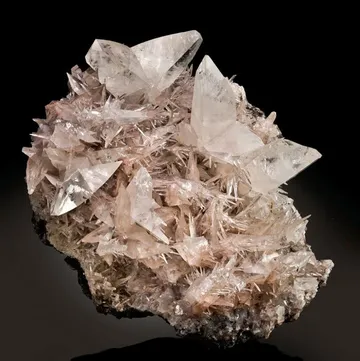
Shangbao Mine, Hunan, China — renowned for fluorite with pearly pink dolomite rhombs, plus quartz and pyrite; a prized collector locality.
Key facts
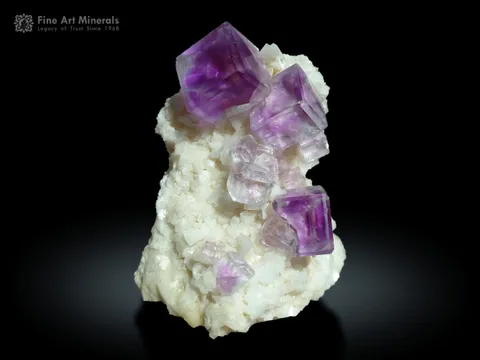
Dolomite from the Shangbao Mine is not a bulk carbonate curiosity; it is the stage on which some of the most recognizable Chinese fluorites were formed. The best specimens show pearly white to flesh-pink, slightly curved rhombs and blocky rhombohedral aggregates, commonly carrying pale blue-green, purple-zoned, or colorless fluorite, brassy pyrite, and quartz. On the finest pieces the dolomite is not merely matrix: it is sculptural, lustrous, and essential to the composition, forming stepped plates, saddle-like clusters, and rounded “snowball” aggregates that give Shangbao combinations their unmistakable look.

Photo: Wikimedia Commons
The locality lies at Leiyang, in Hengyang, Hunan Province, within a skarn-type polymetallic system developed where Carboniferous–Permian limestones meet granitic intrusions. That setting matters to collectors because it produced open cavities and pocket linings in which dolomite, quartz, fluorite, pyrite, calcite, and other minerals could crystallize freely rather than as massive ore. Shangbao’s collector identity is strongest in fluorite, but the dolomite is one of the visual signatures that separates Shangbao fluorite from the many other Chinese fluorite localities: it is bright, porcelain-like to pale pink, often curved, and frequently arranged in crisp terraces beneath gemmy fluorite.

Photo: Wikimedia Commons
Historically, Shangbao began as a small ore mine rather than a specimen mine. Its reputation among collectors developed as fine fluorite, pyrite, quartz, and dolomite combinations entered the international market in the late twentieth century, with particularly memorable material appearing around the years before and after the mine’s commercial closure. Today, collectors look for intact dolomite rhombs with a pearly to vitreous sheen, pleasing curvature, and strong contrast against associated minerals. Dolomite-only Shangbao pieces are much less commonly pursued than fluorite-on-dolomite combinations, but when the dolomite is large, lustrous, and undamaged, it can be a serious specimen in its own right.
Search for specimens: View all dolomite specimens from Shangbao Mine, Hunan, China
The Shangbao Mine, also known in specimen literature as the Shangbao Pyrite Mine, is in Leiyang County, Hengyang, Hunan Province, China. Its coordinates are near 26°13'24" N, 112°58'54" E, and the mine is associated geographically with the Cailun Bamboo Forest area. The locality is recorded as a skarn-type polymetallic deposit, with iron, tungsten, tin, niobium, and tantalum among the important commodities documented from the district.
Geologically, Shangbao sits in the contact environment between Carboniferous–Permian limestones and granitic rocks. The skarn system generated a broad mineral assemblage: dolomite, quartz, fluorite, calcite, pyrite, pyrrhotite, sphalerite, chalcopyrite, bismuthinite, scheelite, cassiterite, garnet-group minerals, diopside, epidote, tremolite, vesuvianite, topaz, tourmaline-group minerals, and several Nb-Ta-bearing phases are all recorded from the mine. For specimen collectors, the open-pocket phases are the crucial part of the story. Dolomite commonly forms pocket linings and matrix with quartz; fluorite, pyrite, calcite, and occasional sulfosalt material add the color and contrast.
The iron skarn was discovered during exploration between 1959 and 1964, when prospecting was focused on pyrite. Later geological work between 1969 and 1971 recognized niobium-tantalum orebodies in the weathered granite crust. More recent exploration has identified economic skarn-type tungsten-tin mineralization in the mine area, reinforcing the view of Shangbao as a complex rare-metal and skarn district rather than a simple fluorite occurrence.
Specimens from Shangbao reached international markets by the 1980s, including fluorite, pyrite, quartz, calcite, bismuthinite, and dolomite. The mine’s strongest specimen fame developed around the mid-1990s and early 2000s, when pockets produced combinations of transparent fluorite on dolomite and quartz, lustrous pyrite cubes, artichoke quartz, and dolomite in pearly curved rhombs or rounded clusters. Commercial ore production ended in the 1990s, and former miners later worked parts of the mine for specimens. Reports from the specimen trade describe production as irregular: the pockets were scattered, costly to reach, and sometimes yielded only after substantial barren rock had been removed.
Access should be regarded as closed to casual field collecting. The mine area has been described as fenced and gated, with underground workings extending through multiple levels. The site sits near a tourism landscape rather than a public collecting dump, and any material reaching collectors should be assumed to come through older stock, mine-associated production, dealer inventories, or recirculated collections rather than recreational collecting.
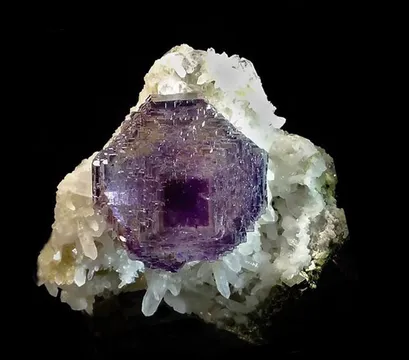
Notable finds include the classic fluorite-on-dolomite combinations with pale blue, green, purple, or colorless fluorite; dolomite plates with brassy pyrite cubes; snowball-like dolomite aggregates; quartz-dolomite pocket linings; and unusual combinations involving sulfosalt inclusions in fluorite or fuzzy dark nests beneath dolomite. The most coveted pieces balance three things at once: the gemminess and zoning of fluorite, the pearly architecture of dolomite, and the metallic punctuation of pyrite.
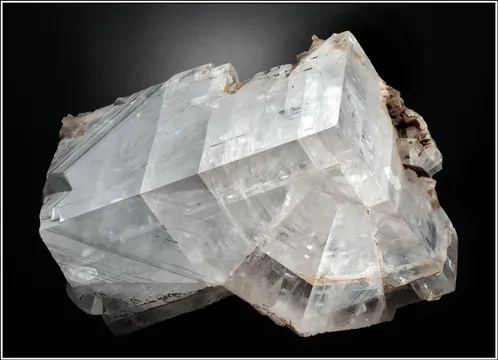
Shangbao dolomite is typically pale: white, cream, porcelain-white, very pale pink, or flesh-pink. The pink tones are usually subtle, strongest in well-lit specimens with fresh, lustrous faces. The luster ranges from pearly to vitreous, and the best dolomite has a clean, satiny brightness that contrasts beautifully with glassy fluorite and metallic pyrite.
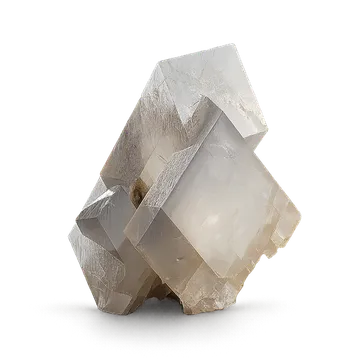
The classic habit is rhombohedral, but many crystals are not flat, textbook rhombs. They are commonly curved, slightly saddle-shaped, stepped, or gathered into blocky composite clusters. Mindat records dolomite crystals from the mine to about 2 cm, and specimen descriptions from the trade document pearly saddle-shaped crystals to around 1 cm and rounded dolomite spheres to about 2.5 cm. Larger dolomite-dominant plates exist, but individual crystal size, freedom from bruising, and three-dimensional arrangement matter more than raw dimensions.
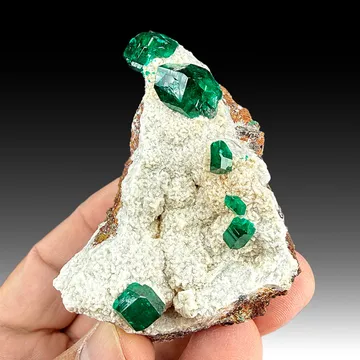
Association is the key to recognizing fine Shangbao dolomite. Quartz is very common and may appear as milky to clear prisms, needle-like crystals, artichoke quartz, or sceptered forms. Fluorite is the star associate: crystals may be cubic, cuboctahedral, octahedral, dodecahedrally modified, or complexly stepped, with colors including pale blue, blue-green, green, violet, pinkish, and colorless. Pyrite occurs as sharp cubes and adds brassy contrast. Calcite may appear as amber or pale scalenohedra or as associated carbonate on fluorite-dolomite specimens. Less common but documented associates include bismuthinite, sphalerite, baryte, topaz, and sulfosalt material reported with fluorite and dolomite combinations.
On high-quality pieces, collectors value dolomite that is clean rather than chalky, lustrous rather than dull, and three-dimensional rather than a flat crust. The most attractive specimens show fluorite perched naturally on dolomite, not crowded into it; the eye should read a deliberate mineral architecture, with dolomite forming a bright base and fluorite rising from it. The strongest combinations also preserve the delicate edges of the dolomite rhombs, because small bruises on pale dolomite are immediately visible.
A particularly desirable Shangbao look is a porcelain-white dolomite plate carrying blue-green or purple-zoned fluorite. Another is flesh-pink dolomite with brassy pyrite cubes and a small accent of purple fluorite. Dolomite-only specimens are most compelling when the rhombs are large for the locality, unusually pink, strongly lustrous, or arranged in mounded sculptural groups.
The first authenticity question is locality. Many Chinese fluorite localities produce fluorite on white carbonate or quartz, and casual labels may drift between Hunan localities. Shangbao pieces should show the locality’s characteristic combination of pale curved dolomite, quartz, pyrite, and complexly modified or color-zoned fluorite. A generic “China fluorite on dolomite” label is not enough for a premium Shangbao attribution unless the specimen has convincing habit, old provenance, or reliable dealer history.
I have not seen a well-documented, locality-specific problem of faked or routinely treated Shangbao dolomite. The more realistic concerns are repairs, assembled compositions, incorrect locality labels, and undisclosed damage. Because Shangbao combinations often have protruding fluorite on a brittle carbonate base, breaks at contact points are plausible. Examine fluorite-dolomite junctions with a loupe and UV light if needed; look for glue menisci, unnaturally glossy seams, mismatched dust in crevices, or a fluorite crystal that appears visually “set” onto the dolomite rather than grown through it. Repaired specimens are not automatically valueless, but repairs should be disclosed.
Condition is especially important. Dolomite bruises show as dull white scuffs on crystal edges, and curved rhombs can be chipped along exposed rims. Fluorite adds another vulnerability: edge nicks, cleavages, internal fractures, and scuffed stepped faces are common grading issues. Pyrite is usually stable on good Shangbao pieces, but check for loose cubes, oxidation staining, or contacts hidden in the back of matrix.
Rarity depends on how the specimen is framed. Dolomite as an associate from Shangbao is not rare; it is one of the defining matrix minerals. Fine dolomite-dominant specimens, however, are much less available than fluorite-dominant combinations. The market is strongest for fluorite on dolomite, especially with gemmy, zoned crystals, strong aesthetics, and old-pocket provenance. Good small-cabinet examples continue to appear through dealers and auctions, while top-end large, undamaged, highly transparent fluorite-on-dolomite pieces can move into several-thousand-dollar territory. Modest specimens with smaller fluorites, bruised dolomite, or weak composition remain accessible, but the best classic Shangbao combinations are increasingly collection pieces rather than abundant fresh production.
In October 2007, Thomas P. Moore’s online column for The Mineralogical Record caught Shangbao at a fascinating moment in its specimen life. He introduced it not as an active commercial giant, but as “a small mine where commercial work ceased 12 years ago,” about 30 km southeast of Leiyang. The old business had been pyrite ore in skarn; the new business was beauty pulled from abandoned or semi-abandoned workings by former miners.
The description of the material offered by Chen Weigang’s TC Mineral-China was a roll call of Shangbao textures. Before the 1995 closure, the mine had already produced handsome fluorites: many-hued transparent cubes, commonly with dodecahedral bevels, some enclosing bright pyrite cubes and milky quartz prisms. After closure, former miners recovered smaller runs of collector and decorator specimens. Moore singled out simple lustrous pyrite cubes, odd “artichoke quartz,” and matrix plates sprouting “forests” of sceptered milky quartz whose crystals touched at canopy level.
Then came the combinations that matter most to dolomite collectors. Moore described sharp pyrite cubes; pearly saddle-shaped dolomite crystals to 1 cm; snowball-like dolomite spheres to 2.5 cm; pale blue fluorite crystals to 4.5 cm; and, most memorably, fluorites with movable water bubbles. There were also jamesonite inclusions in fluorite and fuzzy jamesonite “nests” on which dolomite rested. The same group included curving, tapering compound crystals to 8 cm of a material Chen called “green quartz,” though Moore noted it looked bluish in some photographs. In a few sentences, the mine emerges as more than a fluorite locality: it becomes a pocket system where carbonate, sulfide, sulfosalt, quartz, and fluorite grew into complicated little mineral ecosystems.
A later collector account from Mario Pauwels gives the place a physical setting. On a May 2015 visit to Hunan, he found the Shangbao Mine near Zhushan village, in a lush green landscape at the edge of the Hunan Leiyang Cailun Bamboo Forest. He described it as small-scale but world-famous among mineral collectors, especially fluorite collectors. At the time, specimen searching was nearly at a standstill, yet the lower levels were still being pumped dry so the mine could become operational again if needed. The workings were said to include roughly two kilometers of tunnels on multiple levels, reaching to about 300 meters depth.
The mine entrance itself had changed. The original entry was little more than a tunnel driven into a bamboo-covered green hillside. In 2010, the owners built a more formal entrance portal. The site was enclosed by a high wall and a new wrought-iron gate, and from the road around the bamboo park the mine was not visible. There had been plans to combine specimen extraction with underground commercial tours for the growing number of visitors to the Cailun Bamboo Forest. But Pauwels noticed a converted mine wagon that had once hauled waste rock; its wheels and rails were heavily rusted, suggesting the tourist train had not run in years.
Another trade account captures the economics of the post-ore years. After the mine’s closure, a syndicate of miners leased parts of Shangbao specifically for specimen recovery. The work was unpredictable. Reports describe around ten miners dependent on specimen income, with collectible pockets scattered and hidden behind large volumes of rock. On average, only one sizeable pocket was exposed in a year. When a good pocket opened, dealers from Changsha, roughly 150 miles to the north, bid for first choice. That detail explains the uneven market history of Shangbao: long quiet periods, then sudden appearances of memorable dolomite-fluorite pieces, then another lull.
A small pocket opened in 2010 produced dolomite specimens whose appeal was quieter than the famous fluorites but very much in the Shangbao idiom: pale pink, bright, pearly-to-vitreous rhombs with faces that were not perfectly flat. The slight convex and concave curvature gave the crystals their saddle-like character. Many rested on or with needle-like quartz, supporting the interpretation that quartz and dolomite lined the pockets early, before later accents of fluorite and pyrite completed the most colorful combinations.