Crocoite Collectors Guide
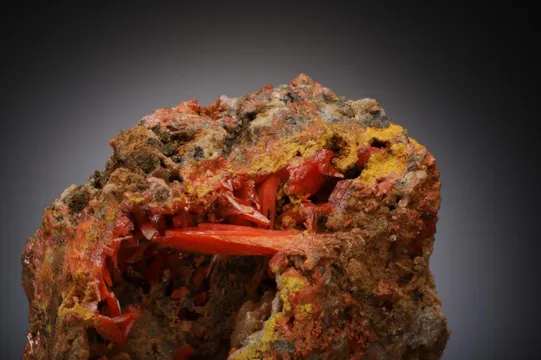
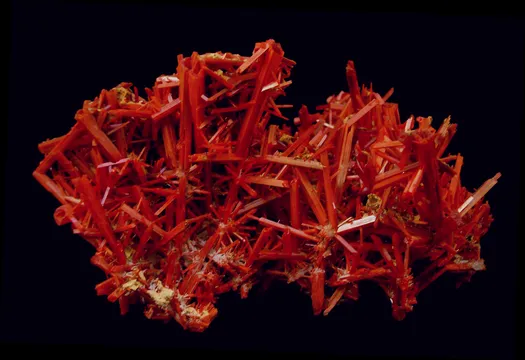
Crocoite, PbCrO4, is one of the most visually electrifying minerals in the hobby. Its long, vibrant orange to scarlet-red prismatic crystals can form dense “fireworks” sprays or elegant, isolated prisms with a high glassy luster. The species is historically important—crocoite from the Urals led Nicolas-Louis Vauquelin to discover chromium in 1797—and aesthetically unmatched when it comes from the famed lead deposits of Dundas, Tasmania. In top pieces, slender transparent to translucent crystals 3–10+ cm long radiate over dark iron-manganese gossan, or contrast against snow-white dundasite or cerussite, creating dramatic color juxtapositions.
Because crocoite is very brittle and most specimens are massed crystal clusters, pristine pieces are scarce. Superb Tasmanian specimens are cornerstones of many display collections, while fine historic Russian examples carry strong provenance appeal. Pricing spans widely: micromounts from classic European occurrences are modest, while large, undamaged Tasmanian clusters or museum-level single crystals can command five to six figures.
Few minerals “wow” like crocoite. Its intense, warm chroma and kinetic crystal sprays make it a perennial showstopper at exhibitions and online. Interest surged following waves of discoveries and re-openings in the Dundas district over the last few decades, bringing to market specimens with unprecedented size, color saturation, and crystal density—often on highly contrasting matrix. Collectors prize crocoite for:
- The unmistakable color and luster (no other species looks quite like it).
- Signature aesthetics from Tasmania: glowing, long crystals in dense, undulating carpets or upright sprays.
- Historical significance from the Ural Mountains, the type locality that launched chromium chemistry.
- Beautiful associations (white dundasite, cerussite, and plattnerite) that add contrast and context.
Despite decent availability, the combination of fragility, extraction difficulty, and breakage during preparation means true top-tier pieces are uncommon. As a result, the best specimens from classic pockets and mines see steady demand and long-term collector interest.
Below are notable, ID-verified localities known for distinctive and collectible crocoite.
The Adelaide Mine is the benchmark source for modern, world-class crocoite. It has produced brilliantly lustrous, transparent to translucent orange-red prisms in dense sprays and carpets over dark gossan, often with white dundasite or cerussite for striking contrast. Crystals range from slender hair-like needles to robust prisms exceeding 5–10 cm, and fine pieces can be remarkably three-dimensional and balanced. Many pockets yielded delicate “jackstraw” growths where crystals cross at lively angles; others produced isolated upright prisms with sharp terminations and mirror luster. Because pockets are fragile, many important pieces have professional stabilization or discrete repairs. Unrepaired, undamaged clusters on matrix remain trophy-level and among the most sought crocoites in the world.
A classic European locality for micromount to small miniature crocoite, Callenberg (Saxony) yields slender orange-red crystals in vugs from the old workings. While pieces are seldom as large as Tasmanian specimens, Callenberg crocoites can be sharp, lustrous, and attractive under magnification, often accompanied by an interesting suite of secondary lead minerals. They are popular with systematic and European-locality collectors and provide an affordable entry point into the species with historical pedigree.
- Color and saturation: Crocoite’s magic lies in its rich orange to deep scarlet-red hues. Thicker crystals typically show deeper red; very thin prisms tend toward orange. Seek vivid, even color visible without strong backlighting. Tasmanian pieces often “glow” under LED case lights; overly pale or brownish crystals are less desirable.
- Transparency and luster: Top crystals are transparent to translucent with a bright, glassy sheen. Matte or etched surfaces reduce impact. Look closely at the terminal centimeters—high clarity and mirror luster at the tips make specimens pop.
- Crystal length, thickness, and form: Long, well-terminated prisms from Tasmania are the gold standard. Perfect terminations are uncommon; sharp, complete tips and minimal contact points boost value. Stout, well-formed prisms (Red Lead, some Dundas Extended) show color strongly even in ambient light.
- Composition and matrix: Strong aesthetics matter—balanced sprays, crystals that point toward the viewer, and harmonious distribution across the matrix. Contrasting matrix (dark gossan) or white companions (dundasite, cerussite) can elevate a piece dramatically. Freestanding “hedgehog” clusters can be spectacular but are very fragile; matrix context often adds value and stability.
- Condition: Crocoite is extremely brittle. Inspect for:
- Chipped or cleaved terminations (often show as bright spots).
- Detached/re-glued crystals or stabilized areas at the base.
- Hidden damage on the reverse.
Minor, professionally executed repairs are common and often acceptable for significant pieces, but heavy restoration reduces desirability. Given the scarcity of pristine clusters, a small, perfect piece may trump a larger, damaged one.
Because pocket extraction is perilous, professional preparation is common:
- Stabilization and consolidants: Many Tasmanian pieces are consolidated (e.g., with Paraloid-type resins) to prevent flaking or to secure crystals. Clues include a slightly uniform sheen over matrix, subtle darkening of porous gossan, or a faint odor if newly prepared. Under longwave UV, some adhesives fluoresce and reveal glue lines around crystal bases.
- Reattachments: Look for perfectly straight break lines, misaligned striations, or a thin glossy seam where a crystal meets matrix. A loupe and raking light help. Some historic specimens were “pinned”—rare today but check for hidden supports.
- Polishing or coatings: True polishing of tips is uncommon for crocoite and generally discouraged. Old “lacquered” surfaces do occur—watch for an artificial gloss on matrix or crystals that differs from natural glassy luster.
- Color treatments: Not typical for crocoite; heating or irradiation is not used to improve color and would risk damage. If color looks unusually artificial or uniform, ask for provenance and preparation details.
- Assemblies/fakes: Wholesale fakes are rare; more often the issue is undisclosed repair. Buy from reputable sources and request full disclosure of preparation.
Crocoite is both chemically and mechanically delicate. Treat it as a display jewel that prefers a quiet, controlled environment.
- Handling:
- Minimize handling; always use two hands and support the matrix, never the crystal forest.
- Avoid touching terminations—light pressure can snap crystals.
- Transport in a rigid, foam-lined container with zero rattle; vibration can cause “crystal snow” (micro-fragment shedding).
- Display and environment:
- Lighting: LED case lights are ideal. Avoid prolonged direct sunlight or hot lights; heat can stress adhesives and matrix.
- Vibration-free shelf or a sealed display case is best. Museum gel or discreet supports can help stabilize bases on larger pieces.
- Dust protection: Enclosed display reduces dust and accidental contact.
- Cleaning:
- Do not ultrasonically clean, steam, or soak. Water can undermine friable gossan and loosen certain adhesives.
- Use a gentle air bulb or very soft brush for loose dust only. If absolutely necessary, a barely dampened swab can touch accessible matrix—not the crystal forest—and must be used sparingly. Always let the piece dry thoroughly in still air.
- Temperature and humidity:
- Keep moderate and stable; avoid heat sources and rapid temperature swings that can induce micro-fracturing.
- Normal indoor humidity is fine; extremes can affect old consolidants or friable matrices.
- Chemical considerations and safety:
- Crocoite is lead chromate. While stable as a display mineral, avoid generating or inhaling dust and wash hands after handling. Do not use acids, bases, or chemical cleaners.
- Long-term storage:
- Store in a rigid box with custom-cut foam or soft inert padding so there is no movement.
- Label repairs/stabilization on the specimen card for future reference.
- Periodically check for newly loosened crystals or consolidant failure; consult an experienced preparator for conservation if needed.
By focusing on vivid color, pristine terminations, balanced aesthetics, and careful stewardship, collectors can enjoy crocoite at its most spectacular—flaming sprays and elegant prisms that remain some of the most dramatic natural art in the mineral world.