Callenberg crocoite is one of the great “small specimen” stories in European mineral collecting: a brief, highly localized, brilliantly colored occurrence of PbCrO4 uncovered not in a classic lead mine, but in an open-cast nickel operation in Saxony. The locality is the Callenberg North open cut No. 1, near Callenberg in the Zwickau district, historically associated with the Glauchau area. Its best specimens carry glassy orange-red to red crocoite crystals on pale quartzose and limonitic matrix, sometimes sharpened into distinctive flattened prisms, arrowhead-like tablets, or slender needles rather than the long, free-standing Tasmanian wands that dominate the world market.
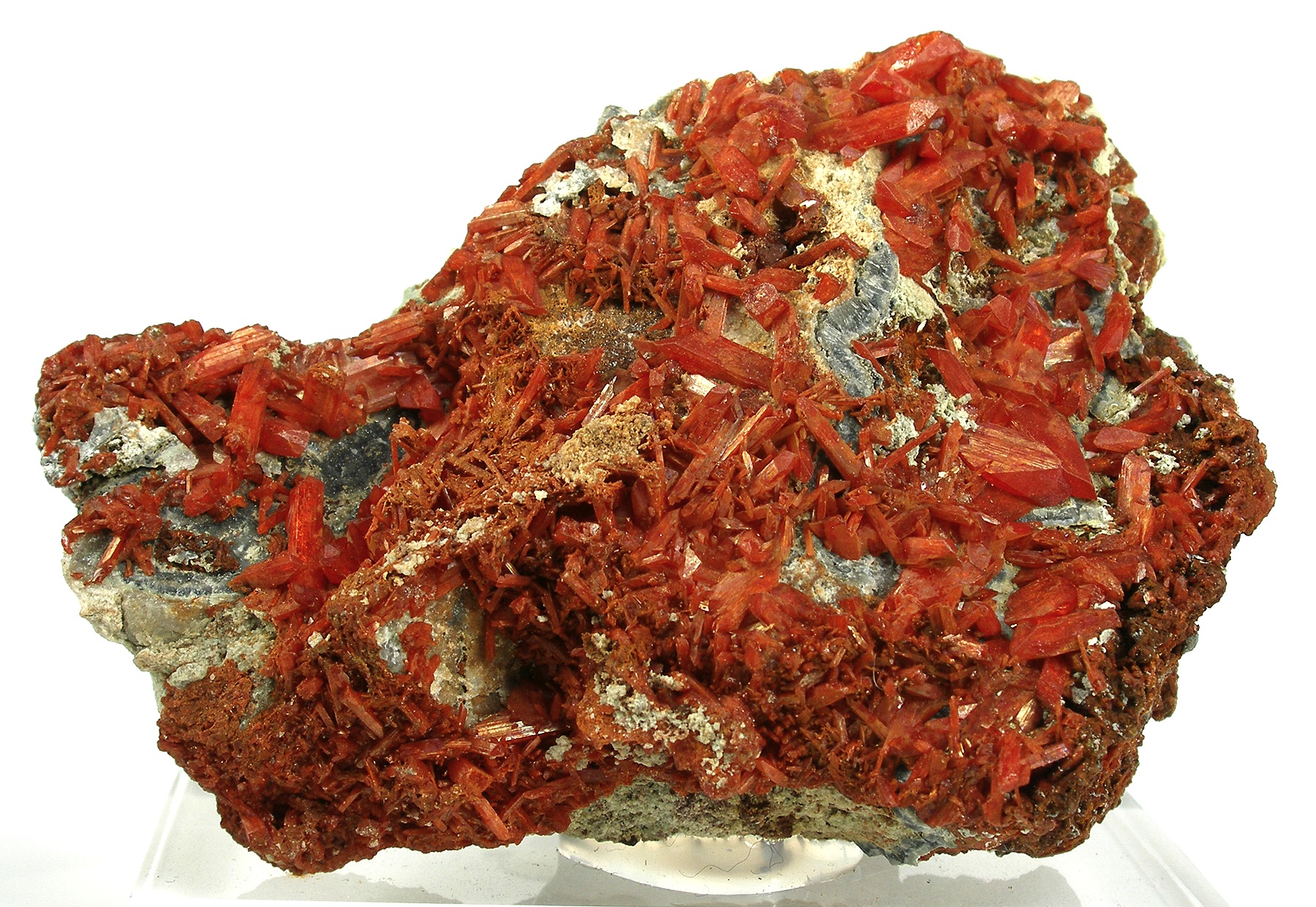
Photo: Wikimedia Commons
The appeal of Callenberg is not scale but pedigree, color, and geological improbability. In a serpentinite-hosted nickel laterite district, chromium was already available from chromite-bearing ultramafic rocks, while lead was present only locally in the secondary assemblage. Where oxidation and groundwater chemistry brought those two geochemically mismatched elements together, crocoite crystallized in small cavities and on broken, siliceous or iron-stained surfaces. That accident of chemistry produced one of Germany’s most famous crocoite occurrences.
For collectors, Callenberg pieces occupy a different category from Dundas or Adelaide Mine crocoite. A Callenberg specimen is usually judged as a European classic: sharp crystals, intense color, intact terminations, visible matrix contrast, and believable old provenance matter more than sheer crystal length. Fine pieces may show crystals around 7 mm to 1 cm, and exceptional display specimens have been recorded with crystals to about 1.1–1.3 cm. Even modest thumbnails are desirable when the color is saturated and the label is convincing.
Search for specimens: View all crocoite specimens from Callenberg, Germany
The precise collector locality is Callenberg North open cut No. 1, a former open-cast mine in the Callenberg nickel district of Saxony. The mine belongs mineralogically to a broader group of Callenberg open cuts that worked nickel-bearing weathering products developed on serpentinite at the southwest margin of the Saxon Granulite Massif. The nickel ores were hydrous nickel silicates and related weathering products formed from Ni-rich serpentinite; the district was mined in several open pits from 1952 until 1990 and is described in modern locality databases as the largest nickel deposit of its type in Central Europe.
This setting is the key to understanding the crocoite. Callenberg was not a normal oxidized lead vein locality. It was a supergene, weathering-crust environment over ultramafic rock. The serpentinite supplied chromium-bearing minerals such as chromite, while localized lead minerals supplied the Pb needed for crocoite. In the oxidation zone, under very particular chemical conditions, lead and chromate combined to form PbCrO4. That is why the occurrence was so startling: the two elements usually travel in different geological worlds, and the Callenberg association brought them together only in a narrowly restricted zone.
The famous find came during active work in the North I open cut. Contemporary accounts place the discovery on March 3, 1977, when mining was proceeding in wet, gloomy weather and a machine operator noticed unusual red marks on large rounded stones after the excavator met harder resistance. The material was collected by the mine geologist and sent for analysis; outside institutes eventually confirmed the red mineral as crocoite. A second crocoite site in the same open cut was later opened about 300 m west of the first find, but the overall occurrence remained small and finite.
Collecting access should be treated as closed historical industrial ground, not an open collecting locality. The nickel mining that exposed the crocoite has ended, the occurrence is no longer producing in the normal sense, and modern specimens on the market are overwhelmingly old-collection pieces from the late 1970s and 1980s. Labels may read “Callenberg,” “Obercallenberg,” “Callenberg Nord I,” “Callenberg North open cut No. 1,” or “Callenberg/Glauchau, Saxony.”
Callenberg crocoite is typically bright orange-red, carrot-orange, scarlet, or deep carmine-red. The best crystals have a glassy to adamantine sparkle and sit in strong contrast on pale, grey, buff, or limonitic matrix. Unlike the long hollow needles familiar from Tasmania, Callenberg crystals are commonly shorter prisms, flattened blades, tablets, spearheads, or compact sprays. Some show fine longitudinal striations and crisp bevelled terminations; others are etched, partly altered, or embedded in earthy red-brown material.
Size is the first locality clue. Most Callenberg crystals are small: millimetric crystals are normal, 5–7 mm crystals are already pleasing, and crystals around 1 cm are notably good. Published and museum-linked references describe tabular crocoite to about 1.3 cm with fornacite, while a well-known illustrated small-cabinet specimen shows sharp arrowhead-like crystals to about 1.1 cm. Large cabinet pieces exist, but they are unusual and should still be judged by crystal quality rather than by matrix size alone.
The matrix is part of the character. Good specimens may show crocoite on cellular quartz, quartzose-limonitic rock, iron-stained porous material, or altered serpentinite-derived matrix. Black coronadite can form dramatic dark patches, while pale green vauquelinite gives some pieces a subtle but important chromate-phosphate association. Other minerals reported from the Callenberg North I assemblage include cerussite, galena, pyromorphite, mimetite including chromium-bearing mimetite, vanadinite, fornacite, embreyite, phoenicochroite, bindheimite, quartz, chalcedony, kaolinite, montmorillonite, and the rare Cr-dominant carbonate petterdite.
The finest Callenberg pieces combine four qualities: saturated red-orange color, visible crystal definition, intact terminations, and an undisturbed old matrix. Flat, broad, lustrous crystals are especially prized because they distinguish the locality from more ordinary acicular crocoite. The most desirable specimens also show an attractive association, particularly with green vauquelinite, yellowish pyromorphite or mimetite, black coronadite, or rare secondary lead-chromium species.
Callenberg crocoite is scarce but not impossible: small specimens still appear from old German and European collections, often priced more accessibly than major Tasmanian crocoites. The supply is thin, however, and quality drops quickly. A loose scatter of tiny orange-red grains on matrix is common; a rich, sharp, lustrous miniature with recognizable crystals is much less common; a well-composed small-cabinet piece is a serious German classic.
The main authenticity issue is provenance. Because Callenberg material is usually small, a good label matters. Look for old-style German locality wording, dates around 1977–1979, or references to “Nickelerztagebau Callenberg Nord I.” Specimens labelled simply “Germany” or “Callenberg” without further history should be evaluated by matrix, habit, and association. Tasmanian crocoite is usually easy to separate visually because of its longer, more open sprays and different matrix, but small fragments can be less obvious when removed from context.
Treatments and artificial enhancement are not the central concern for this locality. The more practical problems are trimming, glued or stabilized matrix, broken terminations, and faded or dulled crystals. Crocoite is soft, brittle, and sensitive to poor handling; projecting crystals chip readily, and old specimens may have tiny losses that are hard to see without magnification. Strong light can diminish the color of crocoite over time, so display should favor low-UV, indirect illumination.
Safety handling is straightforward but worth respecting. Crocoite is lead chromate, PbCrO4. Do not grind, cut, or wash friable material aggressively; avoid creating dust; keep specimens away from children; and wash hands after handling. For display, a small covered acrylic box is often the best solution: it protects fragile crystals, reduces dust, and preserves the old-label character that gives Callenberg pieces much of their value.
The Callenberg story begins like a scene from an industrial diary rather than a mineral show report. On Thursday, March 3, 1977, the North I open cut was already at work. The weather was “trübe und regnerisch” — overcast and rainy — and the stripping and ore haulage were running to plan. Then the excavator hit unexpected resistance. The operator, named Esche in the contemporary account, climbed down to inspect the place and noticed reddish scratch marks on large, rounded stones.
That small red trace changed the reputation of the mine. Esche notified the geologist, Johanna Leonhardt, who collected the exposed stones and had them analyzed. Only after outside institutes examined the material was the mineral confirmed as crocoite. The reported specimen illustrated in the St. Egidien municipal account was a tiny piece, only 5 x 6 mm, in the Leonhardt collection, yet the recognition was large enough to send news racing through the collector world.
The reaction was immediate and unruly. Professors, doctors, students, collectors, and speculators all wanted a share of the bright red mineral. The account says the news spread “in Windeseile,” like wildfire. Some enthusiasts camped near the site, trying “Nacht- und Nebelaktionen” — night-and-fog raids — to reach the tempting material. They left behind broken spade and hammer handles, deep dig holes, and boots stuck in the mud. For a mineral that usually appears in polite drawers and carefully labelled micromount boxes, Callenberg crocoite entered the collector world with mud on its boots.
The mine did not yield only that first pocket. In the North I open cut, a new crocoite occurrence was later discovered and opened about 300 m west of the original find. Even so, the locality never became a broad, long-lived specimen producer. Its fame rests on a compact episode: a nickel mine, a rainy March day, an excavator scrape, a red streak on stone, and a rare lead chromate crystallizing where few collectors expected it.
 Amethyst
 Quartz
 Fluorite
 Tourmaline
 Malachite
 Azurite
 Rhodochrosite