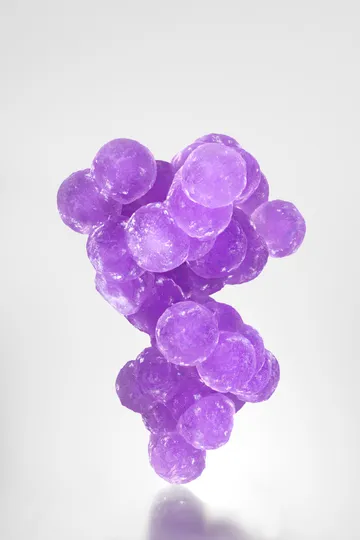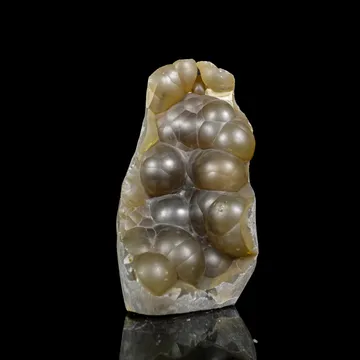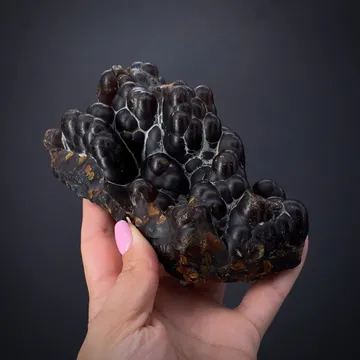
Chalcedony: microcrystalline quartz with agate, jasper, chrysoprase; waxy to glassy surfaces, banding and botryoidal forms, a colorful, collectible spectrum.
Key facts
Chalcedony is microcrystalline quartz that forms as masses rather than distinct macro-crystals. It’s a broad family that includes agate (banded chalcedony), jasper (opaque, impure chalcedony), chrysoprase (nickel-colored apple-green), carnelian (orange-red), sard, onyx, and countless local “picture” and fortification varieties. In the mineral cabinet it appears in botryoidal and stalactitic forms, crusts and drapes over cavity walls, and as nodules and geodes. Surfaces range from waxy/satiny to glassy when coated by drusy quartz. Colors span ethereal ice-blues and lavenders to vivid apple-green chrysoprase and warm reds and browns.
Aesthetic appeal lies in shape and texture: “wet-look” botryoidal luster, perfect globules, sculptural stalactites, intricate fortification banding, and striking color contrasts (e.g., amethyst with a chalcedony rind). Prices are as diverse as the material—common nodules and small botryoids are inexpensive, while top “grape chalcedony” clusters, intensely colored chrysoprase, or dramatic stalactitic sculptures command strong premiums. Fine, damage-free form is the key determinant for natural specimens; for banded agates, sharp, high-contrast banding and pleasing symmetry are paramount.
Chalcedony bridges two worlds: mineral specimens and lapidary art. Historically, agates from Germany (Nahe Valley/Idar-Oberstein), Brazil, Uruguay, and the American West built a global cutting industry. In recent decades, several booms kept collectors enthralled:
Because chalcedony occurs in many environments, beginners can find attractive pieces easily, while advanced collectors hunt for perfect aesthetics, rare colors, and unusual habits (flawless spheres, stalactitic “bouquets,” flower-like chalcedony roses, or museum-sized thundereggs). Its enduring appeal comes from that diversity—there’s always a new look, a fresh texture, or a surprising color to discover.
Mamuju Regency (West Sulawesi) is the type area for the modern “grape chalcedony” craze: tight grape-like clusters of botryoidal chalcedony in purples, lavenders, and greens, often with a glassy, “wet” luster and sparkling drusy overtones. Many specimens show branching stalactitic growth with perfectly spherical beads—highly aesthetic in cabinet sizes. The best pieces have saturated color, translucency, and pristine, undamaged globules with minimal contacts. Production fluctuates, and truly sculptural clusters without damage are the most coveted and increasingly hard to find.
Basalt quarries in Maharashtra (Deccan Traps) yield abundant chalcedony: stalactites, botryoidal linings, and chalcedony-skinned geodes, often with quartz and apophyllite. Choice specimens show sculptural stalactites, vivid pastel colors, and bright drusy overcoats that make the forms glitter. Unbroken “fingers,” minimal contacts, and pleasing, upright compositions distinguish the best pieces.
In southern Brazil, massive amethyst and agate geodes form within basalt—chalcedony provides their structural rinds, interior drapes, and botryoidal “candy” layers. Collectors appreciate geode sections where chalcedony shows refined banding transitioning into quartz, or where it forms contrasting blue-gray “caps” over purple crystals. Matrix cross-sections displaying the full sequence—basalt, chalcedony rind, and quartz—are particularly instructive and attractive.
Because chalcedony is microcrystalline, quality is about color, texture, form, and condition rather than visible crystal faces.
Provenance and reputable sellers are your best insurance. Ask directly about repairs or treatments; well-informed dealers will disclose.
Chalcedony is durable (Mohs ~6.5–7) and chemically stable, but many forms are delicate due to thin stalks or clustered spheres.
With mindful handling and gentle cleaning, chalcedony’s luster, color, and sculptural presence will remain captivating for the long term.