Mamuju Regency on the west coast of Sulawesi is the source behind the modern collector phenomenon sold as “grape agate,” “grape chalcedony,” “grape amethyst,” Batu Manakarra, or Batu Ngalo. The best pieces are unmistakable: clustered lavender to deep violet spheres, often with a glossy wet-looking surface or a frosty sparkle of tiny quartz points, arranged so closely that a cabinet specimen can look less like a mineral crust than a frozen bunch of grapes.
Mineralogically, the name needs care. Much of the trade still calls the material chalcedony, and many catalogues use that name, but published gemological work has shown that the purple grape-like material is better understood as spheroidal amethystine quartz rather than true banded agate. The spheres are radial aggregates of quartz; in the better pieces, magnification reveals fine bundles and sparkling microcrystal surfaces rather than the continuous waxy texture of typical massive chalcedony. For collectors, that distinction does not reduce the appeal. It sharpens it: Mamuju “chalcedony” is collected precisely because it sits at the visual border between botryoidal chalcedony, drusy quartz, and amethyst.

Photo: Wikimedia Commons
The locality is a suite of small specimen-producing deposits rather than a single classic underground mine. The known producing belt begins with beach material around Pantai Ngalo and continues inland and northward toward Mamuju through named localities including Takandeang, Tanete Kalaha, Tanete Pao, Lumbia, and Salletto. The specimens occur in a volcanic terrain, with regional work on Mamuju’s Adang volcanic complex documenting lava, breccia, volcanic conglomerate, limestone, reef limestone, and alluvium, as well as a broader Miocene volcanic setting on the eastern side of the Makassar Strait. In the grape-agate workings themselves, the collector material is associated with altered volcanic rocks and clay-rich pockets, a setting that explains both the spherical quartz growth and the frequent green clay-mineral inclusions in some specimens.
The finest Mamuju pieces are judged as sculptural mineral specimens. Collectors look for saturated violet or lilac color, evenly rounded separate “grapes,” a clean three-dimensional cluster, bright luster, translucency at the sphere edges, and minimal broken contacts. Pieces with both purple and green spheres are less common and can be very attractive when the colors are natural and the composition is balanced. Pale gray, brownish, chalky, or heavily contacted material is abundant by comparison and is less desirable unless the form is exceptional.
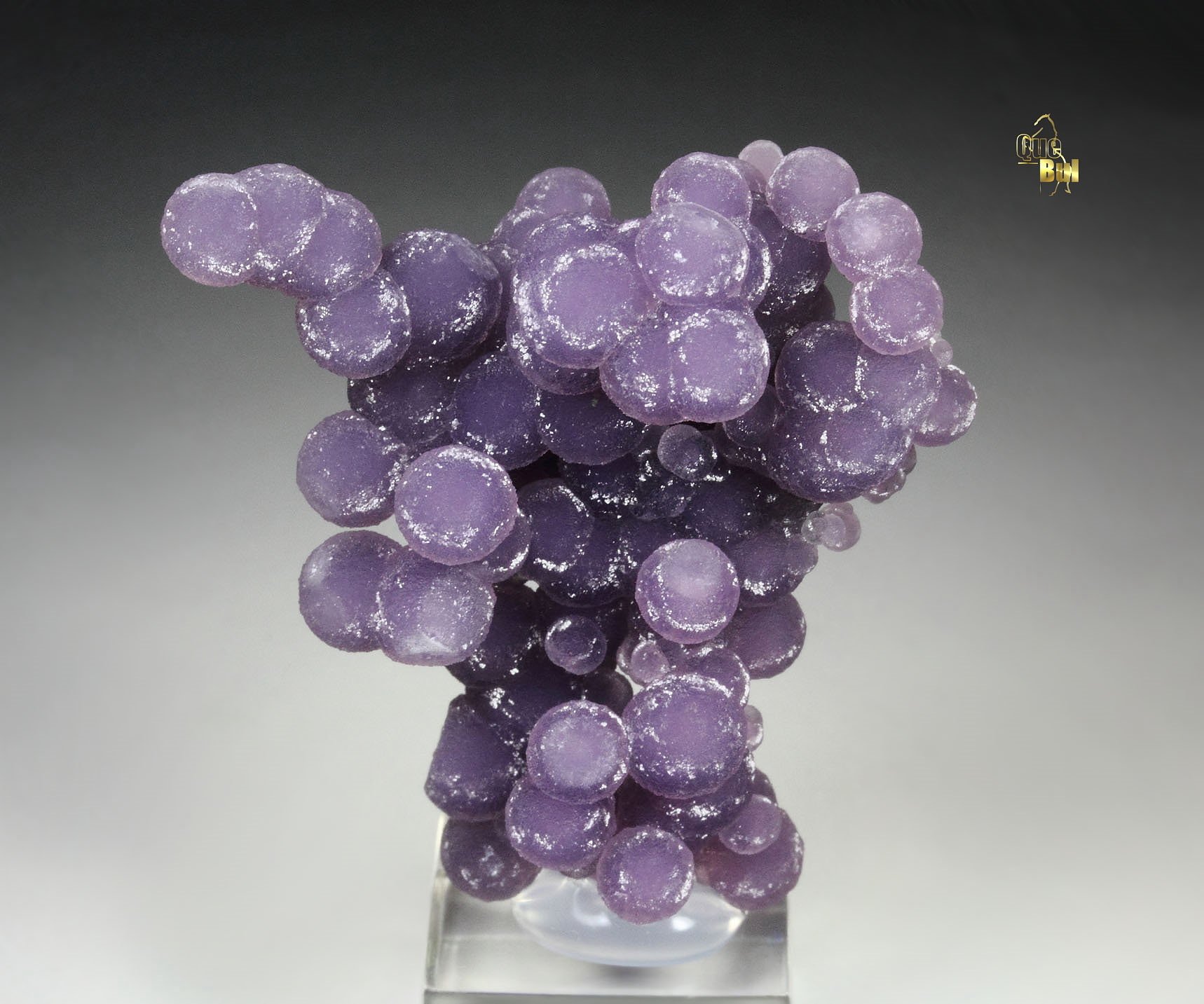
Photo: Quebul Fine Minerals
Search for specimens: View all chalcedony specimens from Mamuju Regency, Indonesia
The specimen locality is best described as the “Grape Agate” mines of Mamuju Regency, West Sulawesi Province, Indonesia. It is a mining area made up of a chain of deposits rather than a single point locality. Published locality records place the occurrence from the beach at Pantai Ngalo inland and northward toward the city of Mamuju, with specific collecting and mining names including Takandeang, Tanete Kalaha, Tanete Pao, Lumbia, and Salletto.
The deposit is volcanic-hosted and clay-associated. The grape-like material is found in pockets and seams within weathered volcanic rock, especially in blue-green clay zones. The broader Mamuju area is dominated by volcanic units of the Adang volcanic complex and related rocks; geologic studies of the region describe volcanic breccia, lava, lava domes, volcanic conglomerate, and associated sedimentary and carbonate units. For specimen collectors, the important point is that silica-bearing fluids and altered volcanic material created a chemically favorable setting for quartz to precipitate as spheroidal aggregates rather than ordinary vein quartz.
The history is unusually recent for a mineral that became so widely recognized. Indonesian accounts of Batu Ngalo or Batu Manakarra place the first local discovery at Pantai Tanjung Ngalo in 2012, followed by cutting and ornamental use during the Indonesian batu akik boom of 2013–2016. International gem and mineral literature generally frames the grape-form quartz discovery as 2014 beach material near Mamuju, with much better collector-grade purple and blue-green material appearing by 2016. That timing explains why the material seemed to arrive suddenly on the world mineral-show circuit: within only a few years, small local finds had turned into a recognizable global trade name.
Mining is local, small-scale, and specimen-oriented. Indonesian reporting describes local miners working near-surface material first and later recognizing that better potential remained at depth. The Indonesian Geological Agency reportedly investigated mining blocks at Pangasaan, Tanete Pao, and Takandeang and estimated combined potential of about 240 tons of Batu Manakarra material. That figure should not be read as 240 tons of top-grade grape clusters; the overwhelming majority of recovered material is dull, fractured, pale, massive, or lapidary-grade rather than fine cabinet-specimen quality.
Collecting access should be treated as private and commercial, not recreational. These are working localities in rural Mamuju Regency, and specimens reach collectors through miners, Indonesian dealers, exporters, and international mineral dealers. Anyone attempting field access would need explicit land and mineral-rights permission, local guidance, and awareness of tropical terrain, unstable weathered rock, pits, and excavation hazards. For most collectors, provenance through a reputable seller is the practical and ethical route.
Notable finds include lustrous lavender miniature clusters, larger cabinet groups of violet spheres, rarer green to blue-green pieces, and mixed purple-green specimens. Some spheres are only a few millimeters across; exceptional individual spheres approach roughly 18–20 mm. The most desirable pieces are not necessarily the largest, but those in which the spheres remain separate, rounded, sparkling, and undamaged, with a natural display face rather than a broken plate of botryoidal crust.
The classic habit is botryoidal to grape-like: close-packed spheroids of quartz, commonly arranged in clusters, crusts, drapes, and branching masses. Individual spheres are typically about 3–6 mm across in ordinary collector material, with reported examples reaching the high teens of millimeters and locality records giving a broader 2–20 mm range. The spheres are composed of radially grown quartz fibers or bundles, and under modest magnification the surface often resolves into glittering microcrystalline quartz rather than the smooth waxy surface expected of ordinary chalcedony.
Color is the first thing most collectors notice. The familiar palette runs from pale lavender and grayish lilac through saturated violet-purple; some specimens are nearly whitish or colorless, and some are gray, brownish, or dull. Green to blue-green material is less common and is generally attributed to inclusions of clay minerals. Mixed purple and green spheres on the same specimen occur and are highly collectible when the contrast is natural and the form is attractive. Light pink, yellowish, and colorless aggregates have also been documented, but they are far less central to the market identity of Mamuju material.
The luster varies widely. Top specimens have a bright vitreous to wet-looking shine, sometimes enhanced by drusy quartz sparkle on the sphere surfaces. Other pieces are satiny, matte, chalky, or dull, especially weathered or lower-grade material. A premium specimen should have lively luster across the front-facing spheres, with any dull clay-filled areas or broken contacts confined to the back or base.
Associated minerals recorded from the “Grape Agate” mines include quartz, amethyst, calcite, pyrite, saponite, possible celadonite, limonite, and a phillipsite-subgroup zeolite. In hand specimens, collectors most often notice clay, green inclusions, quartz sparkle, and occasional matrix remnants rather than distinct accessory crystals. Saponite and possible celadonite are especially relevant because clay minerals help explain the green colors and the earthy matrix commonly lodged between spheres.
Quality is a combination of color, form, surface, and condition. Saturated natural purple is desirable, but not if the piece is flat, broken, or muddy. Well-separated rounded spheres create the strongest “grape” effect. Three-dimensional clusters with natural negative space are more prized than simple botryoidal crusts. Translucent edges, internal glow, and uniform sparkle add value. Damage is especially important: a single chipped front sphere can be visually louder than damage on a conventional crystal specimen because the eye expects every grape to be complete.
Size matters only after aesthetics. Thumbnail and miniature clusters can be excellent if they are sculptural and pristine. Cabinet pieces are impressive when they preserve surface quality across a broad display face, but large plates often have broken margins, dull zones, clay-filled cavities, or repaired branching areas. The best large pieces combine scale with the delicacy of a fine miniature: rounded spheres, crisp separation, saturated color, and no obvious grinding, trimming, or glue.
The first authenticity issue is nomenclature. “Grape agate” is a trade name, not a precise mineralogical name. Mamuju material is not true agate in the strict sense because it lacks the characteristic banding of agate, and published Raman and optical work supports identification of the purple material as amethystine quartz. “Grape chalcedony” remains common in the market and is understandable as a collector category, but serious labels should ideally say something like “quartz var. amethyst, grape-agate habit” or “amethystine quartz/chalcedony, trade name grape agate, Mamuju Regency.”
The second issue is color treatment. Poorly colored Mamuju material is documented as sometimes being dyed violet. Warning signs include unnaturally even neon purple, color concentrated in cracks or porous clay seams, purple staining on matrix, and a tone that looks more like ink than amethyst. Natural color can be quite vivid, so the point is not to reject strong color automatically; instead, compare color behavior against luster, translucency, and the distribution of color inside individual spheres. Natural purple usually feels integrated into the quartz, while dye often pools, halos, or clings to damaged areas.
Repair and assembly are worth checking. Delicate branching clusters can break during extraction, cleaning, export, or mounting. Examine junctions between spheres and stems for glue lines, glossy seams, misaligned breaks, or a sudden change in surface texture. A longwave UV light can sometimes reveal adhesives, though not all repairs fluoresce. Be especially cautious with improbably perfect “tree” forms on acrylic bases, loose individual spheres attached to matrix, or pieces whose display face appears assembled from multiple fragments.
Condition problems are common. Broken front spheres, abraded high points, clay-packed recesses, and dull weathered patches all reduce desirability. Some damage is unavoidable on larger plates, but the best specimens hide contacts on the back, underside, or natural attachment edge. Cleaning should be conservative: warm water, a soft brush, and patience are safer than acids, ultrasonic cleaners, or aggressive mechanical work. The small drusy surfaces and thin connections can be more fragile than quartz hardness alone suggests.
In the market, Mamuju grape material remains available, but the distribution is uneven. Small pale or moderately colored clusters are common. Fine miniatures with saturated color, lively luster, and no obvious damage are much harder. Large cabinet specimens are available from time to time, but top large pieces with vivid color and intact spherical surfaces command a strong premium. The locality’s fame also means that “Mamuju” is sometimes used loosely; insist on a full West Sulawesi provenance when paying for locality quality rather than just a decorative purple botryoidal quartz cluster.
The Mamuju story begins not in a famous old mine but on a coast. Indonesian museum notes describe the earliest Batu Ngalo discovery at Pantai Tanjung Ngalo, where locals first recognized the unusual stone before it became better known as Batu Manakarra. The beach name mattered: “Ngalo” stayed attached to the material locally, while “Manakarra” tied it to Mamuju’s civic identity. When the grape-like form was later found farther from the shore, the stone acquired a second life in the international mineral trade.
By the time Batu Manakarra reached the Museum Geologi Bandung, it had become more than a curiosity. Indonesian reporting in 2021 described gem hunters clustering around the display, drawn by the way the stone flashed and spotted light. Museum head Iwan Kurniawan called attention to its “bercak sinar,” the attractive flecks or flashes that made it stand out. The same report quoted geologists and officials discussing its economic potential: not only as cut stones and jewelry, but as souvenirs, desk ornaments, and suiseki-style natural objects that resemble something without being carved by hand.
The numbers in that report are striking. A Geological Agency team investigated three mining blocks—Pangasaan, Tanete Pao, and Takandeang—and estimated their combined potential at about 240 tons. Tarsis Ari Dinarna, identified as a young earth investigator at the agency, emphasized that miners had only worked the easiest near-surface material. Deeper digging, around 10–12 meters down, was considered promising both vertically and horizontally, depending on the mining technology available. For collectors, those figures explain why the material can be both common and rare at the same time: the district may contain a large volume of stone, but only a fraction becomes the lustrous grape clusters that collectors want.
A 2022 detikSulsel profile brings the trade down to the workshop level. Abdul Rasyid, a Mamuju craftsman, described Batu Manakarra as a native Mamuju crystal stone that he began exporting in 2015 during the Indonesian ring-stone boom. He named export destinations including China, France, and the United States, but explained that shipments were routed through a friend in Sukabumi because of export paperwork. His reported monthly export shipment weighed around 500 kilograms, with profit of about Rp 40 million per shipment. He worked the stone into small spheres, pyramids, rings, pendants, and other forms, employing three local residents in the process.
There is also a folk edge to the Manakarra boom. A 2016 Liputan6 report from the height of Indonesia’s batu akik enthusiasm described hunters traveling steep mountain routes in Mamuju and, in some cases, performing offerings before searching. One young collector, Awin, said the stone could be difficult to find because it lay around 5 meters below the surface, and the report described rituals involving incense, cigarettes, offerings, and a black Cemani chicken. Whether read as belief, showmanship, or batu-akik-era folklore, the account captures how rapidly the stone moved from geological oddity to object of desire, speculation, and story.
 Amethyst
 Quartz
 Fluorite
 Tourmaline
 Malachite
 Azurite
 Rhodochrosite
