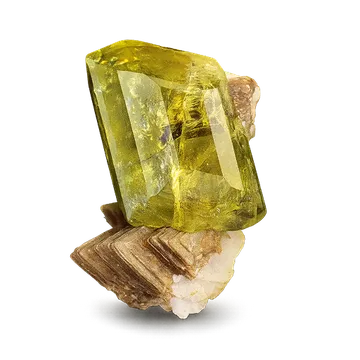
Brazilianite from Linópolis, Minas Gerais: chartreuse to yellow-green crystals with vitreous luster, prized from Córrego Frio pegmatites for rarity and localit…
Key facts
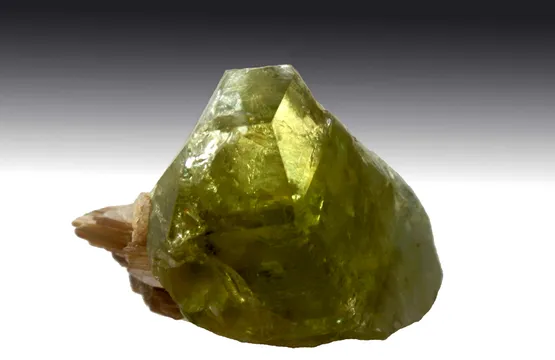
Brazilianite from the Linópolis district is one of the classic green-yellow phosphate specimens of the mineral world: lustrous, glassy, and immediately recognizable when it occurs as sharp chartreuse to yellow-green crystals on pale albite, cleavelandite, muscovite, or quartz. Its appeal is not merely color. The best pieces have the combination collectors prize in pegmatite phosphates: transparent crystal interiors, complex wedge-like terminations, strong vitreous luster, and a visual contrast between saturated brazilianite and pale feldspar or mica matrix.

Photo: Wikimedia Commons
The district’s importance begins with the Córrego Frio pegmatite, the type locality for brazilianite. The species was formally described in 1945 by Frederick H. Pough and Edward P. Henderson as a new sodium aluminum phosphate, NaAl3(PO4)2(OH)4. Older labels may say “Conselheiro Pena,” “Galiléia,” “Doce Valley,” or simply “Linópolis,” reflecting historical geography and mineral-trade usage; the modern locality is best given as Córrego Frio mine or another named claim in the Linópolis district, Divino das Laranjeiras, Minas Gerais, Brazil.
The setting is a phosphate-rich granitic pegmatite district within the Eastern Brazilian Pegmatite Province, in the broader Conselheiro Pena–Galiléia–Mendes Pimentel mineral region. The brazilianite-bearing bodies are generally small, residual pegmatites emplaced in mica schists of the São Tomé Formation, and the mineral tends to occur in the phosphate-rich intermediate and replacement zones rather than as a widespread accessory throughout the pegmatite. This is part of what makes the specimens so collectible: the finest crystals came from localized pockets and replacement bodies, not from broad, uniform ore.
Córrego Frio gave the mineral its scientific identity, but later production from the Telírio claim made Linópolis the continuing standard for collectible brazilianite. Telírio specimens often show bright yellow-green crystals, commonly on albite or with muscovite, and many of the specimens that have circulated through the international market since the late twentieth and early twenty-first centuries trace to that mine. For serious collectors, a Linópolis brazilianite is evaluated on locality precision as much as beauty: “Córrego Frio, type locality” carries a different historical weight than “Telírio,” and both are more informative than a broad “Minas Gerais” label.

Photo: Wikimedia Commons
Search for specimens: View all brazilianite specimens from Linópolis District, Divino das Laranjeiras, Minas Gerais, Brazil
The Linópolis occurrences belong to the Aimorés pegmatite district of the Eastern Brazilian Pegmatite Province. In the field, the productive pegmatites are small tabular to lenticular bodies hosted chiefly by biotite schist and related schistose rocks. The most important brazilianite mines and claims in the district include Córrego Frio, Telírio, Telírio Alto, Belmiro, and Sebastião Cristino, with other nearby phosphate pegmatites contributing to the broader mineralogical reputation of the area.
Córrego Frio, historically known in the area as Lavra do Duquinha, is the foundational locality. It lies northwest of Linópolis and was described as a well-zoned, tabular pegmatite with a quartz core, a border zone rich in massive albite with subordinate quartz and muscovite, and a brazilianite-bearing intermediate zone between them. Early detailed work described the pegmatite as striking approximately east-west and dipping steeply north, concordant with the schistosity of the host rock. Its thickness was reported in early work as only a few meters, and later studies give a maximum thickness of about 2.5 meters. For such a small body, its mineralogical output was extraordinary: brazilianite, scorzalite, souzalite, apatite, albite, muscovite, quartz, tapiolite, zircon, and other phosphates are part of its scientific legacy.
The type-locality mine is no longer a normal collecting locality. Modern geological descriptions characterize the old Córrego Frio working as abandoned and internally collapsed. For collectors, that means authentic early Córrego Frio specimens are essentially old-collection pieces, and precise labels matter. A crystal labeled only “Linópolis” may be fine material, but a credible old Córrego Frio label—especially with a chain of ownership—adds historical and scientific value.
Telírio became the main modern producer. Geological work describes it as a zoned but only modestly evolved pegmatite, about 7 meters in maximum thickness, hosted by biotite schist and containing a narrow discontinuous quartz core. Around the core, the intermediate zone includes microcline, albite, quartz, muscovite, beryl, almandine, cassiterite, and montebrasite. The economically important minerals occur in replacement bodies close to the core, especially in small semi-spherical cavities known to local miners as “ximboquinhas,” and in massive blocks with associated phosphates. Brazilianite from Telírio commonly accompanies albite, muscovite, beryllonite, fluorapatite, eosphorite-childrenite, frondelite, heterosite, greifensteinite, moraesite, vivianite, and zanazziite.
Sebastião Cristino, also in the Linópolis district, produced a significant but apparently limited pulse of brazilianite. Published work reports about a metric ton of brazilianite from that pegmatite in one earlier production period, sometimes in aggregates reaching 50 kg. The mine was later described as inactive. That occurrence is less commonly encountered in the specimen market than Telírio, but it is important for understanding the district as a cluster of small, locally fertile phosphate pegmatites rather than a single deposit.
Mining has historically been small-scale and specimen-sensitive, with work directed at feldspar, mica, montebrasite, beryllonite, brazilianite, and other collectable phosphates depending on the claim and period. Linópolis itself is also known for feldspar extraction, and some of the pegmatites that collectors know through fine phosphate specimens have been worked as much for industrial minerals as for display pieces. Field collecting should be treated as private-mine access, not casual public collecting. Current access depends on landowners, active claims, safety conditions, and local permission; collapsed or inactive underground workings should be considered unsafe.
Linópolis brazilianite is most admired in yellow-green to greenish yellow crystals with a clean, glassy luster. The color can range from pale straw-yellow through chartreuse to lively apple-green or greenish yellow. The finest crystals show transparency in the upper portions, internal brightness, and a saturated but natural-looking color that is not overly dark. Old Córrego Frio material tends to have a special collector following for its historic type-locality status and for classic isolated gemmy crystals; Telírio material is better known for attractive matrix specimens, especially brazilianite on albite or with muscovite.
Crystal form is usually monoclinic and often prismatic to wedge-shaped, with complex terminations and strong edge definition when undamaged. Many crystals are elongated and display parallel striations or growth features. Good specimens may show crystals standing proud on cleavelandite or albite, lining cavities, or perched along matrix edges. In the best pieces, the crystal is not merely translucent but truly gemmy, with bright internal reflections and minimal veiling.
Typical collector specimens are small-cabinet to miniature in scale, with crystals commonly in the centimeter range. The mineral is capable of much larger sizes in the district, and published mineralogical summaries mention brazilianite crystals reaching significant dimensions as a species, but most market-available Linópolis pieces with good aesthetics are built around one or more crystals from roughly 1 to 4 cm. Larger sharp crystals, undamaged clusters, and matrix pieces with multiple well-spaced crystals command strong premiums.
The matrix associations are a major part of the locality’s visual identity. Pale albite and cleavelandite provide the classic white contrast; muscovite adds sparkling brownish to silvery books; quartz can appear as a subordinate pegmatitic matrix mineral; and montebrasite is significant genetically because brazilianite in these pegmatites is interpreted as forming from alteration of montebrasite during an early hydrothermal stage. Associated phosphate species in the district include beryllonite, fluorapatite, eosphorite-childrenite, frondelite, heterosite, greifensteinite, moraesite, zanazziite, and, at Córrego Frio, the historically important scorzalite and souzalite.
Condition is crucial. Brazilianite has good cleavage, moderate hardness, and a brittle nature, so sharp terminations are vulnerable. Collectors should inspect the tips, vertical edges, basal contacts, and any junction between crystals and matrix. Small nicks are common; pristine terminations on exposed crystals are not. On matrix specimens, pay special attention to whether the main crystal is complete or simply a broken crystal attractively seated in albite. A contact or natural attachment scar is not the same as damage, but the distinction matters in pricing.
Quality is judged by a combination of color, transparency, luster, crystal sharpness, undamaged terminations, balanced matrix, and locality precision. For Córrego Frio, age and provenance can be as important as aesthetics. For Telírio, the best specimens are those in which brazilianite crystals are clearly isolated against albite or mica, with enough matrix to establish geological context but not so much that the crystals are visually crowded.
Linópolis brazilianite is not a generic “Brazilian phosphate” in serious collections. A strong label should name the specific mine or claim when possible: Córrego Frio mine, Telírio claim, Telírio Alto, Belmiro, or Sebastião Cristino. Broad labels such as “Minas Gerais,” “Doce Valley,” “Conselheiro Pena,” or “Galiléia” may reflect old trade practice, but they are less useful today unless accompanied by older documentation that clarifies the source.
The major authenticity issue is locality precision rather than a large documented problem of manufactured fakes. Brazilianite crystals from Linópolis have a distinctive pegmatite look, but loose crystals, repaired crystals, and remounted crystals are always possible in the specimen trade. Examine the base of crystals under magnification for glue, unnatural contact, mismatched matrix, and suspiciously clean seating. A crystal apparently “floating” on an unrelated matrix is a warning sign, especially when the price depends heavily on aesthetics.
Treatment is a more subtle concern. Experimental work has shown that gamma irradiation can intensify the yellow component of brazilianite, and heating can reduce that yellow component over a broad temperature interval. The green component appears more stable under those treatments. This does not mean that most Linópolis specimens on the market are treated, but high-value gemmy crystals with unusually intense yellow should be bought from sellers who will stand behind disclosure. For faceted brazilianite, treatment disclosure is especially important because color is a major value factor.
Condition is the everyday problem. Brazilianite’s cleavage and brittleness make tip bruises, edge chipping, and repaired breaks more common than casual buyers expect. Many otherwise attractive specimens have one missing termination, a cleaved corner, or a damaged back side. A specimen can still be desirable with minor damage if the display face is strong, but pricing should reflect the actual condition, not the best angle in a photograph.
Old Córrego Frio examples are substantially rarer on the market than modern or semi-modern Telírio pieces. A credible 1940s or mid-century Córrego Frio specimen with good provenance belongs in a different collecting category from a recent small Telírio specimen, even if the latter is more aesthetic. Telírio material remains the most familiar Linópolis brazilianite in circulation, appearing as thumbnail, miniature, and small-cabinet specimens through dealers and auctions. Fine large matrix pieces with multiple sharp gemmy crystals are far less common than modest singles or small clusters.
The origin story of brazilianite has the pleasing disorder of a real mineral discovery. The first crystals did not arrive in science already labeled as a new species. They were obtained in Brazil by Frederick Pough from an owner who reportedly thought the material was chrysoberyl. That mistake is understandable at a glance: transparent yellow-green crystals from Brazil, bright enough to suggest a gem mineral, would naturally invite comparison with known gem species. But the habit was wrong, and analysis showed something more interesting: a new sodium aluminum phosphate with gem potential.
The announcement carried an excitement that is easy to forget now that brazilianite is a familiar name in collections. A 1946 notice in Nature called it a new gem stone and emphasized how unusual that was. The mineral was attractive enough to cut, yellowish green and glass-like, but also too scarce and not hard enough to become a major jewelry stone. That has remained its fate: important as a collector’s gem and mineral specimen, not as a mainstream gem material.
Córrego Frio’s early history quickly shifted from discovery to international collecting. In late 1944, E. R. Swoboda, an American mineral dealer, recognized the rarity of the crystals, leased the locality, and supervised additional excavation. In 1945 and 1946 he offered brazilianite crystals to museums, dealers, and collectors in the United States. Pough visited the pegmatite in June 1947 while studying the pegmatites of eastern Minas Gerais, and Swoboda donated choice specimens for mineralogical study. That pathway—garimpo discovery, dealer intervention, museum science, then collector demand—is almost a miniature history of twentieth-century Brazilian pegmatite mineral collecting.
The Córrego Frio body itself was surprisingly small for the fame it achieved. Early mapping described a tabular pegmatite exposed for about 18 meters along the surface and about 10 meters vertically, with thickness ranging from roughly 3 meters near the surface to about 1.5 meters in a lower adit. Its mineralogy, however, was outsized. Albite, muscovite, and quartz made up more than 99 percent of the pegmatite, yet that tiny remaining fraction held the phosphate story: brazilianite, scorzalite, souzalite, apatite, and other rare accessories. The quartz lens had already been almost entirely removed by mining by the time it was described in detail.
The later Telírio mine introduced a different kind of collector lore. In the miners’ vocabulary, the small semi-spherical replacement cavities near the quartz core were called “ximboquinhas.” The word is wonderfully specific: not a formal geological term, but the sort of practical field name that survives because it points to what matters underground. In those small cavities and replacement bodies, the valuable phosphates appeared—brazilianite, beryllonite, and their companions—turning a modest pegmatite only several meters thick into a world locality.
One of the most striking production details comes from the Sebastião Cristino pegmatite in the same district. Geological work records that it produced about one metric ton of brazilianite in a past mining episode, with aggregates sometimes reaching 50 kg. That figure is easy to misread: it does not mean tons of perfect specimen crystals. It means that, within this family of small phosphate pegmatites, brazilianite could locally occur in masses large enough to be mined in bulk, while the actual collector-grade crystals remained the selective prize.