






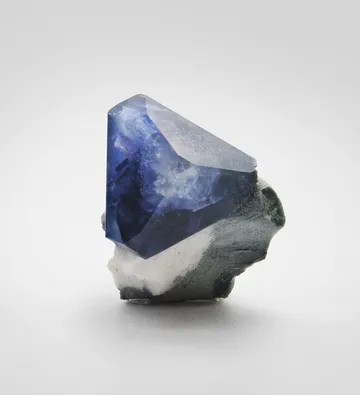
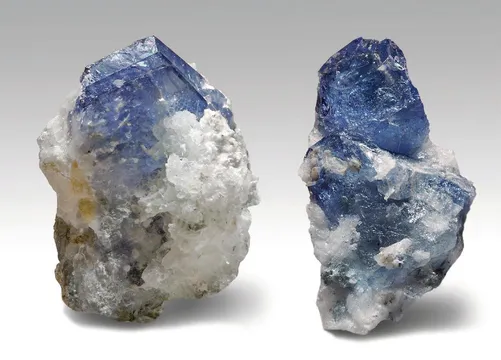
Benitoite - cristaux triangulaires d’un bleu indigo frappant provenant du comté de San Benito, une merveille à une seule localité avec de la natrolite et le statut de pierre précieuse d’État en Californie.
Key facts
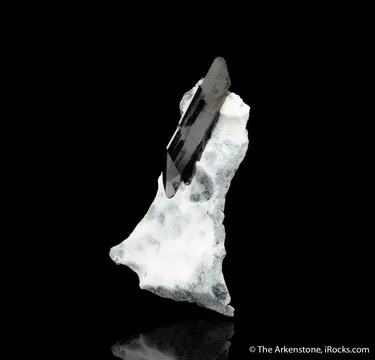
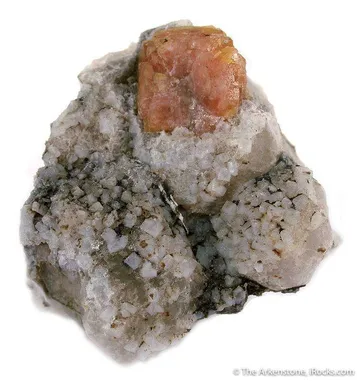
Le benitoite provenant du comté de San Benito est l’un des miracles minéralogiques locaux uniques en Amérique : un cyclosilicate titanate de baryum bleu, BaTiSi3O9, dont les plus beaux cristaux et pratiquement tout le matériel gemme commercial provenaient d’une petite zone minéralisée dans le district d’Idria Nouvelle des Montagnes Diablo. Un bon spécimen a un aspect sans équivoque — cristaux triangulaires indigo à bleu saphir, posés sur la natrolite blanche, généralement avec des lames de néptunite noires et, dans les pièces les plus riches, de minuscules cristaux groupés de joaquinite couleur miel-brun. Le contraste visuel est si fort que même de petites vignettes sont reconnaissables par les collectionneurs expérimentés.

Photo : Wikimedia Commons
La locality classique est la Dallas Gem Mine, aujourd’hui mieux connue sous le nom de Benitoite Gem Mine ou California State Gem Mine, près du Santa Rita Peak à la source du San Benito River. Le gisement n’est pas une vaste zone gemme mais un corps minéralisé très restreint : blueschiste alteré de Franciscan en serpentinite, traversé par de fines veines riches en natrolite. Le Benitoite s’est cristallisé dans ces veines avant que la natrolite n’en remplisse et n’en recouvre les espaces ouverts. Le résultat est à la fois une bénédiction et une malédiction pour les collectionneurs. La natrolite a protégé les cristaux, mais elle les a aussi cachés ; de nombreux spécimens doivent être soigneusement gravés ou préparés mécaniquement pour révéler le benitoite bleu et la néptunite noire sous-jacents.

Photo : Wikimedia Commons
Historiquement, la locality compte bien au-delà de la collection gemme. George D. Louderback a reconnu le benitoite comme une nouvelle espèce en 1907 et a ensuite décrit en détail sa remarquable forme cristalline. Le Benitoite a fourni le premier exemple naturel de la classe cristalline tridigue-dipyramidale, une classe de symétrie qui avait été prédite mathématiquement bien avant qu’un exemple minéral réel ne soit connu. En 1985, la Californie a désigné le benitoite comme pierre précieuse officielle de l’État, un honneur approprié pour un minéral dont les plus beaux cristaux restent majoritairement liés au comté de San Benito.L’attrait du collectionneur repose sur plusieurs couches à la fois.Les meilleurs morceaux combinent une couleur bleue gemme, une forme triangulaire nette ou une dipyramide aplatie, et un placement attrayant sur la natrolite blanche. Des spécimens avec des provions noires lustre neptunite sprays ou lames ajoutent une seconde espèce signature. Les cristaux de benitoite plus gros sont rares : des cristaux autour de 1 cm sont déjà souhaitables, des cristaux autour de 2 cm sont importants, et des cristaux approchant plusieurs centimètres constituent des spécimens majeurs. Dans les gemmes, les pierres de plus de 1 carat sont rares, et les pierres propres, fortement colorées de plus de 2 carats sont exceptionnelles.
La Benitoite est aussi l’un des grands minéraux fluorescents. La Benitoite bleue brille communément d’un bleu vif sous lumière ultraviolet à ondes courtes, tandis que certaines zones plus pâles ou incolores peuvent montrer des réponses différentes sous UV à ondes longues. Cela rend une lampe UV à ondes courtes utile à la fois pour le dépistage sur le terrain et pour l’examen des spécimen préparés.

Photo : Wikimedia Commons## Specimens en vedette
Recherche d’échantillons : Voir tous les spécimens de benitoite du comté de San Benito, États-Unis
La source classique est la California State Gem Mine, historiquement la Dallas Gem Mine et plus tard la Benitoite Gem Mine, dans le district de New Idria, dans le comté de San Benito, Californie. La localité se situe près du Santa Rita Peak, à la tête du fleuve San Benito, dans une région reculée de la chaîne Diablo près de la frontière du comté de Fresno. Des publications plus anciennes situent la mine à environ 20 miles au nord-ouest de Coalinga et à une altitude d’environ 4 500 pieds; l’accès a toujours été difficile, avec de longs trajets sur des routes chaotiques, des portes privées, et plus tard des restrictions d’utilisation des terres liées au terrain ultramafique plus large de Clear Creek et de New Idria.
Géologiquement, le gisement est une occurrence de pierres fines et de spécimens hébergée par des blocs de blueschiste tectoniquement enclavés dans le serpentinite. La zone porte-bénitoite est altérée hydrothermally blueschist coupé par de fines veines de natrolite, dont beaucoup sont moins de quelques centimètres d’épaisseur. La benitoite, la neptunitite, les minéraux du groupe de joaquinite, l’albite, l’apatite, le jonesite, des pseudomorphes de silice après la serandite, et des sulfures de cuivre apparaissent sur ou près des parois des veines. La natrolite est arrivée tard dans la séquence et engloutit fréquemment les cristaux formés plus tôt. Cette paragenèse explique pourquoi les meilleures pièces de la localité nécessitent souvent une préparation: la face d’exposition peut être cachée sous la zeolite blanche, la boue et le schiste bleu-gris jusqu’à ce que la natrolite soit enlevée.
La première découverte est généralement attribuée au prospecteur J. M. Couch, qui bénéficiait du financement de R. W. Dallas. Les premiers récits contiennent des divergences quant à savoir si Couch seul ou Couch avec d’autres parties a fait la découverte, mais le poids du traitement historique ultérieur préfère Couch. Les cristaux bleus furent initialement considérés comme du saphir ou de la spinelle, et au moins une opinion précoce a écarté le matériau comme du verre volcanique. George D. Louderback, à l’Université de Californie, Berkeley, reconnut le minéral bleu comme nouveau pour la science en 1907. La Dallas Mining Company se constitua peu après, mit en place un camp et commença l’exploitation active en juillet 1907. Des cabanes, des enclos et du matériel minier furent acheminés depuis Coalinga par cheval et chariot.
La mine précoce développa une coupe à ciel ouvert et de faibles travaux souterrains. L’objectif était le minerai grossier plutôt que la préservation des spécimens, et cela eut des conséquences. Les cristaux bleus étaient souvent dissimulés comme des “boutons” sous la natrolite. Bien que l’acide chlorhydrique puisse dissoudre la natrolite sans nuire à la benitoite, le processus était jugé trop lent à l’époque initiale, de sorte que les cristaux et les nodules furent délogés à coups de marteau, de ciseau et même d’efforts mécaniques. De nombreuses plaques de spécimens exceptionnels ont probablement été détruites avant que la valeur des pièces intactes benitoite-neptunite-natrolite soit pleinement appréciée.Les opérations de la Primary Dallas Mining Company ont décliné au cours des premières années et n’étaient plus économiques en 1912. Le matériel a été mis aux enchères en 1913, et la propriété a reçu les documents de brevets miniers en 1917. Des années 1920 jusqu’au milieu du XXe siècle, la mine a connu des périodes de travail intermittentes, des locations, la collecte non autorisée, le bulldozerage des inventories, puis la reprise ultérieure des spécimens et des gemmes. Clarence Cole a détenu un bail de 1952 à 1967 et a agrandi la carrière historique. William “Bill” Forrest et Elvis “Buzz” Gray sont devenus des figures centrales lors de la récupération ultérieure, achetant finalement la mine à la famille Dallas en 1987.
La production moderne a été la plus systématique pendant la période Forrest et Gray puis lors de l’opération Collector’s Edge Minerals de 2000 à 2004. Le lavage mécanisé, le criblage et la récupération par jig gravitaire ont traité les matériaux élastique, colluvial, dépôts et veines. Les pièces plus grandes ont été examinées pour leur potentiel en spécimens; les fractions plus petites ont été passées au jig pour récupérer le bore dense Benitoite brut jusqu’à quelques millimètres. Collector’s Edge a exposé et exploité les systèmes de veines restants, a traité le matériel éduqué par l’érosion et a réclamé le site. À la fin de ce travail, les systèmes de veines originaux étaient effectivement épuisés en tant que source commerciale, bien que de petites quantités de matériel continuent d’être récupérées à partir des stocks de minerai issus des mines, des matériaux transportés et des inventaires de spécimens plus anciens.
L’accès à la collecte a changé de manière significative. La mine réelle n’est pas un lieu de collecte publique casual, et la collecte publique actuelle n’implique pas l’entrée dans les galeries minières. Benitoite Mining Company organise une expérience de fouille sur réservation près de Coalinga, où le minerai de la mine est amené à un champ de criblage. Les participants recherchent dans le matériel déversé plutôt que d’entrer dans les puits ou de creuser le lode d’origine. La société indique que les visiteurs peuvent trouver de la Benitoite, de la neptunite, de la joaquinite et de la natrolite; les outils sont fournis; la fouille est généralement une activité d’une journée; et la mine elle-même reste fermée au public pour des raisons de sécurité.
D’autres occurrences de Benitoite dans le district de New Idria incluent la réclamation Junnila, Mina Numero Uno, la réclamation Victor et la propriété Santa Rita Peak. La réclamation Junnila est notable car elle a produit une Benitoite de qualité gemme, bien que à une échelle bien moindre que la Dallas/Benitoite Gem Mine. Les autres occurrences du district sont scientifiquement importantes mais ont généralement donné des matériaux petits, plats ou microscopiques plutôt que les cristaux gemme classiques et les spécimens en matrice qui ont rendu le comté de San Benito célèbre.## Caractéristiques de la benitoïte du comté de San Benito, États‑Unis
La benitoïte du comté de San Benito est prisée pour une forme presque architecturale : cristaux triangulaires aplatis, tablettes en forme de coin et dipyramides ditrigonales qui peuvent apparaître comme deux triangles bleus encastrés dans de la natrolite blanche. De nombreux cristaux présentent un centre pâle ou presque incolore avec un bleu plus prononcé vers les bords; sous une bonne lumière, ce zonage donne aux cristaux de la profondeur plutôt qu’une couleur uniforme. Les meilleurs cristaux présentent un bleu violet saturé à moyen, une dureté vitreuse et une transparence suffisante pour refléter la couleur intérieurement.
Les cristaux typiques destinés à la collection sont petits. Des cristaux de quelques millimètres sont courants dans le matériel extrait, des cristaux de 5–10 mm forment des miniatures attrayantes et de petits éléments de cabinet, des cristaux de 1–2 cm sont très recherchés, et des cristaux dépassant 2 cm constituent des pièces significatives. Les plus grands cristaux documentés de la mine mesurent environ 5 cm de diamètre, mais de telles pièces sont des rarités extrêmes et ne représentent pas ce que les collectionneurs rencontrent habituellement. La plupart des pierres facettées sont également petites : le matériel commercial est communément inférieur à 1 carat, les pierres entre 1 et 2 carats sont rares, et les pierres de plus de 2 carats représentent une très faible fraction de la production.
La matrice classique est une natrolite blanche sur un schiste bleu-gris à verdâtre, avec des cristaux de néptunite noirs à noir-rougeâtre. La néptunite peut apparaître sous forme de prismes nets, de lames ou de cristaux bloc, et peut dominer l’équilibre visuel d’un spécimen. Les minéraux du groupe Joaquinite apportent de petits cristaux bruns, miel ou brun-orange ; leur présence constitue un avantage sérieux pour les collectionneurs de species. D’autres minéraux associés incluent l’albite, l’apatite, la glaucophane ou des amphiboles de type croisite, l’actinolite-tremolite, la Jonesite, des pseudomorphes de silice après le serandite, le djurleite, la digénite, la covellite, la pyrite, et plusieurs espèces plus rares ou localisées par la mine.
La qualité du spécimen dépend de plus que la taille du plus grand cristal. Les exemples les plus désirables présentent des cristaux de benitoïte nets et non endommagés avec une forte couleur bleue, des faces exposées mais non surgravées, un espacement attrayant et un contraste net avec la natrolite. Un seul cristal bleu isolé et parfait sur une matrice blanche peut surpasser un spécimen plus chargé avec de nombreux cristaux meurtris ou chalky. Les pièces comportant à la fois de la benitoïte et une néptunite bien formée sont particulièrement caractérisées ; les pièces qui ajoutent de la joaquinite visible sont plus complètes sur le plan minéralogique.La préparation est centrale pour l’apparence du matériel du comté de San Benito. De nombreux spécimens ont été à l’origine enchâssés dans la natrolite, et la méthode de préparation standard consiste en la dissolution acide de la natrolite, généralement avec de l’acide chlorhydrique dans des conditions contrôlées. Une bonne préparation laisse le benitoite et le neptunite en relief naturel tout en conservant suffisamment de natrolite blanche pour préserver l’esthétique de la localité. Une mauvaise préparation peut laisser des vides au motif gravé, des cristaux desserrés, exposer les contacts de manière maladroite, ou retirer trop de matrice. Les pièces d’autrefois présentent parfois plus de dégâts mécaniques car les premières extractions privilégiaient les pierres brutes et utilisaient des méthodes d’extraction destructrices.
En tant que gemmes, le benitoite du comté de San Benito se distingue par des indices de réfraction élevés, une forte biréfringence, une forte dispersion et une dichroïsme bleu à incolore. Il n’est pas le saphir, malgré l’identification initiale erronée. Il est plus tendre que le saphir et le quartz, environ 6 à 6,5 sur l’échelle de Mohs, et n’a pas de clivage important. Dans les pierres facettées, les collectionneurs recherchent la saturation, la brillance, l’absence d’extinction évidente, une impression nette face-coupée et une taille suffisante pour faire apparaître le feu de la gemme. Les pierres fortement colorées sont préférées, mais des petites pierres trop sombres peuvent perdre le jeu de lumière qui rend le benitoite spécial.
Sous lumière ultraviolette à ondes courtes, le benitoite bleu fluoresce généralement d’un bleu vif à bleu-blanc. Cette réponse est utile pour reconnaître de petits fragments dans les matériaux tamisés, mais la fluorescence à elle seule n’est pas un test d’authentification complet : la forme, le contexte de la localité, l’association minérale, la dureté, le comportement optique et, pour les pierres facetées, les tests gemmologiques professionnels comptent tous.## Notes du collectionneur
La première question avec le benitoite du comté de San Benito est l’intégrité locality. Les spécimens classiques doivent pouvoir être attribués à la mine de gemmes Dallas/Benitoite, à la mine d’État de gemmes de Californie, à la revendication Junnila, ou à une autre occurrence documentée à New Idria. Comme le benitoite de qualité gemme et de qualité spécimen est si fortement lié à ce district, des étiquettes vagues telles que « benitoite californien », « San Benito », ou « mine de Coalinga » méritent des éclaircissements. « Coalinga » se réfère souvent au site moderne de criblage public ou à une ville de service voisine plutôt qu’à la mine d’origine réelle dans le comté de San Benito.
Pour les spécimens en matrice, l’association est un indice d’authenticité important. Les pièces classiques authentiques présentent couramment du benitoite bleu dans de la natrolite blanche sur du blueschiste, avec du néptunit noir et parfois du joaquinite brun. Des « cristaux » bleus transparents, suspects, de grande taille, sans matrice convaincante, sans habitude triangulaire, sans historique de locality et sans support ultraviolet ou optique devraient être traités avec prudence. De petits cristaux lâches et des fragments gravés peuvent être légitimes, mais ils sont plus faciles à déformer qu’un spécimen en matrice bien documenté.
Le benitoite façonné doit être séparé du saphir, de la tanzanite, du zircon bleu, de la tourmaline bleue, de l’iolite, de la spinelle, du verre et des simulants bleus synthétiques par des tests gemmologiques. Les indices de réfraction élevés du benitoite, son biréfringence, sa dispersion, son fort dichroïsme et ses inclusions typiques le rendent facilement identifiable dans un laboratoire compétent. Le benitoite naturel de qualité gemme synthétique n’est pas une préoccupation pratique pour le marché des bijoux: le benitoite cultivé en laboratoire a été produit expérimentalement uniquement sous forme de minuscules cristaux incolores trop petits pour être facettés. Les simulants, cependant, sont toujours possibles lorsqu’une gemme bleue rare commande des prix élevés.
Les traitements sont limités mais mentionnables. Le traitement thermique des benitoites plus clairs a été rapporté pour produire des teintes orange à orangé-rose dans une petite proportion de matière; certaines pierres auraient échoué au chauffage parce que les inclusions se dilataient différemment du cristal hôte. Le benitoite naturel orange n’a pas été établi comme une couleur normale non traitée de la même manière que le bleu. Tout benitoite orange ou orange-pêche inhabituel doit être traité comme un candidat de laboratoire gemmologique, surtout s’il est tarifé comme couleur naturelle rare.
Les problèmes de condition sont fréquents. Les cristaux de benitoite peuvent être émoussés sur les arêtes, éraflés, en contact, gravés ou partiellement semblant dissous par la préparation. Les pointes et les bords triangulaires minces s’écaillent facilement pendant l’exploitation minière, les travaux acides, la taille, l’expédition et la manutention. La matrice de natrolite peut être friable, poreuse ou partiellement entaillée par la préparation acide, laissant des cristaux bien en valeur mais vulnérables. Le néptunite, bien que visuellement spectaculaire, peut aussi être cassé ou incomplet; l’absence de lames noires est courante sur les spécimens plus anciens.Ne pas nettoyer les spécimens de benitoite de manière casual. L’eau et une brosse douce peuvent être sûres pour les pièces stables, mais la préparation acide doit être laissée à ceux qui comprennent la natrolite, la neptunite, la benitoite et la matrice spécifique. L’acide chlorhydrique peut révéler des cristaux cachés, mais il peut aussi déstabiliser un spécimen, desserrer les cristaux et créer une apparence trop préparée. De nombreuses pièces de collection ont plus de valeur avec un équilibre naturel de natrolite et de cristaux exposés que si chaque morceau de matrice blanche est retiré de façon agressive.
La rareté est réelle mais inégale. De petits fragments, de minuscules cristaux et des pièces gravées modestes restent disponibles en raison de la production historique, des stocks plus anciens et du matériel moderne issu d’extraction. Des spécimens de matrice fins avec des cristaux bleus nets à l’échelle centimétrique sont rares. Les pièces de cabinet de premier ordre avec plusieurs Benitoites gemmes, une forte composition, une association avec la neptunite et une bonne conservation sont réellement rares et se vendent rapidement lorsqu’elles sont correctement évaluées. Des pierres facettées en dessous de 0,25 carat apparaissent régulièrement; des pierres propres et vives de plus d’1 carat sont nettement moins courantes; des pierres fines de plus de 2 carats sont des gemmes de collection élite.
La disponibilité actuelle sur le marché est mieux décrite comme une offre en flux faible, et non comme une exploitation commerciale active. Le filon historique est épuisé en tant que source majeure, mais le matériel préalablement miné, les vieux stocks préparés, les trouvailles de sites d’extraction et les collections testamentaires continuent d’alimenter le marché. Les acheteurs doivent s’attendre à des primes élevées pour une localité vérifiée, les étiquettes anciennes, une provenance notable de période de mine, l’association avec la neptunite ou la joaquinite, et des cristaux exceptionnellement nets.## Stories & Field Notes
L’histoire de la découverte commence dans la zone rude près des sources du fleuve San Benito, et non dans un bureau de joaillerie. J. M. Couch, financé par R. W. Dallas, prospectait dans le district de New Idria lorsqu’il tomba sur une petite zone éparse de cristaux bleus. La première hypothèse était compréhensible : saphir. Les pierres étaient bleues, brillantes, et à l’opposé des prospections habituelles du district en mercure, amiante et chromite. Des échantillons passèrent rapidement des collines à Coalinga puis entre les mains de joailliers et de minéralogistes. Un premier expert aurait déclaré que le matériau était « du verre volcanique ». Un lapidaire qui tailla une pierre précoce la trouva trop tendre pour le saphir et supposa la spinelle. George Eacret de Shreve & Co. examina la pierre avec un dichroscope, observa la double réfraction et obtint un échantillon pour George D. Louderback à Berkeley.
Le rôle de Louderback transforma une prospection en une localité type. Il visita la mine le 19 juillet 1907, y revint le 11 octobre pour étudier la géologie, et revint encore le 12 août 1908, main caméra en main pour les photos qui appuieraient sa description complète. Il réalisa que le minéral bleu était nouveau. Il crut aussi au départ que le minéral noir associé était nouveau et proposa le nom « carlosite » d’après le proche San Carlos Peak, pour découvrir ensuite qu’il s’agissait de neptunite, déjà connue du Groenland. Le minéral bleu devint Benitoite, nommé d’après le comté de San Benito et le fleuve San Benito. Avec les travaux de Louderback, le petit dépôt en flanc de colline devint un repère en cristallographie : son morphotype ditrigonal-dipyramidal prouva l’existence naturelle d’une classe de cristaux qui avait été prédite des décennies plus tôt.
Les premières années à la Dallas Gem Mine furent une forme dure et improvisée d’exploitation gemmologique. La Dallas Mining Company construisit des cabanes et des enclos, transporta l’équipement sur des routes difficiles depuis Coalinga à cheval et en chariot, et commença l’exploitation active en juillet 1907. Un certificat d’action daté de février 1907 subsiste dans des comptes publiés, ainsi que de vieilles photographies de la cabane, du camp minier et des mineurs au portail. Les mineurs ouvrirent un petit tunnel dans le blueschiste et firent s’ouvrir la colline. Dans les comptes de l’entreprise, le « rough » n’était pas décrit en carats mais en contenants ordinaires : des « pots de quart » et des « boîtes à cigares » de matériel gemme bleu envoyé au bureau de Dallas à Coalinga.
La grande tragédie de la mine précoce réside dans le nombre d’échantillons probablement perdus avant que les collectionneurs ne comprennent ce que la localité pouvait produire. Les cristaux de Benitoite étaient couramment enterrés sous natrolite. Au lieu de dissoudre patiemment la natrolite, les premiers travailleurs cassèrent les protubérances qui cachaient les cristaux, utilisant le marteau et le ciseau et parfois des méthodes plus violentes. Ce faisant, ils sauvèrent des morceaux de gemme brute et détruisirent des plaques qui seraient aujourd’hui des spécimens minéralogiques de niveau musée. Des comptes ultérieurs suggèrent que des centaines, peut-être des milliers, de beaux groupes de cristaux ont pu être brisés de cette manière avant que les préparations acides ne deviennent courantes.Après le premier boom, la mine est tombée dans une longue après-vie de baux, d’adolescents, de bulldozers et de collectionneurs persévérants. Des années 1920 aux années 1940, il y eut peu d’activité formelle, mais les travaux non autorisés se poursuivaient. Deux noms se démarquent dans la légende : Edward Swoboda et Peter Bancroft, rappelés comme des adolescents entreprenants qui travaillaient la localité à la fin des années 1930. Une photographie du jeune Peter Bancroft à la Gem Mine en 1938 est devenue une partie de l’histoire visuelle de la localité. Plus tard, Miller Hotchkiss apporta un bulldozer pour retravailler les rejets, et Clarence Cole utilisa à la fois un bulldozer et de la dynamite pour agrandir l’ancienne fosse. Gerold Bosley, soutenu par Josephine Scripps, exposa davantage de la fosse ouverte près des vieux tunnels. Bosley trouva peu de pierres brutes précieuses mais récupéra des spécimens minéraux notables, rappel que la mine avait déjà changé d’outil productif de gemmes à localité de collection.
L’ère Forrest et Gray apporta une approche plus systématique. Le matériel était lavé, tamisé et passé au travers de séparateurs gravitaires. Les pièces grandes étaient vérifiées pour leur potentiel de spécimen; les pièces mesurant de quelques millimètres à environ un pouce entraient dans le circuit de récupération; le benétoïte plus lourd était piégé et retiré à la main en fin de journée. À la fin des années 1980, une pièce de matière brute fut récupérée et tailla une gemme de 10,47 carats. La plus fine matière brute rapportée vers le milieu des années 1990 donna une pierre de 15,42 carats. Ce sont des cas exceptionnels. Les mêmes études de production montrent que la majorité des benitoite taillés est bien plus petite, avec l’immense majorité en dessous d’1 carat.
Au printemps 1997, alors que le matériel colluvial et éluvial plus ancien semblait largement épuisé, des machines plus grandes exposèrent une extension occidentale en affaissement du gisement sous jusqu’à 10 mètres d’eluvium non consolidé et de matériaux de dépôts. La nouvelle zone produisit à la fois du minerai de loup et du matériel altéré avec une abondante matière brute gemme. Pour les collectionneurs qui suivent les historiques de localité, cette extension de 1997 est un chapitre important : une dernière impulsion significative avant que l’opération Collector’s Edge n’ait traité les matériaux restants de manière moderne et systématique et que la vie commerciale du système veineux original ne soit effectivement close.
La fouille moderne publique a sa propre histoire de terrain, différente. Les visiteurs ne rampent pas dans l’ancienne mine ni ne dynamitent la veine; l’oxa est acheminé vers un champ de tamisage près de Coalinga. Les gens s’assoient au soleil avec des tamis, de l’eau, des seaux et des lampes ultraviolettes, à la recherche de minuscules cristaux bleus, de néptunit noir et de morceaux de natrolite blanche. L’orientation même de la société minière est réaliste : la plupart des gens trouvent quelque chose, mais trouver quelque chose de bon est le truc, et environ une personne sur vingt visiteurs repart avec une pierre de valeur. Ce ratio reflète la nature de la collecte de benitoite aujourd’hui. La localité est célèbre, accessible de manière limitée et encore capable de ravir — mais elle n’est pas généreuse.## Registres et publications minéralogiques
George D. Louderback et Walter C. Blasdale, “Benitoite, a New California Gem Mineral,” University of California Publications, Bulletin of the Department of Geology, 5, 149–153, 1907 — La description originale succincte du benitoite en tant que nouveau minéral.
George D. Louderback, “Benitoite, Its Paragenesis and Mode of Occurrence,” University of California Publications, Bulletin of the Department of Geology, 5, 331–380, 1909 — La description classique sur la localité et la paragenèse, célèbre pour documenter l’étrange symétrie cristalline du benitoite.
Brendan M. Laurs, William R. Rohtert, et Michael Gray, “Benitoite from the New Idria District, San Benito County, California,” Gems & Gemology, Fall 1997 — Étude moderne essentielle gemmologique, géologique, de production et d’histoire du Benitoite Gem Mine et des occurrences du district.
William S. Wise et Robert H. Gill, “Minerals of the Benitoite Gem Mine,” The Mineralogical Record, 8(6), 442–452, 1977 — Traitement minéralogique clé de la suite complexe d’espèces de la mine.
J. Laird et A. L. Albee, “Chemical Composition and Physical, Optical and Structural Properties of Benitoite, Neptunite and Joaquinite,” American Mineralogist, 57, 85–102, 1972 — Travail analytique important sur les trois silicates de titane signature de l’occurrence de New Idria.
Wise and Pabst, “Jonesite: a New Mineral from the Benitoite Gem Mine, San Benito County, California,” The Mineralogical Record, 8(6), 453–456, 1977 — Description type de la jonesite, l’une des rares espèces liées à la paragenèse de Benitoite Gem Mine.
California Geological Survey, “Benitoite: California’s State Gem,” CGS Note 11 — Résumé géologique officiel de l’État couvrant la découverte, le statut de pierre précieuse d’État, la couleur, la rareté et la forme cristalline.
Mindat locality page for the California State Gem Mine, Santa Rita Peak, San Benito County, California — Enregistrement actuel de la localité dans la base de données avec coordonnées, noms, liste des minéraux, références et photographies.
Natural History Museum of Los Angeles County benitoite specimen noted by the California Geological Survey — La page État-pierre précisée par le CGS illustre un spécimen de benitoite dans la collection NHM Los Angeles.
Smithsonian reference in Laurs, Rohtert, and Gray, 1997 — L’article note que le gemme de 7,6 carats illustrée par Louderback a été recassée plus tard à 7,53 carats et se trouve aujourd’hui à l’institution Smithsonian.## Vidéos et médias
Great Finds - Videos — Benitoite Mining Company — Page média officielle de la Benitoite Mining Company montrant les trouvailles notables du public lors de l’opération de tamisage.
Page YouTube de Benitoite Mining Company — La chaîne vidéo de la mine pour les trouvailles, le matériel du site d’exploitation et le contenu de collection publique.

_1_(47776437011).jpg)
