






Benitoite — California State Gem Mine, USA. Type locality; saturated blue crystals with natrolite and neptunite, high collector appeal and UV fluorescence.
Key facts
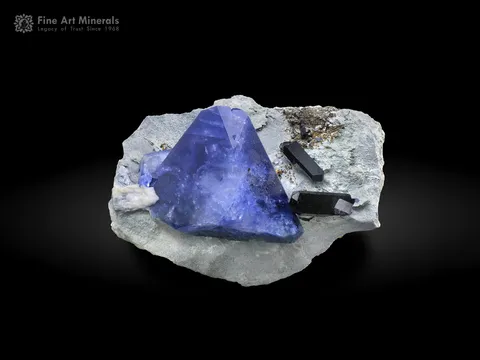
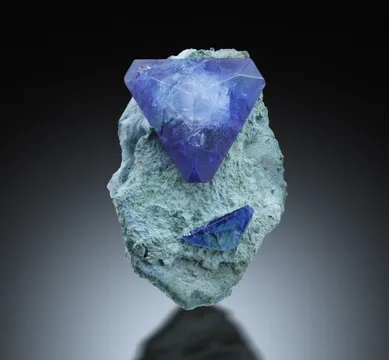
Benitoite from the California State Gem Mine is one of the few American mineral occurrences that can honestly be called unique. The best specimens carry sharp, triangular to tabular blue crystals of BaTi(Si3O9) set in snowy white natrolite, commonly with lustrous black-to-red-black neptunite and small honey-brown joaquinite-(Ce). The color is the first attraction: a saturated sapphire-to-violet blue that can be zoned, with pale or colorless centers and deeper blue rims. Under shortwave ultraviolet light, good benitoite responds with a strong chalky blue fluorescence, turning even modest fragments into unmistakable collector material.

Photo: James St. John / Wikimedia Commons
The locality is the type locality for benitoite and the great source of collectible and gem-quality material. Benitoite is known from other places, but the California State Gem Mine—the old Dallas Gem Mine, also called the Benitoite Gem Mine—gave the species its identity, its finest crystals, its gem supply, and its collector mystique. It lies in the New Idria district of the southern Diablo Range, near Santa Rita Peak and the headwaters of the San Benito River, where altered blueschist bodies occur within serpentinite. The specimen-forming veins are not ordinary alpine fissures or pegmatites; they are natrolite-rich veins cutting glaucophane blueschist in a serpentinite setting, a geological accident so particular that the world has never produced a comparable benitoite locality.
For mineral collectors, the classic piece is a prepared vein specimen: blue benitoite exposed in relief after removal of enclosing natrolite, with black neptunite spears and, when fortune is kind, orange-brown joaquinite. Small loose crystals and faceting fragments are more available than fine plates, but even these are locality-significant because almost all commercial gem benitoite came from this mine. The finest specimens combine crystal definition, saturated daylight color, bright shortwave fluorescence, minimal etching damage, and enough natrolite or blueschist context to make the association unmistakable.
Historically, the mine matters far beyond specimen aesthetics. Benitoite was first mistaken for sapphire, then recognized in 1907 by George D. Louderback as a new mineral species. In 1985, California designated benitoite as the official state gemstone. That honor belongs overwhelmingly to this locality: not to a district-wide abundance, but to one small, strange, exhausted-to-nearly-exhausted source that produced a mineralogical icon.
Search for specimens: View all benitoite specimens from California State Gem Mine, USA
The California State Gem Mine is in San Benito County, California, in the Santa Rita Peak area of the New Idria district. Collectors will encounter several names for the same famous source: California State Gem Mine, Benitoite Gem Mine, Benitoite Mine, Dallas Gem Mine, and simply the Gem Mine. Older labels reading “Dallas Mine” or “San Benito Co.” are common and should not be dismissed; they are part of the locality’s long paper trail.
Geologically, the deposit is a gemstone and specimen occurrence in which natrolite veins cut a glaucophane-rich blueschist inclusion enclosed in serpentinite. Benitoite mineralization is confined to altered blueschist, and the richest collectible material formed along fractures where benitoite, neptunite, joaquinite-group minerals, and other rare barium-titanium silicates developed before or with later natrolite filling. In many pieces the natrolite acted both as a gangue and as a protective plaster, covering delicate crystal faces until preparation exposed them.
The age relationship is striking. The enclosing Franciscan blueschist is much older, while the benitoite-bearing vein mineralization has been interpreted as Miocene, around 12 million years old. The crystals grew from a highly specialized alteration system involving blueschist, serpentinite, and metamorphic fluids that mobilized the necessary barium and titanium. This is why the mine cannot be understood simply as a “gem pocket” locality; it is a rare metasomatic product of a tectonically complicated Coast Range setting.
The mining history began in the early 1900s, when prospector J. M. Couch, grubstaked by R. W. Dallas, found blue crystals in the remote San Benito County hills while searching for other mineral prospects. The material was first suspected to be sapphire, but jewelers rejected that identification. Louderback’s work at the University of California established it as a new mineral, named benitoite for the San Benito region.
Early mining from about 1907 to 1912 produced much of the legendary gem rough and specimen material. A tunnel and open cuts followed the mineralized zone, and the Dallas Mining Company’s early account books became a key source for later production estimates. After the early boom the mine saw long pauses and intermittent leasing. M. Dunn reopened it in 1933. M. F. Hotchkiss later worked old dumps with a bulldozer, and Clarence Cole operated the locality in the 1950s and early 1960s. From 1967, Elvis “Buzz” Gray and Bill Forrest became the dominant modern mine figures, eventually purchasing the property from the Dallas family in 1987.
The late twentieth century brought more systematic exploration. Larger companies, including Kennecott, examined the property, and detailed mapping and testing clarified the geometry of the deposit. In spring 1997, a productive extension down slope from the historic pit yielded additional lode material, specimen boulders, and gem rough. Collector’s Edge Minerals, through Benitoite Mining Inc., then operated the mine from 2000 to 2004, processing old dumps, colluvium, eluvium, and remaining known vein material on a larger scale. Their work used washing, screening, gravity separation, hand picking, and magnetic separation to recover dense benitoite from the difficult clay-rich material.
That modern operation also changed the collecting landscape. Much of the known in-place vein system and old dump material was processed, and the mine site was reclaimed. Current public access is not free access to the historic workings. Collecting opportunities have instead been offered by the Benitoite Mining Company through reservation-based gem hunts and screened mine material, with visitors searching prepared or transported material rather than wandering the old mine. The area is also affected by serpentine and naturally occurring asbestos concerns, private property issues, agency restrictions, and the practical reality that the original rich veins are no longer an open collector’s playground.
Production has always been small in gem terms. Before 1967, estimates place faceted production at about 2,500 carats; from 1967 through the Forrest and Gray era, roughly another 2,000 carats of faceted benitoite were produced. Most finished stones were under one carat, and stones over two carats were exceptional. One of the most famous early stones, originally reported at 7.6 carats and later recut to 7.53 carats, entered the Smithsonian Institution. The largest documented cut stone from the mine literature is a 15.42-carat gem cut from rough recovered in the early 1990s.
California State Gem Mine benitoite is best known as flattened triangular crystals, pyramidal to tabular, belonging to the hexagonal system. The classic crystal looks like a blue triangular shield or wedge, often flattened on the c-axis. Fine specimens show bright vitreous to subadamantine luster, sharp edges, and saturated blue color concentrated toward the outer zones of the crystal.
Color is one of the locality’s signatures. Crystals may be colorless, white, pale blue, medium blue, violet-blue, pink, or zoned combinations of these. The most collectible crystals are richly blue in daylight and strongly fluorescent under shortwave ultraviolet light. Many show pale cores and deeper blue rims; in faceted stones, the same zoning may appear as a blue-to-colorless gradation depending on viewing direction. Benitoite is strongly dichroic, so orientation can make the same stone appear much bluer or much paler.
Crystal sizes vary widely, but most collectible crystals are small. Gemologically, rough crystals around 1 cm are typical, and cut stones commonly fall between 0.10 carat and 1 carat. Crystals around several centimeters are major specimens, and crystals approaching or exceeding 5 cm are exceptional. Large cabinet plates with multiple sharp blue crystals are far rarer than single loose crystals, fragments, or small etched matrix pieces.
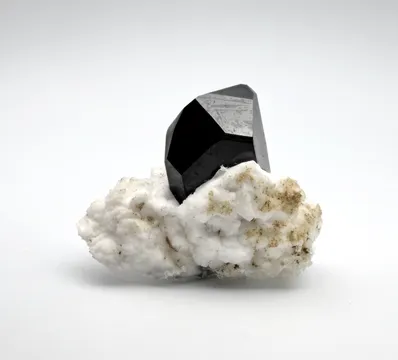
The principal associated minerals are natrolite, neptunite, joaquinite-(Ce), glaucophane or related blue amphibole, and serpentinite or altered blueschist matrix. Natrolite is the white vein-filling mineral that commonly encased the crystals. Neptunite forms elongated black to deep red-black prismatic crystals and is a major aesthetic companion. Joaquinite-(Ce), another type-locality species associated with the mine, appears as small honey-yellow to orange-brown crystals. Other recorded species from the mine include albite, aegirine, actinolite, calcite, aragonite, chrysotile, djurleite, chalcocite, covellite, digenite, fresnoite, jonesite, perovskite, barioperovskite, and several rare barium-titanium silicates.
Preparation is central to how these specimens look. Much classic material was originally embedded or partly embedded in natrolite. Dilute hydrochloric acid removes natrolite and leaves benitoite, neptunite, and other less soluble minerals standing in relief. This is not a deception; it is the standard preparation history of the locality. The best prepared pieces preserve crystal luster and matrix context without over-etching, bleaching away all visual geology, or leaving unstable natrolite residues.
Quality is judged differently for specimens and gems. For specimens, collectors prize saturated blue crystals, sharp triangular habit, natural-looking exposure, contrast with white natrolite, association with neptunite and joaquinite, and freedom from broken tips or etched, frosted surfaces. For gems, the premium factors are color saturation, brilliance, orientation, clarity, and size; because benitoite has dispersion comparable to diamond and high refractive indices, well-cut stones can be remarkably lively. But size is punishing: a clean, strongly colored stone over one carat is already significant, and multi-carat stones are elite.
Authenticity begins with locality context. Genuine California State Gem Mine specimens usually have some combination of blue benitoite, white natrolite, black neptunite, orange-brown joaquinite, and blue-gray blueschist or serpentinite matrix. Loose crystals and faceted stones require more care because they lack matrix evidence. Strong shortwave blue fluorescence, high refractive indices, strong dichroism, and the characteristic triangular habit are useful checks, but valuable stones should be handled like important gems: documentation from a competent gemological laboratory or a trusted mineral dealer matters.
Synthetic benitoite has been grown experimentally, but the documented laboratory crystals are minute, colorless, and too small for normal faceting. In the collector market, the larger concern is not a flood of synthetic benitoite but misidentification, simulants, fantasy labeling, and ordinary blue stones being represented as benitoite. Sapphire, blue spinel, tanzanite, iolite, blue zircon, tourmaline, glass, and other blue materials can confuse casual buyers, especially when offered as loose stones without reports.
Treatment is uncommon in the blue benitoite market. The literature notes that heating colorless material may rarely produce an orange hue, and some crystals can fail during heating. That makes orange or unusual-color benitoite a specialty purchase requiring disclosure and documentation. The standard blue California material is valued as natural, and any claim of enhancement should be treated seriously.
Condition issues are frequent. Benitoite is brittle, with conchoidal to uneven fracture and sensitivity to rapid temperature change and ultrasonic vibration. Specimens often have contacted backs, broken crystal edges, bruised tips, or acid-preparation frost. Natrolite can be massive, porous, and irregular; neptunite can snap; joaquinite is usually tiny and easy to overlook or damage. Avoid ultrasonic cleaners for benitoite jewelry, and avoid heat shock. For specimens, the safest care is dry display, gentle dust removal, and no experimental acid work unless one has real experience with the locality’s preparation problems.
Rarity is structural, not fashionable. The main vein systems have been heavily mined, the historic dumps were reprocessed, and modern public collecting is based on limited material rather than a newly opened bonanza. Small crystals, etched fragments, and modest matrix pieces still appear regularly. Fine cabinet specimens with multiple saturated crystals, sharp neptunite, attractive natrolite contrast, and good provenance are much less available. Top gem stones, especially above one carat with strong color, remain collector gems rather than ordinary jewelry goods.
Labels deserve attention. Older specimens may be labeled Dallas Gem Mine, Dallas Mine, Benitoite Mine, Gem Mine, San Benito River headwaters, Santa Rita Peak, or New Idria district. These names often refer to the same classic source, but similar-looking material from nearby claims such as Junnila or Mina Numero Uno should not be collapsed into the California State Gem Mine without evidence. Provenance to old collections, early dealers, Collector’s Edge material, or documented mine lots can add meaningful value.
The discovery story begins with the wrong gem in the right hands. J. M. Couch was prospecting in the remote hills of San Benito County, grubstaked by R. W. Dallas, when he encountered blue crystals that looked promising enough to hurry back toward Coalinga. The first hope was sapphire. That misidentification is easy to understand: rich blue, bright, transparent material in a rugged California mining district would tempt almost anyone toward the familiar gem name. But the stones refused to behave like sapphire, and the puzzle reached George D. Louderback at the University of California.
There was controversy almost immediately over who deserved discovery credit. Louderback’s earliest note credited L. B. Hawkins and T. E. Sanders, but his fuller 1909 account shifted the story toward Couch, the prospector Dallas had grubstaked. The words preserved in the literature are wonderfully human: Dallas “induced” Hawkins to accompany Couch back into the mountains, and when the party reached the deposit, “each claims to be responsible for the discovery.” Later family accounts, especially Oscar Couch’s The Benitoite Story, pressed the claim that J. M. Couch alone should be remembered as the discoverer. In a locality whose crystals can be separated by a few millimeters of natrolite, even the credit for first sight became a contested vein.
Louderback’s visits gave the mineral its scientific life. He first visited the mine on July 19, 1907, returned on October 11 to study the geology, and came again on August 12, 1908, with Eacret to make photographs for his major 1909 paper. The crystallographic importance was not just that the mineral was new; benitoite’s ditrigonal-dipyramidal symmetry provided a spectacular natural example of a crystal class that mineralogists had treated with special interest. A little blue “sapphire” from a California hillside had become a mineralogical event.
The early commercial race had its own drama. Once word of a new blue gem spread, George F. Kunz of Tiffany & Co. was among those who rushed to secure control of the material. The marketing rights, however, went to G. Eacret of Shreve & Company in San Francisco. R. W. Dallas built a mine camp, and early operations attacked the hillside by open cut and tunnel. For about five years, the blueschist layer yielded thousands of gems and specimens, enough to establish benitoite’s reputation but not enough to make it common.
One of the most memorable episodes is the benitoite and diamond necklace. Forrest and Gray, working dumps in the early 1970s with water pumped uphill through a fire hose, recovered good faceting rough by washing and hand-picking mineralized material. Among the stones from that period was a flawless 6.53-carat pear-shaped brilliant, used as the center stone of a pendant on a necklace containing 52 faceted benitoites totaling about 33 carats. The largest necklace stone was 2.84 carats. The necklace was stolen in Europe in 1974 and recovered in 1975, but the pendant—the one with the 6.53-carat center stone—was never found.
The mine also produced one of the great “what lies under the white crust?” moments in American specimen mining. On May 1, 1997, a remarkable boulder from a newly found extension of the deposit was excavated. Natrolite covered an area about 40 cm by 70 cm on the boulder. To the untrained eye, that white coating might have seemed like little more than massive zeolite. To miners who knew the deposit, knobs on the natrolite surface could signal hidden benitoite and neptunite attached to the vein wall beneath. Several gem-quality pieces came from that find, a reminder that the mine’s best specimens were often invisible until the natrolite was removed.
The Collector’s Edge years turned a small historic mine into a carefully engineered recovery problem. The company processed roughly 30,000 yards of material, including about 20,000 yards of old dump material. Early equipment handled about 25 to 30 tons per day; later, a powered screening plant reached a capacity around 150 tons per day. Material went through washing, screening, jigs, hand picking, and magnetic separation. The mud was sticky enough to form balls that could carry gem material over the end of the conveyor, so material had to be run again. Even organic debris mattered, because it clogged spray nozzles. In that operation, blue gem rough was not found by romance alone; it was teased from clay, water jets, screens, density, magnets, and patient human eyes watching a belt.
_5_(49144211126).jpg)