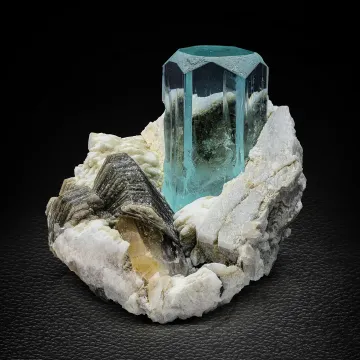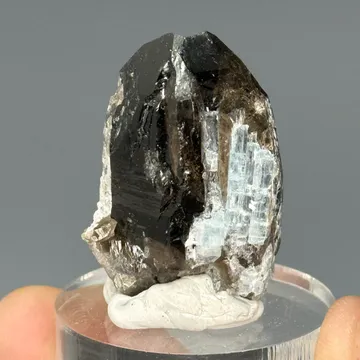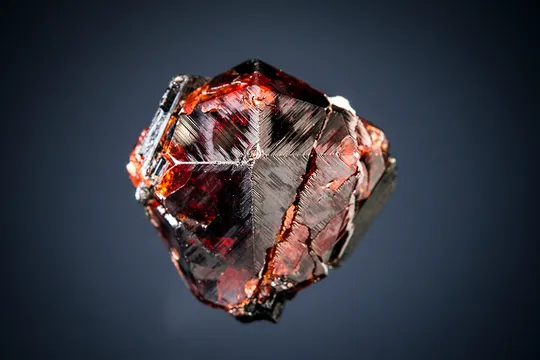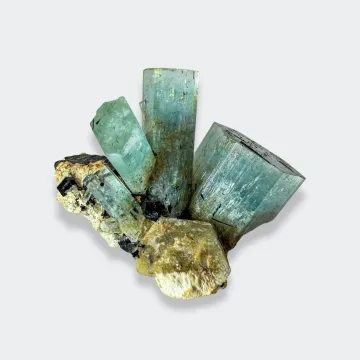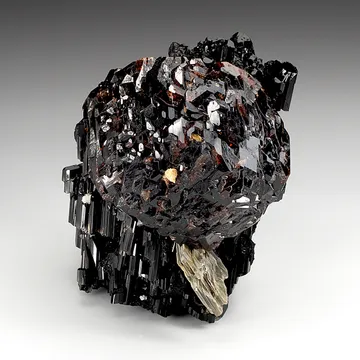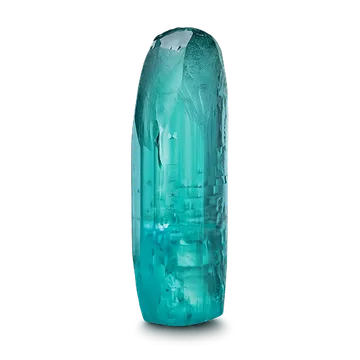
Aigue-marine du district de Shigar, Pakistan - béryl bleu des pegmatites himalayennes, avec des prismes hauts et architecturaux parmi l’albite et la mica, prisée par les collectionneurs.
Key facts
L’aquamarine du district de Shigar occupe une place particulière dans la collection moderne de spécimens, car elle combine l’attrait gemme du béryl fin avec le drame sculptural des poches pegmatitiques himalayennes. Les meilleures pièces ne sont pas de simples cristaux bleus isolés; ce sont des compositions minérales complètes — aquamarine pâle à bleu ciel érigée sur de l’albite blanche ou de la microcline, flanquée de schorl noir, de muscovite argentée, de quartz fumé ou incolore, et, dans des pièces d’exception plus rares, de grenat spessartine-almandin rouge. L’effet peut être architectural : de hauts prismes hexagonaux vitrifiés qui émergent d’une base feldspathique lumineuse, souvent avec des terminaisons évasées ou légèrement en gradins et une fraîcheur qui donne l’impression que les cristaux sont éclairés de l’intérieur.
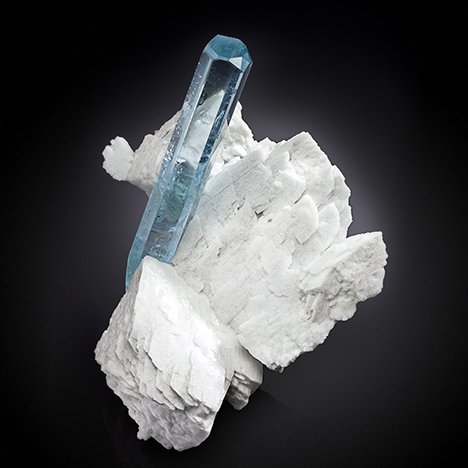
Photo : GIA Gems & Gemology
L’aquamarine du district est le produit de pegmatites granitiques porteuses de gemmes dans le haut Karakoram. Les principaux gisements se situent dans et autour des vallées de Shigar et Braldu, incluant des noms qui reviennent sur les étiquettes des collectionneurs : Shigar Valley, Dassu, Yuno, Mungo, Kashmal, Goand, Goyungo, Nyet Bruk, Baha et les occurrences liées de la vallée de Braldu. Il ne s’agit pas de localités de type « mine » au sens net d’une carrière ou d’un droit minier clôturé. Ce sont un district montagneux de corps pegmatitiques escarpés, de petites mines saisonnières, des tunnels contrôlés par des familles ou des villages, et des routes commerciales qui passent souvent par Skardu, Peshawar, Tucson, Sainte-Marie-aux-Mines et l’extrémité supérieure du marché international des minéraux.
Minérologiquement, l’aquamarine du district est du béryl, Be3Al2Si6O18, coloré par le fer. Les cristaux du district présentent typiquement un aquamarine à faible teneur en alcalinité plutôt qu’un béryl irradié de type Maxixe, et le matériau classique est bleu clair, bleu verdâtre, bleu pâle ou presque incolore dans certaines zones. Nombreux cristaux affichent l’habitus prismatique hexagonal long que les collectionneurs associent au Pakistan : des “crayons” élancés, des prismes gemmes robustes, des flottants doublement terminés et des groupes de matrice où l’aquamarine est perchée naturellement parmi l’albite, la microcline, la muscovite et le schorl.
Historiquement, la localité est passée d’une source attractive de cristaux gemmes lâches à l’une des principales sources modernes mondiales de spécimens de matrice d’aquamarine fine. Cette transition importe. Les aquamarines pakistanaises plus anciennes étaient couramment extraites comme cristaux uniques, et de nombreuses pièces superbes perdaient leur matrice avant que quiconque dans la chaîne d’approvisionnement n’évalue l’esthétique complète du spécimen. Au cours des deux dernières décennies, de meilleures méthodes d’extraction, des mineurs sensibilisés aux spécimens et l’utilisation de scies à diamant ont aidé à préserver des groupes de poches plus importants. La découverte de l’illustre « Roi du Kashmir » de l’aquamarine en 2019 a démontré, de manière spectaculaire, ce que le district de Shigar peut produire lorsque une grande poche est récupérée en ayant à l’esprit des spécimens minéraux — et non seulement des roches gemmes — comme objectif.Pour les collectionneurs, l’attrait est large mais exigeant. Une bonne aquamarine de Shigar doit présenter une couleur bleue nette, un lustré vitreux soutenu, une terminaison naturelle nette et un style de localité crédible. Une excellente pièce ajoute l’équilibre: le cristal doit sembler naturellement inséré, et non simplement attaché; la matrice doit le soutenir et l’encadrer; et les minéraux associés doivent contribuer au contraste sans dominer le cristal principal. Le plus haut niveau est occupé par des groupes de matrice intacts avec un bleu saturé, des cristaux gemmeux, une esthétique naturelle et une provenance transparente à travers un vendeur respecté, une collection, une publication ou une trouvaille minière.## Specimens en vedette
Recherche d'échantillons : Afficher tous les échantillons d’aquamarine du district de Shigar, Pakistan
Le district de Shigar se situe au Gilgit-Baltistan, dans le nord du Pakistan, au cœur du haut Karakoram, au nord et au nord-est de Skardu. Dans l’usage des collectionneurs, « Shigar » peut désigner de manière étroite la vallée de Shigar, de manière plus large le district d’échantillonnage Shigar–Skardu, ou les occurrences situées dans le district administratif de Shigar, y compris les localités de la vallée de Braldu. Cette histoire d’étiquetage est importante : les échantillons plus anciens peuvent porter les mentions « District de Skardu », « Vallée de la Shigar River », « Northern Areas », « Baltistan », ou simplement « Pakistan », même lorsqu’ils provenaient de ce qui est aujourd’hui reconnu comme le district de Shigar. Les collectionneurs sérieux devraient préserver les anciens étiquetages mais, lorsque cela est possible, ajouter une clarification de localité moderne plutôt que de remplacer l’ancienne formulation.
Les gisements d’aquamarine sont des pegmatites granitiques porteuses de gemmes, dont beaucoup sont zonées et localement miarolitiques. En termes simples, les meilleures aquamarines ont poussé dans des cavités ouvertes ou des cavités internes au sein de zones de pegmatite grossière, où des fluides magmatiques-hydrothermaux tardifs ont permis le développement de cristaux bien formés dans les espaces ouverts. Des travaux de terrain et d’analyse sur les pegmatites de la vallée de Shigar décrivent des corps simples et complexes ou zonés, avec de la béryl de qualité gemme concentré près du cœur–marge et des zones porteuses de cavités. Le même système pegmatitique produit ou accueille du topaze, de la fluorite, de la tourmaline, du grenat, de l’apatite, du quartz, de la muscovite, du feldspath et d’autres minéraux, bien que toutes les espèces n’appartiennent pas au même épisode génétique ou à la même environment de poche.
Les roches hôtes appartiennent au cadre métamorphique et igneux complexe du Karakoram. Des publications sur le district décrivent des corps de pegmatite qui s’infiltrent dans des roches métasédimentaires et méta-igneuses du Complexe métamorphique du Karakoram; des travaux pétrogenétiques plus récents mettent l’accent sur des pegmatites granitiques péralumineuses de type S issues de la fusion partielle de roches méta-pelitiques pendant le tectonisme post-collisionnel, plutôt que sur un simple lien direct avec des unités plutoniques voisines. Pour le collectionneur, le résultat pratique est visible dans les échantillons : poches de pegmatite riches en feldspath, matrice blanche contrastante d’albite ou de microcline, tourmaline noire et les précieux cristaux bleus de béryl qui se sont formés dans des cavités ouvertes en fin de chaîne.
L’exploitation minière est à petite échelle, saisonnière et exigeante sur le plan topographique. Nombre d’exploitations sont atteintes par des sentiers escarpés, des traversées de falaises à l’aide de cordes, ou des tunnels creusés dans des veines de pegmatite exposées en hauteur au-dessus des étages de la vallée. À des altitudes plus basses, certains travaux peuvent se poursuivre pendant une grande partie de l’année, mais les travaux les plus hauts et les plus productifs sont contraints par la météo, la neige, l’accès et la courte saison montagneuse. La production est donc par pulsations : une poche s’ouvre, des échantillons apparaissent entre les mains locales, un marchant ou un courtier assure les meilleures pièces, et le matériel s’écoule sur le marché international sous des mentions qui peuvent évoquer la vallée de Shigar, Dassu, Goand, Nyet Bruk, Goyungo, la vallée de Braldu ou Skardu.L’accès à la collecte moderne n’est pas une collecte de terrain décontractée dans le sens occidental. Il s’agit de zones minières actives avec propriété locale, accords de location, revendications familiales et terrain périlleux. Les visiteurs ne doivent pas s’attendre à entrer dans des filons de pegmatite et à collecter. Les spécimens sont normalement acquis par l’intermédiaire de mineurs pakistanais, de marchands locaux, de négociants de Skardu ou de Peshawar, et de marchands internationaux de minéraux. Le chemin de collecte le plus sûr et le plus éthique passe par des vendeurs réputés qui peuvent expliquer la traçabilité et qui divulguent les réparations, la restauration, la stabilisation et toute incertitude concernant la localité.
Des trouvailles notables ont façonné la réputation du district. La vallée de Shigar a longtemps produit des cristaux gemmes détachés et des spécimens en matrice, mais la Pocket Aqua-Garnet de Dassu en 2018 et la pocket “King of Kashmir” dans la zone de la vallée du Braldu en 2019 ont fait monter considérablement le statut du district. La Pocket Aqua-Garnet a donné des associations d’aquamarine exceptionnelles avec de l’émeraude rouge, du quartz, de l’albite, du feldspath et de la muscovite. La découverte “King of Kashmir” a produit un immense groupe d’aquamarine, quartz, albite et microcline provenant d’une poche profondément enfouie dans la montagne; son extraction est devenue un épisode marquant dans l’exploitation minière consciente des spécimens au Pakistan.## Caractéristiques de l’aquamarine du district de Shigar, Pakistan
Le cristal aquamarine classique du district de Shigar est un prisme hexagonal : droit, vitreux, à les arêtes nettes et souvent élégant plutôt que volumineux. Les prismes peuvent être longs et fins comme un crayon, robustes et gemmeux, ou regroupés en gerbes divergentes. Les terminaisons vont de capuchons plat pinacoidal à des modifications biseautées et pyramidales, parfois avec des caractéristiques de croissance en gradins. Des cristaux à double terminaison et des flottants existent et sont particulièrement recherchés lorsqu’ils restent intacts et se sont naturellement ré-entonés ou cristallisés sur le dos.
La couleur est généralement bleue pâle à moyenne, bleu verdâtre ou bleu glacier. De nombreux cristaux sont de tonalité claire, mais les meilleurs exemples présentent suffisamment de saturation pour paraître bleus même sans fort rétroéclairage. Le zonage est courant : un cristal peut être plus saturé au travers du prisme central et plus pâle ou quasi sans couleur près de la terminaison, ou il peut afficher une lueur d’axe c bleu lorsqu’on le regarde le long de la longueur du cristal. Le béryl incolore, ou goshenite, se rencontre aussi dans le même district, donc du matériel presque incolore ne doit pas être automatiquement commercialisé comme aquamarine à moins qu’une couleur bleue ou bleu-verte définie soit présente.
La transparence est l’un des atouts du district. De nombreuses aquamarines de Shigar vont de translucides à transparentes, et les meilleurs cristaux peuvent être de qualité gemme sur une grande partie de leur longueur. Des voiles internes, des tubes de croissance, des fractures partiellement guéries, des inclusions de fluide et des zones basales troubles sont suffisamment courants pour être attendus, en particulier dans les cristaux plus volumineux. Un cristal clair comme du verre dans la section supérieure mais légèrement givré, inclus ou en contact à la base est typique des bons spécimens en matrice du district.
La matrice est centrale pour la valeur. Les combinaisons les plus reconnues sont l’aquamarine sur albite blanche ou cleavelandite, l’aquamarine sur microcline ou orthose, et l’aquamarine avec schorl. La muscovite ajoute scintillement et texture, surtout lorsqu’elle forme des plaques brillantes ou des rosettes autour de la béryl. Le quartz peut apparaître sous forme de cristaux clairs, fumés ou pâles, parfois en équilibre visuel avec l’aquamarine. La fluoroapatite, la topaze, la fluorite, l’elbaïte, le grenat, les minéraux columbite-tantalite et d’autres espèces de pegmatite ont été enregistrés dans le district élargi, bien que tous ne soient pas courants dans les pièces d’aquamarine de haute qualité exposées.
Les fourchettes de taille sont larges. Les échantillons d’étude et les rocailles gemmes peuvent mesurer seulement 1–2 cm de long, tandis que les cristaux de collection ordinaires se situent couramment entre quelques centimètres et des spécimens de taille main. De fines pièces de matrice avec des aquamarines dans la plage 5–15 cm constituent une raison majeure pour laquelle ce lieux est célèbre. Les gros spécimens de cabinet, y compris des exemples publiés mesurant des dizaines de centimètres, sont rares et peuvent entrer dans le domaine des minéraux trophées. Les plus grands regroupements de poches préservées sont des pièces historiques exceptionnelles plutôt que des productions représentatives.Les meilleurs aquamarines de Shigar présentent un aspect particulier : un bleu ciel pâle, semblable à du verre, sur une base blanche et scintillante de pegmatite, généralement avec de l’eschol noir comme contraste. Par rapport à de nombreuses aquamarines antiques brésiliennes, les pièces de Shigar sont souvent plus claires en tonalité mais plus accessibles en tant que spécimens élégants en matrice. Par rapport à certains matériaux de Nagar, les exemplaires de Shigar sont souvent prisés pour des cristaux plus nets, plus proches du verre et une esthétique bleue plus propre, bien que les deux districts aient produit des spécimens importants. Le marché privilégie la couleur, la clarté, l’éclat, la terminaison, le placement naturel, l’équilibre de la matrice, la taille et l’absence de réparation, à peu près dans cet ordre — bien qu’une pièce de grande matrice puisse privilégier l’esthétique à la gemme brute.## Notes du collectionneur
L’aquamarine du district de Shigar est largement disponible sur le marché des spécimens, mais la répartition de la qualité est enormous. De petits cristaux séparés, des prismes cassés, des tiges de béryl pâles et des morceaux de matrice modestes sont courants. De beaux cristaux bleus, intacts et se terminant nettement sur une matrice naturelle attrayante, sont beaucoup moins fréquents. de grands spécimens de cabinet avec plusieurs aquamarines gemmes dans une composition équilibrée sont véritablement rares, et les meilleurs exemplaires avec une provenance publiée ou une histoire de poche célèbre sont des minéraux de niveau élite.
Les questions d’authenticité se divisent en plusieurs catégories. La première est l’imprécision de localité. De nombreux spécimens sont vendus comme « Shigar », « Skardu » ou « Pakistan » sans précision au niveau de la mine. Ce n’est pas automatiquement trompeur ; l’historique commercial des pegmatites du nord du Pakistan est rempli d’étiquettes générales car les mineurs et les négociants n’enregistraient pas ou ne divulgaient pas les détails des travaux exacts. Cependant, un vendeur qui affirme une pocket, une mine ou une trouvaille célèbre devrait pouvoir expliquer pourquoi cette attribution est crédible.
La deuxième préoccupation est la construction. L’aquamarine sur albite blanche ou muscovite est un style Shigar qui existe naturellement, mais c’est aussi un style qui peut être faux en collant des cristaux détachés sur une matrice de pegmatite réelle. Examinez soigneusement le contact à faible magnification et à la lumière UV. Signes d’alerte: une base de cristal qui n’entre pas en contact ou n’intergresse pas avec la matrice, remplissage artificiel, adhésif brillant dans les crevasses, flocons de mica dispersés placés autour de la base pour masquer la colle, ou un spécimen dont le poids et l’équilibre n’ont pas de sens géologique. Les réparations ne sont pas intrinsèquement disqualifiantes sur des spécimens minéraux haut de gamme, mais elles doivent être divulguées. Un cristal réparé ramené à son contact d’origine est très différent d’une association fabriquée.
La troisième préoccupation est la restauration et la stabilisation. L’histoire du « Roi du Cachemire » elle-même montre que la préparation légitime des spécimens peut impliquer un nettoyage minutieux, l’ajustement de cristaux naturellement détachés dans des sockets correspondants, la stabilisation locale par résine des fissures et une coupe professionnelle. Pour les pièces de grande valeur, demandez si le spécimen est non réparé, réparé, restauré, stabilisé ou reconstruit. La différence peut valoir une grande somme d’argent.
Le traitement de la couleur est un autre enjeu, bien que moins souvent documenté pour les spécimens matriciels que pour l’aquamarine facettée. L’aquamarine ordinaire peut être chauffée dans le commerce des pierres précieuses pour améliorer la couleur bleue en réduisant les tons verdâtres ou jaunâtres, et le béryl bleu peut également être confondu avec du matériau Maxixe irradié. Des tests publiés sur les aquamarines de la vallée de Shigar ont trouvé une couleur liée au fer compatible avec l’aquamarine naturelle plutôt que l’irradiation Maxixe dans les échantillons analysés. Pourtant, un matériau étonnamment sombre, électrique ou étrangement uniforme doit être examiné attentivement, surtout s’il est proposé comme pierre brute séparée ou comme cristal « trop beau pour être vrai ».Les problèmes de condition sont prévisibles pour la béryl issue de poche. Les pointes s’écaillent facilement, les arêtes du prisme bruissent, et les contacts basaux peuvent être rugueux lorsqu’un cristal s’est détaché de la paroi de la poche. De nombreux cristaux présentent des contacts naturels où feldspath, mica ou d’autres minéraux les touchaient autrefois; ce ne sont pas des dommages s’ils restent des caractéristiques de croissance, mais ils influent sur l’esthétique. Sur les pièces en matrice, vérifiez si le cristal principal est stable, si les cristaux secondaires sont cassés et si l’arrière a été scié ou taillé de manière agressive. Une coupe nette au dos ou au fond est normale sur certaines pièces modernes récupérées, mais la face d’exposition doit conserver une sensation naturelle de poche.
La disponibilité sur le marché reste forte. Le district de Shigar est l’une des rares localités modernes qui peut encore fournir des spécimens d’aigue-marine pour l’ensemble des collectionneurs, des miniatures abordables aux pièces de cabinet sérieuses et aux œuvres de niveau musée. Le défi n’est pas de trouver “une aigue-marine de Shigar”; c’est d’en trouver une avec une condition honnête, une matrice convaincante, une couleur saturée et une provenance qui justifie le prix. Pour les collectionneurs avancés, les anciennes étiquettes, les noms de poches publiés, l’historique d’ex-collection et les fiches de marchands documentées ajoutent une valeur réelle.## Stories & Field Notes
L’histoire moderne de l’aquamarine de Shigar est, à bien des égards, une histoire d’apprentissage pour sauver la matrice. Le récit de Daniel Trinchillo sur le « Roi du Cachemire » commence par une réalité plus ancienne familière aux collectionneurs de pegmatites pakistanaises : des cristaux magnifiques sortaient des montagnes, mais trop arrivent sous forme de prismes isolés. La roche-mère, la partie que les collectionneurs aujourd’hui apprécient comme contexte et sculpture, était longtemps considérée comme une nuisance. Si un mineur pouvait retirer un cristal rapidement avec un ciseau, le cristal pouvait survivre, mais l’échantillon non. Trinchillo décrivait avoir vu des pièces presque parfaites : un cristal de qualité remarquable mais fortement endommagé, un cristal intact avec un contact énorme, ou un échantillon tout simplement « écorché » de matrice.
Le tournant a pris des années. À Tucson en 2010, Marco Amabili présenta à Trinchillo un négociant pakistanais nommé Ali, qui avait travaillé dans l’orbite du réseau pakistanais d’Herb Obodda. L’anglais d’Ali et sa position dans le commerce du nord du Pakistan en faisaient un pont entre les attentes occidentales sur les spécimens et la pratique minière locale. Plus tard, Haji-Ali, de la région de Dassu, devint une autre figure indispensable. La campagne d’enseignement était pratique : préserver la roche-mère, attendre qu’une poche s’ouvre, utiliser des scies et des coins plutôt que le coup de marteau brutal, et considérer une poche comme un champ de spécimens plutôt que comme une source de cristaux individuels. Des chaînes de diamant ont été envoyées au Pakistan pour la saison 2014, mais dans un premier temps les scies restaient inutilisées, leurs pièces séchant et rouillant pendant que les mineurs continuaient dans la vieille voie. Le concept était étranger et les anciennes habitudes étaient difficiles à rompre.
La première grande avancée vint en 2018 avec la Pocket Aqua-Garnet à Dassu. Cette poche produisait la combinaison rêvée par les collectionneurs, mais rarement vue à échelle: l’aquamarine bleue avec de la grenat rouge, du quartz, de l’albite, du feldspath et de la muscovite. Certaines plaques de matrice étaient si grandes qu’elles mettaient à l’épreuve le système de câbles utilisé pour descendre les spécimens des bords des falaises. Une scie à diamant fut utilisée dans la région de Dassu pour la première fois, non pas pour tailler une belle façade sur un échantillon, mais pour réduire d’énormes morceaux de matrice à une taille suffisamment petite pour être déplacés sans les détruire. Même des pièces récupérées par des méthodes anciennes souffraient, mais les meilleurs survivants montraient ce qui était possible. Un grand échantillon de la poche, décrit comme un bouquet floriforme d’aquamarine dans une matrice de quartz, d’albite, de feldspath et de rosettes de muscovite décorées de grenats rouges, entra dans la collection du Mim Museum à Beyrouth.Puis vint 2019. La poche qui allait produire le « Roi du Cachemire » a été découverte à Biangsapi Gon dans la zone de la vallée de Braldu, profondément dans la montagne — près de 30 mètres à l’intérieur. Le premier signe était dangereux mais chanceux : une charge explosive a fissuré le rebord de la poche sans pénétrer dans la poche elle‑même. Les mineurs ouvrirent une petite ouverture et virent des aquamarines reposant lâches dans l’argile et la boue sur le plancher de la poche. Au‑dessus d’eux, fixé au plafond, se trouvait quelque chose d’en quelque sorte inimaginable : un énorme regroupement d’une trentaine de cristaux d’aquamarine impeccables avec du quartz, sur une matrice d’albite blanche et de microcline.
Les mineurs firent quelque chose qui a peut-être sauvé l’échantillon. Au lieu d’attaquer eux-mêmes la poche, ils rassemblèrent les cristaux du plancher lâches, prirent des photos du grand cluster encore suspendu au plafond, puis descendirent au village pour retrouver Ali. Trinchillo l’a ensuite qualifié de sérendipité, mais c’était aussi le résultat de années de persuasion. Une poche qui aurait autrefois pu être démantelée fut traitée comme une opération de secours.
Les négociations commencèrent le 5 juin 2019, lorsque Marco Amabili reçut des photos et des vidéos des cristaux lâches et de l’échantillon in situ. L’équipe n’avait que des informations fragmentaires : photographies, une vidéo de cinq secondes, des dimensions cristallines incertaines et aucune garantie que les cristaux lâches appartenaient à la pièce du plafond. Le 17 juin, un technicien arriva au camp de base après un trajet en Jeep de quatre heures depuis Skardu, passant par la vallée de Shigar et la vallée de Braldu. À la lampe frontale, lui et les mineurs remontèrent environ 300 mètres le long d’une face rocheuse escarpée et entrèrent dans la montagne. L’ouverture était si étroite qu’il dut retirer son casque pour jeter un coup d’œil. Ce qu’il vit le laissa, selon les mots de Trinchillo, abasourdi et ébahi.
L’accord fut finalement conclu dans la nuit du 22 juin. Les travaux débutèrent sérieusement le 24 juin. L’espace d’exploitation était misérable : un petit tunnel, une paroi vertigineuse à l’extérieur, et la poche à 30 mètres à l’intérieur de la montagne. Le premier problème était l’accès. L’équipe dut élargir le tunnel à l’aide de perceuses, plumes, coins et scies. Les coins originaux n’avaient qu’un diamètre de 2 cm, trop petits pour le travail, il fallut donc trouver des coins plus grands de 3 à 4 cm. Le travail était lent, maladroit et dangereux.
Le 28 juin, une perceuse s’enrailla et recula, frappant violemment un mineur au niveau de la mâchoire, provoquant une coupure de lèvre, cassant presque ses dents et enflant sa joue. Quelques jours plus tard, après que la zone du portail eut été mouillée par la pluie, une autre percussion de perceuse heurte un mineur si fort qu’elle fissura une dent de devant. Il maudit pendant cinq minutes, retrouva son calme et reprit le travail. Ce sont ces détails qui séparent les récits minéralogiques romantiques de la vraie extraction minière : un cluster de cristaux inestimable au‑dessus, de la boue et de la poussière dans le tunnel, une dent cassée et l’horloge qui tourne sans cesse.Les mineurs découvrirent une poche latérale en élargissant la zone de travail. Au début, elle sembla contenir des tourmalines noires détachées, du quartz smoky et de la feldspath blanche mais pas d’aigue-marine. Plus tard, après avoir créé davantage d’espace, ils virent un seul cristal d’aigue-marine embrassant le quartz smoky derrière la roche enveloppante. Les propriétaires scellèrent la poche latérale et repoussèrent ce prix jusqu’à ce que le travail principal soit terminé. Dans le monde de la collecte de spécimens, cette retenue importe presque autant que la découverte elle-même.
Le 2 juillet, l’équipe commença à préparer le spécimen principal pour la coupe. Les cristaux à risque furent enveloppés de ruban nylon et de mousse. Sept coupes à la scie ont nécessité plus de huit heures ininterrompues, avec seulement une pause déjeuner. Certains mineurs qui se trouvaient à l’extérieur de la zone principale de travail furent surpris en train de se détendre et de manger de la pastèque pendant que l’équipe de coupe sortait épuisée. La logistique quotidienne fut tout aussi mémorable : les hommes se déplaçaient entre des rebords de falaises, du rebord de poche au lieu de sommeil et de repas qu’ils appelaient « le quartier général ». Un système de téléphérique à câble transportait l’eau, les fruits, les téléphones portables, les matériel de premiers secours, les scies, les compresseurs, les générateurs et des centaines de kilogrammes de provisions jusqu’au sommet de la falaise.
Le moment décisif arriva le 5 juillet. Les coupes finales devaient détacher le spécimen principal du plafond de la poche sans le laisser pendre par une tige dangereuse et sans laisser la masse de près de 200 kg s’effondrer en morceaux. L’équipe érigea un lit de panneaux de mousse presque un mètre d’épaisseur sous le spécimen. Après la coupe finale, rien ne se passa. Pas de chute, pas de craquement, pas de libération. Ils vérifièrent les calculs, tapotèrent la roche et réalisèrent qu’elle était à peine encore attachée. Trois petites cales de 2 cm furent insérées dans la coupe supérieure. Avec des coups délicats et alternés, le géant se libéra enfin et tomba sur la mousse. Les mineurs le remirent en position verticale, les crystals pointant vers le ciel, et le trouvèrent intact. Aucun cristal n’avait été endommagé.
La descente était encore à venir. Le spécimen devait être enveloppé de mousse et de couvertures, attaché en une dense toile de cordes d’escalade, relié à un câble d’acier et abaissé sur 300 mètres de falaise. Si le câble ou l’ancrage échouaient, le spécimen se briserait et les hommes autour pourraient être tués. Quatre hommes en harnais manœuvrèrent la masse enveloppée en place. Deux mineurs d’une autre équipe aidèrent à guider les cordes. L’ensemble descendit lentement et toucha le sol en toute sécurité. Tout le monde éclata de joie.
De retour chez la famille de Haji-Ali arriva la partie que Trinchillo appelait sa préférée. Les cristaux libres recueillis sur le sol de la poche près de deux mois plus tôt furent déballés et testés contre les sockets sur la grande matrice. Plusieurs des plus gros et des meilleurs aigue-marines s’insérèrent dans les sockets naturellement recristallisées sur le côté gauche du spécimen. Dans une vidéo WhatsApp, Ali les plaça un par un en position. Trinchillo se souvint de la phrase d’Ali : « et celui-ci [est] lui aussi parfaitement adapté ». Le grand spécimen avait non seulement été sauvé du plafond; les pièces manquantes naturelles avaient été récupérées du sol de la poche et réunies avec lui.Dans l’atelier de préparation MCP à Milan, sous la supervision de Federico Pezzotta, l’échantillon a été manipulé dans une zone de travail discrète par seulement quelques personnes autorisées. Il a été nettoyé, taillé et réassemblé avec les fragments d’aigue-marine, de quartz, de feldspath et de schorl provenant du pocket. Même la poussière, le sable et les fragments fins issus du fond du pocket avaient été conservés dans des sacs afin de ne rien perdre. Environ 10 cm de roche ont été retirés du fond pour l’équilibre, laissant l’échantillon complété légèrement en dessous de 200 kg. Pour les collectionneurs d’aigue-marine de Shigar, la leçon était sans équivoque : lorsque le pocket, les mineurs, les acheteurs, les outils et la préparation s’alignent, le Pakistan peut produire non seulement de magnifiques cristaux d’aigue-marine, mais aussi l’un des grands échantillons minéraux de son époque.## Registres et Publications Minéralogiques- Yang Hu and Ren Lu, “Aquamarine from Pakistan,” Gems & Gemology, Spring 2018 — Étude gemmologique GIA de l’aquamarine de la vallée de Shigar, y compris l’habitus, la plage de couleurs, la spectroscopie, la chimie et un spécimen de cristal sur feldspath de 17 cm.
M. H. Agheem, M. T. Shah, T. Khan, M. Murata, M. Arif et H. Dars, “Shigar valley gemstones, their chemical composition and origin, Skardu, Gilgit-Baltistan, Pakistan,” Arabian Journal of Geosciences, 2014, 7, 3801–3814 — Article clé sur les pierres gemmes de la vallée de Shigar, leur chimie et leur origine dans des pegmatites zonées et des roches métamorphiques.
M. H. Agheem, M. T. Shah, T. Khan, M. Arif et A. Laghari, “Mineralogical studies of the gemstones-bearing pegmatites of the Shigar valley, Skardu, Gilgit-Baltistan, Pakistan,” Journal of Himalayan Earth Sciences, 2010 — Résumé documentant les pegmatites porteuses de pierres gemmes de Shigar et leurs assemblages minéralogiques.
M. H. Agheem, M. T. Shah, T. Khan et H. Dars, “Petrogenetic evolution of pegmatites of the Shigar Valley, Skardu, Gilgit-Baltistan, Pakistan” — Résumé pétro-génétique décrivant des pegmatites de type S légèrement aluminées liées à la fusion partielle du Karakoram Metamorphic Complex, métapélites.
Manzoor Ahmad Badar, Safdar Hussain, Shanawer Niaz et Saif Ur Rehman, “X-ray Diffraction Study of Aquamarine from Shigar Deposits, Skardu Valley, Northwest Pakistan,” International Journal of Economic and Environmental Geology, 2017, 8(4), 33–40 — Étude XRD de l’aquamarine du clair de Shigar, allant du vert clair au bleu verdâtre.
Daniel Trinchillo, “Collecting the King of Kashmir Aquamarine,” The Mineralogical Record, Vol. 51, November–December 2020 — Compte rendu détaillé sur le terrain, l’extraction et la préparation de la poche d’aquamarine 2019 « King of Kashmir ».
Mindat occurrence: Aquamarine from Shigar Valley, Shigar District, Gilgit-Baltistan, Pakistan](https://www.mindat.org/locentry-40671.html) — Page d’occurrence minérale avec espèces associées, statistiques photo et références croisées de localité.
Mindat occurrence: Aquamarine from Nyet Bruk, Nyet, Braldu Valley, Shigar District, Gilgit-Baltistan, Pakistan](https://www.mindat.org/locentry-481921.html) — Occurrence spécifique de la vallée de Braldu pertinente pour les échantillons d’aquamarine haut de gamme du district de Shigar.
Mindat occurrence: Aquamarine from Goyungo, Braldu Valley, Shigar District, Gilgit-Baltistan, Pakistan](https://www.mindat.org/locentry-1352911.html) — Occurrence de la vallée de Braldu dans la zone minière associée à l’aquamarine du district plus large.ne production.
Mindat occurrence: Aquamarine from Baha, Braldu Valley, Shigar District, Gilgit-Baltistan, Pakistan — Braldu Valley occurrence with aquamarine, beryl varieties and common pegmatite matrix species.
Mindat discussion: “King of Kashmir” Aquamarine Specimen — Collector discussion noting the Mineralogical Record article and summarizing the scale and importance of the specimen.## Vidéos et médias
« Épisode 3: expédition à la mine d’aquamarine de Shigar | Gem Trails of Pakistan S1E3 », Origin Gems — Origin Gems répertorie cet épisode d’expédition sur le terrain comme faisant partie de sa série Gem Trails of Pakistan, axée sur l’exploitation minière d’aquamarine à Shigar.
« Une visite à la mine d’aquamarine du ‘Roi du Cachemire’ : un bref rapport de terrain », Origin Gems — Rapport de terrain riche en photos des zones minières de Goand et Dassu, incluant les entrées des mines, l’accès par les falaises, des poches de schorl et le contexte du marché local.## Lectures complémentaires & liens externes
GIA : Aquamarine du Pakistan — Le panorama gemmologique le plus concis sur la chimie, les spectres, la couleur et l’habitude de l’aquamarine de la vallée de Shigar.
Mindat : Aquamarine de la vallée de Shigar — Meilleur point de départ pour les associations de espèces, galeries photos et liens de sous-localité.
Mindat : page localité vallée de Shigar — Cadre localité plus large pour les minéraux de la vallée de Shigar et les espèces de pegmatites associées.
Mindat : Aquamarine de Nyet Bruk, vallée de Braldu — Utile pour comprendre les étiquettes d’aquamarine de la vallée de Braldu dans le district de Shigar.
Mindat : Aquamarine de Goyungo, vallée de Braldu — Page d’occurrence spécifique pour une zone notable productrice d’aquamarine dans la vallée de Braldu.
Mindat : Aquamarine de Baha, vallée de Braldu — Page d’occurrence montrant une autre localité importante d’aquamarine dans le district de Shigar et ses minéraux associés.
Daniel Trinchillo, « Collecting the King of Kashmir Aquamarine », The Mineralogical Record — Lecture essentielle sur la découverte et l’extraction de l’aquamarine la plus célèbre du district de Shigar, à l’époque moderne.
Agheem et al., « Shigar valley gemstones, their chemical composition and origin » — Traitement scientifique des gemmes de Shigar et de leurs origines pegmatitiques.
Badar et al., « X-ray Diffraction Study of Aquamarine from Shigar Deposits » — Article technique sur la diffraction des rayons X utile pour la confirmation minéralogique et les données de paramètres de maille.
Origin Gems rapport de terrain sur la mine « King of Kashmir » — Photographies de terrain contemporaines et notes sur le contexte de marché Goand, Dassu, Skardu et les variations de dénominations.
Wilensky Exquisite Minerals : Aquamarine avec Schorl sur Orthoclase, vallée de Shigar — Description d’un négociant haut de gamme illustrant les critères des collectionneurs pour l’esthétique des aquamarines de Shigar.