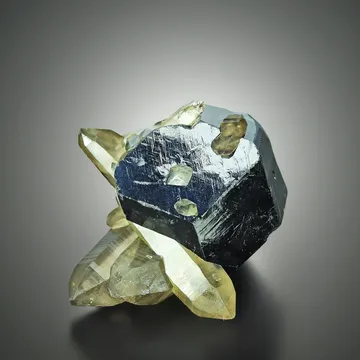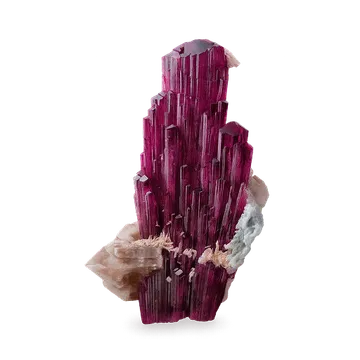
Albite from the Erongo Mountains, Namibia — white to colorless feldspar that enhances emerald fluorite and aquamarine; two generations define locality.
Key facts
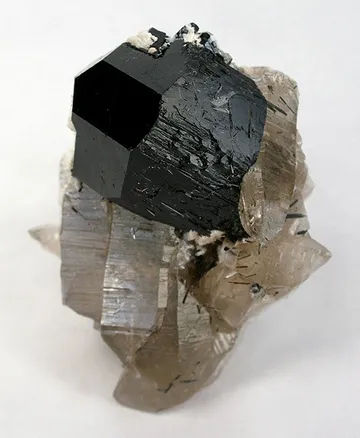
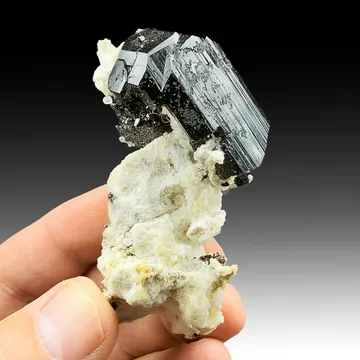
Albite from the Erongo Mountains is rarely the loudest mineral on the specimen, but it is often the mineral that makes an Erongo piece work. In the classic combinations, white to colorless albite gives the stage on which emerald-green fluorite, pale blue aquamarine, black schorl, muscovite, hyalite opal, quartz, and occasional rarer species stand out with dramatic contrast. For collectors, Erongo albite is therefore both a species of interest and a key matrix mineral: the clean white feldspar that turns an aquamarine or fluorite into an unmistakably Namibian display specimen.

Photo: Wikimedia Commons
The mineralogical setting is the Erongo Granite, part of the larger Erongo volcanic-plutonic complex of west-central Namibia. The mountain mass is an eroded volcano-plutonic structure, not simply a single granite body, though “Erongo granite” is the familiar collecting shorthand. Its miarolitic cavities and pegmatitic segregations are the source of the celebrated specimen assemblage: schorl and foitite tourmaline, aquamarine and other beryl varieties, topaz, fluorite, jeremejevite, quartz, feldspars, muscovite, opal, cassiterite, ferberite, and other accessory minerals. Albite occurs in these cavities as a late-stage feldspar, commonly intergrown with or overgrowing earlier cavity minerals.
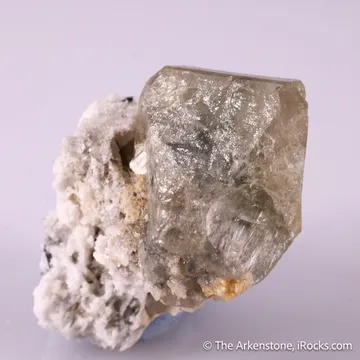
Erongo albite is distinctive because the locality produced two visually different generations. The earlier generation forms rare, several-centimeter, needlelike to acicular crystals that are only millimeters thick and may be epitactically grown on orthoclase. The later generation consists of smaller white to colorless crystals, generally to about 5 mm, deposited on earlier minerals including orthoclase, schorl, muscovite, and the earlier albite. A third common collector expression is the snow-white, granular to crystalline albite matrix seen under fluorite and aquamarine.
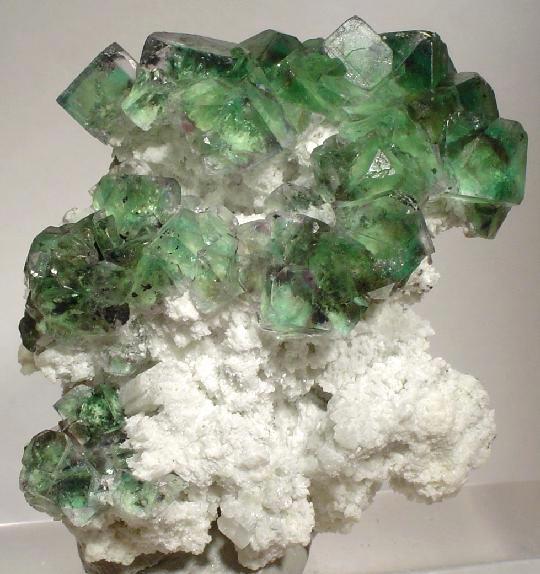
Photo: Wikimedia Commons
Historically, Erongo became a modern specimen locality at the turn of the 21st century. Scattered pieces were known earlier, but the great surge began around 1999–2001, when miarolitic pockets yielded schorl, topaz, aquamarine, quartz, beryl varieties, fluorite, and jeremejevite in combinations that rapidly entered international collections. Albite was part of that same cavity environment, valued especially where it forms a bright base for gemmy green fluorite or blue aquamarine.
The best albite-bearing Erongo specimens have balance: clean white albite with sharp or sparkly texture; well-spaced associated crystals; little iron staining; and a matrix strong enough to support the composition without distracting from it. Albite-only specimens are less commonly pursued than combinations, but a fine Erongo albite association can be highly desirable when the feldspar is fresh, white, and structurally important to the piece.
Search for specimens: View all albite specimens from Erongo Mountains, Namibia
The Erongo Mountains lie in Namibia’s Erongo Region, in the broad Usakos–Karibib–Omaruru mineral district of west-central Namibia. The massif rises conspicuously above the surrounding plains and is one of the major Cretaceous igneous complexes of northwestern Namibia. Geological Survey material describes the Erongo as an eroded core of an ancient volcano with both peripheral and central granite intrusions, bounded in places by high granite cliffs and accompanied by older Damara metasediments and granites.
The albite-bearing specimen pockets belong to the miarolitic pegmatite environment of the Erongo Granite. These are open cavities formed during late-stage crystallization of volatile-rich granitic melts and fluids. The same environment concentrated boron and beryllium strongly enough to produce abundant tourmaline and beryl, and, in exceptional pockets, rare boron species such as jeremejevite. Albite formed as part of the feldspar assemblage in these cavities and is most familiar to collectors as white feldspar matrix, acicular early crystals, and later small white to colorless crystals on earlier cavity minerals.
The broader Erongo mineral province also includes tin, tungsten, fluorite, beryllium, uranium, gold, and rare-earth-related mineralization. Larger-scale mining in the area was historically directed at economic minerals such as tungsten and cassiterite, especially at localities such as Krantzberg, while the modern specimen production is largely from small diggings in miarolitic cavities. The collector-specimen boom began in 1999 and 2000, with major discoveries of schorl, topaz, aquamarine, beryl, fluorite, quartz, jeremejevite, and other species during the following years.
Important named or repeatedly cited areas around the Erongo specimen district include Bergsig Farm 167, Hohenstein Gorge, Tubussis, Davib Ost Farm 61, Ameib Farm 60, Krantzberg, and several pegmatites and workings on surrounding farms. The locality is complex, and older labels may use “Erongo Mountain,” “Mount Erongo,” “Erongo Mountains,” “Usakos District,” “Karibib District,” or “Omaruru District” depending on the period and source.
Collecting access is not casual. Much of the Erongo Mountains area is private farmland, and parts fall within conservation-oriented landholdings. Historic and modern accounts repeatedly stress that permission from landowners is required. Namibia also requires proper documentation for collected or purchased mineral specimens, especially for export. Specimens on the international market usually come through local miners, Namibian dealers, or established mineral dealers who have handled export formalities.
Production has been episodic rather than continuous. The 1999–2006 period produced many of the pieces that made Erongo famous: schorl and topaz pockets in early 1999; green beryl in September 1999; quartz scepters in November 1999; the major Easter 2000 aquamarine pocket; fluorapatite and colorless beryl in 2000; jeremejevite in 2001 and again later; major fluorite discoveries in 2005; and additional fluorite, beryl, and unusual tourmaline habits in 2006. Albite-bearing material appears throughout this history as a matrix and associated cavity mineral, especially with aquamarine, fluorite, muscovite, orthoclase, schorl, and opal.
Erongo albite is a sodium feldspar, NaAlSi3O8, and its local appeal is strongly tied to crystal habit and association. The most specifically described Erongo albite habits are the two generations from miarolitic cavities. The earlier generation consists of rare, elongated acicular crystals several centimeters long but only millimeters thick. These are not the usual blocky feldspar masses of pegmatites; they are delicate, needlelike feldspar crystals, commonly described as epitactic on orthoclase.
The later generation is smaller and more widespread: white to colorless crystals up to about 5 mm, deposited on already-formed minerals. These later albites can sit on earlier albite, orthoclase, schorl, and muscovite, giving some pieces a frosted or sparkling late-stage surface. Albite also occurs as cream-white elongated crystals to about 2 cm on corroded epimorphic molds of orthoclase, in association with pale blue aquamarine and pale yellow fluorite with purple tinges.
Color is usually white, cream-white, or colorless. The cleanest collector pieces show a snow-white albite matrix that contrasts strongly with green fluorite or blue aquamarine. Iron staining is possible, especially on matrix specimens, and can dull the crisp white appearance that collectors prefer.
Typical sizes depend on the form. Late albite crystals are generally millimeter-scale; early acicular crystals may reach several centimeters; matrix pieces can range from thumbnails to large cabinet specimens when albite forms part of a fluorite, aquamarine, or schorl association. In the marketplace, albite is most often encountered as the matrix rather than as the sole focus of the specimen.
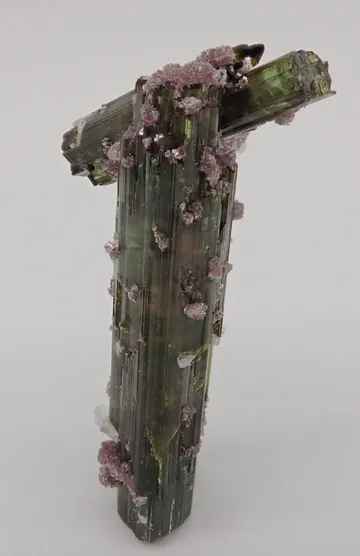
The principal associated minerals for albite-bearing Erongo specimens include aquamarine and other beryl varieties, schorl and other tourmaline-group minerals, fluorite, quartz, smoky quartz, orthoclase, microcline, muscovite, opal-AN or hyalite, topaz, cassiterite, and occasional rarities from the broader cavity assemblage. Albite with aquamarine and schorl is a classic Erongo look; albite with green fluorite is another. The strongest pieces use the albite as visual contrast rather than mere support.
Quality is judged by freshness, contrast, and structural integrity. A good albite matrix should look bright rather than chalky, stained, or sugary. In combination specimens, the best pieces show a natural, well-composed relationship between the albite and the associated crystals: fluorite perched cleanly on white feldspar, aquamarine rising from albite with black schorl accents, or late albite crystals dusting earlier minerals without obscuring them. Damage to the matrix matters, but it is usually tolerated more readily than damage to the principal fluorite, aquamarine, or tourmaline crystals.
The main authenticity issue with Erongo albite is identification, not synthesis. White feldspar matrix from Erongo may be labeled albite, orthoclase, microcline, or simply “feldspar,” and visual distinction is not always reliable on a mounted specimen. Serious collectors should treat old “albite” labels with care unless the piece is from a well-documented albite occurrence, has an analytical basis, or shows the described albite habits. Many Erongo aquamarines and fluorites sit on white feldspar, but not every white feldspar from the locality should automatically be called albite.
Repairs and contacts are more relevant than treatments. Erongo combinations commonly have projecting aquamarine, fluorite, schorl, or quartz crystals on feldspar matrix, and these are vulnerable to breakage during mining and transport. Check carefully for repaired fluorite attachments, reattached aquamarine crystals, filled contacts, and stabilized matrix. Albite itself is not usually treated for color, but aggressive cleaning can leave feldspar surfaces dulled or etched-looking, especially where iron oxides were removed from a delicate matrix.
Condition issues include bruised fluorite corners, broken aquamarine terminations, missing schorl tips, iron staining on white feldspar, and crumbling or undercut albite matrix. Albite-rich bases can also hide old contact points where crystals were attached to cavity walls. On high-end specimens, look beneath the main display crystals and along the albite contact zones for glue lines, unnatural gloss, mismatched dirt, or matrix that seems too freshly broken compared with the rest of the piece.
Rarity depends on what is meant by “albite from Erongo.” Albite as a matrix mineral is not rare; fine albite-dominant specimens are less common; and the described early acicular albite generation is genuinely unusual. Albite with top Erongo aquamarine or fluorite can be expensive because the associated mineral drives the value. A specimen labeled “albite” but visually dominated by aquamarine, fluorite, or schorl should be evaluated as a combination specimen, not as a pure albite specimen.
Market availability remains good for Erongo combinations. Aquamarine-schorl-feldspar specimens, fluorite on albite or feldspar, and mixed Erongo pegmatite pieces appear regularly through dealers and auctions. The best older pieces from the 1999–2006 production period are increasingly collection-held, while newer finds tend to appear sporadically. Buyers should value precise locality data, clear photography of the matrix, honest condition notes, and labels that distinguish albite from undifferentiated feldspar.
The modern Erongo story begins not with albite alone, but with the sudden realization that the mountain’s miarolitic pockets could produce world-class specimen combinations. From the 1960s through the 1980s, pieces surfaced only as a trickle: a large half-“bowtie” schorl in the Desmond Sacco collection, a Krantzberg plumbogummite purchased by the Natural History Museum in London in 1985, and small schorl specimens acquired by South African collectors. Then, at the end of the 1990s, the locality erupted into the specimen world.
In February and March 1999, the first major pockets of schorl and large topaz crystals appeared. In May 1999, miners opened a schorl pocket whose tourmalines showed a distinctive trigonal “Mercedes Benz” termination. By September came the first major pocket of green beryl; by November, sceptered quartz. In April 2000, the “Easter Pocket” on Bergsig Farm 167 yielded roughly 250 to 300 high-grade aquamarine specimens. That pocket changed the tempo of the locality. For weeks afterward, more aquamarine was recovered, some with schorl, fluorescent lime-green hyalite, and complex orthoclase twins. Albite was part of this same cavity language: white feldspar and late-stage albite surfaces framing blue beryl, green fluorite, and black tourmaline.
A 2005 field trip recorded the physical cost of those specimens. The party left Windhoek at 6:00 in the morning to meet Gerd Bachran at the Erongo Mountains by 9:00. West of Usakos, an unusual fog lay over the dry country, drifting inland from the Atlantic coast under the influence of the Benguela Current. As the fog lifted, the granite peaks emerged through the mist. At Bergsig, Bachran had arranged for a local guide, David, to lead the group into the diggings.
The first part of the climb followed a path through granite boulder scree. Even low on the slope, black schorl “nests” in coarse quartz protruded from the boulders, more resistant than the weathered granite around them. The route aimed for a valley, a Schlucht, because the alternative was nearly vertical granite. In some parts of the mountain, local diggers used ropes to haul themselves up the slopes. Just before the ascent, the visitors were told that a digger had recently died there: he had been climbing with a jackhammer on his back when a rope snapped and he fell.
The granite itself helped and threatened at the same time. Its coarse quartz and feldspar laths, some up to 5 cm, made a rough surface that gripped rubber-soled boots. But the slope still ran 40° to 60°, steep enough that “walking” became a learned motion. The local guides moved easily; the visitors did not. At one point a voice called from high above. Looking up, the group saw a digger in a crevice roughly 100 meters up the rock face, waving down from the place they were trying to reach.
The productive zone was a landscape of emptied pockets. Some cavities were less than 10 cm across and only as deep; others were tubular openings 50 to 80 cm wide, winding more than 2 meters into the granite. The miners searched for pockets by reading the surface signs—especially the schorl and quartz nests—but not every opening paid. Some were clay-filled and barren. Because the climb up and down was so arduous, diggers had made semi-permanent camps among fallen boulders, with lean-tos, rudimentary tents, and natural shelters under granite blocks. At Bergsig, one large pocket had filled with rainwater, and David said it would last for months.
Later that trip, the party went to Tubussis 22, where a major schorl discovery had been made in 1999. After obtaining the key to the farm gate, they visited a pipe-like cavity about 2 meters deep and 60 to 70 cm wide. It had produced large orthoclase crystals over 10 cm across, with schorl and yellow hyaline opal. Nearby, in the late afternoon sun, Bushman paintings showed antelope, kudu, eland, giraffes, and human figures on the rock face—a reminder that the same granite that holds miarolitic pockets also holds a far older human history.
The next day’s climb toward the jeremejevite workings was steeper and hotter. The route began on Davib Ost 61 and moved southeast toward the boundary with Ameib 60. Along the way were cavities that had yielded schorl, quartz, and aquamarine. One substantial pocket had left the largest tailings dump the visitors had yet seen. The cavity was about 5 to 6 meters wide and 4 to 5 meters deep, and David explained that, besides aquamarine, smoky quartz, and opal, it had produced highly lustrous complex cassiterite crystals in July 2004. Scratching through the residue still turned up smoky gray to black quartz crystals to 6 cm and fluorescent lime-green botryoidal hyaline opal. Near the jeremejevite diggings, however, the miners had left almost nothing: only one tiny chip of blue jeremejevite in feldspar remained in the tailings.
Krantzberg supplied a different sort of memory. Desmond Sacco recalled that his father, Guido Sacco, chairman of African Mining & Trust, mined the tungsten deposits there in the 1950s until mid-1960. Walter Parker, a mechanical engineer, built the processing plant and recruited miners. The mine personnel lived in nearby Omaruru. Years later, Desmond visited a hotel in Omaruru, mentioned Guido Sacco, and an old-timer at the bar exclaimed, “What? That famous man!” The old man remembered Guido, remembered Parker, and led Desmond to the Omaruru River, to the place where Guido’s car had once become stuck in the riverbed during a rainstorm and was freed just before a flash flood could have swept everyone away.
Guido Sacco traveled from Johannesburg to Omaruru in a blue Buick Roadmaster with luggage tied to the roof, a journey of three to four days by car. Desmond remembered his father saying the Krantzberg ferberite ore was so rich that there was hardly any need to concentrate it. It was crushed, put into containers, and shipped out. Specimen collecting was not a priority there, but the mine did occasionally produce remarkable pieces. Desmond recalled two dinner-plate-sized ferberite crystals his father brought home in the early 1960s—large, well-faced crystals from a mine better remembered for ore than for cabinet specimens.
These stories matter for albite collectors because they place the white feldspar matrix in its real landscape. Erongo specimens did not come from a flat, orderly quarry bench. They came from steep granite, private farms, rope climbs, small camps under boulders, empty miarolitic tubes, and miners reading schorl nests as signs of hidden cavities. A clean albite matrix under fluorite or aquamarine is the quiet survivor of that entire chain.