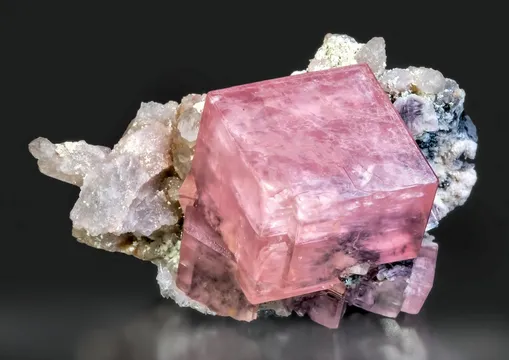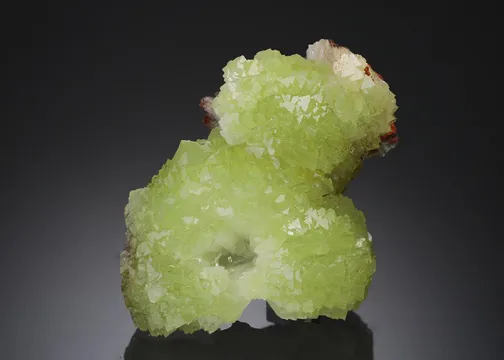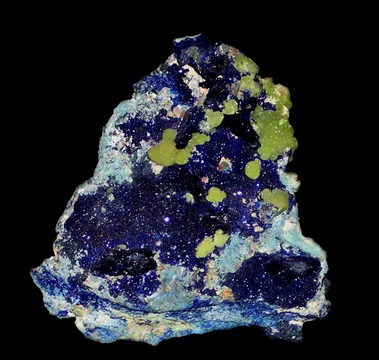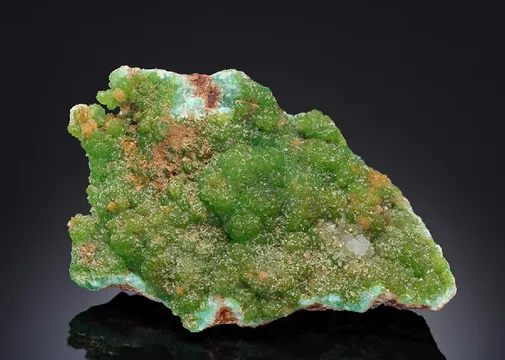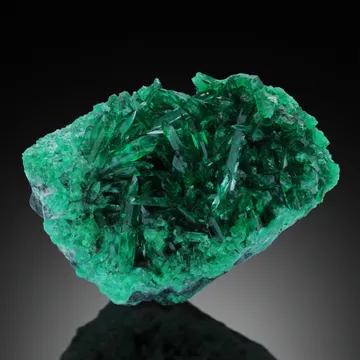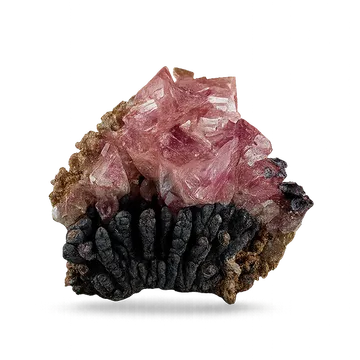
Adamite from Tsumeb Mine, Namibia — sharp yellow to yellow-green crystals on smithsonite; prized for large crystal size, complex paragenesis, and provenance.
Key facts
Adamite from Tsumeb occupies a more complicated and more interesting place in collectors’ cabinets than the label alone suggests. True adamite, Zn2(AsO4)(OH), is the zinc-dominant end member of the adamite–zincolivenite–olivenite compositional range. At Tsumeb, the most familiar “adamite” look is often green, copper-bearing material, but much of what was long sold as “cuprian adamite” or “cuproadamite” is now better identified as zincolivenite unless analysis proves that the composition remains adamite-dominant. That reclassification has not diminished the desirability of Tsumeb specimens; it has made good labels, old provenance, and analytical confirmation more important.
The classic visual appeal is sharp, glassy, yellow to yellow-green crystals on contrasting white smithsonite, grey-black sulphide matrix, yellow-brown tsumcorite, or pale carbonate. Better pieces have individual crystals that are large enough to read across a room, not just drusy sparkle under a lens. A well-known Tsumeb Mine Notebook example shows blocky, yellow-green, near end-member adamite crystals to 25 mm on white smithsonite, and the literature records crystals to 37 mm on smithsonite. For a mineral that is common in many collections as small druses, those dimensions matter.

Photo: Wikimedia Commons / Rob Lavinsky, iRocks.com – CC BY-SA 3.0
Tsumeb’s adamite belongs to one of the world’s most chemically extravagant oxidized ore systems. The mine was a copper-lead-zinc-silver deposit with important arsenic, cadmium, gallium, germanium, and silver in the geochemical mix. The ore pipe sat in Otavi Group dolomitic carbonate rocks, with feldspathic sandstone, dolomite breccia, sulphides, and open cavities providing both chemistry and space for secondary minerals. Oxidizing waters penetrated the pipe in three distinct vertical oxidation zones, an unusual arrangement that helps explain why adamite and its associated arsenates occur in so many different parageneses.
For collectors, the central question is not merely “is it adamite?” but “what kind of Tsumeb adamite is it?” Yellow, brownish, pinkish, or nearly colorless crystals are more likely to be true adamite. Spearmint-green, emerald-green, and bottle-green crystals may be zincolivenite, zoned adamite-zincolivenite, or in some cases copper-bearing adamite near the boundary. The very best specimens combine color, luster, transparency, crystal size, and a secure Tsumeb paragenesis—especially associations with smithsonite, tsumcorite, leiteite, legrandite, mimetite, anglesite, feinglosite, or tennantite-rich sulphide matrix.
Search for specimens: View all adamite specimens from Tsumeb Mine, Namibia
Tsumeb Mine, also known historically as the Tsumcorp or Ongopolo Mine, is in the town of Tsumeb in Namibia’s Oshikoto Region. Its orebody was a steep, pipe-like polymetallic deposit hosted by Neoproterozoic Otavi dolomite. In broad cross-section the pipe has been described as about 120 by 15 meters, extending from the surface to depths of at least 1,000 meters; the broader mined system ultimately reached far deeper, with late workings down to 48 Level, about 1,700 meters below surface.
The deposit’s geology is central to the adamite story. The Tsumeb pipe contained massive and disseminated sulphides, feldspathic sandstone, sandstone breccias, dolomite breccia, calcite, quartz, and complex hydrothermal alteration. Oxidizing groundwater moved through karstic carbonate rocks, fractures, vugs, and permeable horizons, producing three supergene oxidation zones rather than a single shallow oxide cap. Adamite is recorded from all three oxidation zones, but true end-member adamite is only somewhat rare at Tsumeb and is less abundant than zincolivenite and olivenite within the broader adamite–olivenite compositional field.
The first oxidation zone extended from the surface to around 11 Level, with oxide minerals diminishing between 11 and 15 Level. Adamite in this zone is especially uncommon as confirmed end-member material, but the zone produced one of the most distinctive Tsumeb adamite varieties: cobalt-bearing adamite with brownish-green outer coloration and pink to plum interiors. One Harvard specimen from the Hans von Karabacek collection consists of a 110 mm block of mineralized feldspathic sandstone covered by a roughly 10 mm layer of tightly intergrown adamite crystals; broken surfaces reveal the characteristic plum-colored blush.
The second oxidation zone, broadly 24 to 35 Level and centered around the North Break Horizon near 29 Level, was the most important zone for many classic Tsumeb secondary minerals. It is also where many “cuprian adamite” specimens entered collections, later requiring reinterpretation as zincolivenite or zoned material. Yellow adamite on smithsonite, adamite with tsumcorite, and unusual assemblages involving anglesite, feinglosite, and mimetite belong to this deeper oxidized environment.
The third oxidation zone begins around 42 Level and includes the famous 44 Level “Zinc Pocket.” In this deep setting, adamite appeared in an unusual form: white, needle-like crystals associated with leiteite and legrandite, with paradamite also present in the same paragenesis. This is a completely different collecting aesthetic from the blocky yellow second-zone crystals or the green zincolivenite-like material that dominates many old labels.
The mine’s commercial history began after the famous copper-stained “Green Hill” outcrop drew European attention in the late nineteenth century. Mathew Rogers visited Tsumeb in January 1893, and commercial development followed under Otavi Minen und Eisenbahn Gesellschaft, with trial shafts in 1900 and full-scale production beginning after the railway was completed in 1906. Mining moved from open-pit and shallow-shaft work into extensive underground operations. After World War II, Tsumeb Corporation Limited deepened the workings, intersected the second oxidation zone, and helped drive the flood of mineral discoveries that made Tsumeb legendary among collectors.
Large-scale mining ceased in the mid-1990s, and the mine effectively closed in 1996. After labor unrest cut management access to the mine, pumps were switched off and the workings flooded rapidly. Small-scale upper-level work continued briefly, and a short-lived attempt at specimen mining took place between 1998 and 2002. Today, meaningful collector supply comes from old mine production, historic collections, dealer inventories, and the continual re-examination of older specimens—not from normal collecting access underground.
Tsumeb adamite occurs in several habits, and the habit is often a clue to its paragenesis. The most admired true adamite specimens show blocky, lustrous, translucent yellow to yellow-green crystals, commonly perched on white smithsonite. Reported end-member adamite crystals reach 37 mm, while well-documented museum material includes yellow-green blocky crystals to 25 mm and tabular yellow crystals to 9 mm on sheaf-like white smithsonite over yellow tsumcorite.
Color is the most treacherous and most useful feature. Colorless, white, pale yellow, golden yellow, yellow-brown, brownish-green, and pinkish material can all be true adamite at Tsumeb. Pink to plum coloration in rare cobalt-bearing adamite can be caused by very small cobalt contents, with one studied example showing near end-member adamite containing less than 2 mol percent copper and about 540 ppm cobalt. By contrast, much bright green material historically called “cuprian adamite” falls in the compositional range of zincolivenite, not adamite sensu stricto.
Crystal forms vary from blocky and tabular to prismatic and, in rare cases, needle-like. The unusual 35 Level/North East Stope material includes pale-green adamite in tabular, petalloid crystals forming three-dimensional mounds, with adamite mixed with anglesite, feinglosite, and mimetite over massive sulphide. The 44 Level Zinc Pocket produced the opposite style: fine white needles with leiteite and legrandite. Older “cuproadamite” labels may describe rhombic, pseudo-octahedral, prismatic, or chisel-terminated crystals, but many of those are now better considered zincolivenite unless analyzed.
Associated minerals are one of the pleasures of Tsumeb adamite. Confirmed associations include smithsonite, tsumcorite, anglesite, feinglosite, mimetite, calcite, cerussite, chalcocite, conichalcite, duftite, goethite, hemimorphite, leiteite, legrandite, olivenite, paradamite, quartz, reinerite, tennantite-(Zn), wilhelmkleinite, willemite, and zincolivenite. More exotic Tsumeb arsenates and related species can occur in the same chemical neighborhoods, so a matrix sprinkled with minor grains should be examined carefully rather than dismissed as “just matrix.”
Typical collector pieces range from thumbnails and miniatures with a few crystals to small cabinet and cabinet specimens with a full display face. Fine adamite from Tsumeb is not usually a large-mass species; quality is measured in crystal sharpness, damage-free terminations, luster, translucency, contrast, and the confidence of the identification. A 25 mm single adamite crystal is already important. A 37 mm crystal on smithsonite is exceptional. Dense green druses can be attractive, but without analysis they may be better marketed as zincolivenite or adamite-zincolivenite series material rather than true adamite.
The best Tsumeb adamites have one of three personalities. The first is yellow and architectural: blocky, transparent to translucent crystals standing cleanly on white smithsonite or pale carbonate. The second is chemical and historical: cobalt-bearing first-zone adamite with brownish-green surfaces and a hidden plum interior. The third is paragenetic: modest-looking but analytically fascinating material from the 35 Level or 44 Level, where adamite sits among rare arsenates and zinc minerals that could only come from a deposit with Tsumeb’s peculiar plumbing.
The chief authenticity issue is not widespread fakery but naming accuracy. “Cuprian adamite” and “cuproadamite” are legacy labels. The name cuproadamite has been discredited, and modern work on Tsumeb material shows that the vast majority of specimens once labeled that way fall within the zincolivenite range. Green Tsumeb crystals may still be beautiful, historic, and desirable, but a serious collection should not automatically relabel them as adamite without analytical support.
For true adamite, look for yellow, pale yellow-green, brownish, colorless, white, or pinkish material, especially when accompanied by old labels, analytical notes, or a paragenesis consistent with published Tsumeb examples. XRD, EDS, WDS, or EMPA confirmation adds value when the specimen sits near the adamite-zincolivenite boundary. On older labels, “copper-bearing adamite,” “cuprian adamite,” “cuproadamite,” “zincian olivenite,” and “adamite-olivenite series” should be treated as prompts for review, not as final identifications.
Condition matters. Adamite is brittle, and Tsumeb crystals commonly stand proud of the matrix, so chipped terminations, bruised edges, and broken crystal tips are frequent. Yellow adamite on smithsonite is particularly vulnerable because the contrast makes damage obvious. Drusy plates can hide contact damage along the edges, while dense green zincolivenite-like specimens may look undamaged at first glance but show broken crystals under magnification. Always inspect terminations and high points with a loupe.
Matrix and association should be believable. Yellow adamite with sheaf-like white smithsonite, tsumcorite-rich sulphide matrix, calcite, mimetite, or anglesite-feinglosite assemblages fits known Tsumeb parageneses. Cobalt-bearing adamite should not be simply bright pink throughout like a typical “cobaltoan” show mineral; the documented Tsumeb material can show brownish-green exterior color and pink to plum coloration on broken interiors. Overly vivid claims should be backed by analysis.
There are no well-documented, locality-specific treatments that define the Tsumeb adamite market in the way that artificial coloring defines some other mineral markets. The more common risk is a wrong or obsolete name, a vague “Tsumeb” attribution attached to an unlabeled green arsenate, or confusion with visually similar species such as zincolivenite, olivenite, conichalcite, duftite, austinite-group minerals, or secondary coatings on Tsumeb sulphide matrix.
Market availability is uneven. Green “cuprian adamite” style pieces are seen more often than true, confirmed adamite, but many should now be sold as zincolivenite or as adamite-zincolivenite series material. Fine yellow adamite with large, sharp crystals remains much scarcer. Well-provenanced older pieces from the Klein, Karabacek, Barstow, Hammond, Pietsch, Gauthier, Sussman, Melville, or other documented collections deserve special attention because locality, mine level, and collection history can add as much meaning as the crystals themselves.
Before there was a mine, there was a copper-stained hill. African miners had already worked the outcrop for copper long before European prospectors traced traded ore and smelted metal back to Otjisume, “the place of the frog,” the name linked to the look of the green outcrop. In January 1893, the British mining engineer Mathew Rogers reached the place then written as “Soomep” and sent back one of the great mineral-locality reactions: “I have never seen such a sight as was presented before my view at Soomep, (sic.) and I very much doubt if I shall ever see such another in any other locality.” He was looking at the surface expression of a pipe that would eventually become one of the most species-rich mineral deposits ever mined.
The mine developed slowly at first. OMEG began with two trial shafts in 1900, but full production waited until 1906, when the railway from the coast made sustained mining possible. In 1900, even before full-scale production, a large ore sample shipped to Germany for metallurgical testing passed through the hands of Wilhelm Maucher at the Bergakademie in Freiberg. Maucher preserved well-crystallized secondary minerals from the test material and wrote the first detailed mineralogical description of the Tsumeb ore. That small act—saving crystals from what might otherwise have been treated only as metallurgical feed—foreshadowed the entire collector history of Tsumeb.
Adamite’s own story at Tsumeb is quieter and more elusive than azurite or dioptase, which arrived in legendary named pockets. Charlie Key observed in 1977 that adamite had been found intermittently at Tsumeb over the years, but almost never in exceptional specimens until shortly before his report, when several superb pieces were recovered. The best, he wrote, was a single bright yellow crystal measuring 1¼ inches, carrying an attached ⅜-inch spray of opaque white smithsonite. The exact location was not recorded, but the occurrence was almost certainly from the second oxidation zone. For adamite collectors, that crystal is the sort of benchmark that turns a locality from “present” into “important.”
One of the most evocative Tsumeb adamites is not the brightest specimen but one of the strangest: the Karabacek specimen now at Harvard. It is a 110 mm block of mineralized feldspathic sandstone, one face coated by an approximately 10 mm layer of tightly intergrown adamite crystals. Externally, the adamite is brownish green and sub-vitreous; broken surfaces reveal a plum-colored blush. The color is tied to cobalt present only in trace amount. The specimen had been number 4318 in the collection of Austrian industrialist Hans von Karabacek, part of which was purchased for Harvard University in 1935. It is a reminder that Tsumeb’s best stories often hide inside old collections as much as underground pockets.
In February 1980, TCL mineralogist John Innes collected material from the North East Stope on 35 Level that later proved to match an unusual adamite paragenesis: pale-green tabular, petalloid crystals forming three-dimensional mounds over a cavernous layer of white anglesite with sub-millimeter striated mimetite prisms, all in a dense mixture with feinglosite and massive sulphide. One documented specimen passed through Toni Pietsch, Gilbert Gauthier, Marshall Sussman, John Veevaert, and Paul Melville before joining a modern collection, carrying with it the kind of chain-of-custody detail that makes Tsumeb pieces feel like archival objects as well as mineral specimens.
The deepest adamite story belongs to the 44 Level Zinc Pocket. By the 1980s and early 1990s, the mine had already passed through the famed second oxidation zone and then, astonishingly, encountered a third oxidation zone beginning around 42 Level. The Zinc Pocket yielded combinations of zinc arsenates and related minerals—legrandite, leiteite, paradamite, reinerite, smithsonite, and adamite—in a setting far below the classic shallow oxide image of a mine. Here adamite could appear as unusual white needles with leiteite and legrandite, a mineralogical signature that is instantly different from the yellow blocky smithsonite pieces of the second zone.
The end of large-scale mining came abruptly. By the mid-1990s, the workings were down to about 1,700 meters below surface on 48 Level. High mining and pumping costs, low metal prices, and worsening labor relations converged. In mid-1996, striking miners denied management access to the mine site; the pumps were switched off, and the mine flooded rapidly. Small-scale upper-level work and a brief specimen-mining effort followed, but the great productive era was over. Today a Tsumeb adamite is not just a mineral specimen—it is a survivor from a closed, flooded, historically finite system.