Settlingstones is the classic English locality for witherite in its most collectible form: dense, lustrous, translucent white to cream or pale tan barium carbonate, typically built from twinned pseudo-hexagonal orthorhombic crystals that make rounded mounds, plates, and sculptural cabinet pieces. The best specimens have a peculiar combination of glassy sparkle and softly satiny internal texture, with repeated stepped faces and horizontal striations catching the light across the crystal groups. For collectors, a fine Settlingstones witherite is not merely “an English witherite”; it is one of the defining specimens of the species.

Photo: Wikimedia Commons
The mine lies in the Haydon Bridge–Fourstones district of Northumberland, on the northern fringe of the Northern Pennine Orefield. Geologically, its witherite belonged to a barium-rich vein system controlled by the famous Whin Sill, the hard Carboniferous dolerite sheet whose influence was decisive at Settlingstones. The witherite orebody was strongest where the vein cut the Whin Sill; the hard walls helped preserve open spaces and allowed the carbonate gangue to develop as massive crystalline ore with cavities lined by collectible crystals. The surrounding country rock includes Carboniferous sandstones and shales, locally altered to the miners’ “whetstone,” with the Whin Sill forming the structural and mineralogical heart of the deposit.
Historically, Settlingstones began as a lead mine and became far more important as a witherite mine. By the late nineteenth and twentieth centuries it was one of the world’s great sources of natural barium carbonate, and for long periods it was the only significant commercial producer of witherite. Its final shift, on March 28, 1969, effectively closed the chapter on world-scale witherite mining. That history gives Settlingstones specimens a special gravity: every good piece is old mine material from a worked-out industrial source, not a modern field-collected occurrence.
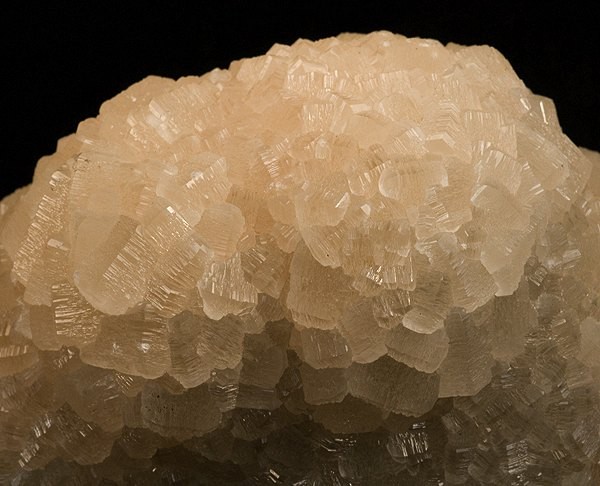
Photo: Wikimedia Commons
Collectors prize Settlingstones pieces for strong crystallization, freshness, translucency, and an unmistakable “old English” look: stacked, pearly-white to honey-tinted crystals, often in mound-like aggregates rather than isolated textbook individuals. Fine examples may show sharp repeated terminations and ribbed faces; more massive specimens show compact crystalline witherite with small sparkling vugs. The most satisfying specimens retain the mine’s character without excessive trimming, acid cleaning, or bruising, and a historic label can add as much desirability as another centimetre of crystal coverage.
Search for specimens: View all witherite specimens from Settlingstones Mine, England
Settlingstones Mine is at Newbrough/Fourstones in Northumberland, near Haydon Bridge and Hexham, in the Haydon Field of the Northern Pennine Orefield. The locality is commonly given as Settlingstones Mine, Newbrough, Northumberland, England, UK; historically it is also described as near Fourstones. Its mine grid reference is around NY849688, and the principal workings were developed through shafts including Frederick, Ellen, Winter, and Gordon shafts.
The deposit is a hydrothermal fissure-vein system in the outer barium zone of the Northern Pennine Orefield. The principal Settlingstones Vein trends roughly northeast–southwest, with a published average direction around N50°E. Early lead workings lay in the northeastern part of the vein, but a major mineralogical change occurred to the southwest: after a barren interval beyond a crosscourse, the vein changed from a baryte–ankerite lead-ore gangue to a witherite-dominant orebody with only small quantities of sulphides and minor baryte, strontianite, harmotome, and barytocalcite.
The Whin Sill is the key to understanding the mine. The witherite orebody was best where the vein had Whin Sill on both walls, and the deposit is described as effectively “blind” upward: it did not crop out as a rich surface witherite vein, but strengthened in depth where the structural and lithological conditions were right. The witherite oreshoot extended for about 4,300 feet, averaged about 8 feet wide, and locally reached about 30 feet. It was worked across a vertical range of roughly 500 feet, with published estimates placing the worked witherite oreshoot between about 300 and 680 feet below surface.
The mine’s history spans nearly three centuries. Lead mining is recorded from the late seventeenth century, with documentary references around 1687–1692 and traditional opening dates around 1690. Lead production continued until 1873. From that point Settlingstones turned decisively toward witherite, and from 1873 through the late 1960s it was a steady producer of natural barium carbonate. Published figures place its total product witherite output at roughly 630,000 tons, making it the leading world producer of natural barium carbonate and the leading producer of barium minerals in the United Kingdom. Earlier lead output from 1849–1873 was about 16,902 tons of lead concentrates.
Mining was underground and industrial, not a specimen dig. The ore was extracted by stoping, with whole sections of vein removed rather than just narrow strings of ore. In the Whin Sill ground the walls were hard enough for shrinkage stoping: miners worked upward, leaving broken ore in the stope as a temporary working floor and underground store. Ore was drawn down through wooden hoppers, hauled in tubs to Frederick Shaft, raised to surface, and then carried by mineral railway to the dressing plant near Ellen Shaft. There it was crushed, washed, and jigged into a saleable product, historically about three-eighths of an inch in diameter.
By the mid-1960s the mine was living on old pillars and remaining blocks of ore. Exploration for new veins was not successful enough to prolong the operation. Settlingstones worked its last shift on Friday, March 28, 1969; Durham Mining Museum records the closure in April 1969. The dumps have since been landscaped, and a later proposal to rework them did not obtain planning approval. Collecting should therefore be treated as a closed-mine, private-land matter: specimens on the market are old mine material, old collection material, or pieces recovered historically from mine dumps and workings when access conditions were different.
Notable mineralogical finds extend beyond witherite. The mine is a recorded locality for baryte, barytocalcite, calcite, chalcopyrite, galena, gersdorffite, harmotome, marcasite, millerite, nickeline, pyrite, quartz, rammelsbergite, skutterudite, sphalerite, strontianite, ullmannite, vaesite, violarite, and witherite. The rare nickel minerals are part of the locality’s scientific interest: Arthur Russell recorded nickeline and ullmannite at Settlingstones, and later work confirmed the mine’s place among the small but significant nickel-bearing occurrences of the Northern Pennines.
Settlingstones witherite is BaCO3, but the locality’s personality lies in the way that orthorhombic witherite repeatedly twins into pseudo-hexagonal forms. Fine crystals can look deceptively hexagonal, with stepped terminations, repeated twin sectors, and rough to horizontally striated faces. The best examples show bright vitreous faces over translucent white, cream, pale grey, beige, or tan interiors. On older cabinet pieces, the colour may be slightly honeyed or tea-stained, especially where internal veils, iron staining, or included material soften the body colour.
The commonest collector forms are mounded aggregates, plates, and clustered masses of crystals rather than isolated spear-like individuals. Many specimens are essentially all witherite: dense, heavy, matrix-free or nearly matrix-free crystalline masses that were broken from the orebody. Others retain small amounts of baryte, calcite, sphalerite, or rock matrix. Vugs in the granular crystalline ore may be lined with shining twinned crystals, while rarer textures include globular, tuberous, botryoidal, columnar, or more amorphous witherite. Settlingstones is also known for rounded masses of witherite carrying baryte crystals, and for specimens where baryte and witherite record a complex replacement history.
Size varies widely. Thumbnail and miniature pieces occur, but the locality is especially respected for small cabinet to cabinet specimens: 5–15 cm plates and mounded groups are well represented in old collections. Larger cabinet pieces exist and can be impressive because witherite is so dense; a 10 cm specimen feels unexpectedly weighty in the hand. Good crystals on cabinet pieces are commonly in the millimetre to centimetre range, with some specimens showing crystals around 1 cm and larger masses composed of tightly packed repeated growth.
Associated minerals are important for attribution and interest. Baryte is the most common barium companion, and at Settlingstones it may occur as sharp pointed crystals in a habit linked to witherite-rich veins. Calcite appears on some pieces. Sphalerite, usually brownish to resinous, may occur as fine-grained strings or small dark grains; galena is much less common in the witherite oreshoot than in the earlier lead-bearing part of the vein. Harmotome, a barium zeolite, was reported filling interstices in the witherite mass. Strontianite was recorded as yellowish or greenish fibrous material. The rarer nickel suite, including nickeline and ullmannite, belongs more to specialist mineralogy than to ordinary display witherite, but it gives the locality extra depth.
Quality in Settlingstones witherite is judged by crystallization first. Sharp, lustrous, translucent crystal groups with clear repeated twinning are far more desirable than massive broken ore. Aesthetic mound or plate form matters, because many specimens are dense aggregates; a graceful profile and all-around crystal coverage can distinguish a top piece from a merely representative one. Colour should be clean white, creamy, pale tan, or softly translucent grey rather than dull chalky white. Damage is common enough that undamaged crystal edges, intact terminations, and minimal bruising are major value factors. Old labels from English collections, mine-era provenance, or historic dealer stock add significantly to collector appeal.

Photo: Wikimedia Commons
The main authenticity issue is not synthetic witherite, but locality confidence. Settlingstones is so famous that poorly labelled English witherite can drift toward a Settlingstones attribution in the marketplace. Fallowfield, Alston Moor, and other northern English localities also produced witherite, and generic old labels reading only “Northumberland,” “Hexham,” or “England” should be treated cautiously. Strong confidence comes from an old, specific label; a documented collection chain; or a specimen whose habit, associated minerals, and style match the classic Settlingstones material.
Settlingstones pieces are often dense, nearly monomineralic aggregates. That is normal. Matrix is not required for authenticity, and in fact many good pieces are essentially crystallized witherite ore. Conversely, a perfectly clean, bright white, matrix-free plate may have been trimmed or cleaned, so it should be judged by surface texture and crystal integrity rather than by whiteness alone. Witherite effervesces in acid and is a barium carbonate, so acid testing or aggressive cleaning can damage specimens. Collectors should avoid unnecessary chemical cleaning, prolonged soaking, or dusty handling; the mineral is also not something to grind, lick, or leave where children or pets can handle fragments.
Condition is critical. Witherite is brittle, only moderately hard, and its ribbed crystal faces can bruise easily. Cabinet specimens often show small nicks along protruding crystal edges; these may be acceptable on older pieces, but fresh chips stand out as dull white scars against glassier surfaces. Crusty baryte overgrowths or alteration are part of the locality story, but heavy dull encrustation can obscure the witherite and reduce display quality unless the specimen is scientifically interesting.
Rarity is relative. Settlingstones produced an enormous industrial tonnage, so representative witherite is not rare in the way that many obscure species are rare. Fine display specimens, however, are finite closed-mine classics. The mine has been closed since 1969, the dumps have been landscaped, and modern supply depends on old collections, estate dispersals, and dealer recycling. Small and mid-sized examples appear with some regularity, but sharp, lustrous, undamaged, well-composed cabinet specimens with old labels are increasingly competitive.
In market terms, collectors should separate three categories. First are massive or weakly crystallized ore pieces: historically interesting, affordable, and useful for locality representation. Second are attractive small cabinet to cabinet crystal aggregates: the core of the market and the best balance of beauty, locality significance, and availability. Third are exceptional old-time plates or mounds with sharp repeated crystals, translucency, minimal damage, and provenance: these are the pieces that belong beside classic English fluorite, baryte, and calcite in a serious Northern Pennine suite.
The best Settlingstones story begins underground in the Whin Sill, where witherite was mined not as a curiosity but as an industrial ore. In the summer of 1965, F. Brook visited the mine several times and based his later account on his observations and on details supplied by Andrew Carstairs, the mine manager. The method was shrinkage stoping. Miners began by bringing down ore from the roof, then set stemples across the vein about five feet above the stope floor and planked them over to make a working stage. Wooden hoppers were built at intervals. As the stope advanced upward, broken witherite was tipped down the hoppers, but most of the loose ore was deliberately left inside the vein to form the floor under the miners’ feet. The stope became an underground storehouse of ore, drawn off through the “mills” below whenever the surface plant needed feed.
The movement of ore was a small industrial geography of its own. Broken witherite was taken to Frederick Shaft in tubs hauled along the levels by ponies. Brook noted that, during his visits, the managers were experimenting with a battery locomotive adapted for the narrow levels. Once raised to surface, the ore did not go directly to sale. It travelled in cable-drawn wagons along a mineral railway to the dressing plant at Ellen Shaft, about half a mile northeast of Frederick Shaft. There it was crushed, washed, and jigged into small pieces roughly three-eighths of an inch across. The machinery, Brook wrote, was nearly a century old and made by Davison’s ironworks at Hexham. In 1965 the plant handled an average of about 220 tons of crude mineral per week.
That same 1965 snapshot fixes Settlingstones at the edge of an ending. The mine employed about seventy men, most from Haydon Bridge, with some living in a terrace of cottages at the mine. The mineral royalties belonged to the Duke of Northumberland and the Commissioners of the Greenwich Hospital. By then, however, output was coming from old pillars of ore. Searches for new veins had not succeeded. Four years later, on Friday, March 28, 1969, the only remaining source of commercially mined witherite in the world worked its last shift.
The geology had its own drama. In the lead-mining part of the vein, the gangue was mostly baryte and ankerite. Southwest of a crosscourse, after a barren interval, the vein changed into witherite. Later British Geological Survey work described the witherite oreshoot as about 4,300 feet long, averaging roughly 8 feet wide and locally reaching 30 feet. The orebody was best with Whin Sill on both walls, but it was blind upwards and persisted downward farther than expected where the mine encountered the “Carstairs Quartzite,” a white, medium-grained, silica-cemented quartzite beneath the sill. That hard bed helped carry the ore to lower levels and contributed to the mine’s postwar success.
One of the most mineralogically vivid episodes lies near the Grindon cross vein. There, investigators could see that witherite had replaced earlier baryte. In thin section, the witherite preserved interlocking platy pseudomorphs after baryte, while bands of galena and sphalerite that once belonged to the crustified baryte vein could be followed through later cavities in the witherite, or seen hanging into them. For a collector looking at a quiet cream-coloured cabinet piece, it is easy to miss that history: the specimen may be the final visible stage of a vein that first built sulphide-banded baryte, then changed chemically into barium carbonate.
Settlingstones also had a dangerous human record, as all old mines did. Durham Mining Museum records the death of Edward Henderson, a 38-year-old miner, on February 12, 1896, when men were preparing to fire and a mass of stone and ore weighing several tons fell and caught him. The old crystals now sitting in drawers and display cases came from that working world: shafts, stopes, hoppers, ponies, jigging machinery, boilers, ore chutes, and men taking down a heavy carbonate vein under hard dolerite walls.
 Amethyst
 Quartz
 Fluorite
 Tourmaline
 Malachite
 Azurite
 Rhodochrosite

