Nentsberry Haggs is one of the great English names for collectible witherite, not because it produced the prettiest single color in the species, but because it produced the most mineralogically expressive specimens: heavy, white to cream and pale honey barium carbonate, commonly in pseudohexagonal compound crystals, radiating masses, and partly altered crusted forms that tell the story of a deposit in motion. A good Nentsberry Haggs witherite rarely looks “simple.” It may carry a powdery white baryte-calcite skin, sit on etched or corroded baryte, show sphalerite or galena on the reverse, or display the stout pseudohexagonal forms that make Pennine witherite immediately recognizable.
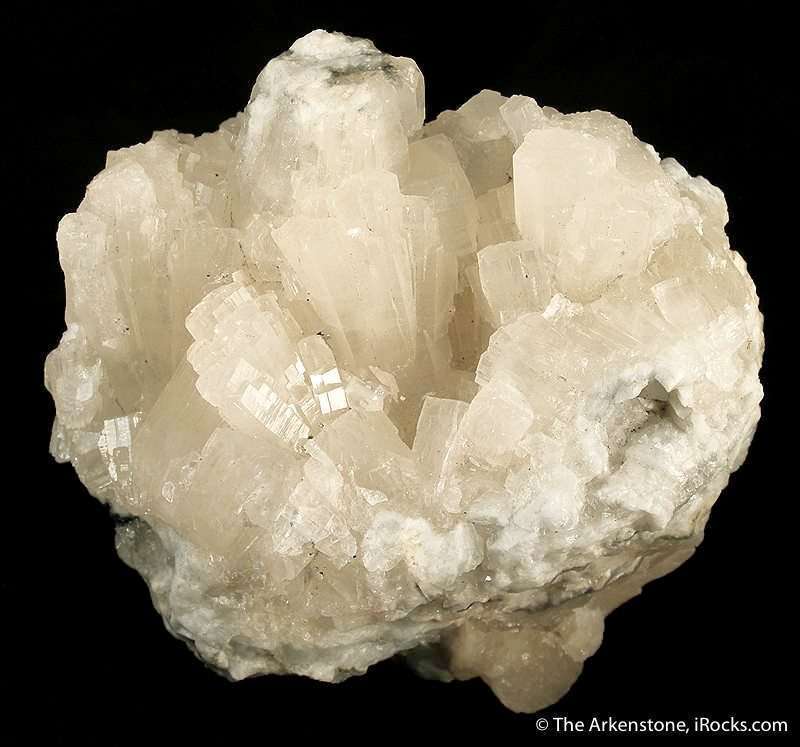
Photo: International Gem Society
The mine lies in the Nent Valley of Alston Moor, within the Northern Pennine Orefield. This is classic lead-zinc country, where Carboniferous limestones, shales, and sandstones were cut by mineralized fractures and replaced along favorable beds. Nentsberry Haggs is especially important because the Admiralty Concession Flat on Second Sun Vein preserves a complicated late barium-carbonate paragenesis in situ. In the lower flat, large baryte crystals were deposited and later corroded, dissolved, broken, and recemented by barytocalcite, witherite, and alstonite. In the upper flat, witherite becomes the dominant barium mineral. That makes the locality far more than a source of attractive white carbonate specimens: it is a natural laboratory for the replacement of baryte by barium carbonate minerals.
Collectors prize Nentsberry Haggs witherite for several overlapping reasons. First is form: pseudohexagonal prisms, pyramidal terminations, doubly terminated crystals, stacked compound crystals, mammillary aggregates, and radiating balls all occur. Second is association: baryte, barytocalcite, alstonite, galena, sphalerite, quartz, and “ankerite” give context and diagnostic value. Third is provenance: much of the best material is old, commonly from twentieth-century mine access, older mine collections, or documented 1970s collecting in the Admiralty Flats. Finally, there is the locality’s status in witherite history. The Northern Pennines are uniquely rich in witherite by world standards, and Nentsberry Haggs is one of the indispensable names within that tradition.
Search for specimens: View all witherite specimens from Nentsberry Haggs Mine, Alston Moor, England
Nentsberry Haggs Mine is best understood as part of the Nenthead-Alston Moor lead-zinc-barium system rather than as a single isolated mine mouth. The principal access was the Nentsberry Haggs Horse Level, driven from the Alston-to-Nenthead road on the northeast side of the Nent Valley. The workings intersected a network of veins and flats that cross the historic county boundary, which is one reason older literature may refer to Nentsberry Haggs, Nentsberry Mine, Nentsbury Mine, Haggs Mine, the Admiralty Concession, High Raise, First Sun, Second Sun, Treloar, Liverick, Cox, and related names in overlapping ways.
The deposit type is a hydrothermal lead-zinc vein and replacement system in the Northern Pennine Orefield. The productive ground is strongly controlled by Carboniferous strata, especially the Great Limestone. In the Admiralty Concession Flat, the mineralization is not simply a clean open-space vein filling: it involved dolomitisation, iron-rich carbonate alteration commonly described as “ankeritisation,” brecciation, limestone dissolution, and cavity formation adjacent to the vein. Sulphides, chiefly sphalerite and galena, were deposited with quartz and carbonate gangue. The later barium mineralization is the collector’s focus: baryte, barytocalcite, witherite, and alstonite occupy cavities and record repeated changes in fluid chemistry.
The most celebrated witherite-bearing setting is the Admiralty Concession Flat at the west end of Second Sun Vein. It has two principal levels. In the lower level, baryte and barytocalcite are the dominant barium minerals, but witherite occurs as a later phase, commonly in contact with corroded baryte. In the upper level, witherite is the principal barium mineral, with barytocalcite subordinate. The result is a vertical and paragenetic contrast that collectors can often read on specimens: lower-flat material may show witherite cementing or coating broken baryte, while upper-flat material more commonly appears as radiating or pseudohexagonal witherite masses with pale alteration crusts.
The mine’s economic story is one of lead, zinc, and the troublesome presence of barium carbonate. Nentsberry Haggs and the connected Nentsberry workings were operated by a succession of companies, including the Alston Moor Mining Co., Nentsbury Mining Co., Alston Lead & Blende Mines Ltd., Lugdale Chemical Co., and later the Vieille Montagne Zinc Co. The Vieille Montagne period brought major development and substantial production from the broader Nentsberry system. Between 1913 and 1938, Nentsberry production was recorded as tens of thousands of tons of lead concentrates and several thousand tons of zinc concentrates. The zinc-witherite ore, however, was difficult to dress because sphalerite and witherite are close enough in specific gravity to make clean separation problematic. For that reason, some zinc-witherite ore remained in place even after sampling showed significant tonnages.
Mining in the area continued into the mid-twentieth century, but the specimen story has a later chapter. Collectors in the 1970s gained access to the Admiralty Flats and recovered large, pitted, pseudohexagonal witherite crystals, many partly altered to baryte. Earlier collectors, including Sir Arthur Russell, had already recognized the unusual barium-carbonate mineralogy of the Nentsberry area; later work by Russell Society members documented the Admiralty Concession Flat in enough detail that the locality became a reference point for baryte replacement by witherite and barytocalcite.
Collecting access today should be treated as effectively closed for ordinary collectors. The portal is on private land, the level has suffered serious collapses, and modern descriptions characterize the horse level as gated, collapsed, or all but inaccessible. The wider Nenthead mine system is also environmentally sensitive. Mine water from the Haggs adit is now captured as part of a treatment scheme designed to reduce cadmium and zinc pollution entering the River Nent. In practical terms, serious collectors should look for old collection material, documented dealer specimens, museum deaccession material where legitimate, and specimens with labels tying them to Admiralty Concession Flat, Second Sun Vein, High Raise, Treloar, Liverick, Cox, or the wider Nentsberry Haggs system.
The formula of witherite is BaCO3, and Nentsberry Haggs material belongs to the classic orthorhombic but pseudohexagonal Pennine style. The most recognizable specimens are white, grey-white, cream, pale yellowish, or occasionally faintly honey-toned. Fresh or glassy examples can be translucent and lustrous, but many locality pieces show the matte, chalky, or snowy surface produced by alteration to fine baryte and calcite. That alteration is not merely a cosmetic overprint; it is part of the locality’s identity.
Crystal form varies by position in the flats. In the upper flat, witherite commonly occurs as radiating masses, sometimes with rudimentary pseudohexagonal outlines. Better examples show stacked or compound pseudohexagonal crystals, glassy faces, or stout columnar forms. In the lower flat, witherite is more likely to appear with baryte: as pseudohexagonal prisms on corroded baryte, mammillary to nearly hemispherical masses embedding broken baryte crystals, prismatic crystals with pyramidal terminations, and small flat hexagonal plates cementing fractured baryte. Doubly terminated crystals occur and are especially desirable when complete.
Typical cabinet and small-cabinet specimens range from roughly 5 to 13 cm across, with individual crystals commonly in the 1–4 cm range. Documented examples include crystals to several centimeters across, compound crystals to more than 8 cm on large pieces, and collector-quality clusters where the main crystals reach about 3–5 cm. Larger masses and “balls” exist, but the best display pieces combine size with recognizable crystal form, clean contrast, and minimal surface bruising.
Associated minerals are central to attribution. Baryte is the most important companion because so much Nentsberry Haggs witherite is intergrown with, replacing, coating, cementing, or being altered back toward baryte. Barytocalcite is also common in the Admiralty Concession Flat and may be present as tan to honey-brown crystals with witherite. Alstonite occurs as a rare and historically important barium-calcium carbonate, commonly altered or encrusted. Sphalerite and galena provide the lead-zinc context, while quartz and “ankerite” line cavities or form part of the earlier assemblage. Minor post-mining minerals such as gypsum, epsomite, hydrozincite, goethite, jarosite, and melanterite reflect later oxidation and damp underground conditions rather than the principal specimen-forming event.
Quality in Nentsberry Haggs witherite is judged differently from quality in bright fluorite or glossy quartz. The best pieces have strong pseudohexagonal architecture, clear terminations, obvious three-dimensional relief, and enough luster or translucency to keep the white mineral from looking dead. A thin, even baryte-calcite skin can be attractive and diagnostic; a thick, chalky coating that obscures form is less desirable unless the specimen is historically important. Associated galena or sphalerite can improve interest, but heavy sulphide staining or broken sulphide matrix can reduce aesthetics. Pitted, etched, or corroded surfaces are common and can be desirable when they clearly show the replacement history rather than simple damage.
Nentsberry Haggs witherite is a classic old-locality mineral. Fresh collecting is not a normal expectation, so the market is dominated by older pieces circulating through dealers, auctions, and collections. Good miniatures and small cabinets appear occasionally; large, well-formed, well-documented specimens are much less frequent. Low-cost massive material also exists, but it should not be confused with the better pseudohexagonal crystal specimens from the Admiralty Concession Flat and related Nentsberry workings.
The most common authenticity issue is not outright fakery but misidentification and ambiguous labelling. Nentsberry Haggs specimens may be labelled “witherite,” “witherite with baryte,” “baryte after witherite,” “witherite altering to baryte,” “barytocalcite,” or “barytocalcite with witherite.” Old labels are not always wrong, but they may reflect older field usage rather than modern species-level certainty. Barytocalcite from Alston Moor has historically been mislabelled as witherite, and Nentsberry Haggs material can contain more than one barium carbonate on the same specimen. When form and provenance matter, visual identification should be treated cautiously; XRD or Raman testing is appropriate for important pieces, especially if barytocalcite, alstonite, or baryte pseudomorphs are suspected.
Condition requires careful reading. Witherite is brittle and comparatively soft, and many Nentsberry crystals have naturally etched, pitted, corroded, or altered surfaces. A rough surface is not automatically damage. Look for fresh-looking conchoidal breaks, sharply white bruises on terminations, missing tips, repaired clusters, and recemented matrix. Some broken baryte cemented by witherite is natural and paragenetically important; modern glue repairs are a separate matter. Doubly terminated crystals and floaters should be examined closely because their completeness is a major part of their value.
Treatments specific to Nentsberry Haggs witherite are not widely documented in the literature, but cleaning can change the look of a specimen. Acid treatment is especially risky: witherite is a carbonate and reacts with acids, while associated barytocalcite and calcite may also be affected. Aggressive cleaning can remove diagnostic alteration crusts or dull glassy surfaces. Water-sensitive post-mining sulphates, if present, may deteriorate under repeated wetting. For collection care, keep specimens dry, avoid acids, avoid ultrasonic cleaning, and store fragile pieces where heavy crystals cannot knock against the matrix.
Market availability is uneven. Modest massive or chalky pieces may be inexpensive, while well-crystallized old Nentsberry Haggs specimens with good form, label history, and locality precision command more attention. Auction records and dealer listings show everything from affordable small pieces to valued classic specimens, but the finest examples are not abundant. A specimen with a convincing old label naming Admiralty Concession Flat, Second Sun Vein, High Raise, or a named Nentsberry vein is generally more desirable than one labelled only “Alston Moor.”
The story of Nentsberry Haggs is partly a story of a mine that became too broken and too wet for casual romance. Older explorers recall Alston Moor workings where artefacts once lay in place: tubs, tools, timber, explosive boxes, and water bottles. Over time the cavities were raked clean, the softer shale drives began to deteriorate, and Nentsberry Haggs was remembered as one of the first of the classic localities to become effectively lost through major collapse in the horse level. For collectors, that matters: the best specimens are not just minerals, but survivors from access windows that have closed.
The Admiralty Concession Flat has its own underground drama. The flat is reached through rises above the Second Sun Vein, where the vein appears as a shatter belt about 3 m wide. In the flat itself, investigators recorded slickensided rock faces with horizontal striations, evidence of strike-slip movement. The upper working lies beneath the Tumbler Beds, where parts of the roof were described as in serious collapse, with large loose slabs suspended overhead. This is the kind of place that makes a specimen label feel different: a cabinet piece of white witherite is the quiet remnant of a cavity system where limestone dissolved into open space, faults shifted fluid pathways, baryte crystals broke, and later carbonate fluids cemented the wreckage.
One of the most vivid mineralogical scenes comes from the lower flat. Baryte crystals there could reach 15 cm on edge and more than 20–30 mm thick. Some were transparent; others were etched, fractured, or partly dissolved. In places, broken baryte was recemented by witherite and alstonite. Elsewhere, barytocalcite preserved cavities shaped like baryte after the original sulphate had vanished. A collector looking at a white Nentsberry Haggs specimen may be seeing not a single crystallization event but a sequence: baryte first, then breakage and corrosion, then barium carbonate deposition, then a final white crust of baryte and calcite.
There is a human thread as well. The 2014 Russell Society paper on the Admiralty Concession Flat acknowledges that Trevor Bridges could not have reached the locality without Frank Bouweraerts, Helen Wilkinson, and the late Malcolm Woodward. That brief note carries weight for anyone who has spent time underground: the science depended on people who knew how to move through the old workings, how to recognize the mineralization in place, and how to come back with observations rather than just specimens.
The 1970s collecting period gave Nentsberry Haggs a second life in cabinets. Collectors gained access to the Admiralty Flats and found large, pitted, pseudohexagonal prismatic witherite crystals, commonly with surface alteration to baryte. Contemporary auction descriptions of old pieces repeatedly point back to that era: 1972 finds from Second Sun Vein, 1975 labels, 1976 collection notes, and pieces passing through the hands of noted British collectors and dealers. The best of those specimens have the look of their origin: white to grey-white, etched, altered, heavy, and unmistakably Pennine.
Modern mine-exploration accounts offer a harsher view. Haggs is described in recent underground reports as wet, confined, and physically demanding, with explorers pushing through flooded levels and tight passages in an attempt to connect through to Brownley Hill. That is not a collecting invitation; it is a reminder that the specimen locality is now primarily a historical and scientific site. For the collector, the sensible fieldwork happens on labels, old publications, museum lists, and careful comparison with verified specimens.
Trevor F. Bridges, Frank Bouweraerts and Helen Wilkinson, “The Mineralogy of the Admiralty Concession Flat, Nentsberry Haggs Mine, Nenthead, Cumbria,” Journal of the Russell Society, vol. 17, 2014, pp. 41–51. Detailed modern account of the Admiralty Concession Flat, including witherite habits, barium-carbonate paragenesis, associated minerals, and in situ observations.
https://russellsoc.org/wp-content/uploads/2018/01/JRS-17-Web.pdf
Trevor F. Bridges and David I. Green, “Baryte replacement by barium carbonate minerals,” Journal of the Russell Society, vol. 9, 2006, pp. 73–82. Key paper on baryte replacement by witherite and barytocalcite, including Nentsberry Haggs and Rampgill examples.
https://www.mindat.org/jrs/JRS%20Vol%2009.pdf
K. C. Dunham, Geology of the Northern Pennine Orefield, Volume I: Tyne to Stainmore, second edition, British Geological Survey Memoir, 1990. Authoritative regional geology and mining account, including Nentsberry Haggs, High Raise, Sun and Second Sun veins, production, ore dressing, and witherite-zinc issues.
https://webapps.bgs.ac.uk/Memoirs/docs/B01796.html
Mindat locality page for Nentsberry Haggs Mine, Alston Moor, Eden, Cumbria, England, UK. Useful mineral list, locality hierarchy, photographs, and references for witherite, baryte, barytocalcite, alstonite, sphalerite, galena, quartz, and related species.
https://www.mindat.org/loc-1413.html
Mindat witherite gallery for Nentsberry Haggs Mine. Includes documented specimens such as stacked hexagonal witherite crystals, witherite with baryte alteration, and large compound crystals.
https://www.mindat.org/gm/4299
Mindat photo 1119672, witherite from Nentsberry Haggs Mine. Described as stacked hexagonal crystals of witherite to 4.2 cm diameter, coated by a fine chalky baryte layer.
https://www.mindat.org/photo-1119672.html
Mindat photo 804770, witherite with baryte from Nentsberry Haggs Mine. Documents a 12.8 cm specimen with compound witherite crystals to 8.2 cm and baryte surface alteration.
https://www.mindat.org/photo-804770.html
Mindat photo 29800, witherite with baryte from Nentsberry Haggs Mine. Documents altered witherite crystals from a stope in the Great Limestone on Liverick Vein, Wellhope.
https://www.mindat.org/photo-29800.html
Nenthead Mines mineral display collection. Lists multiple displayed witherite specimens from Admiralty Concession Flat, including etched crystals, witherite coated by baryte, a witherite ball with baryte, and witherite altering to baryte with sphalerite.
https://www.nentheadmines.com/1528-2/
Journal of the Russell Society, vol. 25, 2022. Includes discussion of Northern Pennine witherite deposits and references to Nentsberry Haggs material, including King Collection specimens from Admiralty Flats and High Raise Vein.
https://russellsoc.org/wp-content/uploads/2025/03/JRS25_web_version.pdf
“A HARDCORE MINE EXPLORE - HAGGS HORSE LEVEL, CUMBRIA UK with @UK Abandoned Mine Explores,” EI MINE. Reposted mine-exploration video of Haggs Horse Level, showing the modern underground character of the mine rather than specimen collecting.
https://www.bilibili.tv/video/2048011731
“Video Report - Haggs Mine Explore, Nenthead,” UKAME, 28DaysLater. Forum report accompanying a Haggs Mine exploration video, with historical notes on the horse level, High Raise Vein, and the mine’s later working life.
https://www.28dayslater.co.uk/threads/haggs-mine-explore-nenthead.132954/
“CCDD1734 BARYTOCALCITE, Nentsberry Haggs Mine, Cumbria, UK,” Crystal Classics. Short specimen video of barytocalcite from the same classic barium-carbonate locality.
https://vimeo.com/1125915863
Mindat: Nentsberry Haggs Mine locality page — Core locality reference with mineral list, photos, locality hierarchy, and literature references.
Mindat: witherite gallery — Broad witherite gallery including Nentsberry Haggs examples and comparative classic localities.
Journal of the Russell Society, vol. 17, 2014 — Contains the essential Admiralty Concession Flat paper by Bridges, Bouweraerts and Wilkinson.
Journal of the Russell Society, vol. 9, 2006 — Includes Bridges and Green’s paper on baryte replacement by barium carbonate minerals.
British Geological Survey Memoir: Northern Pennine Orefield Volume I—Tyne to Stainmore — Authoritative regional account of the orefield, including Nentsberry mining geology and witherite-zinc ore.
Nenthead Mines mineral display collection — Local display list documenting several Nentsberry Haggs witherite and barytocalcite specimens.
Buddlepit Mine Database: Haggs — Concise mine database entry with grid reference, access note, company chronology, and publication leads.
Co-Curate: Haggs Mine, Nentsberry — Local heritage overview with Geograph-linked site photographs and historical summary.
Mining Remediation Authority: Nent Haggs mine water treatment scheme — Current environmental context for the Haggs adit and River Nent mine-water treatment.
International Gem Society witherite gallery — Includes a photographed Nentsberry Haggs witherite specimen credited to The Arkenstone/iRocks.
Mineral Auctions: witherite with baryte, Nentsberry Haggs Mine — Auction record documenting a miniature with a doubly terminated 5 cm witherite crystal and classic baryte alteration coating.
Mineral Auctions: witherite with barite, Nentsberry Haggs Mine — Useful market note on old material, pseudohexagonal crystals, and confusion over baryte/barytocalcite alteration.
Fabre Minerals: Nentsberry Haggs witherite listings — Dealer reference showing documented Nentsberry Haggs witherite specimens and modern market descriptions.
 Amethyst
 Quartz
 Fluorite
 Tourmaline
 Malachite
 Azurite
 Rhodochrosite