Tanzanite from the Merelani Hills is the classic one-locality gemstone: blue to violet, strongly pleochroic vanadian zoisite from a narrow mining district on the Lelatema Mountains near Mount Kilimanjaro. For collectors, its appeal is not merely color. The best crystals combine saturated indigo-blue and violet body color, glassy transparency, sharply striated orthorhombic prism faces, and enough natural pleochroism to flash blue, purple, and, in exceptional unheated crystals, wine-red to brownish axes as the specimen is turned.

Photo: Wikimedia Commons
Mineralogically, tanzanite is the blue-to-violet gem variety of zoisite, Ca2Al3(SiO4)(Si2O7)O(OH), colored principally by vanadium. At Merelani it occurs in a highly specialized metamorphic-hydrothermal setting: vanadium-rich graphitic rocks, calc-silicate units, marbles, and altered gneisses cut by quartz-calcite-zoisite-bearing veins and pockets. This is why the locality has produced not only the world’s tanzanite, but also a remarkable supporting cast of green grossular, diopside, graphite, fluorapatite, sulfides, and rare vanadium-bearing minerals.
Historically, Merelani is one of the defining gemstone localities of the late twentieth century. The discovery in 1967 was followed quickly by a claim rush, commercial naming and promotion by Tiffany & Co., nationalization, block demarcation, large-scale Block C mining, and continuing small-scale work in the surrounding blocks. The locality’s story has always had two lives: the polished-gem trade’s glamorous blue-violet gem, and the mineral collector’s more exacting search for complete, unrepaired crystals that escaped the cutter.

Photo: Wikimedia Commons
Collectors look first for natural crystal form. A fine Merelani specimen should show the long prismatic habit of zoisite, bright luster, sharp vertical striations, clean terminations, and color zoning or pleochroic depth that changes with the viewing direction. Many superb crystals are thumbnails or miniatures; cabinet-size, transparent, well-terminated crystals are genuinely scarce because clean tanzanite rough has so much value as cutting material. Matrix specimens are rarer still, especially when tanzanite is naturally attached with calcite, graphite, pyrite, diopside, quartz, or associated grossular rather than repaired or assembled.
Search for specimens: View all tanzanite specimens from Merelani Hills, Tanzania
The Merelani tanzanite mines lie in northern Tanzania on the slopes of the Lelatema Mountains, in the Simanjiro District of Manyara Region, southeast of Arusha and not far from Kilimanjaro International Airport. Older gem and mineral literature often places the locality in the Arusha Region, reflecting administrative usage and the fact that Arusha is the trade hub through which much Merelani material has passed.
The deposit is not an alluvial gem field in the usual sense, though early finds included weathered crystals at or near the surface. The primary mineralization is structurally controlled and hosted by graphitic gneiss, schist, marble, and calc-silicate rocks within the broader Mozambique Belt. Gem-quality zoisite occurs in boudinaged veins and fracture fillings, especially in hydrothermally altered graphitic rocks. The same system hosts tsavorite and mint grossular, green diopside, tremolite, fluorapatite, graphite, calcite, quartz, pyrite, pyrrhotite, and an unusually rich sulfide suite.
Merelani is commonly described in the gem trade by its mining blocks. In the early 1990s the Tanzanian government formalized the field into Blocks A, B, C, and D. Block C became the principal large-scale concession, associated with Graphtan, Afgem, and later TanzaniteOne, while Blocks B and D became famous for small-scale and artisanal workings. Block D in particular has a strong reputation among collectors and dealers for producing memorable crystals, though “D-Block” has also become a marketing phrase and should be treated as a claim requiring evidence, not as a magic grade.
The earliest tanzanite was gathered from surface occurrences, but the easy material was quickly exhausted. Mining moved into pits and then underground shafts, some reaching hundreds of meters. The working environment varies dramatically: more organized mechanized operations in parts of Block C contrast with steep, narrow, graphite-blackened artisanal workings in other blocks. The locality has also been subject to tight government control, security checks, a perimeter wall around the mining area, and restrictions on casual access. For visiting collectors, this is not a locality where one simply walks in with a hammer. Access is controlled by mine owners, security, military or government personnel, and local rules; buying at or near the mine must be handled through legal, documented channels.
Production has been intermittent in character even when continuous in reputation. The first rush followed the 1967 discovery; nationalization in 1971 was followed by years of variable output; block demarcation around 1990 brought more formal structure; large-scale Block C development accelerated in the 2000s; and small-scale mining has continued to produce both gem rough and the occasional major specimen. In 2020, the locality entered the world news when small-scale miner Saniniu Laizer sold two enormous rough tanzanite stones to the Tanzanian government and then, weeks later, sold a third large stone. Those finds reinforced what collectors already knew: even in a heavily worked district, Merelani can still produce startling surprises.
Notable mineral finds from the district extend beyond tanzanite. Merelaniite, a molybdenum-lead-vanadium-antimony sulfide, was described as a new mineral from the tanzanite deposit, and richardsite, a gallium-bearing stannite-group mineral, was later described from the gem mines near Merelani. The Karo Mine in Block D produced a celebrated occurrence of graphite, diopside, fluorapatite, and associated minerals that broadened collector appreciation of Merelani from “the tanzanite place” to a complex mineralogical province.
Merelani tanzanite most commonly forms elongated prismatic zoisite crystals with strong lengthwise striations, bright vitreous luster, and unevenly developed terminations. Single crystals may be slender and blade-like, stout and blocky, doubly terminated, partly etched, fractured, rehealed, or naturally tapered. The most desirable specimens have clean terminations and undamaged prism faces; even small edge bruises are conspicuous on lustrous tanzanite and can markedly affect collector value.
Color is the heart of the locality. Heated gem tanzanite is typically blue to violet-blue, while unheated crystals may show a more complex mixture of blue, violet, purple, yellowish-brown, greenish, grayish, or reddish-brown pleochroic directions. This is one reason mineral collectors prize unheated crystals differently from the jewelry trade. A crystal that looks less “commercial blue” may be far more interesting as a specimen if it preserves natural trichroism and directional color zoning.
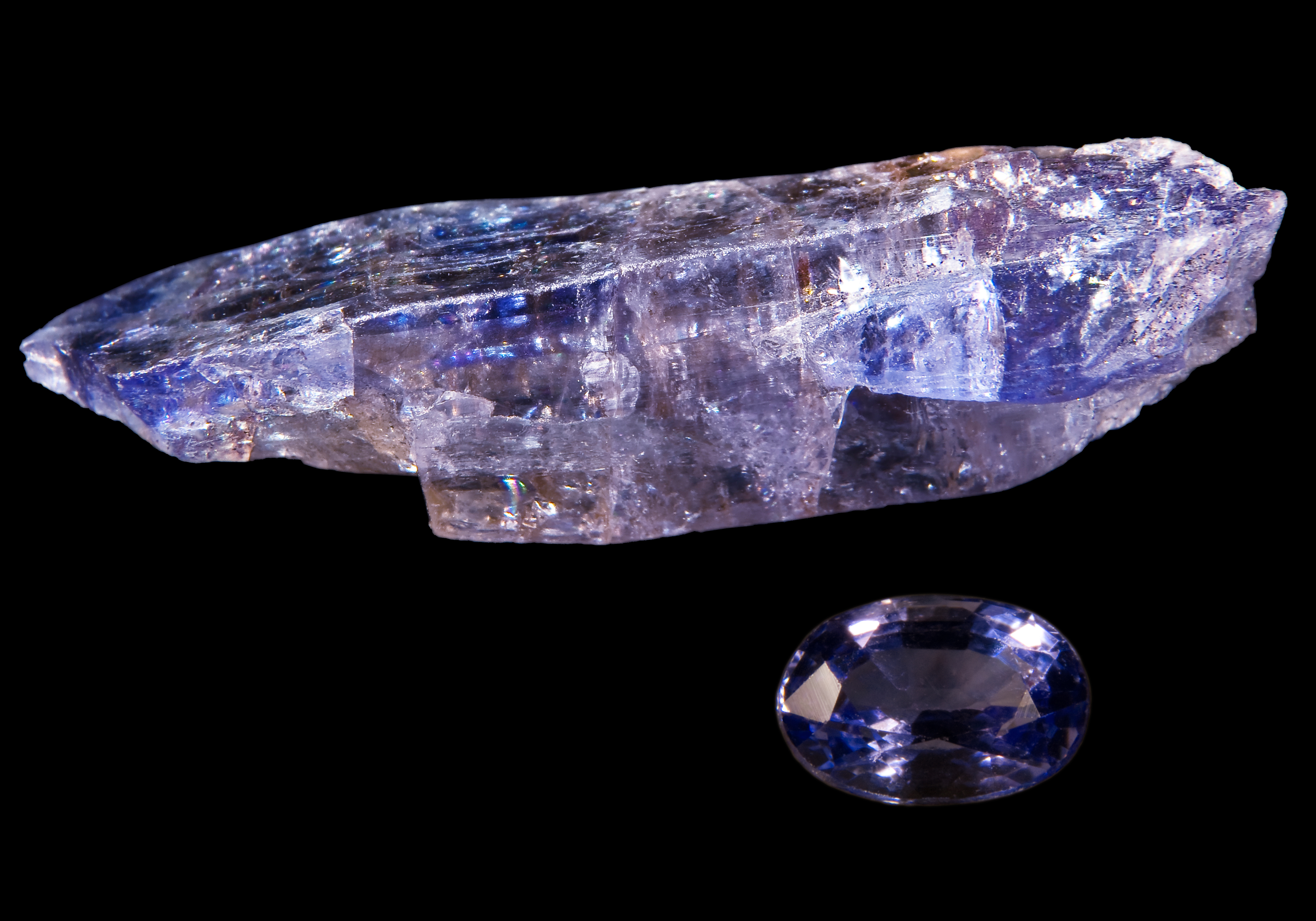
Photo: Wikimedia Commons
Typical specimen sizes range from tiny broken prisms and small terminated thumbnails to crystals a few centimeters long. Good miniature crystals are obtainable but always competitive when gemmy and undamaged. Fine cabinet-size crystals are rare because they require an unusual combination of crystal size, transparency, attractive color, limited fracturing, and survival from mining, transport, and the cutter’s table. Very large crystals may be impressive but are often fractured, etched, repaired, or partly opaque; exceptional large, gemmy, naturally complete crystals are museum-level pieces.
Matrix tanzanite is a special category. The Merelani environment is full of graphite, calcite, quartz, pyrite, diopside, amphibole, and grossular, but loose crystals are far more common in the specimen market than convincing matrix plates. The collector should be alert to repairs, reattachments, and fabricated associations. Natural matrix specimens are usually irregular and geologically plausible, with contact surfaces, growth relationships, and associated minerals that make sense under magnification.
Associated minerals help tell the Merelani story. Calcite and quartz occur with tanzanite in veins and pockets; graphite is abundant and can coat miners and specimens alike; pyrite and pyrrhotite reflect the sulfide-rich environment; diopside may be colorless to green and gemmy; grossular ranges from tsavorite green to lighter mint tones; fluorapatite, tremolite, kyanite, phlogopite, karelianite, and numerous sulfides document the vanadium-rich metamorphic system. For a serious locality suite, a tanzanite crystal accompanied by Merelani diopside, graphite, grossular, or sulfides is far more meaningful than a blue gem alone.
Quality factors differ depending on whether the buyer is judging a gem, a rough crystal, or a mineral specimen. In faceted gems, intense violetish blue color, high clarity, skilled orientation, and size above five carats are major value drivers. In crystals, sharpness, natural termination, pleochroism, transparency, luster, lack of edge chipping, and absence of repair matter more. In unheated collector crystals, brownish, reddish, greenish, or multicolored axes should not automatically be read as lower quality; they may be precisely what makes the specimen mineralogically desirable.
The first authenticity issue is origin. Commercial gem-quality tanzanite is tied to Merelani; when a seller gives a vague locality such as “Africa” or “Tanzania” without Merelani, ask for more context. That said, “Merelani” alone is not proof of quality. It tells you the locality; it does not tell you whether the crystal is natural, heated, repaired, coated, or correctly represented.
Heat treatment is normal in the tanzanite gem trade. Most blue tanzanite in jewelry owes its commercial color to heating, and laboratories can struggle to distinguish natural geologic heating from later human heating in many cases. For cut stones this treatment is accepted and stable. For mineral specimens, however, “unheated” can be meaningful, especially where the crystal preserves yellowish-brown, reddish-brown, greenish, or strongly trichroic directions. Because claims of “unheated” are difficult to prove conclusively, they should be supported by visual evidence, dealer reputation, and, for high-value pieces, laboratory documentation where possible.
Coatings are a separate concern. GIA has documented color-enhancing coatings on tanzanite, including cobalt-coated and titanium-coated examples. Coatings are most relevant to faceted stones, where a pavilion coating can intensify apparent blue-violet color; they are less common in natural crystal specimens but should remain on the collector’s checklist. Under magnification, look for uneven luster, color concentrated on surfaces, abraded facet junctions, chipped areas exposing lighter underlying color, or a color effect that seems too superficial.
Fracture filling is uncommon but known. Because tanzanite has fair to poor toughness and distinct cleavage, fractures are a practical concern whether the material is cut or crystallized. In faceted gems, surface-reaching fractures lower value and may be filled. In crystals, repaired breaks, glued terminations, or stabilized cracks are common enough that every expensive specimen deserves careful inspection under strong light and magnification. Long prismatic crystals are especially vulnerable to cleaving or bruising along edges and terminations.
Composite matrix specimens require caution. Fine tanzanite on matrix is rare and commands a premium, which creates incentive for reattached crystals or entirely constructed pieces. Examine the contact under magnification. Natural attachment should show believable growth relationships, mineral continuity, and no glue meniscus. Calcite-rich matrix can complicate inspection because white cleavage surfaces and adhesive can look similar at first glance; ultraviolet response, solvent sensitivity, and professional examination may help in doubtful cases.
Current availability is broad but uneven. Small crystals, crystal fragments, heated blue thumbnails, and modest faceted gems remain available through dealers. Attractive unheated crystals with good form are less common. Large, gemmy, undamaged, well-terminated crystals are scarce and pursued by both mineral collectors and gem-oriented buyers. Matrix pieces of convincing natural association are among the hardest categories to buy well. In practice, the best Merelani tanzanites should be approached like fine emerald or alexandrite specimens: buy the piece, not the label; inspect condition obsessively; and treat unusually low prices with suspicion.
Care is straightforward but important. Tanzanite is not sapphire. It has a Mohs hardness of about 6 to 7, fair to poor toughness, and cleavage, so it should be protected from knocks, sudden temperature changes, ultrasonic cleaning, steam cleaning, and careless handling. For specimens, avoid aggressive cleaning; graphite and calcite associations can be part of the locality character, and heavy cleaning may damage delicate surfaces or reveal repairs.
The discovery story at Merelani has always carried more than one voice. The polished-gem trade often tells it as a sudden vision of blue crystals weathering from the earth in 1967, followed by Manuel d’Souza registering claims and Tiffany & Co. transforming an obscure zoisite into “tanzanite.” Tanzanian accounts place Jumanne Ngoma at the center. Ngoma described walking through the bush near Kiteto in early January 1967 and seeing blue crystals lying on the ground. In one retelling, within hours he had collected about five kilograms of transparent blue stones. That detail matters: the world’s tanzanite story begins not with a faceted gem in a New York showcase, but with loose blue crystals on the ground in the dry country near Merelani.
Recognition did not come easily. Ngoma’s early certificate identified the material as an unusual variety of zoisite and suggested that a market could be found, but he spent years seeking acknowledgment. The Tanzanian government recognized him in 1984, and decades later, during the commissioning of the wall around the Mirerani mining site, he received a cash award from President John Magufuli. By then, tanzanite had become a global gemstone business, while the man associated in Tanzania with its discovery had lived through a long struggle for recognition.
There is also the legend of fire. Brownish zoisite crystals, the story goes, lay near the surface until a lightning-set grass fire swept the Merelani hills, heating them enough to reveal blue. Maasai herders noticed the changed color and picked up the crystals. Whether taken literally or as a mineralogical fable, the story captures an essential truth: tanzanite’s celebrated blue is tied to heat, and the line between nature’s furnace and the jeweler’s furnace has always been part of the gem’s identity.
A very different Merelani appears when the story goes underground. In the small-scale workings of Block D, visitors have described compounds crowded into tiny claims behind tin siding and barbed wire, with tunnels that ignore surface boundaries in the darkness below. At the Kikuyu Mine, one account records sixty miners working underground in teams of thirty on six-hour shifts. The manager, Nixon Monga, was only twenty-four, running the mine after his father’s death with the help of two partners. He explained that two years had passed with hardly any stones found, even as the tunnels pushed deeper into the earth.
The descent began with about a hundred meters of ladder. Below that, the passages narrowed into irregular tunnels only about a meter high. In places the visitors could not crawl on hands and knees; they had to move on their bellies through graphite-dark rock. Masks became useless in the dense graphite-laden air. At the working face, the miners pointed to pyrite and graphite in the veins they were following, reading those minerals as clues toward a pocket. The return was worse than the descent. The ladder became an exercise in exhaustion, and the surface appeared as a small circle of light above. When the men finally emerged, they were black with graphite and sweat, collapsing in the sun like “black ghosts.” One miner’s only reward after six hours underground was described as a small pale green diopside fragment.
The same district produced one of the modern gem world’s great windfalls. In June 2020, Saniniu Laizer, a Maasai small-scale miner, and his team found two enormous tanzanite stones at Mererani: one weighing 9.27 kg and the other 5.103 kg. He sold them to the Tanzanian government for 7.7 billion Tanzanian shillings, about $3.3 million. Laizer said he would use the money to build a school and a mall for his community and family. Weeks later he sold a third large stone, about six kilograms, for another multibillion-shilling payment. In a district where many miners chase narrow seams for months or years without a major pocket, Laizer’s finds became proof of the old Merelani dream: somewhere in the graphite and calcite, a single pocket can still change a life.
A 2023 mine visit recorded the newer face of security at Merelani. The visitors drove from Arusha for more than an hour toward D-Block, passing from greener country into semi-arid grassland. At the mining area they encountered the wall around the tanzanite field and a government-operated entrance where filming was not allowed. A military escort joined them before they entered the claim. At Suni Marasheki’s Natonya Camp they saw the generator feeding air to the mine, miners’ sleeping quarters, an old entrance with a steep wooden ladder, and a thorny natural barrier the owner jokingly called “wait a little bit” because anyone caught in it had to stop and untangle themselves. The newer entrance was easier than the old ladder but still steep, dusty, and unnerving. Underground, bags of dirt were pulled by a ceiling pulley, blast holes marked previous work, and the miners pointed out mica and other indicators. Above ground, explosives had been bought for fresh blasting; whether the rock would yield anything was still unknown.
Wilson, Wendell E.; Saul, John M.; Pardieu, Vincent; Hughes, Richard W. “Famous Mineral Localities: The Merelani Tanzanite Mines, Lelatema Mountains, Arusha Region, Tanzania.” The Mineralogical Record, 40(5), 346–408, 2009. The major locality monograph for Merelani, covering history, geology, mining, and specimens.
Malisa, E. P. J. “Trace elements characterization of the hydrothermally deposited tanzanite and green grossular in the Merelani–Lelatema shear zone, northeastern Tanzania.” Tanzania Journal of Science, 29(1), Article 3, 2003. Important trace-element and genetic work linking vanadium, hydrothermal processes, shearing, and deposition of tanzanite and green grossular.
Giuliani, G.; Ohnenstetter, D.; Palhol, F.; Feneyrol, J.; Boutroy, E.; de Boissezon, H.; Lhomme, T. “Karelianite and vanadian phlogopite from the Merelani Hills gem zoisite deposits, Tanzania.” The Canadian Mineralogist, 46(5), 1183–1194, 2008. Describes vanadium-rich mineral assemblages in the Merelani gem zoisite deposits.
Harris, C.; Hlongwane, W.; Gule, N.; Scheepers, R. “Origin of tanzanite and associated gemstone mineralization at Merelani, Tanzania.” South African Journal of Geology, 117(1), 15–30, 2014. A key paper on the geological origin of tanzanite and related gemstone mineralization at Merelani.
Jaszczak, John A.; Trinchillo, Daniel. “Miracle at Merelani: A remarkable occurrence of graphite, diopside and associated minerals from the Karo Mine, Block D, Merelani Hills, Arusha Region, Tanzania.” Rocks & Minerals, 88(2), 154–165, 2013. Documents the celebrated Karo Mine occurrence and the broader mineral-specimen potential of Block D.
Pohwat, Paul W. “Connoisseur’s Choice: Diopside, Merelani, Arusha Region, Tanzania.” Rocks & Minerals, 88(2), 166–173, 2013. A focused treatment of Merelani diopside, an important companion species for locality collectors.
Harrison, S. J.; Jaszczak, John A.; Keim, Mike; Rumsey, Mike; Wise, Michael A. “Spectacular sulfides from the Merelani tanzanite deposit, Lelatema Mountains, Manyara Region, Tanzania.” The Mineralogical Record, 45(5), 553–570, 2014. Records the remarkable sulfide suite from the tanzanite deposit, including wurtzite, alabandite, pyrite, sphalerite, chalcopyrite, millerite, stannite, tennantite-tetrahedrite, clausthalite, and colusite-germanocolusite.
Jaszczak, John A.; Rumsey, Michael S.; Bindi, Luca; Hackney, Stephen A.; Wise, Michael A.; Stanley, Chris J.; Spratt, John. “Merelaniite, Mo4Pb4VSbS15, a New Molybdenum-Essential Member of the Cylindrite Group, from the Merelani Tanzanite Deposit, Lelatema Mountains, Manyara Region, Tanzania.” Minerals, 6(4), 115, 2016. Describes merelaniite, named for Merelani and approved as a new mineral.
Bindi, Luca; Jaszczak, John A. “Richardsite, Zn2CuGaS4, A New Gallium-Essential Member of the Stannite Group from the Gem Mines near Merelani, Tanzania.” Minerals, 10(5), 467, 2020. Describes richardsite, another rare sulfide from the Merelani gem-mining district.
GIA Gem Encyclopedia: “Tanzanite Quality Factors.” Useful for gemological quality factors, pleochroism, heat treatment, clarity, cut, and size considerations.
GIA Gem Encyclopedia: “Tanzanite Care and Cleaning Guide.” Practical reference for durability, cleavage, cleaning, heat treatment, coatings, and fracture filling.
GIA Gems & Gemology: Cooper, Amy; Renfro, Nathan. “Titanium-Coated Tanzanite,” Spring 2014 Lab Notes. Documents titanium-coated tanzanite and the diagnostic clues used by GIA.
“Traveling to the Tanzanite Mines of Tanzania” — Steve Moriarty / Tanzanite Jewelry Designs — A narrated 2023 visit to a Mererani mine, including the security gate, D-Block claims, mine entrance, air pump, pulley system, blast holes, and underground footage.
“Going Down a Tanzanite Mine” — Gemstones.com — A mining video following a team into Block D and explaining the four-block structure of the Merelani tanzanite field.
Mindat locality page: Merelani Hills, Lelatema Mountains, Simanjiro District, Manyara Region, Tanzania — The best collector-oriented locality database entry, with species list, references, photos, coordinates, and sublocalities.
Lotus Gemology: “Tanzanite Mines of Merelani — Working the Blueseam” — Vivid field reporting on Merelani geology, mining blocks, Block D conditions, and the human side of tanzanite mining.
GIA: “Tanzanite History and Lore” — Concise history of the 1967 discovery story, Manuel d’Souza, Tiffany & Co., and tanzanite’s rapid rise in the jewelry world.
The Citizen: “Struggles of man who discovered tanzanite” — Tanzanian reporting on Jumanne Ngoma’s long struggle for recognition and the 2018 award connected with the Mirerani wall.
The Citizen: “Tanzanite discovery hits 51th anniversary” — Local account of the Tanzanite Founder Foundation and Ngoma’s recognition by successive Tanzanian governments.
WRAL/CNN: “Largest tanzanite gemstones in history sold for $3m” — News report on Saniniu Laizer’s 2020 discovery of two exceptionally large tanzanite stones.
The Citizen: “Laizer sells his latest 6kg Tanzanite gemstone for Sh4.8 billion” — Follow-up report on Laizer’s third major tanzanite sale in 2020.
Wikimedia Commons: Tanzanite crystal from Merelani Hills — Freely licensed photograph of a tanzanite crystal from Merelani Hills.
Wikimedia Commons: Zoisite var. tanzanite, Rob Lavinsky / iRocks.com — Freely licensed image of a large gemmy Merelani tanzanite crystal.
Wikimedia Commons: Tanzanite rough and cut stone from C-Block Mine — Freely licensed image showing rough and faceted Merelani tanzanite.
 Amethyst
 Quartz
 Fluorite
 Tourmaline
 Malachite
 Azurite
 Rhodochrosite
.JPG)

.jpg)