Tantalite from Shigar Valley occupies a special niche among Pakistan’s high-Himalayan pegmatite specimens: it is not the abundant showpiece mineral of the district—that honor usually goes to aquamarine, topaz, fluorite, albite, and schorl—but it is one of the valley’s most telling rare-metal signatures. The collector material is chiefly tantalite-(Mn), the manganese-dominant tantalum oxide MnTa2O6, historically traded as manganotantalite. In hand, the best crystals have a dense, glassy-to-submetallic presence, with black faces that flash deep cherry-red to reddish brown where light penetrates thin edges or broken corners.
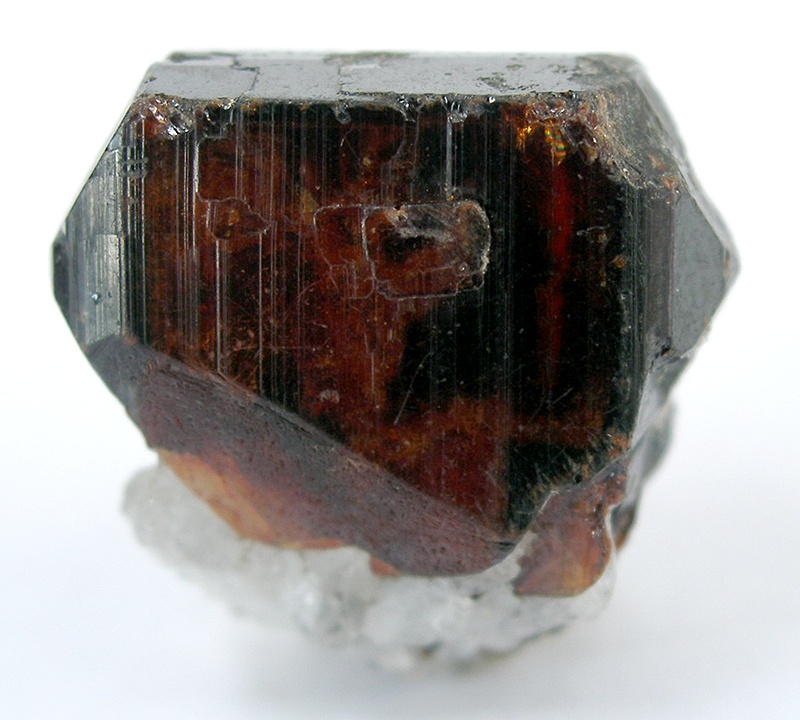
Photo: Wikimedia Commons
The locality’s appeal lies in contrast. A fine Shigar tantalite may sit against white albite or cleavelandite, pale quartz, silvery muscovite, black schorl, or blue aquamarine—an association that makes a heavy, dark, rare-metal oxide feel visually alive. The most distinctive examples are compact, complete crystals with beveled edges, striated faces, and an internal red translucency unusual enough to be remarked upon in specimen records.
Geologically, Shigar Valley sits in one of the great mineral-specimen provinces of northern Pakistan, along the Shigar River system north of Skardu. The valley lies near the Main Karakoram Thrust, where Asian-plate metasediments and gneisses meet the Kohistan–Ladakh arc rocks to the south. Its specimen mines exploit complex granitic pegmatites and, in some subareas, alpine-type fissures. For tantalite collectors, the most important setting is the evolved, rare-metal-bearing pegmatite suite—the same broad geological environment that produces aquamarine, topaz, albite, muscovite, schorl, cassiterite, fluorite, beryl varieties, and other pocket minerals.
Modern research has sharpened the picture of Shigar’s pegmatites. The valley is no longer just a romantic label attached to Pakistani aquamarines; it is recognized as a differentiated pegmatite field with Be–Li–Nb–Ta fertility, late-stage volatile enrichment, and multiple generations of emplacement. In collector language, that means the rare tantalum oxides are not random accessories. They are a mineralogical consequence of highly evolved pegmatitic melts and fluids concentrated in the same cavities and replacement zones that made the valley famous for aesthetic specimens.
Collectors usually look for three things: a confirmed Shigar provenance, a sharp crystal habit, and context. Loose, black tantalites can be difficult to separate visually from columbite-group minerals without analysis, so a matrix specimen with classic Shigar associations is more desirable. A rich red-brown crystal, a crystal on snow-white albite, a tantalite included with aquamarine, or a documented pseudomorph after microlite carries more locality character than a nondescript black fragment.
Search for specimens: View all tantalite specimens from Shigar Valley, Pakistan
Shigar Valley is a river valley locality in Shigar District, Gilgit-Baltistan, Pakistan, with general coordinates near the Shigar River by the town of Shigar. The Shigar River joins the Indus near Skardu, while the Basha and Braldu rivers drain into the broader Shigar system from the north. This geography matters to collectors because labels are often broad: specimens from the Shigar, Basha, and Braldu valley systems may be traded simply as “Shigar Valley,” and pieces from the wider Skardu market may acquire simplified locality names as they pass through dealer hands.
The tantalite-bearing material belongs to granitic pegmatites rather than the alpine-cleft mineralization for which parts of Alchuri and Hashupa are known. Pegmatites occur at high elevations, commonly cited in the broader district at roughly 2,500 to 4,000 meters above sea level. Yuno high mines, one of the named Shigar pegmatite areas, are described as a pegmatite mining area about 1,500 meters above Yuno village, at approximately 3,500 to 4,000 meters elevation. Mungo high mines share the same broader pegmatite field with Yuno and are specifically recorded for tantalite-(Mn).
The regional geological framework is Himalayan and Karakoram in the fullest sense: high relief, structurally complex crust, metamorphic host rocks, and granitic pegmatites emplaced into gneiss and related rocks. Field and petrographic studies separate Shigar pegmatites into simple and evolved types. The evolved pegmatites include muscovite-tourmaline-beryl-garnet and muscovite-tourmaline assemblages, with albite and muscovite especially prominent. These evolved bodies are the collector’s target for rare-metal accessory minerals and for the pocket associations that place tantalite with albite, schorl, aquamarine, quartz, muscovite, and feldspar.
Mining is small-scale, high-altitude, and specimen-driven rather than industrial in the way a large tantalum ore operation would be. Local miners work steep pegmatite outcrops and pockets in difficult terrain, and most Shigar tantalite has entered the collector market as a byproduct of gem-pegmatite specimen mining—especially aquamarine, topaz, fluorite, and associated pocket minerals. Access for casual visiting collectors should not be assumed. The productive sites are remote, often locally controlled, and reached through village- and dealer-based networks rather than through public collecting access.
The valley’s modern specimen history is strongest from the late twentieth century into the present, when northern Pakistan became one of the world’s dominant sources of pegmatite display specimens. Tantalite itself is much scarcer than aquamarine or topaz, but documented material has been present in dealer and reference collections for decades. A well-known 1.4 cm manganotantalite crystal from Shigar, formerly in the Laura and Stevia Thompson collection and photographed by Rob Lavinsky, shows the red, beveled, complete crystal style that made the locality recognizable for this species. More unusual still are Shigar pseudomorphs of tantalite after microlite: sharp octahedral forms, originally microlite-group crystals, replaced or coated by metallic-luster tantalite.
Named Shigar-area localities and sublocalities that matter for context include Mungo high mines, Yuno high mines, Kashmal pegmatites, Alchuri, Hashupa, and the wider Shigar Valley locality. Not all of these are tantalite localities in the strict sense; some are better known for alpine minerals, aquamarine, topaz, fluorite, or other pegmatite species. For tantalite specimens, the important point is to preserve the most precise label available. “Shigar Valley” is a valid and widely used locality, but “Mungo high mines” or another specific pegmatite source is more valuable when supported by reliable provenance.
Shigar tantalite is most often encountered as tantalite-(Mn), MnTa2O6, and is commonly described in older collector language as manganotantalite. Good crystals are short-prismatic, blocky, stout, tabular to barrel-like, or compact and beveled. Faces may show strong vertical striation, and the luster ranges from vitreous on thin, translucent areas to submetallic or nearly metallic on darker faces. The densest-looking crystals can appear almost black until backlit, when reddish brown, cherry-red, or deep garnet-red tones emerge.
The classic single-crystal size for fine display material is small: roughly thumbnail scale, often around 1 to 2 cm. Larger matrix pieces exist, especially where tantalite is part of an associated pegmatite assemblage or a pseudomorph after microlite. Documented pseudomorph examples include cabinet-sized matrices around 10 to 11 cm across, with the replaced microlite octahedron itself much smaller—one auctioned example described a 1.6 cm octahedron on muscovite and adularia. Ordinary grains, incomplete crystals, and dark oxide fragments are less compelling unless they are analytically documented or attached to a strong Shigar matrix.
Associations are a major quality factor. Albite and cleavelandite provide the strongest visual contrast, especially when white, bladed, or sharp. Schorl adds locality character and a structural “perch” for tantalite clusters. Muscovite is common in the evolved pegmatites and appears as silvery books, flakes, or sugary matrix. Quartz, microcline or adularia, aquamarine, and occasionally columbite-group minerals may be present. Shigar aquamarines have been documented with mineral inclusions identified as brown tantalite, which adds another collecting angle: tantalite can appear not only as a specimen mineral on matrix, but also as a diagnostic inclusion in the valley’s most famous gem species.
The most desirable Shigar tantalite specimens combine form, color, and setting. A complete crystal with red translucency and beveled terminations is excellent even as a loose thumbnail. A crystal on albite, quartz, schorl, or muscovite is better. A specimen with aquamarine association is more locality-rich still. A confirmed pseudomorph after microlite is a specialist piece: less conventionally beautiful than a gemmy red single crystal, but far rarer and more scientifically interesting.
Collectors should also distinguish between tantalite and columbite when possible. Shigar is recorded for both tantalite-(Mn) and columbite-(Fe), and the two can be difficult to separate by sight in dark, opaque crystals. High-tantalum, manganese-dominant material is properly tantalite-(Mn); niobium-rich or iron-dominant material belongs elsewhere in the columbite group. When the distinction matters for value, written analytical support, a reputable old label, or a minID tied to a known specimen is worth preserving.
The main authenticity issue is not widespread artificial treatment; it is identification and locality precision. Dark columbite-group minerals are visually treacherous. A black, striated, heavy crystal from a pegmatite may be sold as “tantalite,” “columbite-tantalite,” “manganotantalite,” or “columbite” depending on tradition, analysis, and dealer confidence. For Shigar pieces, the manganese-rich tantalite-(Mn) label is strongest when backed by analysis, a reputable dealer record, a museum or minID reference, or a long-standing provenance.
No well-documented Shigar-specific treatment industry for tantalite specimens is evident in the available mineralogical records. Tantalite is dense, relatively hard, dark, and not a species typically enhanced by heating or dyeing in the way some colorful gems are. The more realistic concerns are glued repairs, assembled matrix, added loose crystals, overcleaning, and mislabeling. Matrix pieces should be examined under magnification where the tantalite meets albite, muscovite, quartz, or schorl. Natural contact should show growth relationships, pocket clay residue, or tight intergrowth rather than shiny adhesive, suspicious gaps, or a crystal base that does not match the surrounding matrix.
Condition issues are common because tantalite is brittle and crystals may have cleavage or fractured edges. The best Shigar crystals show crisp bevels, lustrous faces, and intact terminations; many otherwise attractive pieces have bruised corners, contacted rear faces, or small chips along exposed edges. On pseudomorphs after microlite, a hole, cavity, or irregular surface may be natural to the replacement texture rather than damage, so evaluate those pieces by the integrity of the octahedral form and the quality of the matrix rather than by expecting a perfect glossy crystal.
Rarity is real at specimen grade. Shigar aquamarine, topaz, and albite specimens are abundant in comparison; tantalite appears sporadically and usually in small sizes. Fine red, complete crystals are scarce. Tantalite on matrix is scarcer. Tantalite with aquamarine, schorl, or a strong albite association is better still. The pseudomorphs after microlite form a distinct rarity class, especially when documented as part of the small, old finds that passed through recognized dealer stock.
Market availability is intermittent. Recent online records show Shigar tantalite specimens ranging from modest auction results for smaller or less showy pseudomorphs to multi-thousand-dollar asking prices for larger, rare, or aesthetic examples. A 10.1 x 7.1 x 4.3 cm tantalite-after-microlite pseudomorph closed at auction in January 2024 for $174, while another Shigar tantalite-after-microlite specimen listed through Minfind and The Arkenstone was recorded at 110 x 70 x 40 mm with a $3,000 asking price. A separate “tantalite on muscovite with schorl” Shigar listing was shown in Minfind’s related market data at $4,500. Those figures should not be treated as a price guide by themselves, but they do show the spread: modest examples can slip through specialist auctions, while highly aesthetic or well-provenanced matrix specimens can be priced as serious rare-pegmatite specimens.
For buying, prioritize: exact locality wording, matrix consistency, absence of glue, crystal completeness, red translucency, and whether the specimen is truly tantalite rather than an unanalyzed columbite-group oxide. Keep every old label. Shigar-area labels often compress several valleys and trading centers into one name, and provenance can be the difference between a pretty dark pegmatite oxide and a scientifically meaningful rare-metal specimen from one of Pakistan’s great pegmatite districts.
One of the most memorable Shigar tantalite stories is not about a giant crystal, but about a shape that should not belong to tantalite at all. In January 2024, a cabinet specimen sold at Mineral Auctions under the title “Tantalite ps. Microlite.” The specimen measured 10.1 x 7.1 x 4.3 cm, but the drama was concentrated in a much smaller form: a sharp, well-placed 1.6 cm octahedron. Octahedra are the language of microlite-group minerals, not the normal habit of tantalite. The specimen was described as a microlite octahedron pseudomorphed by metallic-luster tantalite, resting on an undulating matrix of sugary muscovite and adularia. Even the imperfection was part of the character: a hole in the crystal face gave the replaced octahedron an unmistakable look.
The provenance adds another layer. The auction record tied the piece to Herb Obodda dealer stock and called attention to the rarity of the occurrence, describing it as coming from a very small find made in the summer of 2007 and also valuing the material as part of a single one-pocket discovery circa 2000. Those details are a reminder of how Pakistani pegmatite specimens often enter the literature of collecting: not as mine-company production reports, but as pocket finds, dealer stock, old labels, and a handful of memorable pieces that surface years later.
The best single-crystal image of Shigar manganotantalite tells a quieter story. The crystal is only 1.4 x 1.4 x 1.3 cm, yet it has become a reference image because it shows exactly what collectors hope for: a complete, beveled crystal with unusually strong red color. It came from the Laura and Stevia Thompson collection and was photographed by Rob Lavinsky. In a district celebrated for pale blue aquamarine and white albite, that small red-black oxide crystal shows the hidden rare-metal personality of Shigar.
 Amethyst
 Quartz
 Fluorite
 Tourmaline
 Malachite
 Azurite
 Rhodochrosite