Stellerite from Jalgaon District belongs to the great Deccan Trap zeolite tradition: specimens born in basalt cavities, removed from working stone quarries, and prized because soft-looking radial forms emerge from dark volcanic matrix with a delicacy that belies the industrial setting. The best Jalgaon pieces show creamy to colorless, pearly “balls,” pinwheels, bow-ties, and sheaf-like clusters of thin blades. Their appeal is strongly sculptural: rounded aggregates sit in black basalt vugs, sometimes with bright white or pinkish quartz and chalcedony, green celadonite-stained patches, apophyllite, heulandite, or stilbite-like zeolites acting as contrast.
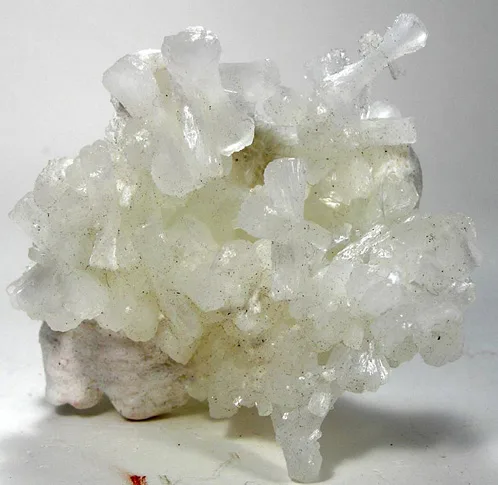
Photo: Minerals.net / iRocks.com Photo
The mineralogical fascination is also the chief collecting complication. Stellerite, Ca4(Si28Al8)O72·28H2O, is the calcium-rich orthorhombic member of the stilbite subgroup, and in hand specimen it can look virtually identical to stilbite-Ca. Jalgaon material has long circulated in the trade under both names, and attractive pieces are often sold on morphology alone. Serious collectors should therefore treat the finest Jalgaon “stellerite” as both beautiful and identity-sensitive: the best examples are display-worthy, but the strongest labels are those backed by XRD and chemistry rather than by the rounded habit alone.
Geologically, the district sits in the Deccan Volcanic Province, where stacked tholeiitic basalt flows cooled with vesicles, amygdales, and larger open cavities. Mineral-rich fluids later moved through the basalt and deposited clay minerals, silica, zeolites, calcite, apophyllite, and related species. Around Savda and neighboring Jalgaon quarry areas, the large cavities of dense flow-core basalt have been especially productive for zeolite specimens. Stellerite is not the common face of Jalgaon collecting—apophyllite, stilbite-Ca, heulandite, chalcedony, and quartz dominate the market—but when confirmed, Jalgaon stellerite gives collectors a rarer calcium-zeolite member from one of India’s most famous specimen districts.
Search for specimens: View all stellerite specimens from Jalgaon District, India
Jalgaon District is in northern Maharashtra, within the Nashik Division, and its zeolite specimens come from the basaltic lava-flow landscape of the Deccan Traps. The collector locality is not a single mine in the ore-deposit sense; it is a district-scale suite of basalt quarries, quarry complexes, and related road or construction exposures. The best-documented sublocality is the Savda quarry complex near the city of Jalgaon, recorded around 20°59′N, 75°27′E at roughly 230 m elevation. Mindat records stellerite for Jalgaon District and for Savda, while also recording the closely related and visually confusable stilbite-Ca from the same district.
The deposit type is classic secondary mineralization in basalt cavities. Individual compound lava flows at Savda show a vesicular upper zone, a denser core zone with larger cavities, and a lower zone with fewer vesicles. Small vesicles and amygdales may be filled completely by clay minerals, chalcedony, zeolites, or calcite, while the larger cavities in the flow core can be several decimeters to more than a meter across. Those larger cavities are the source of the cabinet-quality Deccan specimens: crystals had open space, fluids had time to evolve, and mineral generations could grow over earlier wall linings rather than simply filling the vesicle as massive amygdaloidal material.
Mining is primarily for basalt aggregate and construction stone, with mineral collecting as a secondary activity. This is an important point for collectors: the productive pockets are discovered because rock is being quarried, not because stellerite is being mined as a commodity. Fresh cavities may be opened by blasting or quarry work; specimens are then removed by workers, local dealers, or visiting collecting networks. Access is therefore quarry-controlled, variable, and commercial. A visitor should not assume that a named Jalgaon locality is open to casual collecting, and older labels may say only “Jalgaon,” “Jalgaon District,” “Savda,” “Savada,” or simply “Maharashtra, India.”
The modern specimen history of the district belongs to the broader rise of Indian Deccan zeolites in the international market from the late twentieth century onward. In the Jalgaon/Savda area, scientific studies and specimen observations document long-running quarry activity from the 1990s into the 2010s, with fresh cavities allowing repeated observation of mineral sequences. Dealer records show Jalgaon stellerite appearing as cabinet specimens, small cabinets, and miniatures in the 2010s and 2020s rather than as a constant bulk mineral. Production is thus episodic: a productive pocket can briefly place attractive material on the market, then the locality may be represented for years mainly by older collection pieces and occasional secondary-market specimens.
Notable Jalgaon finds include cream-colored stellerite spheres to several centimeters, pinwheel clusters on matrix, colorless blade groups, and large vug specimens with stellerite set among apophyllite, stilbite-like blades, quartz, chalcedony, and celadonite-stained green areas. A particularly striking cabinet example was described with two translucent cream stellerite spheres to about 6 cm in a basalt vug with smaller apophyllite and stilbite and a patch of green celadonite-infused chalcedony. Other documented market pieces include a 5.2 cm partial radial ball on basalt, a 2.6 cm raised pinwheel in a small-cabinet composition, and miniature white to colorless spherical aggregates to about 2.1 cm.
The classic Jalgaon habit is radial. Rather than isolated single crystals, specimens usually present as intergrown blades forming rounded balls, partial spheres, bow-ties, rosettes, pinwheels, or sheaves. Individual blades are typically thin, pearly, and tightly stacked, giving the aggregates a silky shimmer. Where the blades are more open, the piece can read as a spray or fan; where they are compact, the aggregate becomes a lustrous cream-colored dome or ball.
Color is generally white, colorless, off-white, pale cream, or very light yellowish cream. The most attractive pieces balance translucency with pearly luster: the aggregates glow softly at the edges while flashing from the cleavage faces. Dark basalt matrix is highly desirable because it frames the pale zeolite clearly. The best compositions look deliberately arranged, with one or two dominant balls or pinwheels set in a vug rather than scattered shapelessly over matrix.
Typical collector sizes range from miniatures with 1–2 cm balls to cabinet pieces carrying 5–6 cm aggregates. Verified market examples document specimens around 3.7 x 3.6 x 2.1 cm with spherical aggregates to 2.1 cm, small cabinets around 5.5 cm across with multiple pinwheels, and cabinet pieces exceeding 10 cm with a dominant 5.2 cm partial radial ball or paired aggregates to 6 cm. Larger matrix specimens are much less common than small examples and command a premium when the stellerite is clean, centered, and not battered from pocket removal.
Associated minerals are those of the Jalgaon basalt-cavity suite. The most collector-relevant associations are fluorapophyllite-(K), stilbite-Ca or stilbite-subgroup blades, heulandite-Ca or heulandite-subgroup crystals, quartz, chalcedony, celadonite, calcite, and occasionally powellite in the broader Savda system. Chalcedony and quartz can provide glittering or stalactitic substrates; celadonite can add green contrast; apophyllite can contribute glassy blocky or pyramidal crystals. Association is a major quality factor only when it improves the composition. A stellerite ball isolated cleanly on black basalt may be more desirable than a crowded zeolite plate with better species diversity but weaker display.
The best Jalgaon stellerite has four traits: confirmed identity, undamaged radial form, lively pearly-to-wet luster, and strong contrast. Confirmation matters because stellerite and stilbite-Ca can be visually indistinguishable. Undamaged radial form matters because the outer tips of the blades mark the sphere; once bruised, the aggregate loses its geometry. Luster matters because a dull, chalky ball can look inert, while a silky translucent one catches light across hundreds of cleavage faces. Contrast matters because pale cream zeolite on pale quartz can disappear visually, whereas cream on black basalt or green celadonitic chalcedony has the boldness collectors expect from the district.
The central authenticity issue is not artificial treatment but species identity. Jalgaon stellerite should be approached as a member of the stilbite subgroup that requires analytical support for certainty. Stellerite is orthorhombic and calcium-rich; stilbite-Ca is monoclinic and sodium-calcium bearing, yet both may form the same bow-tie, sheaf, fan, and spherical aggregates. Visual ID is especially risky for Indian Deccan material because both species occur in basalt cavities, both can be cream to colorless, and old labels may have been assigned by habit rather than analysis.
For high-value pieces, ask whether the specimen has XRD and chemical data, or at least whether it came from a collection with analytical documentation. EDS alone can indicate a calcium-rich, sodium-poor composition, but XRD is needed to distinguish the orthorhombic structure from visually similar stilbite-Ca. Be cautious with labels that use the words “stellerite,” “stilbite,” “epistilbite,” or “stilbite subgroup” interchangeably; this is not automatically dishonest, but it signals that the piece may have been identified in the trade rather than in the lab. One detailed study of Savda material reported that crystals examined from Savda were confirmed as stilbite-Ca even though stellerite was known from several other Deccan outcrops, which is exactly the kind of caution serious collectors should keep in mind.
Condition problems are typical of radial zeolites from basalt pockets. The edges of balls and pinwheels are easily contacted where they separated from the pocket wall, and the outermost blades bruise or cleave during extraction. Look for flat shaved areas, missing sectors, crushed blade tips, and dull abrasion on the highest points. A basal contact is normal if the ball grew against the cavity wall, but fresh-looking scuffs on the display face are a major value penalty. The dark basalt matrix can also be fragile around the pocket edge, so stabilized bases and custom mounts are common for larger vug pieces.
Rarity is relative. Jalgaon District is a prolific zeolite region, but stellerite is scarce compared with apophyllite, stilbite-Ca, heulandite, quartz, and chalcedony. Small Jalgaon stellerite specimens do appear periodically, especially through auction channels and older collection dispersals, but top examples with confirmed identity, clean form, and strong aesthetics are uncommon. Recent documented auction records show modest miniatures selling in the under-$100 range, while large, aesthetic, old-collection cabinet pieces have been described with retail expectations around $1,000 or more. The wide spread reflects the realities of the species: a small attractive sphere is collectible, but a large confirmed Jalgaon stellerite with undamaged display geometry is a much more serious specimen.
The best field story from Jalgaon is not a romantic tale of a lone prospector with a hand pick; it is the stranger reality of a working basalt quarry repeatedly opening sealed mineral chambers in lava that erupted tens of millions of years ago. At Savda, researchers described a huge quarry complex near Jalgaon where cavities in dense basalt were not industrially valuable for stone production, yet became scientifically and commercially important because they contained fine minerals. The same quarrying that breaks rock for aggregate also exposes pockets lined with chalcedony, zeolites, calcite, apophyllite, and the dark green filamentous structures that made Savda a subject of serious mineralogical research.
One quarry wall described in the Savda studies stood about 7 m high and showed the architecture of a basalt flow in plain view. The upper part was altered and vesicular, crowded with small mineral-filled cavities. The flow core was denser, but that is where the larger voids occurred—irregular cavities big enough to preserve centimeter-scale euhedral crystals. A single flow could contain small sealed amygdales near the top and larger specimen cavities in the core, so the quarry face was essentially a cross-section through the pocket-forming anatomy of the lava.
The Savda cavities could be dramatically shaped. Researchers illustrated arched-roof cavities, round cavities, cavities with flat bottoms, and upward-convex “skirted” forms. In the larger core-zone cavities, a lining of celadonite or smectite could be followed by chalcedony, calcite, heulandite, stilbite, apophyllite, and related zeolite generations. Even neighboring cavities could differ sharply: one might be only thinly lined, another filled by stilbite or apophyllite, another rich in chalcedony-coated filamentous forms. That variation is part of why collector labels from the district can be frustrating. “Jalgaon” may be truthful, but it often hides the pocket-level complexity that determined which minerals actually grew together.
The most vivid scientific episode concerns the subsurface filamentous fabrics, the SFFs, that occur in the Savda quarry complex. In one described cavity about 40 cm wide, dark green filamentous structures coated the ceiling and walls. Some projected downward from the roof in a gravity-controlled orientation; others grew randomly along the walls; still others were embedded in chalcedony at the cavity bottom in a texture compared with moss agate. These were not simple stalactites. Detailed work argued that the innermost filament cores had features consistent with microbial activity, later mineralized by Fe/Mg-rich clays and silica. For a collector holding a Jalgaon zeolite specimen, that story adds depth: the same district that yields glossy apophyllite and pale radial zeolites also preserves macroscopic mineral fabrics that researchers considered possible biosignatures of former subsurface life.
Another field detail matters directly to specimen collectors: the best crystals are not necessarily from the most altered, most vesicular part of the rock. At Savda, the large display cavities occurred in the dense flow core, where open space allowed free growth. The upper vesicular zone produced abundant mineral fillings, but small vesicles tend to make complete amygdales rather than dramatic cabinet specimens. This is why a large basalt vug with a clean stellerite ball or zeolite rosette is more than an attractive object; it records the rare coincidence of a big enough void, the right fluid chemistry, enough time, and an extraction gentle enough to keep the delicate radial blades intact.
Berthold Ottens, Jens Götze, Ralf Schuster, Kurt Krenn, Christoph Hauzenberger, Benkó Zsolt, and Torsten Vennemann, “Exceptional Multi Stage Mineralization of Secondary Minerals in Cavities of Flood Basalts from the Deccan Volcanic Province, India,” Minerals 9(6), 351, 2019 — Essential Savda/Jalgaon paper for the quarry setting, flow-core cavities, multistage mineralization, apophyllite ages, and zeolite paragenesis. (mdpi.com)
Jens Götze, Beda Hofmann, Tomasz Machałowski, Mikhail V. Tsurkan, Teofil Jesionowski, Hermann Ehrlich, Reinhard Kleeberg, and Berthold Ottens, “Biosignatures in Subsurface Filamentous Fabrics (SFF) from the Deccan Volcanic Province, India,” Minerals 10(6), 540, 2020 — Detailed study of Savda/Jalgaon filamentous fabrics, cavity textures, and mineralized structures associated with the same basalt-cavity environment. (researchgate.net)
R. N. Sukheswala, R. K. Avasia, and Maya Gangopadhyay, “Zeolites and associated secondary minerals in the Deccan Traps of Western India,” Mineralogical Magazine 39, 658–671, 1974 — Classic regional treatment of Deccan Trap zeolites, their cavity occurrence, zonation ideas, and associated secondary minerals. (rruff.net)
R. B. Golekar, S. N. Patil, Mrunali Joshi, Aakanksha Vaidya, Pooja Kamble, and Rohini Ranjit Ambure, “Chemico-Mineralogical and Petrographical Study of Natural Zeolites and Apophyllite in Basalts from Deccan Trap, Northern Maharashtra (India),” Bulletin of Pure and Applied Sciences 37F(1), 1–17, 2018 — Petrographical and analytical study of zeolites and apophyllite from the Savda quarry area of Jalgaon District. (bpasjournals.com)
International Zeolite Association, “Stellerite” natural zeolite data sheet — Useful mineralogical reference for stellerite morphology, structure, composition, and the analytical distinction from stilbite-Ca. (iza-online.org)
Mindat locality page: Jalgaon District, Nashik Division, Maharashtra, India — Primary locality record listing stellerite, stilbite-Ca, fluorapophyllite-(K), heulandite-Ca, quartz, chalcedony, and other district minerals. (mindat.org)
Mindat locality page: Savda, Sawade Pr Chandsar, Jalgaon District, Maharashtra, India — Key sublocality page for the Savda quarry complex, including coordinates and the recorded mineral suite. (mindat.org)
Mineral Auctions: “Superb Stellerite,” Jalgaon, Maharashtra, India, D. R. Kennedy Collection — Documented cabinet specimen with two cream, translucent spherical aggregates to 6.0 cm in a large basalt vug with apophyllite, stilbite, and celadonite-infused chalcedony. (mineralauctions.com)
Mineral Auctions: “Stellerite (fine quality) (ex Charlie Key Collection),” Jalgaon District, Maharashtra, India — Documented 10.2 cm cabinet specimen with a 5.2 cm partial radial ball on basalt matrix and useful discussion of mislabeling as epistilbite. (mineralauctions.com)
Mineral Auctions: “Stellerite (good quality),” Jalgaon, Maharashtra, India, ex Jack Halpern Collection — Recent miniature market record for white/colorless spherical aggregates to 2.1 cm on dark matrix, with auction price history. (mineralauctions.com)
“Stellerite (Sherburn Coll.)” — Mineralauctions.com — Short auction video for a Jalgaon stellerite pinwheel specimen from the Tim Sherburn Collection. (vimeo.com)
“Stellerite (good quality)” — Mineralauctions.com — Short auction video for an ex Jack Halpern miniature stellerite from Jalgaon. (vimeo.com)
Mindat “Best of Stellerite” article — Best single collecting-oriented discussion of stellerite, including the caution that Jalgaon and other Deccan Trap material is difficult to separate visually from stilbite-Ca. (mindat.org)
Mindat stellerite mineral page — Mineral data, formula, physical properties, habits, and identification warnings for stellerite. (mindat.org)
Mindat Jalgaon District locality page — District-level mineral list and rock-type record for Jalgaon. (mindat.org)
Mindat Savda locality page — Key sublocality record for Savda/Sawade Pr Chandsar, including the recorded zeolite and silica assemblage. (mindat.org)
International Zeolite Association stellerite data sheet — Concise scientific reference for stellerite crystallography, chemistry, and diagnostic separation from stilbite-Ca. (iza-online.org)
Minerals.net stellerite gallery — Includes a photographed Jalgaon District stellerite example and comparative stellerite images from other world localities. (minerals.net)
Mineral Auctions Jalgaon stellerite pinwheels record — Useful recent market example documenting size, habit, collection provenance, and auction result for a small-cabinet Jalgaon specimen. (mineralauctions.com)
Mineral Auctions Jalgaon stellerite cabinet record, ex Charlie Key Collection — Important market record for a larger radial-ball specimen and for the epistilbite/stellerite labeling issue. (mineralauctions.com)
Ottens et al. 2019, Minerals: Exceptional Multi Stage Mineralization of Secondary Minerals in Cavities of Flood Basalts from the Deccan Volcanic Province, India — The most useful geological paper for understanding Savda/Jalgaon cavity formation and multistage secondary mineralization. (mdpi.com)
 Amethyst
 Quartz
 Fluorite
 Tourmaline
 Malachite
 Azurite
 Rhodochrosite