Huanggang sphalerite is one of the great modern surprises among Chinese sulfides: transparent to richly translucent yellow ZnS from a hard-rock Fe-Sn skarn system better known to many collectors for fluorite, ilvaite, arsenopyrite/löllingite, scheelite, prase quartz, and complex calcite associations. The best pieces have a clear lemon-to-golden body color that reads very differently from the brown-orange, red, or greenish tones seen in many other gem sphalerite localities. When a strong light is placed behind them, the crystals can glow with a glassy internal fire that makes their zinc-sulfide identity feel almost improbable.
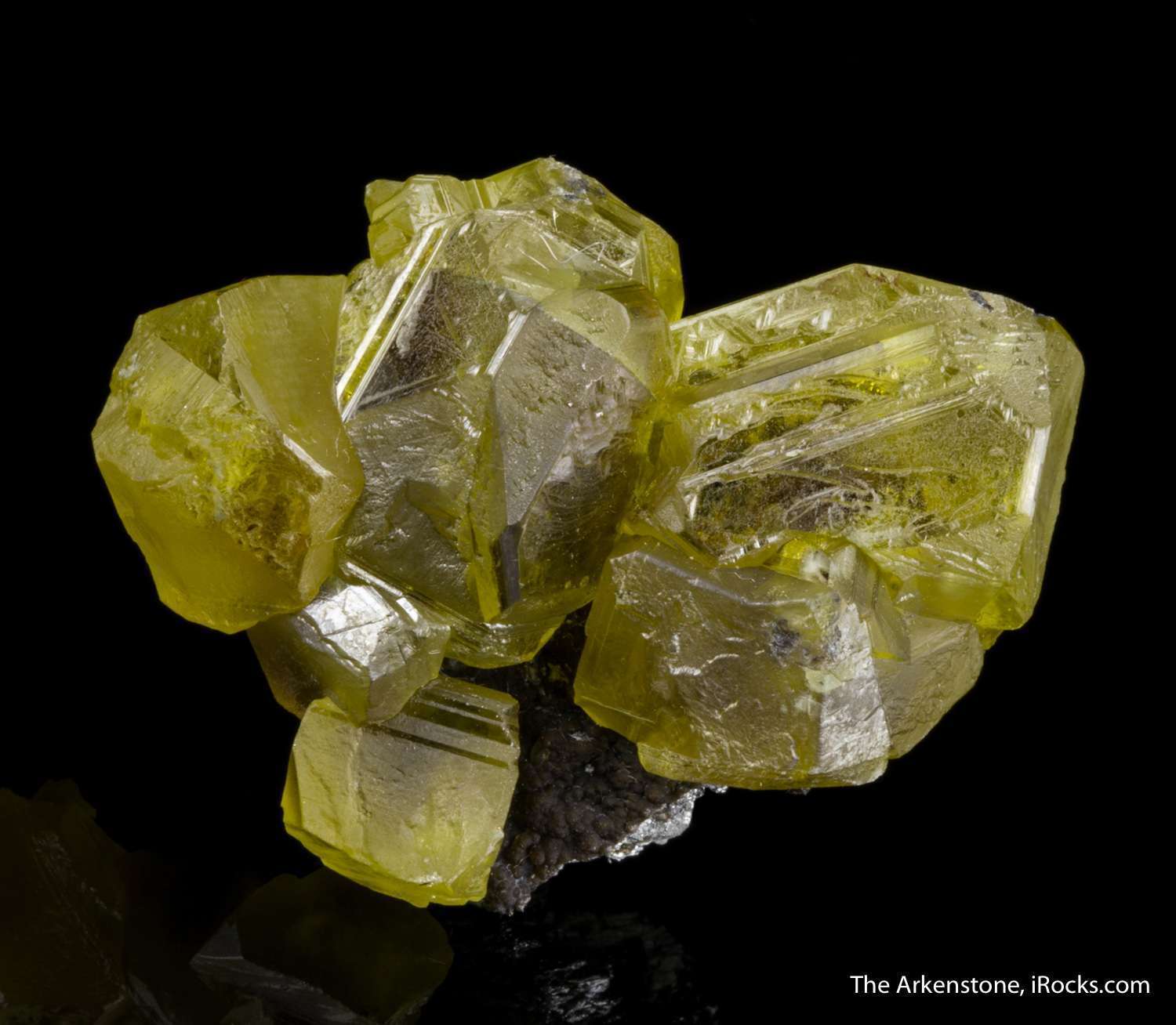
Photo: International Gem Society
The locality is the Huanggang Fe-Sn deposit in Hexigten Banner, Chifeng City, Inner Mongolia. Mineralogically it is not a simple “zinc mine” occurrence; it is a polymetallic skarn and hydrothermal system in which magnetite, cassiterite, fluorite, quartz, calcite, galena, pyrrhotite, chalcopyrite, pyrite, arsenopyrite, sphalerite, and other species formed through a long sequence of magmatic-hydrothermal events. That setting matters to collectors because Huanggang sphalerite often appears as late, gemmy crystals in aesthetic association with white calcite, clear quartz, galena, siderite, or fluorite rather than as massive ore.
The collector appeal is very specific: sharp, lustrous, gem yellow crystals; strong transparency under backlighting; attractive contrast against pale carbonate or quartz; and specimens that preserve sphalerite as a mineral specimen rather than cutting rough. Matrix pieces are especially desirable because a notable portion of the loose gemmy material was suitable for faceting, and fine natural clusters have become much less common on the market than they were when the discoveries were fresh.
Search for specimens: View all sphalerite specimens from Huanggang Mine, Inner Mongolia, China
Huanggang is a large Fe-Sn-polymetallic skarn deposit in the southern Greater Khingan Range of northeastern China, in the broader metallogenic province that also hosts important tin, lead-zinc, silver, copper, molybdenum, and iron systems. The deposit lies in Inner Mongolia’s Hexigten Banner, near Chifeng City, and is commonly labeled in the specimen trade as Huanggang Mine, Huanggang Mines, Huanggangliang, or Huanggang Fe-Sn deposit. For precision, serious labels should retain the Fe-Sn deposit name and, when known, the mine number or ore zone.
The ore system formed mainly along contacts between granitoid intrusions and carbonate-rich country rocks, especially marble units of the Huanggang and Dashizhai formations. Named intrusions include the Luotuochangliang intrusion and the 204 intrusion, and the skarn mineralogy varies with distance from the intrusive centers. Garnet is widespread; proximal skarns are richer in amphibole and fluorite, while more distal skarns are more calcite-rich. Later hydrothermal stages introduced cassiterite, quartz, calcite, fluorite, arsenopyrite, pyrite, galena, pyrrhotite, chalcopyrite, sphalerite, and other sulfides.
Modern genetic work places the principal skarn-forming and ore-related magmatic event in the Early Cretaceous, around 132 Ma. The sequence is best understood as an early high-temperature skarn and oxide system followed by cooler sulfide and carbonate stages. The sphalerite of collector interest belongs to the polymetallic sulfide part of the system, where sphalerite occurs with galena, chalcopyrite, pyrrhotite, pyrite, quartz, and calcite rather than with the earliest magnetite-rich skarn alone.
Mining history and specimen history do not perfectly overlap. The deposit was discovered in 1959, and exploitation of iron and tin ores began in the early 1990s under Inner Mongolia Huanggang Mining Co. Fine specimens, however, became widely known to the international collecting community much later. Significant specimen production began entering the market around 2009–2010, and Huanggang quickly acquired a reputation as one of the most exciting new Chinese localities of the period. Early attention focused heavily on ilvaite, fluorite, arsenopyrite/löllingite, scheelite, quartz, and calcite; gem yellow sphalerite followed as one of the locality’s most distinctive sulfide specialties.
Access should be regarded as industrial, not recreational. Huanggang is an operating mining complex, and specimens have reached collectors through mine workers, Chinese dealers, show networks, and international dealers rather than through open public collecting. As with many Chinese industrial localities, exact mine-number attribution may be inconsistent unless a specimen has strong contemporary documentation from the original dealer or collection.
Notable finds include world-class ilvaite in 2010, pink and multicolored fluorites, löllingite/arsenopyrite combinations, purple scheelite from early 2012, and gem yellow sphalerite discoveries around 2010–2012. The best sphalerites from this period are now viewed as finite find material: small groups of loose gem crystals, sharp yellow crystals on galena, yellow sphalerite on calcite, and rarer combinations with quartz, fluorite, siderite, or scheelite.
Huanggang sphalerite is most admired for color. The classic hue is saturated yellow to lemon-yellow, sometimes leaning golden or yellow-green, and the finest crystals are transparent enough to transmit light cleanly through the body of the crystal. Lesser examples are more translucent, cloudy, cracked, contacted, or smoky from inclusions and internal strain. A good Huanggang sphalerite should not merely be “light brown that looks yellow in a photograph”; it should show a genuine yellow body color in hand and a strong glow when backlit.
Crystal form is typically complex and modified rather than simple. Collectors encounter sharp twinned crystals, intergrown crystal groups, and modified tetrahedral-to-dodecahedral-looking forms with stepped growth, fine striations, and lustrous faces. Some crystals show broad bright faces with smaller modifying faces along edges; others are chunky, gemmy, and somewhat rounded by growth rather than abrasion. The best pieces combine sharp geometry with enough internal clarity to give the crystal depth.
Individual crystals on documented market specimens commonly range from about 1 to 3 cm. Examples have been recorded with sphalerite crystals to roughly 1.2 cm on siderite, about 1.5 cm in loose intergrown groups, 2 cm on galena matrix, 3.3 cm on calcite-rich matrix, and a 4 cm complex crystal on quartz-bearing matrix. Complete miniatures and small cabinets are the most realistic target for collectors; larger display pieces with multiple undamaged gem crystals are much scarcer.
Associations are one of the pleasures of the locality. Huanggang sphalerite is documented with galena, calcite, quartz, siderite, fluorite, scheelite, chalcopyrite, pyrite, arsenopyrite/löllingite, and rarer silicates or late-stage species. A single yellow crystal perched in white calcite can be very strong visually, but the elite pieces are balanced combinations: yellow sphalerite contrasting with silvery galena, clear quartz, pale calcite, or colorless to pastel fluorite. Such associations also help anchor the specimen to Huanggang’s polymetallic skarn paragenesis.
Quality is judged on four things above all: true yellow color, transparency, crystal integrity, and matrix aesthetics. Internal fractures are common and not automatically disqualifying, but chips on exposed edges, bruised terminations, contacted rear faces, and glued repairs matter because the material is prized as gemmy. Backlighting is useful, but it should not be the only way the specimen works; the best Huanggang sphalerites remain attractive under normal display lighting and then become electric when light passes through them.
The main authenticity issue with Huanggang sphalerite is not a well-documented color treatment problem but provenance discipline. Inner Mongolia has several productive specimen districts, and Chinese mineral labels have often circulated with broad or simplified locality names. “Huanggang,” “Huanggangliang,” “Chifeng,” and “Inner Mongolia” may all appear on labels, but a serious specimen should ideally carry the more complete locality: Huanggang Fe-Sn deposit, Hexigten Banner, Chifeng City, Inner Mongolia, China. If a mine number is claimed, it should be treated as useful only when supported by reliable provenance.
Misidentification is a real concern at Huanggang generally. Some metallic specimens from the deposit that were first sold as arsenopyrite were later shown by analysis to be löllingite. That does not directly implicate sphalerite as a frequently misidentified species—the yellow gemmy material is usually visually and physically distinctive—but it does remind collectors that analytical confirmation and careful labels are important for Huanggang combinations, especially where accessory minerals add value.
Condition requires close inspection. Sphalerite has perfect cleavage, relatively modest hardness, and a high refractive, resinous-to-adamantine luster that makes small chips and cleaves show readily. Check exposed crystal edges, high points, contact zones against calcite or quartz, and the backs of matrix pieces. Internal veils, growth lines, and healed fractures are common in gem sphalerite and can add character, but fresh cleaves and impact bruises should be priced accordingly.
Repairs are possible on any gemmy sulfide specimen, especially one with isolated crystals rising from carbonate matrix. Use a loupe and UV light to check suspicious joins at the base of crystals, unnatural glossy seams, and resin-filled cracks. Matrix-mounted yellow sphalerites with improbable balance should be examined more carefully than loose crystal groups. As always, buy from dealers who disclose repairs and who will stand behind locality and condition.
Market availability is intermittent. Small loose crystals and modest miniatures still appear, but fine matrix specimens from the early 2010s are increasingly hard to replace. Recent auction records show affordable small examples when crystals are limited, contacted, or off matrix, while stronger matrix pieces with larger gem crystals and good color can move into much higher retail territory. The most desirable pieces are those that escaped the cutter, remain unbroken, and show the yellow sphalerite as a sculptural mineral specimen rather than as rough gem material.
When Huanggang specimens first began moving into international collecting circles, the locality had the feel of a place suddenly discovered by the specimen world rather than by mining geology. The mines themselves were not new—the deposit had been known for decades—but the collector market had only recently begun to see what the skarn pockets could produce. The first fine ilvaites reached collectors around 2010, and information about the remote Inner Mongolian source was still scarce enough that the locality acquired an aura of rumor, relabeling, and rapid discovery.
Dealers and collectors soon began calling Huanggang the “New Dalnegorsk,” a revealing nickname. Dalnegorsk had supplied a generation of collectors with dramatic Russian calcite, quartz, galena, sphalerite, fluorite, borates, and sulfides in the 1980s and 1990s; Huanggang seemed to offer a Chinese echo of that richness, but with its own palette: pink fluorite, dark blue and green fluorite, ilvaite sprays, löllingite blades, purple scheelite, prase quartz, and then gem yellow sphalerite. The comparison was not merely romantic. Both localities appealed because they produced many different mineral species in display-quality crystal groups rather than one predictable ore mineral.
One of the most telling early Huanggang stories concerns not sphalerite but the education of the miners. A large pink fluorite habit found in 2010 reportedly suffered because most larger specimens were destroyed during collecting before the miners learned how to remove them intact. That detail explains why early Huanggang survivors can feel unusually precious: the locality was producing world-class material before the full specimen value of certain pocket styles was understood underground. The same market transition helped preserve later sphalerites, scheelites, fluorites, and combinations more carefully once miners and buyers realized that intact cabinet specimens could be worth far more than broken crystal fragments.
The yellow sphalerite tells another version of the same story. Some of the gem crystals were attractive enough to cut, and a number were faceted into stones. For gemology that is understandable; sphalerite has extraordinary dispersion and a brilliance few collectors forget. For mineral collectors, however, every faceted crystal is one fewer natural Huanggang specimen. That is why an intact cluster of lemon-yellow sphalerite on galena, quartz, calcite, or siderite carries a kind of double appeal: it records both the pocket and the moment when the specimen was spared from the lapidary wheel.
Berthold Ottens and Günther Neumeier, “The Huanggang mine, Inner Mongolia, China,” The Mineralogical Record, 43(5), 529–563, 2012 — The key collector-oriented locality article for Huanggang, with mineral descriptions and specimen context.
Robert Lavinsky and Chen Xiaojun (John), “Visiting the Huanggang mines,” The Mineralogical Record, 43(5), 571–581, 2012 — Field-visit account that helped introduce the mining complex to Western collectors.
Li Juan Wang, Hidehiko Shimazaki and Yoshihide Shiga, “Skarns and Genesis of the Huanggang Fe-Sn Deposit, Inner Mongolia, China,” Resource Geology, 51(4), 359–376, 2001 — Foundational skarn-genesis study describing ore-body zoning, mineral assemblages, and the role of granitoid intrusions.
H. Xue, K. Wang, Q. Sun, J. Chen, X. Wang and H. Li, “Ore Genesis of the Huanggang Iron-Tin-Polymetallic Deposit, Inner Mongolia: Constraints from Fluid Inclusions, H-O-C Isotopes, and U-Pb Dating of Garnet and Zircon,” Minerals, 15(5), 518, 2025 — Modern open-access study of mineralization stages, fluid evolution, isotopes, and Early Cretaceous dating.
“Huanggang Fe-Sn deposit,” Mindat locality page — Current species list, sublocalities, references, photographs, and locality hierarchy for Huanggang.
International Gem Society, “Translucent Yellow Sphalerite Specimen from China” — Published photo record of yellow Huanggang sphalerite on galena matrix, 4.1 x 3.0 x 2.3 cm, credited to Rob Lavinsky/iRocks.
Mineral Auctions, “Sphalerite,” Huanggang Mines, near Chifeng, Inner Mongolia, China — Market record for a miniature with six yellow sphalerite crystals to 2 cm on galena.
Mineral Auctions, “Sphalerite (gemmy yellow crystals) with Calcite,” Huanggang Fe-Sn deposit — Market record for a small-cabinet specimen with yellow sphalerite crystals to 3.3 cm on calcite-bearing matrix.
Minfind, “Gem Sphalerite and Quartz with Calcite,” Huanggang Fe-Sn deposit — Dealer-indexed record of a 60 x 50 x 30 mm Huanggang sphalerite-quartz-calcite combination.
“Sphalerite (gemmy crystals),” Mineralauctions.com, Vimeo — Rotating video of a Huanggang gem yellow sphalerite thumbnail auction specimen from 2025.
“Sphalerite (gemmy yellow crystals) with Calcite,” Mineralauctions.com, Vimeo — Video record of a Huanggang sphalerite-calcite small cabinet specimen with larger yellow crystals.
“Sphalerite (gemmy crystals),” Mineralauctions.com, Vimeo — Video of a Huanggang miniature with gemmy yellow sphalerite crystals on dark siderite matrix.
Mindat: Huanggang Fe-Sn deposit — Best starting point for locality hierarchy, species list, sublocalities, references, and photo records.
Mindat reference page: Ottens & Neumeier, 2012 — Useful cross-reference showing Huanggang species tied to the major Mineralogical Record locality article.
The Mineralogical Record: China-IV, Vol. 43 No. 5 — Issue listing for the principal Huanggang locality article and the “Visiting the Huanggang mines” field account.
MDPI Minerals: Ore Genesis of the Huanggang Iron-Tin-Polymetallic Deposit — Open-access modern geological treatment of the deposit’s stages, fluids, and dating.
Resource Geology DOI: Skarns and Genesis of the Huanggang Fe-Sn Deposit — Classic skarn-genesis paper for the deposit.
Ore Geology Reviews: Ore genesis and hydrothermal evolution of the Huanggang skarn iron-tin polymetallic deposit — Open-access research article placing Huanggang in the southern Great Xing’an Range metallogenic setting.
International Gem Society: Translucent Yellow Sphalerite Specimen from China — Photo and basic gemological record for a yellow Huanggang sphalerite specimen.
Mineral Auctions: Huanggang sphalerite on galena — Market archive showing color, size, matrix association, and collector commentary for a classic miniature.
Mineral Auctions: Huanggang sphalerite with calcite — Market archive for a larger yellow sphalerite-calcite specimen with useful condition notes.
FossilEra: Huanggang Mine background note — Brief trade-oriented summary of the mining complex and early specimen flow.
 Amethyst
 Quartz
 Fluorite
 Tourmaline
 Malachite
 Azurite
 Rhodochrosite